5 Years: Humor in the Bible

This June is the 5th anniversary of Wherethewind.com, and we are celebrating by looking back at some of the best of the last five years of this website. Today we have the the second of the four video Bible studies I shot in my house in West Virginia before I moved to Massachusetts. (Originally posted October 22, 2009)

If I were a superhero, this video Bible study would serve as part of my origin story. About six weeks after filming it, I received a phone call from Ron, an editor at the United Methodist Publishing House. The video had ended up on Ron’s computer by way of a complicated series of connections borne equally by the Internet and the Holy Spirit. This is the video that started my relationship with my publisher, and I am so thankful it made its way to them. (And now, a plug: remember my new book, Letters from Ruby, arrives in stores August 20th!)

Sermon Reconstruction: Luke’s Lord’s Prayer

A few weeks ago, I preached* a sermon on Luke’s version of the Lord’s Prayer, but I never wrote it down. The sermon existed in my mind as a skeletal structure of six or seven keywords, but with no meat or movement. So during the preaching moment, I wove in the muscles and tendons, and (as she so often does) the Holy Spirit animated the whole thing with breath. All that to say, my fingers never hit the keys on this particular sermon, so when a dear, dear lady at my church asked for a copy, I had none to give her. So what follows is not exactly what I preached, but a rough approximation of the sermon based on a reconstruction of my initial skeletal thought processes.

Jesus is praying in a certain place when his disciples approach him and say to him, “Lord, teach us to pray.” I imagine Jesus looking at them with bemused surprise and thinking: “Took you guys long enough. I called you six chapters ago!” Then he teaches them his own prayer:

Father, hallowed be your name.
Your kingdom come.
Give us each day our daily bread.
And forgive us our sins,
for we ourselves forgive everyone indebted to us.
And do not bring us to the time of trial.

You might look at these words and say, “Hey, wait a second. Where’s the rest of it? Is this the Cliff’s Notes version or something?” True, the version of the Lord’s Prayer in Luke’s account of the Gospel is not quite as long as the one found in Matthew and there are also a few differences in word choice (“sin” instead of “debt/trespass,” for example). Most scholars agree that Luke’s version is the older one, citing the fact that shorter versions of similar passages tend to be older because phrases tend to get added over time rather than subtracted. For our purposes, just remember that we’ll be talking about Luke’s version during this sermon and not the one we’ll pray later on in the service.

Jesus begins his prayer with the expectation of close relationship with God. Rather than saying something like “Almighty God, Lord of the Universe,” Jesus starts with a familial word. By addressing God as “Father,” Jesus tacitly shows himself to be in the role of child. And because he is teaching his prayer to his friends, he lets them and us know that we, too, are God’s children. With one word, Jesus sets up the relationship between God and us. We are both closely connected to the Father, and we occupy the position of dependent in the relationship.

With the words “Your kingdom come,” Jesus introduces hope into the prayer. Hope is about the future. When we hope, we begin to expect that the boundaries of possibility are far wider than we once supposed. When we pray for the coming of the kingdom, we show our willingness to participate in the advent of that kingdom here on earth, both in its current, unfinished manifestation and in its future culmination. The mere act of hoping for a better future can begin to change the present, which is the subject of the next phrase.

While scholars aren’t quite sure of the meaning of the word translated into English as “daily,” the fact that two words in this next sentence have to do with “today” stands out. Jesus teaches us to pray for the nourishment that sustains us just for this day – not yesterday, which is past, nor tomorrow, which is yet to come, but right now. When we pray for sustenance today, we remain grounded in the present moment, the moment in which we can encounter God moving in our lives. Nourishment today helps us hope for tomorrow, and sustains us to continue walking the path with Christ.

More than anything else, this path is about reconciliation, which is the subject of the next sentence. We ask for forgiveness, and at the same time we make a commitment to forgive others. I’m reminded of that great Anne Lamott line, in which she says that not forgiving is like drinking rat poison and then waiting for the rat to die. A quick recap: forgiveness is the action we take in the present to participate in the coming of the kingdom. Nourishment sustains us in the present. Hope drives us to the future. And a close relationship with God allows us to pray. One more sentence to go.

With the final phrase, Jesus gives voice to the fear that crops up in each of us. We do not like to think about coming into a time of trial. But by saying the words aloud, we permit ourselves to give that fear up to God. And the thing that occupies the space left by that fear is peace. This peace frees us from the worry that might keep us from praying in the first place.

And Jesus says that we must never stop praying. The disciples asked him to teach them to pray, but he’s interested in more than just the words they use. Like the person who keeps knocking and knocking to get his friend to come to the door, Jesus tells us that persistence is the key to prayer. Just like improvement in sport comes through constant training, practicing prayer makes the act of praying second nature (or perhaps, even first nature).

This persistence in defining a close relationship with God, hoping for the future, finding nourishment for the present, reconciling and asking for forgiveness, and discovering peace leads us into deeper faith in God. Through prayer, we participate in God’s movement in our lives, and our persistence helps us notice God’s blessing in our lives.

Relationship, hope, nourishment, reconciliation, peace, persistence, blessing. Jesus teaches us to pray these things. I pray that God may grant us these so that we can continue to be blessings in this world.

The sermon went something like this, though I know there was a line from The Shawshank Redemption in there somewhere. Mrs. E, I hope this is what you were looking for!

Footnotes

* Perhaps you’ve never given this much thought, but I’ve always wanted the past tense of “preach” to be “praught.”

Whatever Passes Along the Paths of the Sea: The Oil Spill and Psalm 8

I first posted this reflection on Psalm 8 (the Psalm from Trinity Sunday) on the website Day1.org, a site on which I am a “key voices” blogger. If it sounds more academic than my normal writing, it is because this piece began it’s life as a seminary paper. I promise it sounds way more academic in it’s original version.

* * *

source: huffingtonpost.com

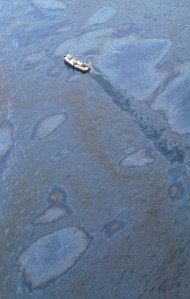
Seen from aerial photographs, the oil spill looks like any old gasoline rainbow you might see on the pavement outside a gas station after a drizzle. Then you realize the picture is taken from a few thousand feet and the patch of oil is hundreds of square miles in area and the spill is growing because it’s not a leak, it’s a geyser. Such thoughts send the mind reeling. How could we be so bold, so cocky, so derelict in our duty to God to be stewards of this creation that we pump toxic liquids out of the ground without so much as even a sketch of a plan to deal with the consequences of our own fallibility?

With these thoughts on my mind (and, I must confess, I am safely ensconced on a different coast far from the poisonous ooze), I glance at the readings for Trinity Sunday and the words of Psalm 8 hit me hard upside the head.

1. O LORD, our Sovereign,
how majestic is your name in all the earth!
You have set your glory above the heavens.
2.  Out of the mouths of babes and infants
you have founded a bulwark because of your foes,
to silence the enemy and the avenger.
3.  When I look at your heavens, the work of your fingers,
the moon and the stars that you have established;
4.  what are human beings that you are mindful of them,
mortals that you care for them?
5.  Yet you have made them a little lower than God,
and crowned them with glory and honor.
6.  You have given them dominion over the works of your hands;
you have put all things under their feet,
7.  all sheep and oxen, and also the beasts of the field,
8.  the birds of the air, and the fish of the sea,
whatever passes along the paths of the seas.
9.  O LORD, our Sovereign,
how majestic is your name in all the earth!

With uncanny prescience, the psalmist speaks to our modern world about humanity’s role in creation, one based on the proper comprehension of humanity’s status as God’s subjects and therefore as servants of God’s creation. The second verse, which introduces the theme of dependence, seems out of place in the overarching language praising God for creation and humankind’s place in it. Of course, it’s always the verses that seem out of place that hold the most interpretive weight. By introducing the idea of dependence, the psalmist directs the audience to reflect on the necessity of human humility in regards to humanity’s relationship with God, especially concerning the dominion over creation.

At first glance verse 2 stands in contrast to the rest of the psalm since it concerns itself with enemies that are not mentioned again; further, verses 1 and 3 flow together nicely, with the thought of heaven connecting the two verses. But instead of mentally removing verse 2 so that the psalm flows smoothly, the reader must dwell on the second to come to the subtler and deeper orientation that the psalmist attempts to reach. The psalmist praises God for founding a “bulwark” (or strength, stronghold) against enemies “out of the mouths of babes and infants.” For those reading the psalms in order, this is the first time infants are mentioned in the entire Book of Psalms; indeed, the image of the babe is a fresh idea. A prevalent mental association made with infants is their dependency on their parents. The psalmist makes this association explicit by using not only the word for child, but also the word for “nursing infant,” The nursing infant truly is dependent on his or her mother in a way to which no other relationship quite compares. And it is out of the mouths of the utterly dependent that God achieves God’s plan — in this case beating back the foes, which scholar J. Clinton McCann deems “the chaotic forces that God conquered and ordered in the sovereign act of creation.”

With the interpretive key of dependence planted firmly in our minds, we can turn to the rest of the psalm. Verse 1 names God with the divine name and then follows with a title for God. The divine name automatically engenders feelings of obedience, but the addition of a title of “sovereign” serves as a further reminder that God is in charge. Because God exercises complete sovereignty, humans are as completely dependent on God as nursing infants are on their mothers.

Moving to verses 3-5, the psalmist looks up to the night sky and is walloped with a feeling of insignificance. And why not? In The Hitchhiker’s Guide to the Galaxy, Douglas Adams unwittingly offers an explanation of verse 3: “Space…is big. Really big. You just won’t believe how vastly hugely mindbogglingly big it is. I mean you may think it’s a long way down the road to the chemist, but that’s just peanuts to space.”

Scholar Peter Craigie points out that the psalmist drives home the point of humankind’s insignificance by saying that God establishes this mindbogglingly big thing with God’s fingers. This awareness of humanity’s smallness in the grand scheme could reduce us to apathetic movement through life because nothing we do would seem to matter. The psalmist nearly slips into this dangerous mode of thinking in v. 4; indeed, the hymn of praise could become a psalm lament at this point. But in the words “mortals that you care for them,” the reader recalls verse 2 and remembers that we are in a dependent relationship with God, who is our sovereign. Verse 5 continues this recollection by adding “yet you have made them (a little lower than God).” By reading verses 3-5 in light of verse 2, the faith that God made us and cares for us outweighs any feelings of insignificance that the night sky may provoke.

Verses 6-8 shift the focus from humankind’s dependence on God and humanity’s misplaced feelings of insignificance to the role God has ordained for humankind on earth. These verses recall the vocation God gives humanity on the sixth day of creation. While the word “dominion” in verse 6 is different than “dominion” in Genesis 1:26, the parallels with Genesis 1 are unmistakable. The language of largeness and smallness remains in these verses, which continues the theme of significance/insignificance seen in the previous three verses. God gives humankind dominion over small sheep, birds, and fish, and also large oxen, beasts, and “whatever passes along the paths of the seas” (the Leviathan which God “has made for the sport of it,” perhaps? (Psalm 104)). Humankind is given charge over great and small creatures; as the psalmist says, “you have put all things under their feet.” However, the psalm does not end with humanity’s dominion. In an inclusive bookend with verse 1, the psalmist reiterates the sovereignty of God over all things. This reprise recalls once again the dependence that humanity has on the LORD, who is their Lord.

What does this discussion offer the modern audience? We live in a global society hell-bent on destroying itself. We clear-cut forests, remove mountaintops, and pump toxic levels of Carbon Dioxide into the air. We do not share the bounty of the land, thus pushing others to burn rainforests and oases for farmland. We live under the delusion that we can develop “safe” oil rigs. We refuse to believe that our actions are slowly turning our world, a piece of God’s creation, into a planetary rubbish bin, fit only for storing the waste we accumulate.

Psalm 8 is a wakeup call, the An Inconvenient Truth of the Bible. To put it simply, the world today has forgotten the truth, which Psalm 8 espouses — that we are dependent on God even though (or more appropriately, especially because) we exercise dominion over the earth. We miss the all-important message that God has given us dominion: we do not intrinsically have it. We properly receive this gift only when we recognize our relationship with God is one of total dependence. Scholar James Mays puts it this way: Psalm 8’s “vision of the royal office of the human race is completely theocentric, but humanity in its career has performed the office in an anthropocentric mode. Dominion has become domination; rule has become ruin; subordination in the divine purpose has become subjection to human sinfulness.”

In the end, the problem is the oldest problem in the book — human self-aggrandizement destroys the purpose that God originally conceived for humanity. Misplaced delusions of grandeur unravel humanity’s proper relationship with God. Scholar Walter Brueggemann says, “Human persons are to rule, but they are not to receive the ultimate loyalty of creation. Such loyalty must be directed only to God.” Psalm 8 calls us back to the correct relationship with God concerning creation. We are utterly dependent on God, we are significant in the realm of creation, but we are not the source or the beginning (though we may very well be the end). In Psalm 8, the psalmist reclaims our primal orientation as dependent subjects on God who has been given us the gift of caring for creation. When we recover this proper relationship, we can take steps to retrieve creation from its slow decline, so that we can once again see the “majesty of God’s name in all the earth.”

Schooling Nicodemus (or) “Imagine what you’ll know tomorrow”

The following post appeared Sunday, March 14th on Episcopalcafe.com, a website to which I am a monthly contributor. Check it out here or read it below.

* * *

In the film Men in Black, Jay discovers that aliens exist and many of them live on Manhattan Island. When he confronts Kay about this unnerving new detail, of which he (Jay) was previously unaware, Kay deadpans: “A thousand years ago everybody knew, as a fact, that the earth was the center of the universe. Five hundred years ago, everybody knew that the Earth was flat, and fifteen minutes ago, you knew that humans were alone on it. Imagine what you’ll know tomorrow.”

The season of Lent invites us to examine what we know, or, put more precisely, what we think we know. When we tackle this examination, we open ourselves up to encounters with Christ, which tend to augment, rearrange, and expand our knowledge with the addition of deeper faith. The Gospel contains myriad stories of Jesus blasting people with new knowledge,  so we should expect nothing different in our own lives. One such story co-stars the Pharisee Nicodemus (read up on John 3 before you continue).

As a general rule, if someone in the Gospel besides Jesus says “I know” or “we know,” then that person either knows a small fraction of the whole or, more commonly, nothing at all. Strangely enough, knowing nothing at all can even manifest itself when the statement made is quite true and correct. Such is the case with this leader of the Jews, who comes to see Jesus one night.

Nicodemus uses his “knowledge” displayed at the beginning of the conversation as a weapon to corner Jesus into a particular set of expectations. The Pharisee says, “Rabbi, we know that you are a teacher who has come from God, for no one could do these signs that you do apart from the presence of God.” Apparently, so far so good. This statement is true: Jesus has come from God and most definitely stands forever in the presence of God. But there’s irony in the statement, also. Nicodemus calls Jesus “teacher” twice — once in Hebrew (Rabbi) and once in Greek (didaskalos, from which comes the word “didactic”). But at the same time, Nicodemus’s conversational opener allows no room for Jesus to teach. Instead, Nicodemus is the one attempting to teach Jesus, to pigeonhole him into what Nicodemus and his colleagues have labeled him.

But Jesus refuses to be put on the defensive. In usual fashion, he completely ignores Nicodemus’s opening salvo and immediately expands the conversation to a depth and height that Nicodemus is not expecting. Jesus says, “No one can see the kingdom of God without being born from above/again.” There’s a delightful ambiguity here: in Greek, “from above” and “again” are the same word (anothen). They both work in the context, and Jesus probably means both when he says the word. How better to jostle someone loose from his rigidity than with a small helping of ambiguity?

But Nicodemus grasps at the more mundane of the two meanings and responds: “How can anyone be born after having grown old? Can one enter a second time into the mother’s womb and be born?” This may seem like a sarcastic response, but at least this Pharisee, who has always been the one answering questions, is now (albeit haltingly) beginning to ask some of his own. But Jesus doesn’t seem interested in staying on the terrestrial plane, so he ignores Nicodemus questions and pushes him to a new level of understanding. “No one can enter the kingdom of God without being born of water and spirit. What is born of the flesh is flesh and what is born of the Spirit is spirit.” At this point, I imagine Nicodemus’s brain starts hurting.

But Jesus keeps pushing him. Nicodemus’s opening “we know” now sounds empty in comparison to the mysteries Jesus is revealing to him. To begin to absorb these mysteries, Nicodemus must turn this empty “we know” into an “I don’t know” full of desire and curiosity. With his next words, Jesus gives Nicodemus license to let go of what he thinks he knows: “The wind/Spirit blows where it chooses and you hear the sound of it, but you do not know where it comes from or where it goes.” (Here’s another delightful ambiguity—in Greek, “wind” and “spirit” are the same word, pneuma.) Nicodemus must now consent to trusting in things he can never quite figure out. Indeed, he must realize that the truest things that have ever been or ever will be can be believed without being adequately explained. In a word, Jesus asks Nicodemus to have faith that the words he speaks are true, no matter how difficult, preposterous, or confusing they may sound.

And Nicodemus takes a tentative step into the shallows of faith in Jesus. He asks one of the sincerest questions in the Gospel: “How can these things be?” With this question, Nicodemus allows the cognitive dissonance that has been cresting to break on him like a wave. This dissonance is the necessary distress that happens when he realizes he doesn’t know something he thought he knew. But dissonance isn’t a bad thing. In music, dissonance is the interesting part, the part that pushes the piece onward. A pleasing harmony (called “consonance”) can hang in the air indefinitely, but a dissonance begs to move forward to the next consonant chord.

So it is with Nicodemus and anyone who opens up himself or herself to the possibility of the unknown. Allowing the cognitive dissonance to enter our comfortable worldviews pushes us to grow into the next consonant chords in our lives. When Jesus confronts us, like Nicodemus, with the mysteries of the faith, we can either step backward into the comfort of what we think we know or step forward, fully expecting the boundaries of possibility to be far wider than we can perceive. This confrontation goes by another name: revelation.

Every encounter with Jesus, whether in the text or in life, promises an opportunity for revelation, which obeys no boundaries of possibility. Revelation is that thing you know, but don’t know how you know it. Revelation is visceral as well as mental because the brain alone is ill-equipped to handle it. Revelation infuses us with an odd mixture of peace and exhilaration—peace because we know God is there, exhilaration because we know God is calling us to serve. Cognitive dissonance is the birthplace of such revelation. The dissonance reminds us that what we know is far less than the whole. When we can acknowledge that we don’t, in fact, know where the wind comes from or where it goes, we are primed for receiving the revelation of God’s love that Jesus is forever revealing to the world. This is a scary proposition, for if we do, indeed, remain attentive we might actually hear God calling us to serve in a way that doesn’t fit our plans.

But revelation bursts our ability and our desire to control because it blows where it chooses on the wind of the Spirit. When Nicodemus says to Jesus, “We know,” he is seeking to control the conversation that will follow. But he immediately discovers he’s in over his head. When we acknowledge that Jesus has things to reveal to us that we couldn’t possibly imagine, we discover we’re also in over our heads. The trick is to learn to breathe in the wind of the Spirit while underwater (to grow gills and fins) and to find a new natural state submerged in the revelatory love of Christ.

When Nicodemus says to Jesus, “How can these things be,” he allows the possibility for revelation to strike him in his head and in his gut. His cognitive dissonance jettisons his need to control. He is open for Jesus to reveal new and wonderful things to him. And Jesus does — things about the Son of Man ascending to and descending from heaven, things about the Son of Man being lifted up as Moses lifted up the serpent in the wilderness, things about eternal life and self-giving love and believing and salvation.

I imagine Nicodemus left his encounter with Jesus in a daze, his heart and mind on overload attempting to process all he had seen and heard. Is he able fully to put his trust in Jesus, to allow the dissonance to resolve into a new and deeper consonance? Not quite yet. But we are lucky enough to meet Nicodemus twice more in the Gospel (check them out! John 7 & John 19). His journey towards the consonance of a life of faith following Jesus models for us our Lenten journeys of self-examination. If we open ourselves up to encounters with Christ during this season of Lent, then (as Kay says), “Imagine what you’ll know tomorrow.”

A Gospel Medley

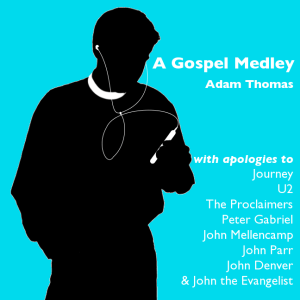
Several people who’ve heard me sing this live have asked for a recording, so here it is. And I’m including the lyrics because parts of it (especially the Peter Gabriel section) are a bit difficult to follow. If you want to play it yourself, let me know, and I’ll send you the lead sheet. I hope you enjoy it!

(Oh, btw, I’m working on a second Gospel Medley. If you think of a song I could use for a piece of the Gospel, let me know. Right now, I just have Bryan Adams for the call of the disciples.)

(To download, right-click picture and choose “Save Link As…”)

The Nativity (Journey, “Don’t Stop Believin'”)
Just a virgin girl when the angel said to her,
“You will bear the Son of God.” She said, “Here am I.”
Just a carpenter of David’s line from Bethlehem;
He took her for his wife (the angel told him to).
So Caesar made the census rule
Telling all to go back home
In a stable Mary bears her babe
He’s the Son, the Son, the Son, the Son.

Shepherds grazing up and down the countryside
The wise men searching in the night
Starlight, angels singing ‘bout the Incarnation
Shining on this holy night

Don’t stop believing
Remember it’s with God you’re dealing
Peace to people

– – –

John the Baptizer (John Mellencamp, “Jack and Diane”)
A little ditty about John the Baptist
Whose favorite dinner was honeyed locusts
John, he’s saying, “I’m just the voice crying out:
Prepare the way of the Lord, that’s what I’m talking ‘bout.” (Sayin’)
Oh yeah, it won’t be long:
the kingdom has come near, repent your wrongs
Oh yeah, it won’t be long:
He is coming soon, I can’t tie his sandals’ thong (now walk on)

– – –

The Feeding of the 5000 (The Proclaimers, “I’m Gonna Be (500 Miles)”)
Jesus looks up, and he knows he’s gonna feed,
He’s gonna feed the people coming to see him.
The disciples, they all say they’re gonna need
They’re gonna need denarii to feed them all.

But I see there five loaves of bread
And I see there two tiny fish
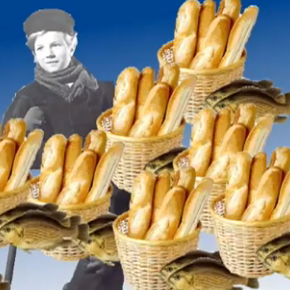
I will bless this food to feed five thousand people
So sit down in the grass
Gotta lot now! Gotta lot now!
Gotta lot of scraps of bread leftover now!

– – –

Peter’s Confession and the Transfiguration (John Parr, “Man in Motion (St. Elmo’s Fire)”)
Jesus asks, “Who do you disciples say has come?”
Peter says, “You’re the Son of God, the Chosen One.”
God revealed this to you, not some fleshly search
So I name you Rock, now go build my church.

Then they climb the highest mountain, underneath the starry sky
And they witness Jesus’ changing, whiter and whiter
Gonna build some tabernacles, but then a cloud descends:
“This is my beloved Son, listen to him”

– – –

The Last Supper (John Denver, “Leaving on a Jet Plane”)
All my friends are here in this upper room.
Their feet are clean, now my Passion looms:
Here’s a four long chapter speech to say goodbye.
See this bread I’m breakin’, it’s a special loaf,
The wine you’re drinkin’ is my blood’s merlot.
Let’s share this meal before I’m brought to die.

So take, eat: you’re sharing me.
Drink this to remember me.
Hear my words ‘cause soon I’ll have to go.
I’ll be dying on the cross soon,
But know that I’ll be back again
Oh, friends, I hate to go…

– – –

The Crucifixion (Peter Gabriel, “In Your Eyes”)
On his head’s placed a crown of thorns;
The temple veil will soon be torn.
Without a noise, without his pride, he reaches out to his bride.

They crucify: the blood, the sweat
His mouth is dry from thirstiness.
Eli, Eli, Have you forsaken
Me to die? You’ll be with me in
Paradise. Oh God forgive them.
Then he cries: I commend my Spirit.
I see the blood and the sweat, oh, but it’s not over quite yet.
Just come on down this Sunday, meet you there at sunrise.

– – –

The Resurrection (U2, “Beautiful Day”)
They go to the tomb, on the first day of the week
But there’s no stone, so Mary takes a peak
She’s out of luck, and the reason that she had to care
Was apparently snuck away when they were unawares
But she knows she’s found a friend when the gardener says her name.
And then Jesus sends her saying, “My return proclaim.”

On this Easter Sunday, the grave falls and you know
On this Easter Sunday, death’s sting is wiped away
On this Easter Sunday…

Touch me, put your finger in my side
When I leave, my Holy Spirit will abide

It’ll be Pentecost Day, tongues of fire, you know
On that Pentecost Day, the Church is here to stay
On that Pentecost Day…

Proclaiming the mystery: John’s first five

The following post appeared Saturday, August 22nd on Episcopalcafe.com, a website to which I am now a monthly contributor. Check it out here or read it below.

* * *

The mystery section was on the back wall of the small independent bookshop at which I worked my last few years of high school. When a customer entered the store, her eyes would glance past the smaller shelving units and fix on the placards proudly bearing the word “MYSTERY.” The shelves containing the mystery section were taller and broader than those holding the other books, and I was the only employee tall enough to dust the top ones without a stepladder. Let’s just say that the manager loved mysteries, so we had a disproportionate number of them. We had humorous mysteries and thrillers, beach reads and stay-up-till-one-in-the-morning nail biters. In those books, a mystery was set forth: say, how did the killer manage to murder someone in a room locked from the inside? The plot revolved around the detective attempting to solve the puzzle. In the end, the detective figured out that the bell rope used to call for the maid was replaced with a poisonous snake, which somehow slithered unnoticed out of the room in the ensuing hubbub of discovering the body. Mystery solved. No more mystery.

The Gospel according to John begins with a mystery, but it is a mystery that is wholly different from the Whodunnits? on the back wall of the bookshop. The mystery that begins the Gospel cannot be solved, cannot be explained away. It can only be unapologetically presented and then unabashedly proclaimed.

rainbowTake a look at the first five verses that John gives us:In the beginning was the Word, and the Word was with God, and the Word was God. He was in the beginning with God. All things came into being through him, and without him, not one thing came into being. What has come into being in him was life, and the life was the light of all people. The light shines in the darkness, and the darkness did not overcome it. (1:1-5; NRSV)

Here John presents the mystery: somehow the Word (who we find out a few verses later becomes enfleshed in Jesus Christ) is in the beginning with God and is also God. Remember in Algebra class when you had to show your work to get full credit? Well, John skips down to the bottom of the page. There is no balancing of equations or solving for “x.” He states the mystery simply: in the beginning, the Word was with God and was God. This is frustrating at first because I’m conditioned to think that mysteries are all supposed to be like the ones on the back wall of the bookshop. I want to know how it’s possible and I won’t be satisfied until I figure it out and if I can’t figure it out then it must not be true.

But I take a deep breath and look at the words again. I read them slowly and speak them aloud. I notice that the rational part of me is sitting in the corner sulking because “with” and “was” should be mutually exclusive. But I find that the creative part of me sees past such mundane things as mutual exclusivity and begins to roll around in the muck of ambiguity. I squelch my toes in the mud, relishing the notion that God lives in a reality where choosing between alternatives is not the only viable option. Of course the Word can be both with God and was God! The limits of my language do not limit God, only my understanding of God. I realize my language skills are not up to the challenge of describing God. And my rational side joins my creative side in the muck of ambiguity because my rationality has been given the license to imagine.

In a few short phrases, John presents the mystery. Then, he deepens the mystery by retelling the story of creation. It’s no coincidence that John uses the same phrase that opens the book of Genesis: “In the beginning.” All things came into being through the Word who was with God and was God. My creative side connects with these verses because they are about creation. Life is created through him, and because I have been given the gift of creativity, I can sense in my gut or in my bones that the Creator is continuing to create me.

This creative force is the light that shines in the darkness. The darkness cannot comprehend or overcome or understand the light because the darkness has never been a part of creation. The darkness is just the absence of any created thing. It tries jealously to unmake created things but fails to triumph since God never stops creating or calling creation to God.*

In these first five verses, John locates us (“life,” “all people”) within the mystery of God and creation, and he presents the adversary of creation, namely darkness. We have the makings of an epic story here.** The seemingly out-of-place verses 6-8 help me realize my role in this story. The mystery has been presented, and now John the Baptizer steps onstage for a brief scene. He is a witness who testifies to the light. (The words “witness” and “testify” are from the same root in Greek; the English word “martyr” comes from it.) His proclamation points to the light, which is the Word made flesh, Jesus Christ. So too, my life, which has come into being through the Word, is meant to be a proclamation of the mystery of God and God’s movement in creation.

When I encounter these first few verses of the Fourth Gospel, I feel the enormity of the mystery of God surrounding me, and I rejoice that this mystery discloses itself in light and life and love. If I could explain the mystery, I would be in danger of explaining it away, of shelving it like the Whodunnits? on the back wall. The mystery transcends explanation. It is elusive, and at the same time intimate; it cannot be grasped, but it can be embraced. The intimacy and the embrace happen when the mystery touches the spark of creativity within me, spurring me to proclaim the Word made flesh, Jesus Christ. Life has come into being through the Word. And my life expands to every pocket and corner of my being when I live to proclaim this good news.

Footnotes

* My apologies for hurling this paragraph at you with no further comment. If it confused you at all, blame Karl Barth.

** I am using the word “story” to convey something that is important enough to be told and retold down through the centuries, something that is about God and about us and is a tale that is never quite finished being woven. Please do not take my use of the word in the sense of “it’s only a story.”