
Sermon for Sunday, April 26, 2015 || Easter 4B || 1 John 3:16-24
 Many of you met (or at least saw) my sister Melinda two weeks ago when we baptized Charlie and Amelia on this very spot. She’s one of the strongest and most loving people I’ve ever known, and I’m glad that my years spent being her “annoying little brother” didn’t damage our long term prospects of maintaining a close connection. This may sound funny, but I think one of the primary reasons we survived our young years with our friendship intact was the movie The Princess Bride. We both loved it, and no matter how long it had been since we last watched it, we would quote it to each other at every conceivable opportunity. And we still do sometimes. Rest assured, you can mute the film, and Melinda and I can supply the dialogue.
So it should come as no surprise to you that when I’m doing pre-marital counseling with couples preparing to be married, wisdom gleaned from The Princess Bride tends to slip in. As of last count, I’m officiating at ten weddings this year, so I’ve had the golden opportunity to give the “As you wish” talk to many couples, with many more to come.
The film opens with a grandfather reading S. Morgenstern’s “classic” tale to his sick grandson. As he reads, the picture melts into a bucolic setting where we meet two beautiful people. Buttercup commands the farm boy, Westley, to do several menial tasks – polish her horse’s saddle, fill buckets with water, fetch a pitcher. Each time, he responds, “As you wish.” Then we hear the grandfather, voiced by Columbo himself, the inimitable Peter Falk, say, “That day, she was amazed to discover that when he was saying ‘As you wish,’ what he meant was, ‘I love you.’ And even more amazing was the day she realized she truly loved him back.”
This discovery, of course, leads to a sunset kiss, a leave-taking to seek fortune across the sea, a supposed death, and (eventually) a harrowing reunion, a second separation, another supposed death, a rescue, and (finally) an escape together from the homicidal schemes of the evil prince. (It’s a fantastic movie.)
I bring up Westley’s “As you wish” with couples preparing for marriage because I’ve found that often they don’t realize or haven’t processed the ways in which their partners show their love. Rarely do both members of a couple display their love in the exact same ways. Because our husbands or wives show love differently than we do, we have a tendency to miss it and thus fail to appreciate this love.
Our New Testament lesson this morning speaks to the “As you wish” exercise. “Little children,” says the writer of the first letter of John, “let us love, not in word or speech, but in truth and action.” Just before this, the letter gives an example from Jesus: “We know love by this, that he laid down his life for us – and we ought to lay down our lives for one another.”
The writer of First John knows that saying, “I love you,” is all too easy – just three little monosyllables. Subject, verb, object. Meaning it is the hard part. Too often, the abused wife returns to her husband because “he says he loves me.” Too often, the college freshman wakes up crying the next morning, after being duped by “I love you.” Too often, “I love you” hurts more than it heals. The abusive husband and the collegiate predator weaponize the phrase, with no thought to its destructive consequences.
But this is where action comes in. This is where service separates truth from manipulation. You may be tempted to say that action is needed to prove that a spoken “I love you” is real. If this were the case, however, there would still be regular jousting tournaments throughout Christendom. Rather, active service is a spontaneous symptom of love – one that makes the spoken words extraneous (even though they are still nice to hear).
Loving and serving – we really mustn’t separate the two. Love expresses itself not only in poetic protestations: “Shall I compare thee to a summer’s day? Thou art more lovely and more temperate…” No. Love expresses itself in holding the beloved’s hair back when she’s bent over the toilet with stomach flu. Love waits all night in the hospital room, visits the prisoner, builds affordable housing, donates mac & cheese. Love gets its uniform dirty.
We will be reaffirming our baptismal covenant in just a few minutes. One of the promises echoes Jesus’ great commandment: “Will you seek and serve Christ in all persons, loving your neighbor as yourself?”
Will you serve? Will you love? “I will, with God’s help,” you’ll say. How will you serve? What will your love propel you to do?
This week I invite you to talk to your spouse or child or sibling or friend. Ask them how they see you demonstrate love. What ways do you show it above and beyond the spoken “I love you?” To whom are these displays of love directed? How can you employ your unique set of gifts to become an even better version of the loving person that God made you?
Do the same thing for your spouse, child, sibling, or friend. Discover together the ways God is calling you to be God’s loving servant. Discover together how God prompts you to be servants of one another in the power of mutual love. And discover together where God is inviting you to turn that internal love into external service. The writer of First John continues on this theme: “How does God’s love abide in anyone who has the world’s goods and sees a brother or sister in need and yet refuses help?” How indeed?
In The Princess Bride, Miracle Max reminds us that “True love is the greatest thing in the world.”* But unless we display that true love through our service to one another and to our brothers and sisters in need, what good is it? After we share Holy Communion with each other this morning, we will orient ourselves away from the table and toward the door. And we will pray, “Send us now into the world in peace, and grant us strength and courage to love and serve you with gladness and singleness of heart.” God sends us out to love and to serve. I pray that we will respond, “As you wish.”
—

 Stigma is not a happy word. If you use it in a sentence, more than likely the word “stigma” will be linked to something that people view as disgraceful or humiliating, whether that view is warranted or not. A couple of us recently read a book called The Rich and the Rest of Us by Tavis Smiley and Cornel West, who spoke of the need to lift the stigma associated with the word “poverty” if we are ever going to muster the societal will to lift those on the margins. In years past, society has stigmatized attributes of people who exhibit less capacity than most, using words like “retarded” and “crippled” to describe those with mental and physical challenges. Suffice to say that members of every minority group – no matter the difference used to justify labeling them as “those people” – have been stigmatized in one way or another. Stigmas lead to segregation and prejudicial behavior and animosity. “Stigma” is not a happy word.

 Good morning, and welcome to St. Mark’s on this glorious Easter Sunday. This morning we walk with Mary Magdalene to the tomb and find it empty. And yet our emptiness doesn’t last for long because Jesus, the Risen Christ, stands there, shining before us, as the dew glistens on the early spring flowers blossoming in the garden.
 It’s great to have a baptism scheduled for the Easter Vigil, but we didn’t this year at St. Mark’s. I still wanted to bless the water of baptism before we renewed our baptismal covenant, so my father suggested I build the blessing into my sermon. At the vigil, you can preach before or after the transition from darkness to light, and this year I chose before.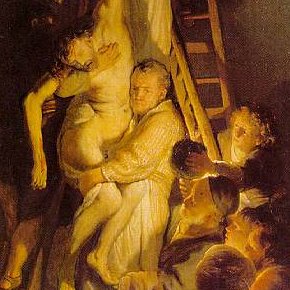
 Imagine with me the thoughts of the Pharisee Nicodemus on his way home from helping Joseph of Arimathea bury the body of Jesus. Nicodemus appears at the end of the Passion Gospel reading, as well as two other places in the Gospel according to John, both of which are referenced in what follows.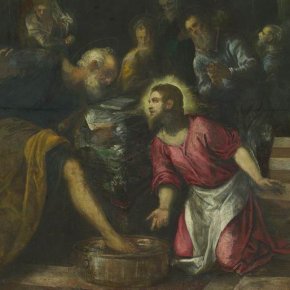
 “Before the festival of the Passover, Jesus knew that his hour had come to depart from this world and go to the Father. Having loved his own who were in the world, he loved them to the end.” Thus begins the second half of the Gospel according to John. We’ve walked with Jesus for three years since he called his first disciples, since he miraculously turned water into wine, since he drove the businesspeople out of the temple. We’ve overheard his conversations with the Pharisee Nicodemus and the Samaritan woman at the well. We’ve seen him heal a man suffering from paralysis and a man born blind. We’ve eaten the bread broken to feed 5,000 people. We’ve listened to Jesus call himself all sorts of names: the bread of life, the light of the world, the good shepherd. Recently, in an act that probably sealed his fate with his enemies, he raised his friend Lazarus from the dead.

 This is the last Sunday of the year in which we are worshiping according to the older, Rite I format of our liturgy. A few weeks ago, I mentioned that the reason we’ve been using the more traditional language was so we could say that beautiful line about inclining our hearts towards God. But there’s another reason, one that I didn’t mention then because I was fairly sure I was going to preach about it today. There’s a special prayer found in the traditional rite that is not duplicated in the modern one, a prayer we’ve been praying directly before communion for the last several weeks. Today, we will pray it one last time. The “Prayer of Humble Access” goes like this: