
Sermon for Sunday, September 6, 2026 || Proper 18A || Matthew 18:15-20; Pope Francis, Laudato Si’
You might have noticed that our second reading today came from a non-biblical source. This is a highly uncommon practice in the Episcopal Church, so uncommon in fact that the bishop had to approve it. For today and for the next four Sundays, we will hear readings from sources other than the Bible as we celebrate a Season of Creation. This special season is a fairly new invention in the life of the Church. The season sets off a series of Sundays in September and early October with the specific intention of praising God’s presence in Creation and recommitting ourselves to the preservation and renewal of the natural world. It makes sense that this special season takes place during the long months of so-called “ordinary time,” which is another name for the thirty-ish Sundays between Pentecost and Advent. The days of harvest are upon us. The liturgical color of the time after Pentecost is green. Godly Play calls this time the “green and growing” Sundays. So, each Sunday from now until October 4th, we will share special readings, prayers, and songs in order to grow our awareness of, appreciation for, and commitment to God’s movement in Creation.
We’ll get to today’s special reading in a few minutes, but first I need to tell you about what happened Monday evening. I had not slept well the night before. My upper back was knotted up tight from stress. My lower back ached from nothing more than the fact that I’m in my mid-40s, which is apparently the time you age more than any other time in your life. I was feeling ill and exhausted and irritable, like that wonderful description by Bilbo Baggins before he leaves Hobbiton for good. I felt “thin, sort of stretched, like butter scraped over too much bread.”
For the previous week or two, I had been overeating. I had not been exercising. And my sleep was a mess. So on Monday afternoon, my body finally said, “Enough.” I had just talked to my sister on the phone, which is probably where the idea to do some yoga popped into my head. (Melinda is a yoga instructor, as well as a poet and nature mystic in the vein of Mary Oliver.) I decided to go out on my back porch, which overlooks the woods. I laid out my yoga mat and set up a Bluetooth speaker so I could play meditative music during my practice – you know the type: no melody, just a series of long chords and ethereal tonalities.
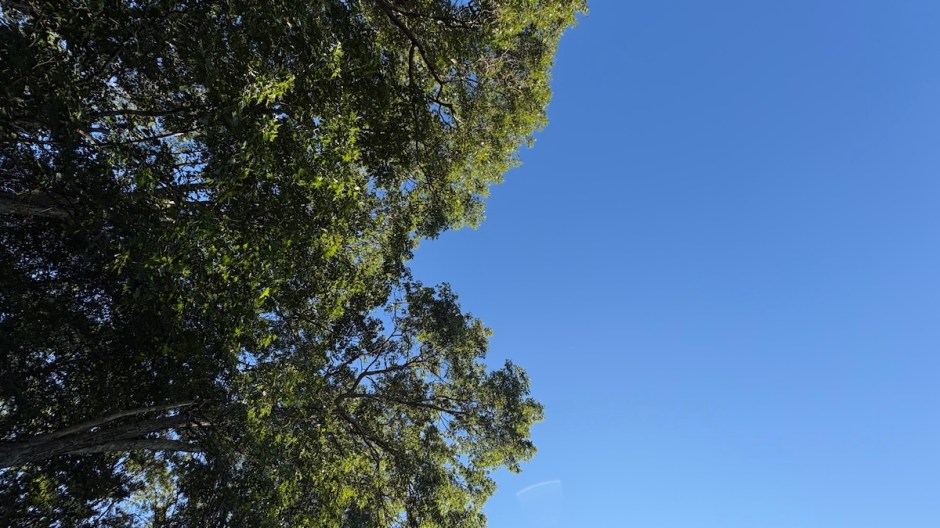
I practiced yoga for 25 minutes, moving through the flows and focusing on my breath. As I flowed from pose to pose, my view of the nature all around me changed. Sometimes I looked at the thousand shades of green in the trees stretching into the forested distance. Sometimes I looked at the siding of my house and the kitchen window. Sometimes I looked up at the sky, where high clouds moved slowly above the overhanging branches. The music played. The birds chirped. The wind blew. For those few minutes, I prayed with my breath. I asked God to rebalance me, help me find a new beginning. It was a lovely, intentional moment of reset, of flowing with the natural world and the God who moves through all things.
Then I turned off the music and realized the chirping birds were on the recording!
Part of my 25-minute communion with God and nature was artificial! And the funny thing is that there were real birds also chirping out in the woods, but I couldn’t hear them because of the recording. This realization did not ruin the yoga practice, but it did remind me of the unhelpful dichotomy we live as humans in the resource heavy, highly industrialized West: the dichotomy between the natural and the artificial, between the environment and human construction.
This false dichotomy teaches that human life and the natural world are separate, teaches that humans stand over and above nature rather than within it, teaches that nature begins at the end of the subdivision. But that’s not how the world works. On Monday, I might have thought that I was willingly surrounding myself with as much nature as I was comfortable with. But that point of view is just plain wrong. We are never surrounded by nature. We are nature. We are natural, as natural as the real birds chirping in the woods and the acorns falling on the deck.
In our special reading today, Pope Francis makes this point. “When we speak of the ‘environment,’” the pope says, “what we really mean is a relationship existing between nature and the society which lives in it. Nature cannot be regarded as something separate from ourselves or as a mere setting in which we live. We are part of nature, included in it and thus in constant interaction with it.”
I don’t know about you, but I’ve spent most of my life holding the unconscious thought that nature is the “mere setting in which we live.” The woods behind my house are a beautiful backdrop that we can gaze at from the patio. But how often do I stop and think about the countless creatures who live in those woods: oaks and ivies and bunnies and bacteria, each the protagonist of their own story?
Each oak and bunny is a subject, a beloved being wrought by God’s love and creativity, each entitled to the central role in their own stories rather than simply a peripheral role in ours. The foundational sin of humanity is our capacity to objectify. Across history, humanity has distorted innumerable relationships – both individual and collective – due to the objectification of the other. This objectifying happens writ large with the natural world.
But Jesus gives us a corrective in today’s Gospel reading. Jesus is speaking about broken relationships between members of the “assembly” (which is translated as “church” in our reading, but the word had a broader secular meaning at the time.) I wonder what the oak tree would say to us if it brought us before the assembly, if we treated it as the subject it is rather than the object we think it is, just the scenery before which we lead our lives. How can we be reconciled with the trees like we can be reconciled with our human siblings? The process starts with the intentional acknowledgment of Christ’s presence that Jesus mentions at the end of the reading: “For where two or three are gathered in my name,” Jesus says, “I am there among them.” Those two or three do not have to be human. The presence of Christ fills Creation, this presence the poetic prologue of John’s Gospel calls “the Word”: “All things came into being through [the Word], and without [the Word] not one thing came into being. What has come into being in [the Word] was life…”
Christ dwells in the midst of all things, human and otherwise. When we live this truth, with God’s help, we behold our proper place within Nature, within the web of life, not apart from it. We touch the oak tree as a sibling and not as copy paper in its preprocessed state. We give thanks to God for Creation, of which we are one species of millions. And we commit ourselves to living simply so that others, including the entire more–than-human world, can simply live.
Banner image: The view looking skyward from my deck.

