Sermon for Sunday, May 8, 2016 || Easter 7C || Revelation 22
You probably didn’t realize it, but a few minutes ago _____ read the very last prayer in the Bible. “Amen. Come, Lord Jesus.” These are the words of John of Patmos as he wakes from his vision, which we know as the Book of Revelation. Come, Lord Jesus. A succinct prayer, to be sure, but powerful. It sounds to me like a breath prayer; that is, a prayer short enough to be said slowly in a single breath. <demonstrating>Come, Lord Jesus. Praying a breath prayer is a wonderful practice that helps us stay immersed in the healing waters of God’s presence. A breath prayer can be anything that you can say with one breath: Continue reading “Come, Lord Jesus”→
Sermon for Good Friday, March 25, 2016 || John 19:25-27
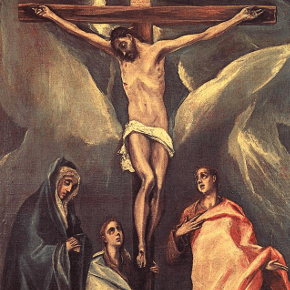
The Passion narrative Stacey just read can be quite overwhelming. It is by far and away the longest reading we listen to all year, and there’s a lot going on. There’s Judas’s betrayal, Jesus’ arrest, Peter’s denial, the trial with the high priest, the interview with Pilate, the frenzy of the crowd, the crucifixion, and the last words from the cross. There’s so much going on, in fact, that we can easily lose sight of the overarching story of the Gospel when we find ourselves overloaded by this painful and heart-breaking narrative. So instead of talking about the entire Passion narrative, each year I like to focus on one little moment of it that speaks to the whole story. On this Good Friday, that moment happens between the soldiers gambling for Jesus’ clothes and Jesus drinking the sour wine.
“Meanwhile,” the Gospel tells us, “standing near the cross of Jesus were his mother, and his mother’s sister, Mary the wife of Clopas, and Mary Magdalene. When Jesus saw his mother and the disciple whom he loved standing beside her, he said to his mother, ‘Woman, here is your son.’ Then he said to the disciple, ‘Here is your mother.’ And from that hour the disciple took her into his own home.”
Have you ever noticed the beauty of this moment? Have you ever noticed how succinctly these three verses sum up Christ’s mission of reconciliation? I see in my mind’s eye these two people standing apart from each other. One weeps silently for his beloved friend, and his tears wash two clean lines on his dusty, grimy face. The other has no more tears; she has cried her eyes dry, and now she just stands there counting her son’s breaths, treasuring each one in case it’s his last. She always knew this day would come, but not like this. God, not like this.
A few other women comfort Jesus’ mother, but his beloved friend remains several paces away from them, perhaps not wanting to intrude on their stunned grief. He stands there alone, wondering how it all went wrong, wondering if he had been hoodwinked or if he had just gotten caught up in messianic hysteria. No, I believe. He doesn’t mean to, but he says the words out loud. Then he adds, I just don’t understand.
That’s when he looks up at Jesus, and his friend’s lips begin to move. He’s trying to speak, but he can’t catch his breath. After all, the cross kills by suffocation, not by loss of blood. With a monumental force of will, Jesus pulls himself up, using the nails for leverage. He sucks in a ragged breath and looks down first at his friend, then at his mother. His gaze connects them, and they stumble towards each other. With fleeting breath, Jesus manages to say, “Woman, here is your son.” His mother leans her head on his friend’s shoulder. Jesus inclines his head, “Here is your mother.” His friend wraps his arm around her and squeezes.
While dying on the cross, Jesus stitches together this new family. He creates a new relationship built on two people’s own relationships with him. Before Jesus redefined it, the cross was the ultimate symbol of domination and separation. The cross brutally demonstrated who was in charge and who was discarded, the human garbage of the empire. But even before the resurrection – even in this beautiful moment we are discussing here – Jesus is changing the meaning of those two planks of wood. No longer would they be the terrifying symbol of ruthless subjugation. Now the cross would be the symbol of the promise of eternal life, which is really the promise of eternal relationship with God.
By creating this new relationship between his mother and friend, Jesus reminds them and us that his mission is one of reconciling us to each other and all things back to God. Indeed, it’s no accident that the Gospel writer never names these two people. We know his mother’s name is Mary and tradition tells us that his beloved friend is John. But the Gospel steadfastly resists naming them as such, and does so for this purpose: So we can put ourselves in their place. So we can feel ourselves being called “beloved” by Christ. So we can feel in our relationships with Christ the unique closeness that a mother has for her child – the act of cherishing. And in feeling this intimacy with Christ, this belovedness, we might feel the call to create and engage in deep relationships with others, each one fostered by Christ’s love for all people.
This is the story of the Gospel: God came to us to bring us back into relationship with one another and with God. Good Friday marks the cliffhanger in that story, the moment when it all looks bleak. But even in this bleakest moment, even while struggling for breath on the cross, Jesus is still bringing people together, still performing miracles.
Sermon for Sunday, February 21, 2016 || Lent 2C || Philippians 3:17–4:1
Last fall, I had to renew my passport before my trip to Haiti with Tim Evers. I had originally gotten my passport in advance of a choir trip to England back in college in 2003, and that first document was still valid when Leah and I went to South Africa for our honeymoon in 2011. But they’re only good ten years, so in the fall of 2015, I found myself stapling an unsmiling picture to an application I picked up at the post office. I filled in all the information – name, address, social security number. I checked the box marked “U.S. Citizen,” dropped the package in the mail with the processing fee, and a few weeks later, received my new passport.
The trip back and forth to Haiti went swimmingly. The government agents stamped my shiny new document and welcomed me to Port-au-Prince and New York City, respectively. All was well until this week when I read the lessons for today. All was well until I realized that I lied on my passport paperwork. I checked the box marked “U.S. Citizen.” I checked that box because I was born in the great state of Maine, and I have the birth certificate to prove it. But the Apostle Paul claims something else for me: “Our citizenship,” he says, “is in heaven.”
Reading those words this week knocked my socks off. Our citizenship is in heaven. Not some time in the future. Not after we die. Paul doesn’t say, “Our citizenship will be in heaven.” No. Our citizenship is in heaven. Take a few breaths to let that sink in.
If we believe our passports our wrong; if we believe we are citizens of heaven, then we can take this imagery one of two ways. First, we can extend the metaphor and claim to be resident aliens here on earth. We have green cards, but this isn’t really our home. Our home is in heaven, and we’ll get there someday and be reunited with those we love who have gone home before us. This idea of heaven brings comfort and hope and peace, especially when life here on earth lurches towards the intolerable.
This idea of heaven finds expression in so many African-American spirituals, which have their roots in the horror of slavery. “Deep river, my home is over Jordan.” “I’m goin’ home to be with Jesus, since I laid my burden down.” “Swing low, sweet chariot, coming for to carry me home.” What better way to combat the misery of enslavement than to sing about one’s true home, a home that can never be bought or sold or taken away? What a sense of power enslaved people must have felt to be able to claim citizenship in heaven?
This legacy of hope and consolation – this balm in Gilead, so to speak – is the positive side of thinking of heaven as a home we are heading towards. But there is a negative side, as well. During the Industrial Revolution, the notion of heavenly citizenship began meandering down a long path towards environmental apathy. “We don’t really belong here on this planet,” this thinking goes, “so we need not take care of it.” This poor judgment had little effect on the environment until we got really good at polluting. But now the idea of heavenly citizenship is oftentimes weighed down by indifference for the earth and for generations yet to come. This is especially true in the United States where heavenly citizenship and American individualism collide.
Both the positive balm in Gilead and the negative environmental apathy find their roots in the idea of heaven as somewhere else. Somewhere better and new, and often “up.” Along with this idea of heaven as a home over Jordan, we can also think of our heavenly citizenship in another way. Here we must think of heaven not as a place, not as a location, but as the full and all-encompassing presence of God.
Now suddenly heaven is not just somewhere we go when we die; heaven is the kingdom of God breaking into this reality. Heaven is the name for the reality we strive for when we pray the Lord’s prayer, a prayer that is decidedly about now, today. “Thy kingdom come, thy will be down, on earth as it is in heaven.” In other words, “May thy reign, O Lord, be so present and so participatory that we can’t tell the difference between heaven and earth.” This is our prayer, and we pray it everyday to remember where our citizenship lives: in the full and all-encompassing presence of God. That’s our true home.
And that home is here. The full and all-encompassing presence of God is all around us, within us, permeating and sustaining creation. You may have felt this presence in your life. You may have stumbled into it one day when you least expected it and needed it most. You may have encountered this presence and not known what to name it. Its name is heaven, and it happens more than we realize.
When you see someone in need, and your heart trembles, urging you to reach out with open arms, then heaven is close by, the presence of God is calling you home – this home that is not up or away, but deeper in. Deeper in relationship. Deeper in solidarity. Deeper in love.
When you look out at an eagle in flight, and for a moment you are struck by the incredible closeness of your son who has passed away, then heaven is close by. Your loved one is awash in the full and all-encompassing presence of God. And for an elusive minute you realize you are there, too. And so you two are close again, and the barrier of death seems ever so flimsy.
When you fall to your knees in thanksgiving or in fear or in mourning or in joy, and your soul whispers to you that you are not alone and that you are loved beyond measure, then heaven is close by. It’s only our frail and limited perception that keeps us from seeing the home of our true citizenship breaking in all around us.
Living into our heavenly citizenship combines these two understandings of heaven: first our hope of future consummation and bliss in our home across the Jordan, and second our awareness of the immediate presence of God, which through us, continues to bring heaven closer to earth. There will never be true heaven on earth until all people and all things are fully reconciled to God. Put another way, there is no way for some of us to experience true heaven in the here and now. Either everyone does or no one does. If there is even one person living in hell on earth, then heaven is not fully realized this side of the Jordan.
These may seem like abstractions, like pie-in-the-sky theology that will never, ever in a million years become a reality. And yet, as followers of Jesus Christ, we live each day with the willing expectation that heaven on earth will come to fruition. And in so doing, we make it more real. We live our heavenly citizenship. Thy kingdom come, thy will be done. We pray this daily because we are a people of hope.
And if there’s one thing I hope for more than any thing else, it is this. That every person on this planet, when their earthly journeys are done, might swim across the Jordan, back home to the full and all-encompassing presence of God, and have this one thought on their minds: “I think I’ve been here before.”
Sermon for Sunday, January 17, 2016 || Epiphany 2C || John 2:1-11
I love my mother with all my heart. For thirty-three years and five days, she has never wavered in her steadfast love for me, support of me, and delight in me. She delivered me in the middle of a Maine snowstorm; she endured through my advanced childhood self-centeredness; and she never let her own demons keep her from being my nurturer, advocate, mentor, and friend. I get my love of reading from her. I get my precociousness from her. And I get my ability to be quiet and listen from her. When I had my first ever bona fide moment with God, it was my mother who held me and rocked me – her seventeen-year-old baby boy – while I bawled my eyes out, overwhelmed by the immensity and clarity of it all.
As I said, I love my mother with all my heart. I’m saying this aloud today for two reasons. The first is to say “thank you” to my mother, who will be reading this tomorrow, I have no doubt. If she were here right now, I’d give her a big hug, and my chin would rest snugly on top of her head. The second reason is to locate myself on the continuum of relationships between mothers and sons. I am an unabashed “momma’s boy,” and proud of it. I would never think to call my mother by her first name, Edna. It just wouldn’t feel right. And while I now tend to call her “Amma” (her chosen grandmother name), I will always cherish the way my heart feels when I address her as “Mom.”
So when I read the story of the wedding in Cana of Galilee, I tend to focus on the relationship between Jesus and his mother. If you were paying attention, you might have noticed that the Gospel writer does not name her. She is not called “Mary” in this story. She is simply known as “the mother of Jesus.” In her only other appearance in the Gospel of John – at the foot of the cross – she is also only identified as Jesus’ mother. No name, just a relationship. This isn’t a fluke, as another recurring character in the Gospel of John is given the same treatment, someone mysteriously known as “the disciple whom Jesus loved.” Tradition tells us this disciple is “John,” but the story never names him. The relationship to Jesus is what matters.
Identifying people by their relationships to us is commonplace. Who’s that? “Oh, that’s my boss. Oh, that’s my best friend from high school. Oh, that’s my first cousin once removed.” (By the way, if you ever want to confuse my mom, try to explain the difference between first cousins once removed and second cousins. It’s really funny.)
When you were a kid, you more than likely fell victim to this tendency to identify via relationship. You were behaving badly and one of your parents identified you as the child of the other parent, right? “Tell your daughter to pick up her shoes.” “Tell your son to eat his zucchini.” (It’s possible that second example is personal – I do eat zucchini now, as long as it’s in soup.) In our language we stress our relationships. If a stranger asked me who is the vertically challenged woman with the beautiful smile and the heart of gold, I wouldn’t just say, “Edna.” I would surely add, “My mother.”
Yes, in our language we stress our relationships. We use possessive grammatical constructions quite a lot. My mother. Jesus’ mother. “There was a wedding in Cana of Galilee, and the mother of Jesus was there. Jesus and his disciples had also been invited to the wedding. When the wine gave out, the mother of Jesus said to him, ‘They have no wine.’” Now, he sasses her here, calling her, “Woman.” I’ve read that in Jesus’ day such an appellation was not considered rude, but I’m not sure I buy that. Jesus seems a mite petulant here; perhaps a bit of childhood regression for the Son of God. I know that I would never get away with it if I called my mother “Woman,” so I’ve never tried.
By calling her “Woman” instead of “Mom,” Jesus plays down the relationship. He doesn’t really want to be bothered. He just wants to keep a low profile and enjoy himself. But his mother is having none of that. She pushes him to help the wedding planners retain their hospitality. She pushes him to be his best, to reveal his glory. Just like a mother, right? – wanting her kid to shine. And, of course, Jesus gets over his momentary petulance and does what she says. So their mother-son relationship remains intact: she coaxes him to be brilliant, to be extraordinary. And he is.
By never calling her by name, the Gospel writer tacitly tells us to focus on this relationship. She is the mother of Jesus. Focusing on this relationship begs the question: Who are we? Yes, we have our names, which later on in the Gospel the Good Shepherd will speak as he leads us out of the sheepfold. Yes, we have our names, but who are we?
Well, to answer that question, we must quote the famous Christian axiom, “It’s not who you are that matters. It’s whose you are.” So whose are we? Last week, we spent the whole sermon answering this question. We are God’s beloved children. If we believe that, we have the starting point for every relationship that matters in our lives.
Who are you? I’m a child of God. Each of us is “child of God.” That’s the beginning. That’s the spark. That’s the soul. Every other meaningful relationship springs from this one. That’s why the marriage vows begin, “In the name of God.” That’s why the solemn, scrunched up faces of our infant children make us fall to our knees in gratitude to the Giver of all life. That’s why every difficult or inconvenient encounter can be transformed by remembering the other person is a child of God, too.
Indeed, the good news of Jesus Christ resounds with the beauty of relationships based in God’s own connective tissue. Today’s story happens at a wedding, after all! Over and over again in the Gospel, Jesus invites people into deep and abiding relationships with him. “I am the vine,” he says, “and you are the branches.” And just to make sure we get the point of all this, when Jesus’ mother appears for the second time, at the foot of the cross, in the moments before Jesus’ death, do you know what he does? With his last few ragged breaths, he stitches together a new family. He gives the two people who have no names into the other’s care: his mother and the disciple whom he loved. “Here is your son. Here is your mother.”
That’s what God’s story is all about: stitching us and all people and all creation more deeply into the fabric of God’s love. So the next time you see someone with whom you have a deep and abiding relationship – perhaps your own mother or your spouse or your child or your friend – give thanks to God for that relationship. And notice how the love of God strengthens that relationship. And notice how that relationship strengthens your love for God.
—
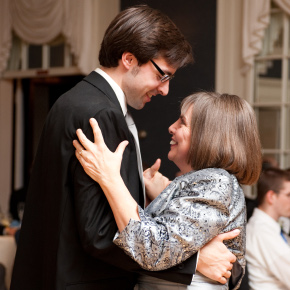
Image: Groom and Mother of the Groom dancing at mine and Leah’s wedding. A lovely memory, dancing with my mom.
Sermon for Sunday, July 5, 2015 || Proper 9B || 2 Corinthians 12:2-10
The first weekend of June, I was doing some yard work with my father-in-law outside the rectory. While carrying some brush down the stone front steps, I slipped and fell backwards. I caught myself, but my lower back hit the edge of the step with enough force for me to feel it, go inside, and start icing. The ice helped, and I felt much better the next day. The day after that, I played soccer. I didn’t hurt my back during the soccer game, but running around for two hours at my age didn’t do me any favors. (Yes, yes, I know I’m young, but there’s a reason most professional athletes retire in their early thirties.) Put the soccer and slipping on the steps together with sleeping in a soft bed and picking up two babies for ten months, and Wednesday morning I could barely move. I spent the day lying on the floor, in a sizable amount of pain.
The next morning, I arrived at church to prepare for the 7 a.m. service. The pain was less than the day before but still considerable. I did my best to hide it during the first half of the service, but my acting job was unconvincing. After the peace, folks asked what happened, and I told them the story I just told you. When we came together around the altar for communion, I was about to start the prayer when Barbara Barrett asked: “Adam, can we lay our hands on you and say a healing prayer for your back?”
I looked around at the people circling the altar. They seemed eager to assist Barbara in her request. I had never considered asking for such a gift, but when it was presented, there was only one possible answer, a very thankful, “Yes, of course!”
The fifteen or so people present clustered around me and touched my back and arms and shoulders. Barbara prayed aloud. When she was finished, I exhaled and inhaled. As I breathed, I felt my insides expand and the stiffness in my back stretch out just a little bit. The pain remained, but it was lessened because fifteen people were now bearing it with me.
As I reflect back on that morning, two questions spring up for me. First, why had I never considered asking for the laying on of hands? And second, why did I feel it necessary to hide my obvious pain? I could answer each of these questions at length, but in the end, the answer to both questions boils down to a single word: weakness.
Something inside me convinced me not to show my weakness. That something might have been the myth of the tough guy: “Walk it off. Gut it out. No pain, no gain.” Or perhaps the myth of perfection: “You’ll only be loved if you always get straight A’s or fit in those jeans or never strike out.” Or perhaps the myth of individualism: “I can get on very well by myself, thank you. I don’t need help from anyone.”
Whatever it was that convinced me not to show my weakness, it worked; that is, until Barbara spoke up. Her invitation to healing silenced the myths, and in that silence, the words of Paul we heard today bubbled to the surface: “Three times I appealed to the Lord about [my thorn], that it would leave me, but he said to me, ‘My grace is sufficient for you, for power is made perfect in weakness.’ So, I will boast all the more gladly of my weaknesses, so that the power of Christ may dwell in me.”
My grace is sufficient for you, for power is made perfect in weakness. There are many countercultural things embedded in the Christian faith, and this is a prime example. In effect, God says, “Don’t look for power where the world looks for power: in the bank account, on the TV screen, at the point of a gun. No, my grace is enough for you to find fulfillment, if you allow my grace to infuse your weakness.”
In his own trials and tribulations, Paul has uncovered something that I personally (and I bet many of you) need to hear over and over again. The power of Christ dwells in us, and it dwells most effectively in the parts of us that the myths tell us to hide. These are the parts of us that need the most help, the parts we don’t want to show other people because we think this or that facet of ourselves is deficient or shameful. The grace of God and the power of Christ enliven our whole selves, but like an antibody targeting a disease, God’s grace heads straight for our weaknesses.
And since God’s grace meets us where we are weakest, we learn to rely on that grace to help us overcome our presumed deficiencies. God uses our weakness to gain a foothold within us. God trains us to rely on God when we think we need to (that is, our weaknesses) in order that we might just start relying on God when we think we don’t need to (that is, our strengths). In that way, we eventually rely on God all the time. If God tried to gain the foothold the other way around, I don’t think we’d ever let God in because our strength, our power, would be telling us we are okay on our own.
When Barbara spoke up about healing prayer, she reminded me that I’m really not okay on my own. I need God. And I need you. Priests can fall into the trap of serving their flock with such single-mindedness that they forget sometimes they need to accept service too. Being unwilling to accept the service of another is a debilitating weakness. I suffer from it. Maybe you do too. Too often I forget what a gift mutuality is. I forget that Christ washed his disciples feet and allowed certain women to wash his. On that Thursday morning, the power of Christ worked through my weakness, and, God met me in the hands of fifteen parishioners, who gave me the gift of healing and helped me bear a burden. My weakness kept me from asking for healing, but perhaps it was that weakness (and not my back), which found healing that day.
My grace is sufficient, for power is made perfect in weakness. I’ve experienced this truth. So did the Apostle Paul. So did the disciples when Jesus sent them out two by two with only a staff in their hands, but with the power of Christ dwelling in their hearts. So my questions for you are these: what weakness of yours might God’s grace be trying to shine forth from? What part of yourself are you hiding because of some myth or other? Pray these questions. Ask God to help you face that weakness, to live into it, to find grace in it, to use it to connect with someone else feeling the same weakness. After all, strength and power are not a universal human constant. But we are all weak in some way, somehow. We’ve all been in pain. We’ve all failed at something. So did Jesus. What else but a weak, painful failure was the cross in those few days before the resurrection?
But the good news is this: the power of God’s grace redeemed the cross when Jesus rose from the dead. And the power of God’s grace redeems our weaknesses when we don’t hide them, but instead use them to connect to each other. Thank you Barbara and the rest of the Thursday morning group for your gift to me: the gift of reminding me its okay to be weak because y’all are there to help bear my burdens and because God’s grace is not just sufficient – God’s grace is abundant, extravagant, more than we could ever ask for or imagine.
Sermon for Sunday, May 31, 2015 || Trinity Sunday B
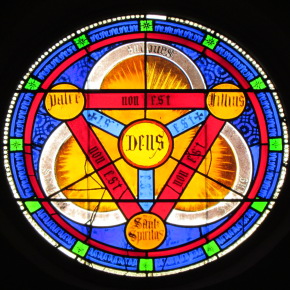
Have you ever looked closely at the round window high up the wall in the back of the church? Go ahead – turn around and give it a good look. I love this window. I love the vibrant colors. I love that when the sun is shining through it, an afterimage gets imprinted on my eyes, so I see it when I close them. If you’ve never given the window much thought, I don’t blame you. The words on it are in Latin, after all. But let’s keep looking. The window presents a diagram of the Holy Trinity. “Deus” – God – is encircled in the center. Three smaller circles float around it: Patri, Filius, Spiritus Sancti – Father, Son, and Holy Spirit. Each of the smaller circles is connected to the others with the words “non est” (is not), and each smaller circle is connected to the large central one with the word “est” (is). The diagram is telling us that the Father, Son, and Holy Spirit are not each other but they are all One God. How does this work? Wisely, the window doesn’t tell us. The window just illustrates the reality, a theological blueprint in stained glass.
Likewise, I’m going to take my cue from the window and stay silent on the “How does this work?” question. Too many sermons over the years have tried to explain the mystery of the Trinity by talking about apples or flames. What those sermons didn’t understand is that you can’t explain a mystery without destroying the very quality that makes it mysterious. When Sherlock Holmes figures out that the bell rope used to call for the maid was replaced with a poisonous snake, which somehow slithered unnoticed out of the room in the ensuing hubbub over discovering the body, the mystery is solved. No more mystery. This Whodunnit? type mystery is the kind we’re used to: Gibbs and the NCIS team solve their mysteries within the length of the 45-minute episode. The light-hearted mystery novels my mother loves to read always wrap up the intrigue by the end of the story.
But here’s the difference between these small, ordinary mysteries we watch or read and the great mystery of the Holy Trinity. The small mysteries have answers to them, like the poisonous snake. But the mystery of the Holy Trinity is the answer – the fundamental answer that rests at the very core of existence. Here’s what I mean.
Before creation came into being, there was God. There was only God. Then God spoke, “Let there be light,” and creation erupted in a rush of dust and energy and far flung fire. And suddenly, there was something known as “not God.” Suddenly, there was an “other” for God to love. And yet, we believe that God’s essence is love, which means that God must have loved before there was a creation to love. Confusing, right? It is confusing until we realize there’s only one possible answer for whom God loved before there was anything else. God loved God. This may sound narcissistic or vain, but it’s not. Narcissism and vanity are distortions of love, but God’s love is perfect and unsullied. God loves God with such perfection that there is still only One God, even though a loving relationship exists.
That’s the keyword: relationship. To try to come close to the mystery of the Holy Trinity, we employ relational words: Father and Son, Parent and Child. We speak of the Holy Spirit as being the love that flows between them. This perfect relationship existed before creation, and thus serves as God’s blueprint for creation. Have you ever noticed that if you drill right down to the core of any subject whatsoever, you end up at relationship? At the most fundamental level, life, the universe, and everything are based on the relationships between things. Elemental particles vibrate next to other elemental particles, weaving the fabric of creation. Atoms repel and attract each other. Ecosystems thrive as complex series of relationships. Celestial bodies dance the precarious waltz of gravitational balance. Not to mention, the most important things in the lives of us humans on this fragile earth is our relationships with one another.
All of this grows from that blueprint God used from God’s own self – the perfect relationship of the Holy Trinity. In the act of creating something that was not God, God knew creation wouldn’t be perfect. And yet, God made it anyway. The reason the Holy Trinity remains a mystery is that our relationships – indeed, all relationships in creation – are not perfect, and thus we cannot fathom perfection.
But while we aren’t perfect, the idea of perfection lingers within us, an echo of our Creator’s own perfect love. We feel this echo as a longing for connection, for relationship with God and with each other. God loves us perfectly, even though we have the capacity to return a mere sliver of that love. But that sliver is more than enough to activate our ability to engage in loving relationships here and now. When we nurture such loving relationships in our lives, we come as close as our imperfection allows to the perfect relationship of the Holy Trinity.
Indeed, the Holy Trinity transcends our imperfection, draws us in, and strengthens our earthly relationships. The echo of God’s perfect love grows louder, more insistent, as we give ourselves over to be born again from above, to be remade closer to the blueprint than we were before. The blueprint calls for less domination and more mutuality, less prejudice and more generosity, less pride and more humility. The blueprint calls for less defending and more welcoming, less grasping and more embracing, less tearing down and more lifting up. And above all, the blueprint calls for love to spill forth in the forms of justice-seeking, mercy-granting, grace-sharing, hope-planting, and joy-singing.
And so you go home and do the dishes even though it was your brother’s turn. Or you tell your wife “thank you” for her poise in the middle of chaos and for putting up with you all these years. Or you introduce yourself to that bedraggled person you always seem to run into on your morning jog and ask if he needs assistance. Or you look those who are oppressed in the eye and say, “I’m sorry for not showing up sooner,” and then turn to stand with them.
Each of these is an expression of the blueprint of the perfect relationship of the Holy Trinity. And each of these will be done imperfectly. And yet, the mystery of the Holy Trinity rests at the core of all existence, of all we do and all we are. And so our imperfection is even now being redeemed by the perfect love of God, which somehow manages to fit all of itself into our mere slivers of love.
If in your life, the Holy Trinity has seemed no more than an abstraction, as clear as the Latin writing on the window back there, then I invite you to take a step back and look again. Reassign every single urge you have ever had to seek justice, to grant mercy, to share grace, to plant hope, to sing joy, and to love. Reassign all of them to the perfect love of the Trinity flowing, however imperfectly, through you. Notice now the Father, Son, and Holy Spirit catching you up in the ever-spinning dance of perfect love, and be thankful.
—
* The diagram of the Holy Trinity is the window on the back wall of St. Mark’s in Mystic, CT.
Sermon for Sunday, April 6, 2014 || Lent 5A || John 11:1-44
The prayers have all been prayed. The farewells to the deceased have all been said. The dirt has been cast on the shining, glossy coffin. The low murmur of voices mingles with the whisper of the wind through the long, cemetery grass. The new widow rises from the velvet-covered folding chair, the triangle of the blue field and white stars of the American flag peeking out from under her arm. A line of black-clad people forms, and they begin to file past her. You watch her receive with grace each well-meant, but well-worn sentiment. You join the line, and soon it’s your turn. You grasp her hand in both of yours and wait for the words to come.
I’m sure each of us has been in this position. Some of us have also been on the other side of it. Sometimes words tumble out before we have a chance to catch them, to measure them, to reflect on how they will be heard. Other times, we have no words, and we trust that the fervent squeeze of the hand or an embrace will communicate what we want to say. Most times, the language of embrace is more potent and effective than the language of words.
In today’s Gospel reading, we have the opportunity to listen in as Jesus and Martha converse near the grave of her brother Lazarus. They’ve both lost someone: Martha, a brother; Jesus, a friend. Indeed, the Gospel doesn’t describe too many individuals specifically as ones Jesus loved, but Lazarus is among the honored few.
Martha speaks first: “Lord, if you had been here my brother would not have died.” We could interpret Martha’s first words as an accusation or as a statement of faith. More than likely, they are (as is so often the case) a combination of the two. Since her sister Mary echoes these same words a few verses later, we can assume Martha and Mary had spoken them to each other in the four days since Lazarus died. “If Jesus had been here, Lazarus would still be alive,” they might have whispered to each other. And then I imagine, “Why didn’t he come?” And then, “I heard he’s on his way,” followed shortly by, “What took him so long!”
In any case, Martha says these words to Jesus, “Lord, if you had been here my brother would not have died.” At first, Jesus responds with what sounds like an empty, stock answer to a grieving person: “Your brother will rise again.” Such a statement had probably reached the status of well-worn platitude in that time, considering a large portion of Jewish society believed in a final resurrection. Judging by her next words, Martha certainly takes Jesus’ statement in this clichéd manner. I imagine her hanging her head when she says, “I know that he will rise again in the resurrection on the last day.”
But here’s where Jesus changes the rules of the standard funereal conversation. He stretches out his hand, places it on Martha’s cheek, gently raises her head so their eyes meet. “I AM the resurrection and the life,” he says. And for those few words his voice rings like a well-struck bell, and the truth of them resounds deep within Martha’s soul. I AM the resurrection and the life.
You may recall last week, we discussed how frequently Jesus employs this sentence structure in the Gospel According to John. When he states I AM, he reaches back to the conversation between Moses and God at the burning bush. Moses asks God for God’s name, and God replies, “I AM WHO I AM.” When Jesus echoes these words in the Gospel, he reveals a piece of his own divine identity.
“I AM the resurrection.” By taking resurrection into his very identity, Jesus proclaims to Martha and to us that his business is always remaining in life-giving relationships. Yes, death occurs. But death is not final. Yes, life ends. But new life – life in some superlative form – emerges because of the power of the promise of Christ’s resurrection. I do not know what this new life looks. I cannot describe it to you. But because Jesus says, “I AM the resurrection,” I believe he will be there, continuing to call us into full and complete relationship with him. Only then, in the power of the resurrection, we will truly be able to reciprocate and join him in that full and complete relationship.
Martha understands the truth of the promise of this relationship. Notice how she answers Jesus’ next question. He asks: “Those who believe in me, even though they die, will live, and everyone who lives and believes in me will never die. Do you believe this?”
Here Martha replies in the affirmative, but she answers a different question than the one Jesus asked: “Yes, Lord, I believe that you are the Messiah, the Son of God, the one coming in the world.” By saying she believes in him, Martha affirms her relationship with Jesus. And Jesus, unwilling to let such a relationship ever end, offers her the gift of resurrection. Our belief in Jesus affirms our desire to remain in relationship with him. His gift of resurrection affirms his desire to remain in relationship with us.
So the promise of resurrection, which Jesus builds into his very identity, is the promise of eternal relationship with God. And that sounds like a pretty good definition of heaven. In their conversation near the grave of Lazarus, Martha and Jesus reaffirm their desire to be together. Their words are a verbal embrace that points to the eternal embrace promised by the power of the resurrection.
And so we return to the windswept cemetery, to the widow holding the crisply folded American flag, to the receiving line filing past. It’s your turn. You grasp her hand in both of yours and wait for the words to come. And you remember Jesus’ conversation with Martha. You remember Jesus’ promise to remain in life-giving relationships with all who desire them. You remember his resurrection proclaims this triumphant promise.
And you realize that Christ is already calling you into such a life-giving relationship. You don’t have to wait for your own death for such a relationship to begin. You can practice it everyday in your interactions with other people as you speak words of life and grace and blessing to them, as you discover the presence of Christ in them, as you seek to deepen your relationships with them.
You open your mouth to speak to the widow, but no words come. And so you resort to the language of embrace to communicate this desire to demonstrate how important your relationship with the widow is to you. You put your arms around her, and now your mouth is by her ear. Now something prompts you to speak. “I love you,” you whisper. That’s all you need say, if you say anything at all.
(Sermon for Sunday, November 24, 2013 || Christ the King Year C || Luke 23:33-46)
Today, on this final Sunday of the church’s year, we celebrate the “kingship” of Christ or (put another way) the “reign of Christ.” I prefer this second word because “kingship” conjures up for me images of thrones and jousting and ladies bestowing tokens on knights who catch their eye. Possibly, I’ve read too many novels in the “historical fantasy” genre. But more than that, the word “reign” just feels broader and more energetic. The eternal “reign of Christ” stretches out from Christ the King and supplants the lesser things that attempt to reign in this world and in our lives. When we turn our attention away from these lesser (yet louder) things – power, money, fame, and the like – we can see and participate in the greater (yet quieter) reality of Christ’s reign.
The territory over which Christ reigns encompasses the whole of Creation, and yet we tend to cede our personal territory to the lesser things that seek to rule because it seems like the normal and acceptable thing to do. But there’s the rub: Jesus never did the normal or the acceptable thing, so, of course, his reign subverts the expectations of the world.
Speaking of expectations – show of hands – how many of you expected to hear the story of Jesus’ crucifixion when you came to church this morning? Yeah, I didn’t think so. A little jarring, wasn’t it? We’re about as far from Good Friday as we can get on the calendar, and yet we read this story today. So my question is: why?
Well, the easy answer is that the reading speaks of Jesus being a king and today is Christ the King Sunday. But this sermon has about seven minutes left in it, so I should probably say more than that, right?
While reading this story may seem strange, no other passage of the Gospel sheds more light on Christ’s reign than this one which recounts his torturous crucifixion. On the cross, Jesus was expected to succumb to the agony of the nails driven through his wrists and feet. He was expected to be ashamed of his nakedness. He was expected to cry out for pity’s sake and beg for mercy even as his breath came short and ragged because of the slow asphyxiation the cross delivers.
The normal and acceptable thing to do on the cross was to whimper your way to your last pitiful breath, all for the pleasure of Rome. But remember, Jesus never did the normal or the acceptable thing.
He was expected to show agony and shame and to cry out for mercy to an empire that never showed any. But instead, in the midst of his torture, he spoke three kind, generous words, words that echo through history and come to us and show us what Christ’s reign is really about. The cross magnifies the power of these three words because they stand in stark contrast to what the cross represents. The cross represents domination, separation, and fear. And yet, while nailed to its wood, Jesus spoke words of forgiveness, relationship, and trust. When we live into the reality dreamt by these three words, we cede our personal territory back to the reign of Christ and the lesser things slink off in defeat.
First, forgiveness. The sound of the hammer’s echo is still reverberating when Jesus speaks his first word. He looks down from the cross, sees his captors gambling for his clothing, grubbing over bloody scraps of cloth, and he says, “Father, forgive them; for they do not know what they are doing.” Forgive them: my betrayers, my torturers, my murderers. Forgive them. I have trouble forgiving the guy who cuts me off in traffic, and here’s Jesus choosing to use his last breaths to forgive those who numbered those breaths. What does he know that we forget all the time? What about forgiveness places it squarely in the center of Christ’s reign?
Jesus knows that forgiveness is a much larger concept than mere pardoning of misdeeds. Forgiveness is both an action and a state of being. When we forgive, we choose not to let anger, isolation, and vengeance reign in our lives. Forgiveness allows us to let go of these lesser things that, in the long run, can damage us irreparably. Writer Anne Lamott puts it this way: “Not forgiving is like drinking rat poison and then waiting for the rat to die.” Forgiveness releases us from the damaging power of brooding malice, of getting even. In their place, we find Christ’s reign, and with it the healing of brokenness and the bestowing of generosity of spirit.
Second, relationship. The sound of the thief’s request hangs hopeful in the air. And Jesus says, “Truly I tell you, today you will be with me in Paradise.” You will be with me. I can’t think of a more wonderful promise for Jesus to make. With these words, he reminds us that the cross, which dominates the scene, is just a passing thing. The separation it stands for is one of those lesser things that tries to rule, but which will ultimately fail.
Death seems so final, the pinnacle of separation, but in Christ’s reign, death is just another passing thing. In his resurrection, Jesus demonstrates the utter lengths he goes to be with us forever. He proclaims this promise to the thief on the cross and he fulfills this promise in our lives when he claims our personal territory as part of his reign. The thief himself speaks of his just condemnation as a criminal, and yet Jesus doesn’t see this as a barrier to relationship. Rather, Jesus sees the thief’s sin as a reason for relationship. In the reign of Christ, our sin separates us from God; but, in a mysterious cosmic paradox, our sin does not separate God from us. We may cede our personal territory to such a lesser thing as sin, but the territory, in the end, belongs to Christ. He’s not going to let passing things like sin and death defeat his presence and relationship in our lives.
Third, trust. With his last breath, Jesus cries out, “Father, into your hands I commend my spirit.” Another translation says, “Father, into your hands I entrust my life.” With these words, Jesus once and for all destroyed the power of the cross, which is a symbol for the power of fear. The Romans used this torture device precisely because it struck fear into the hearts of those living under Roman rule. But Jesus knows that trust is the antidote for fear.
The reign of Christ is a place where fear finds no foothold. Fear reduces us to selfish hoarders, whose lives are scarred always by the thought of “never enough.” But trust expands us, makes us generous givers, and vaults us into the reign of Christ, where the “never” of “never enough” falls away. When we trust God, we let go of the fear that grips us. Indeed, the act of simply attempting to trust God is in itself an act of trust. So even when we are bad at trusting, each attempt is a little skirmish that God wins over fear. Trust allows us to see past the deserted island of fear and view the ocean of God’s presence surrounding it. When we step off the island and into the water, we find ourselves floating in God and trusting God to keep us from sinking.
Forgiveness. Relationship. Trust. These are the words on the lips of Jesus as he hangs on the cross. Forgiveness. Relationship. Trust. These are the ways Jesus invites us to participate in his reign. We might be tempted to cede our personal territory to the lesser things that seek to rule us. But in the end that secession is a mere illusion because our personal territory has never been ours to cede. We belong to Christ. We live in his reign. By the standards of the world, Christ’s reign is neither normal nor acceptable. But Jesus never did the normal or the acceptable thing. And nor should we.
For this past Sunday, I chose to deviate from my normal sermon preparation (sit in my chair writing and polishing until the full text is presentable) in favor of an extemporaneous style which I do once or twice a year. This less common style is the one I grew up listening to, as my father* (who was on the radio before becoming a priest) is very good at holding an entire sermon in his head and stringing his thoughts together with nary an “um” to be heard. While my father and I share a lot in common, preaching style is not one of them. I’m a writer through and through.
So it came time to preach on Sunday. I had a few notes written down. I preached. I recorded it through the church’s sound system. I was about to post the recording, and then noticed my digital recorder’s battery had run down. Long story less long — what follows is a short reconstruction of the thoughts in the sermon. It’s not exactly what I said, but here goes. (Check outLuke 12:13-21before reading on.)
Jesus often talks about priorities, specifically about reorienting our priorities so they line up better with the order God yearns for us to adopt. For us today, the two priorities that need lining up are possessions and relationships. So, show of hands: who think Jesus would put our possessions above our relationships.
(No one raised his or her hand here. I went to sit down, saying that I guess I didn’t need to finish the sermon. A bit of laughter. Then I continued.)
Right. For Jesus, relationships always trump possessions. In today’s Gospel reading he says: “For your life does not consist in the abundance of possessions.” But have you ever stopped to wonder why relationships are more important than possessions?
That’s my guitar at a concert back in 2008.
The answer starts with how relationships and possessions differ. We possess our material goods. We own them. We paid for them or they were given to us. My most prized possession is my 2006 Taylor 410e Fall Limited Edition acoustic guitar, which was a present for my ordination to the priesthood from my home parish. It is a beautiful instrument and it makes a beautiful sound. It also makes me want to write songs as often as possible, which was not the case with my previous guitar.
So if for some reason I had to give up my guitar, would I be able to do it? If the answer is “no,” then I cease possessing my guitar and the instrument begins possessing me. The moment I can’t let it go is the moment I cede my sovereignty to the object. I become its vassal. It becomes my idol.
Our possessions have an uncanny ability to lead us down this life-denying path. Just think: when you were three years old, were you able to let the other kid play with your firetruck? I didn’t think so.
But possessions differ from relationships because other people cannot be possessed. The history of the United States is tarnished by the evil of trying to possess other people, and the legacy of slavery still reaches its cancerous tendrils into modern society. While one set of people thought of another as property, I can’t imagine that those subjected to the dehumanizing nature of slavery ever thought of themselves as possessions. People can’t be possessed, and when we try, evil is the result.
Since we cannot possess others in the same way we can possess objects, our relationships teach us how best to prioritize our material possessions. A relationship flourishes precisely when we aren’t trying to possess it; therefore, sustaining life-giving relationships helps us practice the kind of emotional letting go that we aren’t good at where our material goods are concerned.
Each of us is blessed with an abundance of possessions, but abundance becomes a blessing when we pair it with generosity. Generosity turns our possessions into the resources which fuel new relationships. As we give away the things that we might otherwise bow down to, we come into contact with the recipient of those things and discover the opportunity to form a new relationship.
Thus generosity catalyzes a virtuous cycle: generosity spurs new relationships. Generosity in relationship helps it flourish. This flourishing teaches us to be generous with our possessions and turn them into new relationships.
When we prioritize possessions over relationships, we become lonely misers like the foolish man in the parable. His foolishness is not that he’s wealthy. It’s that he desires to share his wealth with no one else. God blesses us with abundance, but God also blesses us with the ability to turn abundance into blessing when we pair it with generosity. So what does a life full of God consist of? Not the abundance of possessions, but the generosity of relationship.
—
* You can hear my father, The Rev. Dr. William Carl Thomas preach at balconyperspective.com.
(Sermon for Sunday, February 26, 2012 || Lent 1B || Mark 1:9-15)
Every year on the First Sunday of Lent, we hear the story from the Gospel that tells about Jesus’ time in the wilderness. We hear this story on this particular Sunday because Jesus’ forty days off by himself, fasting in the arid austerity of the desert, are a model for our own forty-day Lenten journey. Last year, we heard Matthew’s telling of this tale – an eleven-verse treatment, complete with the devil’s three-pronged attack on a famished Jesus. The year before that, we heard Luke’s version, a full thirteen verses that recount the same story as Matthew does. Now, if Matthew and Luke spend on average a dozen verses on this story, then you might be wondering whether you nodded off during the Gospel reading from Mark a few moments ago and missed something. Where was the dialogue between the seductive devil and the stalwart Jesus? Where were the temptations: the bread from the rock, the leap from the temple, the view from the mountain? The answer is that I didn’t read them because they aren’t there. And I can assure you that you didn’t have time to nod off, no matter how sleepy you are.
Never one to spend his words frivolously, Mark gives us a grand total of two verses on Jesus’ time in the wilderness. “And the Spirit immediately drove him into the wilderness. He was in the wilderness forty days, tempted by Satan; and he was with the wild beasts; and the angels waited on him.” That’s all Mark has to say on the subject. So, to keep you all from feeling gypped by a two-verse Gospel reading, the framers of our lectionary tacked on a few verses before and a few verses after Jesus’ time in the wilderness. And I’m so glad they did.
I’m glad because Mark’s rapid style progresses from scene to scene with such haste that the individual scenes cannot be isolated from one another. Indeed, I don’t think Mark intended for them ever to stand alone. Rather, taken together like the three panels of a comic strip, the three short scenes we read a few minutes ago tell the concise story of our life of faith.
Here’s the first panel: Mark draws Jesus emerging from the waters of the River Jordan. A dove alights on his outstretched arm. A text bubble points out the top of the frame and reads: “You are my Son, the Beloved; with you I am well pleased.” This first panel in the story of our life of faith is “relationship.” Jesus hears God’s voice calling him “Son.” And not just son, but a son whom God loves. And not just a son God loves, but a son God loves, in whom God finds delight and joy. This relationship that God has with Jesus is the same relationship that God initiates with each one of us. Each of us is a son or daughter whom God loves and in whom God delights.
I know this can be hard to accept because most of the time we feel way too messy and unkempt for God to want to know us, let alone to delight in us. Our socks have holes in them. We haven’t vacuumed in a while. We ate that pretzel we found between the couch cushions. And that’s just the surface stuff. Why would God want to have anything to do with such untidy people?
But the wonderful thing about this first panel of our story is that Jesus hasn’t done anything yet. We’re less than a dozen verses into Mark’s account of the Gospel. Jesus hasn’t spoken a word or accomplished anything more remarkable than traveling from Nazareth to the Jordan and coming up for air after John dunked him under the water. Before Jesus has time to win or lose God’s favor, God has already staked out a place in their relationship. Likewise, God tossed God’s lot in with us long before we let God see our untidiness. And God’s not going to cut and run just because of our state of disrepair. God’s knowledge of us, love for us, and delight in us do not depend on our worthiness. In fact, they create our worthiness. Because God is in relationship with us, we are worthy to be in relationship with God. This is the first panel of our story.
In the second panel, Mark draws Jesus walking in the desert. At first glance, he seems to be alone. But then you notice the faint outline of an angelic hand holding one of Jesus’ hands as the other fends off Satan. This second panel in the story of our life of faith is “adversity.” Immediately after God affirms God’s relationship with Jesus, Jesus finds himself in the wilderness with the wild beasts and the temptations of Satan. I always assumed that Jesus had to travel quite far to get to the wilderness, but as I thought about this sermon, I changed my mind. I doubt he went very far at all. The wilderness is all around us. We live in the wilderness. Sometimes through our actions and inactions, we contribute to expanding the wilderness. The wilderness exists anywhere that we feel isolated or afraid or tempted or lost. And let’s be honest – we are feeling at least one of those most of the time.
But the adversity, which brings on these feelings, does not make the wilderness a trial or a proving ground. God does not drop us in the desert just to test our endurance. We simply wander into the wilderness, and we get caught there because the wilderness is vast and tangled. But remember the first panel of our story. The relationship God entered into on our behalf does not end at the desert’s edge. When the people of Israel wandered in the desert for forty years after fleeing Egypt, they made a remarkable discovery. Their God was in the desert, too. The adversity of the wilderness is the second panel of our story, but the relationship of the first panel carries through.
When we discover God’s constant presence even in the midst of the wilderness, we are ready to move to the third panel. Mark draws Jesus striding through Galilee proclaiming a message to everyone who will listen and to some who won’t. A text bubble points to Jesus, saying, “The time is fulfilled, and the kingdom of God has come near; repent, and believe in the good news.” This third panel in the story of our life of faith is “proclamation.” After God has claimed a delight-filled relationship with the beloved Son, and after the Son has wandered in the wilderness, Jesus returns to Galilee with the words of the good news of God on his lips.
Our proclamation of this same good news happens whenever we act on the faith that comes from God’s delighted, loving relationship with us. Our proclamation happens when we come to know, love, and delight in all the messy and unkempt people around us. Our proclamation happens when, even in the midst of the tangled wilderness, we rely on God to show us the path to freedom.
Our life of faith moves from relationship through adversity to proclamation. But this life of faith is not linear; rather, this life is a spiral. As we grow in our faith, we delve more deeply into our side of our relationships with God. As we come ever closer to the God who is always close to us, we can endure greater adversity. And we can proclaim more continuously and more courageously the love and delight God has for all people.
As we enter this holy season of Lent, I invite you to take stock of where you are in this life of faith. Are you nurturing your relationship with God? Or are you wandering through the tangled wilderness of adversity? Or are you reveling in all the ways that you show forth God’s love? Or perhaps, you are living out a little of all three. Wherever you are in this story of the life of faith, trust that God began a relationship with you before you were worthy of one, that God is hacking away at the tangle of wilderness right alongside you, and that God is constantly speaking the words of the good news through your words and deeds into the hearts of those you meet along the way. Thanks be to God.

 You probably didn’t realize it, but a few minutes ago _____ read the very last prayer in the Bible. “Amen. Come, Lord Jesus.” These are the words of John of Patmos as he wakes from his vision, which we know as the Book of Revelation. Come, Lord Jesus. A succinct prayer, to be sure, but powerful. It sounds to me like a breath prayer; that is, a prayer short enough to be said slowly in a single breath. <demonstrating> Come, Lord Jesus. Praying a breath prayer is a wonderful practice that helps us stay immersed in the healing waters of God’s presence. A breath prayer can be anything that you can say with one breath: Continue reading “Come, Lord Jesus”
 The Passion narrative Stacey just read can be quite overwhelming. It is by far and away the longest reading we listen to all year, and there’s a lot going on. There’s Judas’s betrayal, Jesus’ arrest, Peter’s denial, the trial with the high priest, the interview with Pilate, the frenzy of the crowd, the crucifixion, and the last words from the cross. There’s so much going on, in fact, that we can easily lose sight of the overarching story of the Gospel when we find ourselves overloaded by this painful and heart-breaking narrative. So instead of talking about the entire Passion narrative, each year I like to focus on one little moment of it that speaks to the whole story. On this Good Friday, that moment happens between the soldiers gambling for Jesus’ clothes and Jesus drinking the sour wine.
 Last fall, I had to renew my passport before my trip to Haiti with Tim Evers. I had originally gotten my passport in advance of a choir trip to England back in college in 2003, and that first document was still valid when Leah and I went to South Africa for our honeymoon in 2011. But they’re only good ten years, so in the fall of 2015, I found myself stapling an unsmiling picture to an application I picked up at the post office. I filled in all the information – name, address, social security number. I checked the box marked “U.S. Citizen,” dropped the package in the mail with the processing fee, and a few weeks later, received my new passport.
 I love my mother with all my heart. For thirty-three years and five days, she has never wavered in her steadfast love for me, support of me, and delight in me. She delivered me in the middle of a Maine snowstorm; she endured through my advanced childhood self-centeredness; and she never let her own demons keep her from being my nurturer, advocate, mentor, and friend. I get my love of reading from her. I get my precociousness from her. And I get my ability to be quiet and listen from her. When I had my first ever bona fide moment with God, it was my mother who held me and rocked me – her seventeen-year-old baby boy – while I bawled my eyes out, overwhelmed by the immensity and clarity of it all.

 Have you ever looked closely at the round window high up the wall in the back of the church? Go ahead – turn around and give it a good look. I love this window. I love the vibrant colors. I love that when the sun is shining through it, an afterimage gets imprinted on my eyes, so I see it when I close them. If you’ve never given the window much thought, I don’t blame you. The words on it are in Latin, after all. But let’s keep looking. The window presents a diagram of the Holy Trinity. “Deus” – God – is encircled in the center. Three smaller circles float around it: Patri, Filius, Spiritus Sancti – Father, Son, and Holy Spirit. Each of the smaller circles is connected to the others with the words “non est” (is not), and each smaller circle is connected to the large central one with the word “est” (is). The diagram is telling us that the Father, Son, and Holy Spirit are not each other but they are all One God. How does this work? Wisely, the window doesn’t tell us. The window just illustrates the reality, a theological blueprint in stained glass.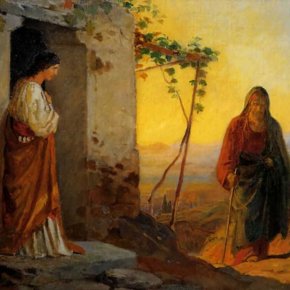
 The prayers have all been prayed. The farewells to the deceased have all been said. The dirt has been cast on the shining, glossy coffin. The low murmur of voices mingles with the whisper of the wind through the long, cemetery grass. The new widow rises from the velvet-covered folding chair, the triangle of the blue field and white stars of the American flag peeking out from under her arm. A line of black-clad people forms, and they begin to file past her. You watch her receive with grace each well-meant, but well-worn sentiment. You join the line, and soon it’s your turn. You grasp her hand in both of yours and wait for the words to come.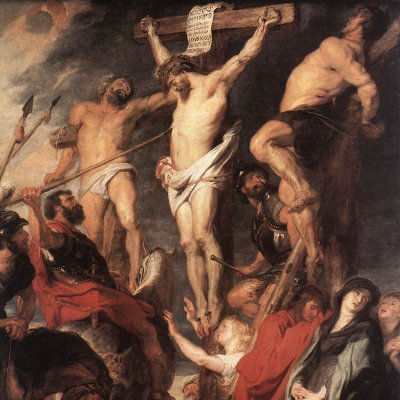
 Well, the easy answer is that the reading speaks of Jesus being a king and today is Christ the King Sunday. But this sermon has about seven minutes left in it, so I should probably say more than that, right?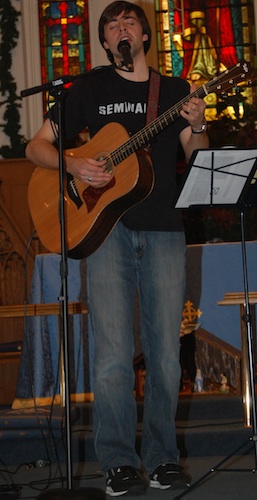

 Where the Wind...