Performed at St. Mark’s in Mystic, CT on Sunday, December 21, 2014
 This version of the Christmas pageant employs two sets of main characters, one younger and one older. The older versions sit on stools flanking the main action. They stand up to deliver their monologues. During the monologues the younger versions pantomime the action and speak at the end of each speech.
Prologue
NARRATOR
Before the universe existed, there was God. There was no time and no space, but there was God. Then God spoke and Creation came to be. One of the things God created was freedom, which was the ability to say “yes” or “no” of your own free will and not be compelled to answer one way or the other. God yearned with all of God’s heart that the Creation God made would say “yes” to a deep relationship with God its creator. But more often than not, parts of that Creation said, “No.” People said, “No.” We said, “No.”
Saying “No” to relationship with God led people down some dark paths. They dominated each other instead of serving each other in love. Fear ruled the day. And yet God did not give up. God decided to send God’s own Son into this wayward Creation to show us the path back to the God who never broke the relationship like we had done. All God needed was someone to say, “Yes.”
Scene 1: The Annunciation
While the OLDER MARY speaks her monologue, YOUNGER MARY and GABRIEL pantomime their conversation.
OLDER MARY
Until that day, nothing had ever happened to me. I grew up like everyone else in my town. I worked my father’s farm with my brothers and sisters. I watched the sun set. I watched the sun rise. That was life. Even getting engaged to be married to Joseph was just another day. It was expected. I always did what was expected.
Then Gabriel appeared to me, and every day since has been more unexpected than the last. He told me not to be afraid, but there was no need. His presence wasn’t frightening. It was exciting. From the moment he spoke, I felt a quickening in my gut, a hum, a desire finally to discover the person I longed to be.
The angel told me of the son I would have, the heir of David’s throne, the flesh and blood of the Most High God. It all sounded impossible. But Gabriel said nothing is impossible for God. I thought for a moment: I’ve never done anything in my life. I’ve never been anywhere. I’m not special in any way. Why would God choose me?
And that’s when it hit me. God chose me because God knew I would say…
YOUNGER MARY
Yes.
Scene 2: Joseph’s Dream
NARRATOR
Mary said, “Yes,” to the angel. She said, “Yes,” to God’s dream for her life, and that dream became a reality. And as the dream was growing inside her, the angel made another stop.
YOUNGER JOSEPH is fast asleep when GABRIEL stands over him pantomiming speaking.
OLDER JOSEPH
My namesake was a great interpreter of dreams. He saved Egypt during a seven-year famine. He saved his own family, too. I always wondered what it would be like to have that kind of gift. Then one night I found out. My dream didn’t need interpretation, however, because the angel stood before me plain as day, and when he spoke, the words tasted true.
Everyone around me, society at large, even my own father, urged me to get rid of Mary, to dismiss her quietly so as not to cause a fuss. But I couldn’t bring myself to do it. Then the angel told me why. Somehow I knew, even before the angel told me, that the child was special. I didn’t have the words to describe the way I felt until the angel called my son, “Emmanuel.”
GABRIEL departs, and YOUNGER JOSEPH rises from sleep. He join YOUNGER MARY and puts his hand on her pregnant belly.
OLDER JOSEPH
Yes, the joy I felt came from that place, that place of nearness. When I looked at Mary and felt the baby kick, I knew…
YOUNGER JOSEPH
God is with us.
Scene 3: Arrival in Bethlehem
As the NARRATOR speaks, YOUNGER MARY and YOUNGER JOSEPH make their way to Bethlehem.
NARRATOR
Mary spent the first few months of her pregnancy with her cousin Elizabeth. But as the time drew near for the baby to be born, the Empire called for a counting of all the people in their territories. Joseph had to go to Bethlehem to be registered because his ancestors hailed from there. Mary went with him.
OLDER MARY
The waves of pain began weeks before Jesus was born. At first I thought I was going into labor, but Elizabeth assured me it was normal. I learned to live with them, even though they got worse as the day drew near. But that first night in Bethlehem, a different pain hit me, and I knew it was time.
YOUNGER MARY AND YOUNGER JOSEPH pantomime the story being told: breaking into the room, being surrounded by ANIMALS.
OLDER JOSEPH
In desperation, I broke into the backroom of a house to get us out of the cold. The owner’s animals were huddled there. It stunk to high heaven, but at least it was warm. When Mary started to cry out in pain, I thought that we were done for, that the people of the house would drive us back into the night.
The FARMER comes in with a rake. Then the MIDWIFE enters.
OLDER MARY
But they didn’t. The farmer came in brandishing a threshing rake, but he took in what was happening right away and called for his wife. We asked if we could stay, and she said, “Yes.” Turns out she was a midwife. What a blessing from God. Joseph was beside himself. He didn’t know what to do. But she calmed him down, directed him.
OLDER JOSEPH
She put a blanket in my hands and guided them.
OLDER MARY
One last thunderous wave of pain washed through me, and then…
YOUNGER JOSEPH holds the BABY JESUS in his arms.
OLDER JOSEPH
I held my son Jesus in my arms. I held God. And I knew God was holding me.
Scene 4: The Shepherds
The SHEPHERDS and SHEEP cluster in the center aisle.
NARRATOR
The light of the world shining from the baby wasn’t the only light shining that night. In the fields outside Bethlehem, dawn seemed to be breaking impossibly early.
The ANGELS and GABRIEL stand on the first pew and pantomime talking to the SHEPHERDS.
OLDER SHEPHERD
The light grew slowly at first, so we didn’t notice anything out of the ordinary. But then the field was awash in brilliance. It was like an eclipse in reverse. But what I remember more than the light was the song. The angels sang a song of peace. Of peace! How could you sing a song of peace in such a war-torn age? And yet that is what they did.
The SHEPHERDS and SHEEP walk to the Nativity scene and join it. The ANGELS gather around behind the Nativity scene.
We went to find the One of whom the angels sang. And we found him in the dirt, among the animals just like my own children were born. The song of the angels rang in my mind and I sang it for the baby, a lullaby of peace for the Prince of Peace. And I knew he was one of us. And he was here…
YOUNGER SHEPHERD
To make us more like him.
Scene 5: The Magi
The MAGI begin their trek slowly from one side aisle of the church around the back and up the other side aisle. At the side of the church near the lectern, the MAGI meet HEROD, who pantomimes a conversation.
NARRATOR
Not only did Jesus’ own people seek him out. Immigrants from a far off land arrived guided by a star in the heavens. They first met King Herod in Jerusalem, but they knew Herod was not the king they sought.
The MAGI move to the main group and present their gifts.
OLDER MAGUS
We had been searching the stars for a sign of the One who was to come. And when we found the celestial body streaking westward we knew we had to follow. We didn’t know where it would lead. What we didn’t expect, though, was for it to lead us not only across the desert, but deeper into our own hearts. When we met our true King the first time, we felt the inadequacy of the gifts we had brought – the gold, the frankincense, the myrrh. The infant gazes at us, into us, into our hearts. And we knew the gift he truly wanted. And so I gave him not just a box of gold…
YOUNGER MAGUS
I gave him myself.
Epilogue
The OLDER CHARACTERS move to join their YOUNGER SELVES.
NARRATOR
And so God sent God’s only Son to teach people to use their freedom to remain open to God, to say “Yes” to that deep relationship. A few decades later, he would die for his convictions. But then he rose again to show that nothing, not even death, can separate us from God’s love.
OLDER MAGUS
So when you are searching for God…
OLDER JOSEPH
Know that God is always with us…
OLDER SHEPHERD
And when the Prince of Peace calls to you…
OLDER MARY
Say “Yes.”
* * *
The Players
(*=tiny speaking part; **=big speaking part)
Little Children
SHEEP
ANIMALS
ANGELS
(BABY JESUS)
Children/Tweens
GABRIEL
YOUNGER MARY*
YOUNGER JOSEPH*
SHEPHERDS (1*)
(HEROD)
FARMER
MIDWIFE
MAGI x3 (1*)
Tweens/Teens
OLDER MARY**
OLDER JOSEPH**
OLDER SHEPHERD**
OLDER MAGUS**
NARRATOR**
—
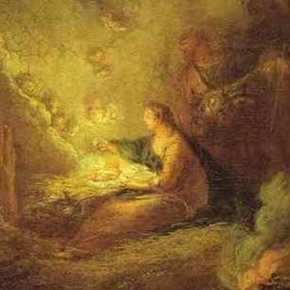
*Artwork: detail from “Birth of Christ” by Antoine Pesne (1745)

 One
One

 The Gospel writer Mark wastes no time telling us what his story is about. The very first words of his account of the Gospel proclaim without hesitation: “The beginning of the good news of Jesus Christ, the Son of God.” Matthew begins with a genealogy linking Jesus back to Abraham. Luke begins with a short address about his research methodology. John begins with a mysterious poem about creation. But Mark just hits the ground running and never looks back. “The beginning of the good news of Jesus Christ, the Son of God.”
 When I was a kid, there was a series of books called the Magic Eye books. Each page of these books was filled with what looked like very precise and geometric versions of Jackson Pollock’s art work. The pictures were just jumbles of kaleidoscopic lines and shapes, and if you didn’t know any better, that’s all you saw. But the trick with these books was that if you looked at the pictures a different way – sort of squint a bit – then you saw an image hiding beneath the jumbled surface picture. I’ll let you in on a little secret: I never once saw anything besides the geometric Jackson Pollock’s. No matter how often I lied to my friends and said, “Of course, I can see the person walking the dog,” I just could never get my eyes to focus correctly to see the hidden images. Let me tell you, it was quite frustrating.
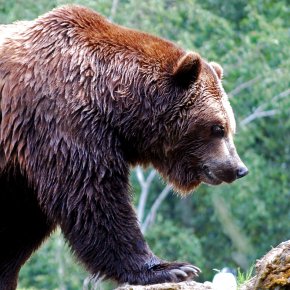
 English is a strange language. We have thousands upon thousands of words – more than most languages – and more get added every year. And still there are plenty of instances in the English language where we employ the same word to speak about multiple concepts. I can’t bear to be in the same room as him. The apple trees are about to bear fruit. Yikes, there’s a bear in our campsite! Now bear with me. This idiosyncrasy of English often leads to confusion, especially among non-native speakers. What’s worse is that it can also lead to a concept being watered down, diluted when the various understandings of the word start to merge.
 “Give therefore to the emperor the things that are the emperor’s, and to God the things that are God’s.” Give to God the things that are God’s. Two weeks ago in the sermon and last week at the forum hour between services, we talked quite a bit about giving to God. We said that all giving to God is really and truly giving back to God. We said that good stewardship comprehends the intentional awareness that what we have isn’t really ours; therefore we cultivate an attitude in which all that we are and all that we have is a gift given back and forth between us and God.
 My twins are not quite two months old, and yet I wonder when they will first look at the other and feel jealous. It might be my imagination, but I swear I’ve seen a barely perceptible glint in my daughter’s eye while she’s rocking away in the mechanical swing and I’m holding her brother – a barely perceptible glint of envy. Her eyes haven’t settled on a color yet, but I would swear in those few moments that they were green.
 “For when two or three are gathered together in my name, I am there among them.” I’ve always heard these famous words of Jesus as an astonishing promise, as a steadfast assurance that Christ is present in our midst no matter what. If you’ve ever been to a church gathering where only a few people showed up, I bet someone said, rather wistfully, “Well, when two or three are gathered…” I’ve said the same many times as a way to remind myself that what we’re doing when we gather as the church, as the body of those whose faith and action is motivated by the life, death, and resurrection of Jesus Christ, is important, no matter the size of the group.
