
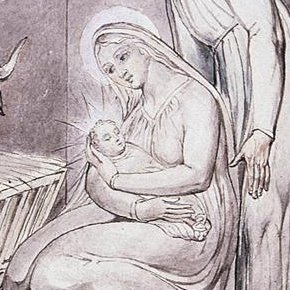
Sermon for Christmas Eve 2015; John 1:1-14
 Right now, you might be thinking, “Wait a second…where are the baby and the manger and the shepherds and the angels? I know it’s late, but I don’t think I nodded off during the Gospel reading.” Now, I don’t know whether or not you nodded off, but I can assure you that I didn’t say anything about the baby or the manger or the shepherds or the angels. Tonight, I read a different version of the story of Jesus’ Nativity. Allow me to explain in brief, and then we’ll get to what I really want to talk about on this most Holy Night, which is God making a home here.
But first: yes, we are used to the Christmas Pageant version of the story of the Nativity. Most of that story is found in the Gospel according to Luke. I say “most” because a few bits come from the Gospel of Matthew and a few others bits are made up entirely. Tonight we read another take on that same story, a take so vastly dissimilar that it seems to be a different story entirely. But it’s not. The story is just condensed. The story of the Nativity is distilled down to a single, yet powerful verse of scripture: “And the Word became flesh and lived among us, and we have seen his glory, the glory as of a father’s only son, full of grace and truth.”
That’s it. That’s the Gospel of John’s Nativity story. That one verse; half a verse really. “And the Word became flesh and lived among us.” Pretty concise, right? But even in their brevity, these words pack in a whole lot of meaning. They are pregnant words, so to speak.
The Word that becomes flesh is the main character of this prologue to John’s account of the Gospel. In just eighteen verses, John explores some pretty weighty theological ideas, and he does so using poetry. Indeed, these verses are best understood as a poem: John uses special words and rhythm and imagery in an attempt to get to the very heart of God’s making of and presence in Creation. The weightiest of these special images is the word “Word.”
This is the Greek word logos. We get the English suffix “-ology” from it; you know, biology, zoology, paleontology. We also get the word “logic” from it. When something is “logical,” it is orderly, organized, it makes good sense. So when John claims that Creation “came into being through [the Word],” he’s stating that God was organized about the act of creating, that God had a plan for the universe and wasn’t just creating all willy-nilly. You can see how John’s poem goes all the way back to before anything existed, all the way back to when there was only God. John needs this cosmic perspective in order to demonstrate the extraordinary specialness of what happens next.
This organizing principle, this logic behind Creation, this giver of all life, this Word became flesh. This Word took on the very meat and bones and skin and breath and soul that had evolved over untold millennia within the Word’s own orderly Creation. This Word became flesh in the person of Jesus of Nazareth, a man of seemingly humble origin who had a knack for helping people live better, fuller, and more authentic lives, serving one another in love. This Word became flesh, which means he got dirty and tired; he grieved and wept and sought comfort; he ate and drank and laughed with his friends. He was homeless at times; he was also a refugee. He was welcomed and excluded; he was loved and hated. He touched and healed so many people, but sometimes he needed to go off by himself to recharge. He took a first, newborn breath. He took a last dying breath. All this to say: he was one of us.
In fact, he was the best one of us. He was the best one of us because he was so much more than simply one of us. He was the Word. He was life as life is meant to be lived, as God dreams for life to be. As so many theologians have said, this Word became like us, so that we could become more like him.
And this thought brings us to the last important word in John’s brief Nativity story: “And the Word became flesh and lived among us.” Lived among us. I don’t like this translation. It’s about as weak a translation of the original language as you can get. I prefer this: “And the Word became flesh and made his home among us.” Made his home among us. This gets much closer to the intent of John’s original poetry. The Word didn’t just live here for a time. The Word settled here. The Word made a home here.
I think this second translation impacts me so much because I have lived quite a nomadic existence. In my nearly thirty-three years on this planet, I’ve lived in ten different states. The longest I lived anywhere was six years in Tuscaloosa, Alabama. The second longest was four years at college. I’ve lived a lot of places. But I never, ever felt like I was making my home anywhere. Until now. I live in a real house with my wife and two children. We brought the twins home to that house. In their short lives, they have never lived anywhere else. That is their home. We have made a home.
The Word became flesh and made his home among us. God made a home here. The Nativity we celebrate this night marks not a brief dalliance with Creation, not simply a passing through, but a commitment to be present, to be active, to be here. And through the power of the Holy Spirit, this commitment continues long ages past the Word’s earthly walk. The home God made is no longer just in Bethlehem or Nazareth or Jerusalem. The home God makes is here, in each beating heart. And the home God makes is also out there, within the whole of Creation. As the Godly Play stories so aptly put it: “All of God is in everyplace.” That’s God’s home. We are God’s home. And God is our home, now and into eternity.
So this night, we celebrate not only the first, newborn breath of the babe in the manger. We celebrate the deep reality that God made a home here in order that we might have a home in God.

 I find it ironic that the framers of our lectionary chose the Gospel lesson I just read as the one for today. Today is the feast we call “Christ the King” or “Reign of Christ.” And yet, for the entire length of his conversation with Pontius Pilate, Jesus specifically dodges Pilate’s questions about his kingship. “Are you the king of the Jews?” Do you ask this on your own, or did others tell you about me? “So you are a king?” You say I am a king. But if Jesus is king of anything, if Jesus claims to reign over anything in this passage, his kingdom would not include land or crops or livestock or resources. His reign would be over “the truth.” For this I was born, and for this I came into the world, to testify to the truth.
 I’ve been preparing recently for Confirmation class, which begins later today. We have four tenth and eleventh graders and their sponsors ready to begin a five-month journey through their faith: learning, discussing, sharing stories. The next time the bishop visits, these four will have the opportunity to make a mature profession of faith if they so desire, and I am really excited to get to walk with them these next several months. Because I’ve had Confirmation on my mind, I’ve been thinking and rethinking some of the “nuts and bolts” of the way we express our faith as Episcopalians. Every once in a while, I like to preach on these “nuts and bolts” because in my job I get asked the same dozen or so questions about our practice all the time, and exploring such questions can help us all deepen our engagement in worship and in mission.
 Today’s sermon is about practicality and belief. I don’t have time for a fancy intro about when I was in fourth grade or about how something my children did reminded me of the Gospel. We’ve got too much to do in this All Saints’ Day service for that – most importantly, getting to the baptism, which is up next. Since today’s sermon is in part about practicality, I thought I’d be practical in my time-management and just skip the intro. So to reiterate, today’s sermon is about practicality and belief.
 Imagine with me the beggar Bartimaeus. He is remembering the fateful day when a large crowd passed his perch beside the road from Jericho. It started like every other day, with a certain memory dancing before his sightless eyes.

 Jesus feels drawn to the man kneeling in front of him. His heart is warmed, and he feels the stirrings of love and compassion for this frightened soul in the midst of an existential crisis. Perhaps the man recently had a parent or friend die, or perhaps he himself had experienced an accident or illness that brought death near. Whatever the trigger, the man comes to Jesus with a serious question that has obviously been plaguing him because of some unspoken dread roiling within him.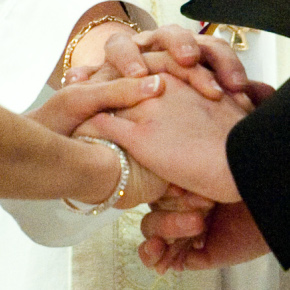
 “Those whom God has joined together let no one put asunder.” By the end of this year, I will have said these words eleven times after hearing the marriage vows of eleven couples. Jesus says these words in today’s Gospel lesson. And he says many other words about marriage and divorce, about fidelity and desire, and about relationships with the most vulnerable. Beneath these words, no matter how hard they are to hear or to speak, beneath these words shimmers Jesus’ surpassing dream for all creation – that none of us and no part of that creation will ever truly be alone.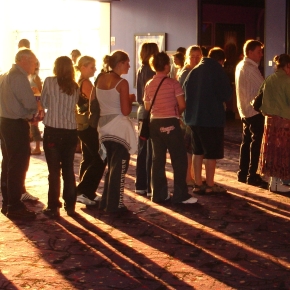
 Every day of my fourth grade year, my class lined up at the end of recess to go back inside. The bell rang, and we raced to our spots in the line. But the race was in vain because no matter who arrived at the door first, we always lined up alphabetically by last name. By last name. What I wouldn’t have given to line up by first name. Then (Oh happy day!) I would have been at the very front of the line. No Aarons or Abigails in my class. No. Adam would have been the first name on the list. But those days were cruel. Every morning, I stood on tiptoes to see over the twenty-three heads in front of me, and only one boy – Shane Yellin – was worse off than I.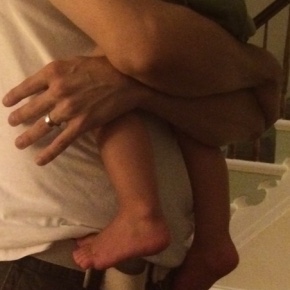
 This week has been a particularly tough one for our twins, Charlie and Amelia. At thirteen and a half months, we think they are cutting their molars, so their extreme fussiness is understandable. On Tuesday, I walked in the door of the kitchen, and before I had taken three steps, Charlie was toddling up to me as fast as his little legs and precarious balance would allow. He ran into me and buried his head between my knees, which is his way of saying, “Pick me up, Daddy.” I hefted him into my arms. He put his arms around my neck and his head on my shoulder. And for the next twenty minutes, I just walked around, holding him and speaking softly into his ear. It was a special moment, a physical heart to heart.
 Where the Wind...