Breathing on Statues

(Sermon for Sunday, May 1, 2011 || Easter 2A || John 20:19-31)

Imagine with me the Apostle Peter, who is in Rome near the end of his life, talking to a friend about the day when Jesus rose from the dead and appeared to the disciples in the locked house.

"Aslan Breathes" by Melissa Carter. Click the picture to see more of her paintings.

I wish I could tell you that seeing the empty tomb was enough. I went inside the tomb and saw the linen cloths lying there and the cloth that had covered Jesus’ face folded up in a corner. Thinking back now, surely grave robbers would not have folded his ceremonial burial garments while stealing his body! But in the semi-darkness of that early morning, I wasn’t thinking rationally. I wasn’t thinking at all. I was numb on the outside, immune to the sliver of hope that the empty tomb brought.

I was numb on the outside, but on the inside, I was at war. I always thought of myself as his most faithful disciple, but at the time of his greatest need, I abandoned him, I lied about knowing him to save my own skin. In the garden, I had been ready to fight to the death for Jesus. But the moment he took away my sword, I crumbled. I wasn’t strong enough to remain by his side without a weapon in my hand. I wasn’t strong enough to trust him, to trust that his plan included death without fighting. I was at war within myself, and I could not access a single crumb of the peace that Jesus had always radiated.

I saw the empty tomb, but the conflict within kept me blind to what the emptiness might mean. The war inside of me – with fresh reinforcements of guilt – was still raging when I returned to the house we had used a few nights before, on the night when I didn’t want Jesus to wash me feet. Nine of the others were there; they had been locked in the room since the mob had formed three days before. As I was shutting the door, Mary Magdalene rushed up and squeezed her way into the room. “I have seen the Lord,” she shouted.

She was breathing hard. I had left her standing outside the tomb, so she must have raced all the way to the house to catch up with me. I looked at Mary: her face glistened with sweat, her eyes were bright. If the conflict within had not been blinding me, I might have identified the brightness in her eyes as “joy,” but how could there ever be joy again after what had happened? The other disciples barely looked up when she burst in shouting. She looked around the room, then back at me. “He has risen from the dead,” she said, defiantly.

I took a step toward her. “Just because the tomb was empty,” I began, but my voice trailed off. She backed away, and now her voice was very small, small and wounded. “But I did see him,” she said. And I shut the door with Mary on the other side.

Sliding the bolt home, I slumped against the door and slid to the ground. Oblivious to Mary’s pounding on the door, I looked around the room. Judas was gone, of course, but everyone else was there, I was sure. We had escaped the mob and the authorities. Would they be content with the death of our leader or would they be coming after us, too? I counted the others. Nine, and I made ten. Someone else was missing. “Where’s Thomas,” I called out.

Philip looked up for a moment and managed a one-word response. “Gone,” he said, and he put his head back into his hands. I sat with my back to the locked door. Eventually Mary gave up her pounding. I could hear her sobbing, her breath coming in great heaves. She was, no doubt, sitting against the other side of the door. Three inches of wood separated us: three inches of wood and my disbelief and the war raging within me.

Inside the room, we might have been statues. I couldn’t even hear the others breathing. Hours passed and no one noticed. No one spoke. No one ate or drank. We were entombed in the locked house, alive but acting like dead men. And all the while the war raged on while numbness froze my body against the bolted door.

The ten of us were still frozen in place when evening fell. I had been staring at nothing in particular when I began unconsciously counting the others again. “Eight. Nine. Ten.” I counted aloud, and then I put my finger to my own chest. “Eleven.” I counted again. Eleven again. I leapt up and stared at the man in the center of the room. He was slowly spinning in a circle, studying each statue in turn. I looked where he was looking: at the hollow eyes, at the sunken cheeks, at the dried up streams of tears that had washed clean lines on dirty faces.

As far as I could tell, I was the only one who had noticed his presence. Since my rational mind was still turned off, I didn’t even wonder how someone else had entered the room while I was sitting against the locked door. I just stared at him, uncomprehending, but the sliver of hope that lay dormant in me since the tomb was beginning to glow. Then he said, “Peace be with you.”

They were the first words spoken since Philip’s one-word response to my question hours earlier. The words rang out, and the others began to stir. They raised their heads. Some stood up. The man walked over to me, gripped my arm in a firm grasp, and I noticed fresh wounds that cut through both of his wrists. He went around the room clasping the others’ shoulders and lifting their chins with his fingers. “He can’t be,” I said, as the war of guilt and pain and loss continued to rage within me, stronger now that the faint glow of hope was illuminating the battlefield.

The man heard me and turned to face my direction. “Peace be with you,” he said again. We were all standing now. The room, so empty a moment before, seemed full now, but not full enough for him. He gestured to me. I turned, unbolted the lock, and opened the door. Mary, still slumped against the other side, fell into the room. I helped her to her feet. “Is he?” I whispered to her. She looked from the man to me, and she beamed at me through brimming eyes.

“As the Father sent me, so I am sending you,” he continued. With these words, we, who had been as still as statues mere minutes before, all leaned in, like trees bending toward the sunlight. And he exhaled a deep, cleansing breath, then another and another. As he breathed out, I breathed in. I breathed in his breath, the wind of his life. I breathed in the words he had spoken twice since his arrival, the very peace that he proclaimed, that he radiated. This was Jesus, and he was alive, and he was breathing life back into us, into the ones who had entombed ourselves in that locked house.

As we leaned closer, Jesus said, “Receive the Holy Spirit.” And his breath washed over me, into me, through me. His Spirit brought peace to the war raging within. His breath blew across the faint glow of hope, turning the glow into a spark, and the spark into a flame, and the flame into a fire. And the fire set my heart alight with all the fervor of rekindled belief in this Jesus, this risen Lord, this one who would not abandon me to the grave even after I had abandoned him to die.

I tell you, friend, that in the years since that day, my daydreams have often brought me back to that moment when Jesus breathed his Spirit into me. When I am in distress, when I am in grief, when I forget that I believe that I am with God, I can take a breath. And I will remember that I am breathing in the peace that our Lord has given to each of us, the peace that passes all my ability to understand and lodges where I need that peace the most – in the secret places within where the war still rages from time to time. You see, every time I take a breath, and, for that matter, every time you take a breath, we are not only filling up our lungs with air. We are filling up our souls with the Holy Spirit of God, who continues to breathe into us the new life of the Risen Christ.
Esperanza

(Sermon for Sunday, October 17, 2010 || Proper 24 Year C RCL || Luke 18:1-8)

On August 25, 2010, a crucifix traveled 2,300 feet down into the earth. The Apostles’ Creed tells us that Jesus, after he suffered and died on the cross, “descended to the dead.” This crucifix, this representation of the cross supporting the weight of the crucified Lord, descended to the living. Twenty days had passed since the mine collapsed, trapping 33 miners nearly half a mile beneath the soil of the Atacama region of Chili and nearly ten weeks from rescue.

(image from mirror.co.uk)

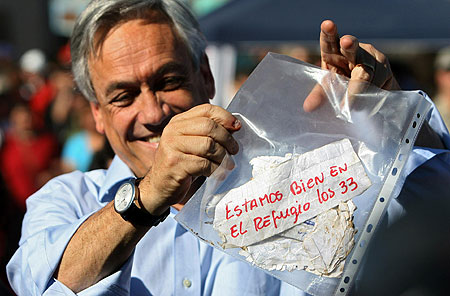
Backing up to August 5th, the day of the collapse, a single thought began to spread from the miners’ families to the community to the city to the country to the world: Oremos por nuestros hermanos, “Pray for our brothers.” On August 22, a note scrawled in red marker came to the surface: “We are fine in the shelter, the 33 of us.” The message was a glimmer of hope. And over the next several weeks, the glimmer turned into a beacon of hope shining in the depths of the earth.

That crucifix, that image of the suffering Christ, which descended to the living, was a physical representation of the hope that was already present in that shelter half a mile down. The persistent, unceasing prayers of the world – from the pregnant wife of miner Ariel Ticona to the bus driver coming off a double shift in Boston – sustained the hope of the miners. And so, in a fit of divine synchronicity, the Gospel reading for the Sunday following the miners’ rescue would, of course, begin like this: “Jesus told his disciples a parable about their need to pray always and not to lose heart.”

Rarely, if ever, in the Gospel does the writer tip his hand while introducing a parable. Every once in a while, the writer will explain a parable once the story is over. But most often, parables stand alone, with neither introductory material nor closing explanation to help the reader. Indeed, Jesus seems to enjoy speaking in parables for the simple fact that parables make his audience dig deep into his words and find meaning for their lives by searching for meaning in his stories. So, when Luke prefaces Jesus’ parable today with the story’s apparent meaning, we’d be justified in being a bit indignant toward our Gospel writer. Luke doesn’t give us the chance to figure this parable out for ourselves. He tells us the meaning of the parable like a teacher going over the answers to a test before passing out the exam.

But while our indignation toward Luke might be justified, I think we should let him slide just this once. He has our best interest in mind, after all. Luke doesn’t want us to miss the meaning of this story because living out this parable makes our lives fundamentally better. Living out this parable helps us live lives full of God. “Jesus told his disciples a parable about their need to pray always and not to lose heart.” To pray always and not to lose heart. In other words, the story is about praying always and never giving up, or to put the meaning in positive terms, to have the stamina and fortitude to pray persistently and to hope all the time.

We’ve seen over the last seven weeks in Chili that prayer and hope are linked together. In the midst of disaster, prayer and hope rose to the surface and sustained the people affected by the mine’s collapse. Now, let’s be clear. We use the word “hope” for simple, everyday situations such as “I hope the train is on time” or “I hope this week’s episode of Glee is better than the rest of the season, which has been pretty dreadful.” This everyday use of “hope” is of a different magnitude than the hope we are talking about here.

Hope (you might call it capital “H” hope) is the active component of not losing heart. In a world that excels at distracting us from following Jesus Christ and seducing us with the ease of apathy, hope keeps us relying on God to direct us down the right paths. Hope in God allows us to take the long view of our own futures, trusting that God, like a master chess player, has already seen twenty moves ahead. Hope in God opens us to possibilities for our lives that the urgent need of now simply dismisses offhand. Hope in God tells us that God will never lose heart in us, and therefore, we should never lose heart in God.

Hope is the active component of the heart’s steadfastness, and prayer is the active component of hope. Prayer nurtures hope by reminding us that, despite the world’s distraction and seduction, God is present. The Catechism at the back of the Book of Common Prayer says this about prayer: “Prayer is responding to God, by thought and by deed, with or without words.” Notice how this definition adds much needed depth to the popular understanding of prayer. The popular understanding simply makes God the recipient of our prayers: if I pray for my cat to stop scratching me, and the next day she does anyway, I am liable to think that God is not present. But the Catechism’s definition goes back a step in the process of prayer. Prayer is “responding to God.” Therefore, each and every time we pray, we are participating in the life-changing act of acknowledging that God is present in our lives. God calls prayer forth from us. We respond by praying. Each time we enter this exchange of call and response, God fuels our hope with God’s steadfast and eternal presence.

This is why Jesus tells the disciples a parable not just about the need to pray, but the need to pray always. A continuous life of prayer, of response to God, offers us continual awareness of God’s presence. This awareness leads to hope, which, in turn, enables us to live lives open to all of God’s possibilities and to trust in God’s directing creativity.

The widow in the today’s parable exemplifies this need for continuous perseverance and dedication. She keeps coming to the judge, and, in the end, her persistence pays off. Her unwavering commitment to obtaining justice moves the judge, who grants her request simply to get her out of his hair. If she had gone to court once, been dismissed, and never returned, the judge wouldn’t have given her a second thought. But her persistence changes her situation.

This persistence, this dedication to a life of prayer changes our situations, too. Like the persistent widow, our commitment to prayer signals our commitment to respond to God in every situation. The more we commit to prayer, the more apt we are to invite God into our lives and our decision-making. And opening ourselves to God’s presence allows us to soak up the hope that radiates from God’s movement in our lives. Seen from this angle, prayer works very much like food. If your mom or your husband calls you downstairs for meatloaf, you don’t call back, “No thanks. I ate last month.” Prayer leads to openness and trust and hope in God only when we integrate prayer into our daily lives.

The miners surviving 2,300 feet below the surface fed off of the hope generated by God’s presence, a presence proclaimed by the vast multitude of prayers descending on Chili from around the world. Upon his rescue, miner Mario Sepulveda spoke haltingly about his own persistence and hope: “I was with God and I was with the devil, but God won. I held onto God’s hand, the best hand, and at no point in time, how do I explain this, at no point in time, did I doubt that God would get me out of there.”

Sepulveda’s persistent awareness of God’s presence allowed him to survive for 69 days beneath the earth. The parable of the persistent widow teaches us that a life of prayer leads to hope, and hope leads to renewed lives lived in the fullness of God. I invite you to enter into a life of prayer, to find the hope that proceeds from that life, and finally to share the joy of our hope in God with everyone you meet. This happened in Chili: Elizabeth Segovia, wife of trapped miner Ariel Ticona, did not lose heart that her husband would be rescued. She joined her prayer with the prayers of millions. And halfway through the seven-week ordeal, she gave birth to a beautiful baby girl. And she named her “Esperanza,” which means “Hope.”

Note

Quotations and dates for the mine rescue from CNN.com.

Make believe

(Sermon for November 15, 2009 ||Proper 28, Year B, RCL || 1 Samuel 1:4-20; Hebrews 10:11-25)

Inigo Montoya, the Spanish hired sword who helped kidnap Princess Buttercup, is losing his duel with the Man in Black. The fight has ranged all over the rocky terrain at the precipice of the Cliffs of Insanity. The two swordsmen had both begun left-handed, but have switched to their dominant hands when they recognized the masterful fencing of the other. Thrust. Parry. Riposte. The Man in Black acrobatically flips off the ruins. Inigo stares at him, clearly amazed: “Who are you?” he asks.

inigoandwestley“No one of consequence,” replies the Man in Black.

“I must know,” pleads the Spaniard.

“Get used to disappointment.”

The fight continues, only to end a minute later with an increasingly flustered Inigo receiving a knock to the back of the head. And the Man in Black sprints off to track down the title character of The Princess Bride.

Get used to disappointment. Sounds like quite sensible advice. Sounds like the Man in Black has been around the block a few times. Sounds like he knows something about the ways of the world. However, this worldly wisdom is often counterproductive to a life of faith. The Letter to the Hebrews urges us this morning to “hold fast to the confession of our hope without wavering, for he who has promised is faithful.” In a world that teaches us to “get used to disappointment,” holding fast to our hope can be so very difficult.

Our inoculation begins at an early age. Children enter life with bright, wide eyes and unbounded, unfettered imaginations. Every couch cushion is a stone in a castle under siege by the invading hordes who desire nothing more than to pillage your kingdom. Every bath is a deep-sea expedition to find the lost city of Atlantis. Every day is another chance to see a unicorn. But before long, we start getting used to disappointment. We are told that couch cushions are for sitting, baths are for bathing, and there’s no such thing as unicorns.

I remember my mother shouting: “Young man, there are no dinosaur bones in the backyard. Stop digging up my flowerbeds.” But what she didn’t know was that my imagination was equipped with ground-penetrating sonar and that there was an intact velociraptor skeleton just underneath the gardenias. It was the find of the century. Any moment, Richard Attenborough was going to land in a helicopter and whisk me off to Jurassic Park. (I don’t mean to rag on my mother – she always cultivated her children’s imaginations as long as we left her flowers alone.)

But in the grand scheme of things, from the moment we are born, our imaginations do nothing but shrink as our understanding of so-called reality grows. Only a few people make it to the major leagues or become astronauts or famous singers. But children always start out dreaming about these things. Do you know anyone at age six who wanted to be a CPA?

As we get used to disappointment, our ability to imagine new worlds wanes. The trouble is that hope exists in the imagination’s ability to frustrate the enclosing nature of the so-called “real” world. We are made in the image of God; therefore, our imagination connects us to the creative spark of our Creator within each of us. And hope resides in this spark. As mounting disappointment attempts to snuff out our imaginations, we encounter great difficulty in accessing the hope, which our Creator installed in us.

In this morning’s lesson from the Hebrew Scriptures, Hannah has gotten used to disappointment. She has no children, and her husband’s other, very fertile wife, provokes her on this account. Every year, when the family goes up to the house of the Lord to sacrifice, Hannah weeps and does not eat because of her situation, which is made all the more humiliating by Penninah’s taunting.

But Hannah does not let her disappointment snuff out the hope she has in the Lord. Hannah goes to the temple and asks God to remember her. She pours out her soul before the Lord. She prays so fervently that Eli, the priest, supposes she’s drunk. But no: Hannah is only anxious and vexed. She still believes that God continues to be present in her life, despite the worthlessness, which the world tells her she should be feeling. Hannah combats her own disappointment with the hope that she still has in God to act in her life. Soon God remembers Hannah. She bears a son named Samuel, and he grows up to be the prophet of the Lord.

Hannah’s devotion and perseverance serve as a model for the words of the Letter to the Hebrews. Hannah approaches God “with a true heart in full assurance of faith.” And she “hold[s] fast to the confession of our hope without wavering,” for she knows that “he who has promised is faithful.”

We, too, hold fast to the confession of our hope because he who has promised is faithful. Too often, we think that our faith in God needs to sustain us. We think that if we had been just a bit more faith, everything would turn out the way we want and there’d be no more disappointment. But our faith is a wavering, sporadic thing. If we had to feed on our faith alone, we would have starved long ago.

But Hebrews urges us to reorient our understanding of faith. Our wavering, sporadic faith in God pales in comparison with the ultimate reality that God is the faithful One. God keeps God’s promises. God is the rock upon which our disappointments shatter. We do not manufacture our faith. Faith is not self-centered. Faith is God-centered, and God invites us to step into the reality where our faith is as constant as God’s. The confession of our hope proclaims that this reality exists and that we will encounter its utter joy when we finally and fully enter God’s eternal presence.

We believe that this happens in the power of the resurrection when we pass from life through death to new life. But the confession of our hope does not merely cast our thoughts to the life beyond death. Remember, hope exists in the imagination’s ability to frustrate the enclosing nature of the so-called “real” world. This real world is full of disappointments, but it doesn’t have to be. While we may never find the lost city of Atlantis or see a unicorn, concrete disappointments, which may be better termed “crises,” abound in our world.

But God has blessed us with hope-fueled imaginations. God has blessed us with the mission, as Hebrews says, “to provoke one another to love and good deeds.” God has blessed us with the resources to feed and clothe everyone in this world. We must only provide the will. We must only get over our own disappointments and harness the hope that God’s own faith makes real in our lives.

When we were children, the magical words “Once upon a time” lost their luster when we heard their counterparts: “Sweetheart, it’s only make-believe.” But I say to you that we have the opportunity, we have the imagination, we have the will to change this world for the better. Because God keeps God’s promises, we are able to keep our promises. We are able to make a difference in people’s lives. We are able because God’s own faithfulness makes us believe.

Hope near the fourth jumbotron

We arrived on the Mall in the predawn chill after a two hour power walk from 24th and M. During the walk, we passed pairs of camouflaged soldiers at each cross street, a siren-blaring police car from the DC public library (?), and hundreds of vendors hawking T-shirts, hats, keychains, and copies of the Washington Post. Since we were ticketless, my friend and I walked west along Independence Avenue looking for a numbered street with access to the Mall. At 12th Street, we turned right. A block later, we spilled out onto the Mall with 1.8 million of our closest friends. Over the next hour, we threaded our way through the ever-growing crowd and staked our claim on a few square feet of dirt four jumbotrons back.themall

As dawn turned to frozen morning, the sun rose from behind the Capitol dome and shone on the sandstone tower of the Smithsonian Castle off to our right. As the morning wore on, we sang and danced to the recorded concert playing on the big screens, ate granola bars, contemplated trying to make it to the porta-johns and back again, listened to the conversations around us, and wondered just how many mobile phones were vying for the closest tower’s signal. 9:00am. 10:00am. We were cold, muscle-cramped, footsore, buffeted by the crowd. But we were there, and none of our discomfort mattered.

The Marine Corps band (whose brass players I’m sure had the coldest mouths in Washington) played march after march as important people trickled onto the Capitol steps. As their importance grew, so did the crowd’s excitement. My friend and I played a game of name-that-politician (we weren’t very good). Flag-wavers practiced their craft with Jimmy Carter and the Clintons. A few ungenerous souls in the crowd booed as the soon-to-be-former president made his way on stage. Most applauded, but out of respect or relief, I couldn’t tell.

As the moment of the Obamas’ arrival neared, the Mall fell nearly silent, as if all 1.8 million of us held our breath at the same time. They appeared, and the Mall erupted with cheering, whooping, weeping, and the outpouring of all the emotion of decades and centuries of indefatigable expectancy.

In that moment and the moments to follow, I discovered an untapped well of hope inside myself. Hope, Paul tells us, along with faith and love, abides. Hope catalyzes the imagination. Hope furnishes a future for faith and love. Hope is the expectation that the boundaries of possibility are always far wider than we can perceive. On Tuesday at 12:05pm, I felt those boundaries expanding, closed my eyes, and thanked God.

President Obama spoke of a “less measurable but no less profound” indicator of the crises we face: “A sapping of confidence across our land — a nagging fear that America’s decline is inevitable, and that the next generation must lower its sights.” As a member of that next generation, I’ve felt that nagging fear, I’ve sighed and shaken my head too many times, I’ve disengaged. Sure, I’ve done “my part” — recycled, used CFLs, donated food and clothing. But those acts always felt insignificant, tokenistic, like I was trying to take down an aircraft carrier with a .22 caliber pistol. I did “my part” not with hope, but with the memory of what hope once felt like.

After Tuesday, however, I feel like “my part” has transformed and grown and coalesced into “our part.” “On this day,” said President Obama, “we gather because we have chosen hope over fear, unity of purpose over conflict and discord.” Hope and unity. How fundamental to the fabric of our lives as God’s children are these things. God reveals the power of unity to us in the perfect, rhythmic dance of three person’s in one God. Jesus reveals the power of hope to us in the resurrection, by which he overcame the sting of fear and death.

After my friend and I escaped the mad press of people leaving the Mall, we circled back to 24th and M by way of the frozen Potomac River. I was still cold, muscle-cramped, and footsore. But that untapped well of hope was warming me, flooding me with renewed purpose and energy. I had forgotten how good it feels to hope, forgotten that there was a time before I was beset by that nagging suspicion of our deterioration. As we tramped up the last block from L to M, I remembered the closing moments of The Shawshank Redemption. Andy Dufresne, recently escaped after 19 years of incarceration in a Maine prison for a crime he did not commit, writes to his friend: “Remember Red, hope is a good thing, maybe the best of things, and no good thing ever dies.”