Sermon for Sunday, March 22, 2026 || Lent 5A || John 11:1-45
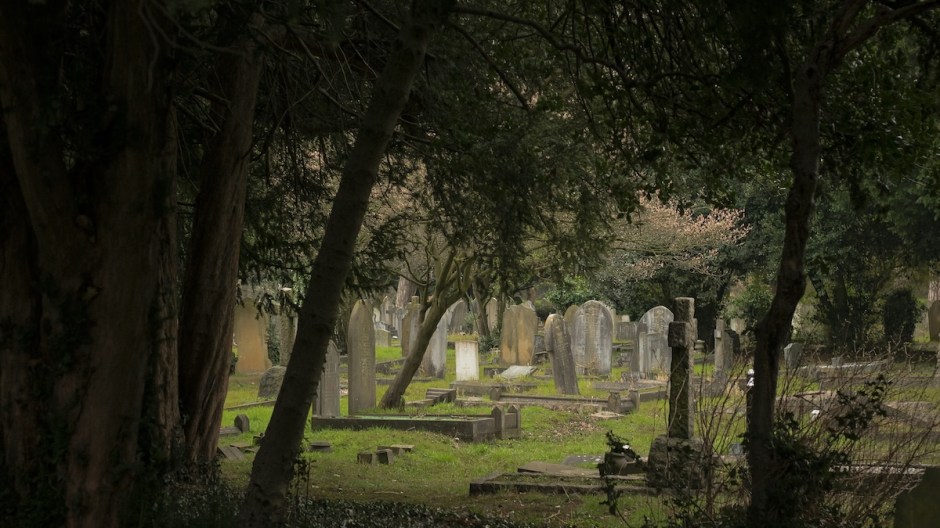
Today’s sermon is about the promise of the resurrection. And we’ll start today at a windswept cemetery as a funeral comes to end. The prayers have all been prayed. The earth has been cast on the shining, glossy coffin. The low murmur of voices mingles with the whisper of the wind through the long, cemetery grass. The new widow rises from the velvet-covered folding chair, the triangle of the blue field and white stars of the American flag peeking out from under her arm. A line of black-clad people forms, and they begin to file past her. You watch her receive with grace each well-meant, but well-worn sentiment. You join the line, and soon it’s your turn. You grasp her hand in both of yours and wait for the words to come.
Sermon for Sunday, November 9, 2025 || Proper 27C || Luke 20:27-38
Jesus’ words to the Sadducees in today’s Gospel are words that speak of the sublime mystery and majesty of God. I’m so excited that we got to hear this story today because Jesus’ words light my theological imagination on fire. We’re going to spend all of today’s sermon in my theological imagination as we envision as best we can our way into God’s point of view. None of us is really qualified to talk about God’s point of view, so you’ll have to take everything I say today with a grain of salt – or as a professor of mine used to say, “with salt mine.” In the next few minutes I might say something that is true, but if I do, it will have been by accident because what I’m really going to talk about is Adam’s point of view about God’s point of view. But maybe the Holy Spirit will help us glimpse the corner of the edge of the majesty of how God sees things.
Sermon for Sunday, May 11, 2025 || Easter 4C || Psalm 23
Today, on this beautiful Sunday morning in springtime, when plants are growing and animals are having babies, we’re going to talk about…death. Now, as you can probably tell, I am not dead. So I have no special information to impart to you about what happens after we die. I have only my hope in the resurrection, that the essence of who God created us to be embraces new and abundant life in a way that we cannot even imagine in the midst of our physical existence. I have only this hope in the resurrection and my faith in the promise that Jesus makes to prepare a place for us and bring us to himself, so that where Christ is, we may also be.
During my sabbatical, I’m not writing new sermons, so on Mondays I am choosing one post from every year of WheretheWind.com to highlight. In 2023, my church was in the midst of an unprecedented number of deaths and funerals in the parish. This sermon was a response to that reality and is now one of the most often viewed posts on this website.
Sermon for Sunday, March 19, 2023 || Lent 5A || John 11:1-45
(Part Four of Sermon Series on John 3:16 – Part One – Part Two – Part Three)
Today we finish up our sermon series on John 3:16 – “For God so loved the world that he gave his only Son, so that everyone who believes in him may not perish but may have eternal life.” Three weeks ago, we talked about God loving every nook and cranny of creation. Two weeks ago, we said that God gave the gift of God’s only son to show us how to enter into the story God is telling. Last week, we looked at the concept of belief as “abiding in relationship” with Jesus. And that brings us to the final phrase of John 3:16 – “may not perish but may have eternal life.”
Sermon for Sunday, January 29, 2023 || Epiphany 4A
On this day of our Annual Meeting, I’d like to spend this sermon time fulfilling a request from a number of people over the last few months. Today, I am going to share with you some of the elements of the funeral homilies I have preached over the last year. Because funerals are mostly attended by family and close friends, very few of the members of our church have heard me preach at a funeral. And yet we are all grieving in one way or another the deaths of so many of our church family – 23 of whom we have buried in the last year. A funeral homily is my chance to set the life (and new life) of the person who died within the greater context of the resurrection of Jesus Christ. So today, on this day of our annual gathering, we are going to remember those who have died, and I am going to share with you some thoughts on heaven and the eternal love of God.
Sermon for Sunday, February 19, 2017 || Epiphany 7A || Matthew 5:38-48
Just today and next week left in our Epiphany sermon series in which we are imagining our way into God’s eyes and trying to see ourselves as God sees us. God sees, names, and celebrates us as beloved, befriended, gifted, blessed, and enlightened. Last week we talked about God designing us to be unfinished products, always ready for further growth as we love and serve the Lord. So it might surprise you that we return to God’s point of view today and see that God also names us “finished.” How can we be both finished and unfinished at the same time? Well, this is one of those experiences of both/and reality so common where God is concerned.
More than any sermon in this series, I am least qualified to talk about this one. In the next few minutes I might say something that is true, but if I do, it will have been by accident because what I’m really going to do is talk about Adam’s point of view about God’s point of view. It springs from Jesus’ command at the end of today’s Gospel: “Be perfect, therefore, as your heavenly Father is perfect.” In other words, be complete, be your entire self, be finished. Now from our own point of view, it is impossible to be our entire selves, to be finished as it were, because we still have many days ahead of us. But God’s point of view is, I think, entirely different.
Sermon for Sunday, February 21, 2016 || Lent 2C || Philippians 3:17–4:1
Last fall, I had to renew my passport before my trip to Haiti with Tim Evers. I had originally gotten my passport in advance of a choir trip to England back in college in 2003, and that first document was still valid when Leah and I went to South Africa for our honeymoon in 2011. But they’re only good ten years, so in the fall of 2015, I found myself stapling an unsmiling picture to an application I picked up at the post office. I filled in all the information – name, address, social security number. I checked the box marked “U.S. Citizen,” dropped the package in the mail with the processing fee, and a few weeks later, received my new passport.
The trip back and forth to Haiti went swimmingly. The government agents stamped my shiny new document and welcomed me to Port-au-Prince and New York City, respectively. All was well until this week when I read the lessons for today. All was well until I realized that I lied on my passport paperwork. I checked the box marked “U.S. Citizen.” I checked that box because I was born in the great state of Maine, and I have the birth certificate to prove it. But the Apostle Paul claims something else for me: “Our citizenship,” he says, “is in heaven.”
Reading those words this week knocked my socks off. Our citizenship is in heaven. Not some time in the future. Not after we die. Paul doesn’t say, “Our citizenship will be in heaven.” No. Our citizenship is in heaven. Take a few breaths to let that sink in.
If we believe our passports our wrong; if we believe we are citizens of heaven, then we can take this imagery one of two ways. First, we can extend the metaphor and claim to be resident aliens here on earth. We have green cards, but this isn’t really our home. Our home is in heaven, and we’ll get there someday and be reunited with those we love who have gone home before us. This idea of heaven brings comfort and hope and peace, especially when life here on earth lurches towards the intolerable.
This idea of heaven finds expression in so many African-American spirituals, which have their roots in the horror of slavery. “Deep river, my home is over Jordan.” “I’m goin’ home to be with Jesus, since I laid my burden down.” “Swing low, sweet chariot, coming for to carry me home.” What better way to combat the misery of enslavement than to sing about one’s true home, a home that can never be bought or sold or taken away? What a sense of power enslaved people must have felt to be able to claim citizenship in heaven?
This legacy of hope and consolation – this balm in Gilead, so to speak – is the positive side of thinking of heaven as a home we are heading towards. But there is a negative side, as well. During the Industrial Revolution, the notion of heavenly citizenship began meandering down a long path towards environmental apathy. “We don’t really belong here on this planet,” this thinking goes, “so we need not take care of it.” This poor judgment had little effect on the environment until we got really good at polluting. But now the idea of heavenly citizenship is oftentimes weighed down by indifference for the earth and for generations yet to come. This is especially true in the United States where heavenly citizenship and American individualism collide.
Both the positive balm in Gilead and the negative environmental apathy find their roots in the idea of heaven as somewhere else. Somewhere better and new, and often “up.” Along with this idea of heaven as a home over Jordan, we can also think of our heavenly citizenship in another way. Here we must think of heaven not as a place, not as a location, but as the full and all-encompassing presence of God.
Now suddenly heaven is not just somewhere we go when we die; heaven is the kingdom of God breaking into this reality. Heaven is the name for the reality we strive for when we pray the Lord’s prayer, a prayer that is decidedly about now, today. “Thy kingdom come, thy will be down, on earth as it is in heaven.” In other words, “May thy reign, O Lord, be so present and so participatory that we can’t tell the difference between heaven and earth.” This is our prayer, and we pray it everyday to remember where our citizenship lives: in the full and all-encompassing presence of God. That’s our true home.
And that home is here. The full and all-encompassing presence of God is all around us, within us, permeating and sustaining creation. You may have felt this presence in your life. You may have stumbled into it one day when you least expected it and needed it most. You may have encountered this presence and not known what to name it. Its name is heaven, and it happens more than we realize.
When you see someone in need, and your heart trembles, urging you to reach out with open arms, then heaven is close by, the presence of God is calling you home – this home that is not up or away, but deeper in. Deeper in relationship. Deeper in solidarity. Deeper in love.
When you look out at an eagle in flight, and for a moment you are struck by the incredible closeness of your son who has passed away, then heaven is close by. Your loved one is awash in the full and all-encompassing presence of God. And for an elusive minute you realize you are there, too. And so you two are close again, and the barrier of death seems ever so flimsy.
When you fall to your knees in thanksgiving or in fear or in mourning or in joy, and your soul whispers to you that you are not alone and that you are loved beyond measure, then heaven is close by. It’s only our frail and limited perception that keeps us from seeing the home of our true citizenship breaking in all around us.
Living into our heavenly citizenship combines these two understandings of heaven: first our hope of future consummation and bliss in our home across the Jordan, and second our awareness of the immediate presence of God, which through us, continues to bring heaven closer to earth. There will never be true heaven on earth until all people and all things are fully reconciled to God. Put another way, there is no way for some of us to experience true heaven in the here and now. Either everyone does or no one does. If there is even one person living in hell on earth, then heaven is not fully realized this side of the Jordan.
These may seem like abstractions, like pie-in-the-sky theology that will never, ever in a million years become a reality. And yet, as followers of Jesus Christ, we live each day with the willing expectation that heaven on earth will come to fruition. And in so doing, we make it more real. We live our heavenly citizenship. Thy kingdom come, thy will be done. We pray this daily because we are a people of hope.
And if there’s one thing I hope for more than any thing else, it is this. That every person on this planet, when their earthly journeys are done, might swim across the Jordan, back home to the full and all-encompassing presence of God, and have this one thought on their minds: “I think I’ve been here before.”
(Sermon for Sunday, November 10, 2013 || Proper 27C || Luke 20:27-38)
Today, I’d like to speak with you on a topic I’m entirely unqualified to talk about. No, it’s neither mortgage-backed securities nor the sport of cricket, though I’m definitely unqualified to talk about each. Nor is the topic the mysterious reasons for why my wife’s apple pie is so much more delicious than the ones I used to make. I know that one has something to do with butter, but that’s as far my understanding takes me. No, today I’d like to speak with you on a topic that no one besides Jesus has ever been qualified to talk about. I’d like to speak with you today about God’s point of view.
Because I’m unqualified to talk about this topic, you’ll have to take everything I say with a grain of salt. In the next few minutes I might say something that is true, but if I do, it will have been by accident because what I’m really going to do is talk about Adam’s point of view about God’s point of view. But maybe, just maybe, the Holy Spirit will help us glimpse the corner of the edge of the majesty of how God sees things.
So with those caveats aside, let’s listen in to the end of Jesus’ conversation with those wily Sadducees in today’s Gospel reading. They thought they could embarrass Jesus with a trick question, but in characteristic fashion, Jesus answers the question he wishes they had asked, not the one they’d actually asked. He finishes with these words: “The fact that the dead are raised Moses himself showed, in the story about the bush, where he speaks of the Lord as the God of Abraham, the God of Isaac, and the God of Jacob. Now he is God not of the dead, but of the living; for to him all of them are alive.”
Here Jesus references the third chapter of the book of Exodus, in which God says, “I am the God of your father, the God of Abraham…Isaac, and…Jacob.” Jesus notices that God doesn’t say, “I was the God of your father…” From our limited point of view, Abraham, Isaac, and Jacob are long dead – somewhere in the neighborhood of three thousand years ago, or about a thousand years in Jesus’ day. But God, says Jesus, sees things differently, as his emphatic end to the conversation demonstrates: “Now he is God not of the dead, but of the living; for to him all of them are alive.”
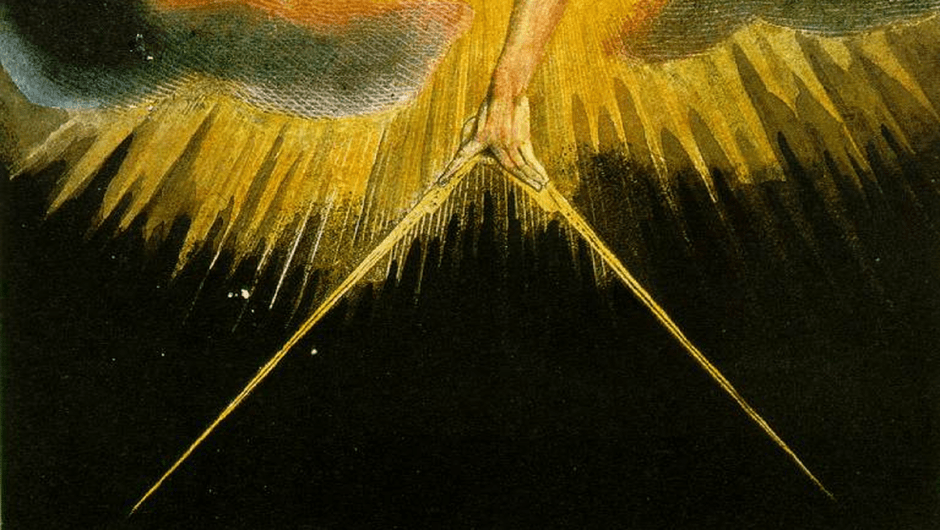
William Blake, Ancient of Days
This is our first glimpse into God’s point of view: “to God all of them are alive.” Can you imagine what that must be like for God? All of creation from the moment that moments began alive all at once. Every star that died billions of years ago, but whose light is just reaching us now; every single-celled organism gliding through the primordial ooze; every person we have ever loved and every person we have never known; all of them alive to God, all of it happening now for God.
I don’t know about you, but I get a little dizzy just trying to comprehend this thought – the riot of color and sound, the collision of what we see as the past and future, the unmeasured light years of space and uncounted eons of time all seen now by God, all spoken into being now by God, all loved and cherished now by God.
We can’t ever hope to comprehend this thought because we live our lives in linear fashion, moving moment to moment. We have memories of the past, and we have hopes for the future. Yesterday happened yesterday. It’s not still happening today. This linear model is like flipping through the pages of a magazine. Once I’ve flipped from page 35 to 36, I’m no longer looking at page 35. But from God’s point of view, the magazine is a collage of all the pages, with each picture cut out and arranged just so, like an elementary school art project.
This thought comforts me. From God’s point of view, I’m not simply Adam as I stand here before you: two months until his 31st birthday, his mother visiting from North Carolina, his sermon moving along apace. No. From God’s point of view, I am the totality of myself: everything that has ever happened, everything that will ever happen, every joy, every regret, every skinned knee, every embrace, every relationship, every failure, every triumph – everything that makes me the person I am, God sees and God speaks into being. This totality of myself includes my death and whatever there is in what we would call “After,” but what God still sees as “Now.”
The apostle Paul understands the difficulty of speaking about God’s point of view, and he says what I’m trying to say much better than I ever could. He says these words to the church in Corinth: “For now we see in a mirror, dimly, but then we will see face to face. Now I know only in part; then I will know fully, even as I have been fully known” (1 Cor. 13:12).
To be fully known. This is how God’s point of view works. God knows us fully. God knows the totality of each of us, just like God sees the entirety of creation happening now.
Speaking about God’s point of view has the unfortunate byproduct of making us feel so small, even insignificant. It’s only natural in the face of the idea that all of creation is always present to God to think that we don’t matter, that in the grand cosmic scale our lives are worthless.
But from God’s point of view, nothing could be farther from the truth. God couldn’t care less about the “grand cosmic scale” because the notion of a “scale” of any kind is meaningless to our eternal and infinite God. God speaks every subatomic particle into being and celebrates it as if it were the only speck in existence. Each speck has God’s full attention; if it didn’t, it would cease to be.
We may look up at the night sky and see ourselves as small, insignificant specks on a small, insignificant planet orbiting a small, insignificant star. But to do so is to deny the truth not just about ourselves, but about all of creation. All of creation is present to all of God. This includes you and me. If God weren’t constantly and continuously speaking each of us into existence, we would cease to be.
So if we are anywhere in the ballpark of the truth of God’s point of view, what does this all mean for us? Too many things, of course, to close this sermon with, so we’ll look at three – what we call past, present, and future, but each of which is always now to God.
First, the past and our grief over people dying: From our perspective, the sun sets below the horizon. But in reality, we are spinning away from the sun. Likewise, we grieve when someone dies because, from our perspective, that loved one is gone. But we know in a place deeper than normal knowing that, in reality, our loved one is still alive to God. Ultimately, grief is a way to express our frustration that we have a severely limited ability to perceive reality. But for anyone who has ever had a loved one die, you know that every now and again, you catch glimpses of true reality when you feel the presence of that loved one alive in a different way.
Second, the present: Since God is fully present to every particle of creation, which includes each of us, we have no business thinking of ourselves or anybody else as insignificant. Everyone matters, so we must affirm this in our actions.
Third, the future: Those we perceive as future generations are as alive to God as we are. Therefore, it is our duty to honor their significance in the same way we are called to honor those we meet today. This means making choices in our personal and communal lives that sustain our world, which, in the end, is another piece of creation fully present to God and therefore worthy of our honor.
So there you have it. I have now talked for more than ten minutes on a topic I’m entirely unqualified to speak about. However, being unqualified does not mean that we shouldn’t strive to see creation through the eyes of God. When we do this, we become better stewards, better servants, better followers. And we see deeper into the heart of what it means to be a child of God.
(Sermon for Sunday August 11, 2013 || Proper 14C || Luke 12:32-40)
C. S. Lewis once said, “Aim at Heaven and you will get earth ‘thrown in’; aim at earth and you will get neither.” He said this in a radio talk on the BBC during World War II, and it was later collected in a little book known as Mere Christianity. Lewis’s words aren’t meant as a threat or a platitude, but simply as the truth behind how we orient our lives. “Aim at Heaven and you will get earth ‘thrown in’; aim at earth and you will get neither.”
Zelda shooting a light arrow.
I suspect Lewis had today’s Gospel reading in mind when he spoke these words; well, more precisely, today’s reading plus the ten verses before it, which the framers of our reading schedule oddly decided to skip. The ones we jumped over are fairly well known: Jesus speaks of the lilies of the field, how they grow; and about the birds of the air, how God provides for them. All of this distills down to one simple request by Jesus to his disciples: “Don’t worry!” He goes on to say that God knows what we need, so we shouldn’t spend all our time and energy chasing after such things. “Instead,” says Jesus, “desire God’s kingdom and these things will be given to you as well.”
Or as C. S. Lewis paraphrases: “Aim at Heaven and you will get earth ‘thrown in.’” Of course, we’re talking about priorities again, as we did last week. Aiming at heaven, desiring God’s kingdom – this is the most important priority of our lives. All other priorities build from the sure foundation of desiring God’s kingdom, of being part of God’s dream of bringing all creation back to God. This is the foundation of our priorities because we would find it quite impossible to desire something greater or more eternal than this dream.
Think of it this way. When I was a child I dreamt of being a professional baseball player. (Well, a paleontologist baseball player who also got to drive the garbage truck, but let’s stick with baseball.) My big dream was catching the final out of the World Series while playing centerfield for the Boston Red Sox. My friends and I imagined that ninth inning of Game 7 every time we put on our gloves. Now, wouldn’t it have been a little odd if I dreamt of playing centerfield for Double-A Portland? Maybe more practical, but practicality holds no sway in dreaming. Much like our childhood aspirations, God invites us to dream big – to desire God’s kingdom above all else, to be part of the coming of that kingdom here on earth, and by doing so, to aim always for heaven.
Of course, the world about us entices and cajoles us to set our aims lower. “Heaven is too far away, too much hard work,” say the grumbling, demonic voices of this world. “It’s all pie in the sky, better to focus on the here and now,” they continue, louder and more confident. “You’re not good enough for God’s kingdom, anyway,” they finish with a flourish. These grumbling voices chorus with a multitude of reasons why we should set our aims lower than heaven, but we have limited time, so we’ll focus on these three common ones: laziness, worldliness, and unworthiness.
First: laziness. Ah, my old foe. Out of the three we’re looking at today, laziness has most often enticed me to aim at anything but heaven. I’ve tried to combat my lazy streak myriad ways. One is that a few years ago, I stopped describing myself as a Christian because the label didn’t cause me to act any different than I normally did. Instead, I started calling myself a “follower of Christ.” I chose to do this to remind myself that a follower does something: he follows. This has helped a little, but the old kneejerk laziness is still there. It’s just so easy, so seductively easy to drift through life without purpose or goal. It’s just so easy simply to shoot at the target rather than aim for the middle of the target.
But in today’s lesson, we followers of Jesus hear him tell us to “be dressed for action and have our lamps lit.” Be on the lookout for ways to shine the light of God’s kingdom in the darkness of this world. Be prepared to find God where you least expect it, but where God most needs to be proclaimed. This is the way to aim for heaven, and I assure you, despite the seductive ease of laziness, this is the way to live.
Second, worldliness – the secularist’s call to us spiritual types to get our heads out of the clouds, plant our feet on solid ground, and start using common sense. But what the secularist doesn’t understand is that engaging our uncommon senses fills our lives with joy and purpose. Still, worldly distractions make our aim wild. We worry too much about our security; not that security is bad, but we do tend to overcompensate. We stray too far to the “rich fool” end of the spectrum: he who in last week’s parable wanted to build even bigger barns to store all his stuff. The weight of this overcompensation pulls our aim lower.
But in today’s lesson, Jesus encourages his friends not to worry, but to sell their possessions and give to the poor. He reorients their aim and ours to heaven, where the treasure is unfailing. Your heart will be where your treasure is, he says, so desire to enshrine your heart in God’s eternal presence. The more our hearts soak up the radiance of God’s kingdom, the more generous we will be in the here and now, and the more we will spread that radiance ourselves.
Third, and most menacing: unworthiness. Aim at heaven, instructs C. S. Lewis. Desire God’s kingdom, says Jesus. And yet in a cold, dank corner of our minds, each of us has a small raspy voice endlessly intoning: “Not you…Jesus doesn’t mean you…you’re not good enough for heaven…you’re not worthy enough to spread God’s kingdom.” This feeling of unworthiness is so common and yet so far from God’s reality. It is a feeling that shackles us, that keeps us not just from aiming at heaven, but from aiming at all.
But in today’s lesson, Jesus intimates that worthiness has nothing to do with the equation. He says, “Do not be afraid, little flock, for it is your Father’s good pleasure to give you the kingdom.” Another translation says, “Your father delights in giving you the kingdom.” If God delights in this act of giving then God surely isn’t putting up barriers of worth that would keep God from showering the radiance of God’s kingdom on all people. The more we accept that God’s delight in us is what makes us worthy, the more we can participate in spreading the kingdom.
These three – laziness, worldliness, and unworthiness – can keep us from aiming at heaven. But Jesus Christ proclaims to us today that none of these has the power we think they do. The power lies with God, who delights in giving us God’s kingdom and hopes with all the radiance of heaven that we desire to receive the kingdom. When we do, we enter into the great, eternal dream that God has for all of God’s creation, and we join with God in making that dream a reality. So aim at heaven and you’ll get the earth thrown in.





 Last fall, I had to renew my passport before my trip to Haiti with Tim Evers. I had originally gotten my passport in advance of a choir trip to England back in college in 2003, and that first document was still valid when Leah and I went to South Africa for our honeymoon in 2011. But they’re only good ten years, so in the fall of 2015, I found myself stapling an unsmiling picture to an application I picked up at the post office. I filled in all the information – name, address, social security number. I checked the box marked “U.S. Citizen,” dropped the package in the mail with the processing fee, and a few weeks later, received my new passport.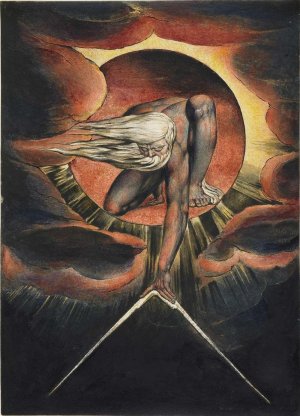


 Where the Wind...