Make believe

(Sermon for November 15, 2009 ||Proper 28, Year B, RCL || 1 Samuel 1:4-20; Hebrews 10:11-25)

Inigo Montoya, the Spanish hired sword who helped kidnap Princess Buttercup, is losing his duel with the Man in Black. The fight has ranged all over the rocky terrain at the precipice of the Cliffs of Insanity. The two swordsmen had both begun left-handed, but have switched to their dominant hands when they recognized the masterful fencing of the other. Thrust. Parry. Riposte. The Man in Black acrobatically flips off the ruins. Inigo stares at him, clearly amazed: “Who are you?” he asks.

inigoandwestley“No one of consequence,” replies the Man in Black.

“I must know,” pleads the Spaniard.

“Get used to disappointment.”

The fight continues, only to end a minute later with an increasingly flustered Inigo receiving a knock to the back of the head. And the Man in Black sprints off to track down the title character of The Princess Bride.

Get used to disappointment. Sounds like quite sensible advice. Sounds like the Man in Black has been around the block a few times. Sounds like he knows something about the ways of the world. However, this worldly wisdom is often counterproductive to a life of faith. The Letter to the Hebrews urges us this morning to “hold fast to the confession of our hope without wavering, for he who has promised is faithful.” In a world that teaches us to “get used to disappointment,” holding fast to our hope can be so very difficult.

Our inoculation begins at an early age. Children enter life with bright, wide eyes and unbounded, unfettered imaginations. Every couch cushion is a stone in a castle under siege by the invading hordes who desire nothing more than to pillage your kingdom. Every bath is a deep-sea expedition to find the lost city of Atlantis. Every day is another chance to see a unicorn. But before long, we start getting used to disappointment. We are told that couch cushions are for sitting, baths are for bathing, and there’s no such thing as unicorns.

I remember my mother shouting: “Young man, there are no dinosaur bones in the backyard. Stop digging up my flowerbeds.” But what she didn’t know was that my imagination was equipped with ground-penetrating sonar and that there was an intact velociraptor skeleton just underneath the gardenias. It was the find of the century. Any moment, Richard Attenborough was going to land in a helicopter and whisk me off to Jurassic Park. (I don’t mean to rag on my mother – she always cultivated her children’s imaginations as long as we left her flowers alone.)

But in the grand scheme of things, from the moment we are born, our imaginations do nothing but shrink as our understanding of so-called reality grows. Only a few people make it to the major leagues or become astronauts or famous singers. But children always start out dreaming about these things. Do you know anyone at age six who wanted to be a CPA?

As we get used to disappointment, our ability to imagine new worlds wanes. The trouble is that hope exists in the imagination’s ability to frustrate the enclosing nature of the so-called “real” world. We are made in the image of God; therefore, our imagination connects us to the creative spark of our Creator within each of us. And hope resides in this spark. As mounting disappointment attempts to snuff out our imaginations, we encounter great difficulty in accessing the hope, which our Creator installed in us.

In this morning’s lesson from the Hebrew Scriptures, Hannah has gotten used to disappointment. She has no children, and her husband’s other, very fertile wife, provokes her on this account. Every year, when the family goes up to the house of the Lord to sacrifice, Hannah weeps and does not eat because of her situation, which is made all the more humiliating by Penninah’s taunting.

But Hannah does not let her disappointment snuff out the hope she has in the Lord. Hannah goes to the temple and asks God to remember her. She pours out her soul before the Lord. She prays so fervently that Eli, the priest, supposes she’s drunk. But no: Hannah is only anxious and vexed. She still believes that God continues to be present in her life, despite the worthlessness, which the world tells her she should be feeling. Hannah combats her own disappointment with the hope that she still has in God to act in her life. Soon God remembers Hannah. She bears a son named Samuel, and he grows up to be the prophet of the Lord.

Hannah’s devotion and perseverance serve as a model for the words of the Letter to the Hebrews. Hannah approaches God “with a true heart in full assurance of faith.” And she “hold[s] fast to the confession of our hope without wavering,” for she knows that “he who has promised is faithful.”

We, too, hold fast to the confession of our hope because he who has promised is faithful. Too often, we think that our faith in God needs to sustain us. We think that if we had been just a bit more faith, everything would turn out the way we want and there’d be no more disappointment. But our faith is a wavering, sporadic thing. If we had to feed on our faith alone, we would have starved long ago.

But Hebrews urges us to reorient our understanding of faith. Our wavering, sporadic faith in God pales in comparison with the ultimate reality that God is the faithful One. God keeps God’s promises. God is the rock upon which our disappointments shatter. We do not manufacture our faith. Faith is not self-centered. Faith is God-centered, and God invites us to step into the reality where our faith is as constant as God’s. The confession of our hope proclaims that this reality exists and that we will encounter its utter joy when we finally and fully enter God’s eternal presence.

We believe that this happens in the power of the resurrection when we pass from life through death to new life. But the confession of our hope does not merely cast our thoughts to the life beyond death. Remember, hope exists in the imagination’s ability to frustrate the enclosing nature of the so-called “real” world. This real world is full of disappointments, but it doesn’t have to be. While we may never find the lost city of Atlantis or see a unicorn, concrete disappointments, which may be better termed “crises,” abound in our world.

But God has blessed us with hope-fueled imaginations. God has blessed us with the mission, as Hebrews says, “to provoke one another to love and good deeds.” God has blessed us with the resources to feed and clothe everyone in this world. We must only provide the will. We must only get over our own disappointments and harness the hope that God’s own faith makes real in our lives.

When we were children, the magical words “Once upon a time” lost their luster when we heard their counterparts: “Sweetheart, it’s only make-believe.” But I say to you that we have the opportunity, we have the imagination, we have the will to change this world for the better. Because God keeps God’s promises, we are able to keep our promises. We are able to make a difference in people’s lives. We are able because God’s own faithfulness makes us believe.


From arrogance to obedience

(Sermon for Sunday, October 18, 2009 || Proper 24, Year B, RCL || Mark 10:35-45)

Here we go again. A month has passed since my last sermon delivered to you. A chapter has passed in the Gospel According to Mark. And Jesus has passed through Capernaum on his way to Jericho and then on to Jerusalem for his final days. In the Gospel lesson four weeks ago, the disciples argued about which one of them was the greatest. In response, Jesus placed a small child in their midst and said to them, “Whoever wants to be first must be last of all and servant of all.” In today’s Gospel lesson, two of Jesus’ disciples, James and John, get a little more specific in their quest for greatness: “Grant us to sit, one at your right hand and one at your left, in your glory.” In response, Jesus repeats himself (I imagine, with some exasperation), “Whoever wishes to become great among you must be your servant, and whoever wishes to be first among you must be servant of all.” And so I say, here we go again.

The disciples exhibit the eminently human habit of forgetting everything Jesus has been teaching them. And we love them for their poor memories because we can relate. But Jesus matches their eminently human forgetfulness with eminently divine patience. Jesus could say, “Didn’t you take notes last month? No?! Well, then get them from someone who was paying attention.” Instead, Jesus reiterates his message and offers us the opportunity to dive more deeply into his words.

Don’t worry: I’m not going to repeat my sermon about the linear model turning into the circular one, and I’m not going to use any examples from fourth grade. Rather, today’s Gospel lesson, in conjunction with the other lessons, helps us explore the roots of the two models. The linear model, in which hierarchical disparity perpetuates a “me first, you last” attitude, finds its roots in presumptive arrogance. The circular model, in which relational expectations lead to a “you before me makes us better” attitude, finds its roots in unassuming obedience. Thus, the giving up of the linear model for the circular necessitates a move from arrogance to obedience.

Let’s look at arrogance first. James and John, the sons of Zebedee, preface their request with these words: “Teacher, we want you to do for us whatever we ask of you.” Right away, we know something is out of joint. The brothers attempt to get Jesus’ consent before they make their appeal known. Every parent out there knows that a child only employs this tactic if the request is unlikely to garner agreement. Earlier in the Gospel According to Mark, Herod makes the rookie mistake of swearing to his daughter to give her whatever she asks, and John the Baptizer turns up minus one head.

But Jesus makes no such mistake. He’s on to James and John from the start. “What is it you want me to do for you,” he says. Foiled in their search for premature commitment, the brothers soldier on and ask to sit on either side of Jesus in his glory. And here, Jesus exposes their arrogance by saying, “You do not know what you are asking.” In other words: You have no clue what you are talking about. Haven’t you been listening to me? Are you read to drink my cup? I’m about to die a gruesome death. This isn’t a Sunday stroll. If you knew what you were getting yourselves into, you would never have asked.

In their arrogance, James and John expect their request will be fulfilled on their terms. Sitting on Jesus’ right and left hands is as easy as asking him. The brothers do not contemplate the consequences of their appeal because, in their arrogance, they see none. Arrogance is a delusion of grandeur, a state of mind borne out of misplaced, narcissistic superiority. Arrogance assumes that the world works according to the expectations of the arrogant. But Jesus attempts to puncture the brothers’ delusion by reminding them of the very real consequences of their request. “Are you able to drink the cup that I drink,” he asks. Their terse reply of “We are able” shows more deluded arrogance – they are able to say the words, but their comprehension of the weight of those words leaves much to doubt.

The arrogant worldview, which conforms to the reality of narcissistic desire, has contributed to most, if not all, of the world’s worst sins: the enslavement and degradation of other races; the destruction of the environment for purposes of insatiable consumption; the apathy for the plight of others masked as laudable self-interest; the horror of war. In all of these, arrogance leads to the objectifying of some nebulous other in order to maintain the narcissistic reality. Everything is fodder, every person a pawn.

In today’s reading from the Hebrew Scriptures, God reminds Job that this deluded, arrogant worldview is far from reality. The writer does this in a rather snarky way, by having God interrogate Job on subjects, about which Job can know nothing. God says, “Where were you when I laid the foundation of the earth? Tell me, if you have understanding. Who determined its measurements – surely you know!” This continues for a few pages, but you get the picture. God reminds Job that reality and Job’s delusion of reality are two different things. The implication is this: only the arrogant assume they know enough about creation to substitute for the Creator.

God’s interrogation of Job calls us out of our arrogance. Of course, we weren’t there when God laid the foundation of the earth. Much like James and John, who arrogantly assume their own primacy, we often forget that we aren’t the centers of our own universes. When we accept the grace from God to look past our delusions, we begin to grasp the other way to live. We begin to see that our own narcissistic realities pale in comparison to the harmony, radiance, and joy of God’s reality. And we begin to realize that obedience to God is our participation in this reality.

The word “obedience” is much maligned, so we must quickly reassemble its meaning. Banish from your minds the thought of canine “obedience” school or the memory of a ruler to the back of your hand to teach “obedience.” Obedience relies neither on the carrot nor the stick because obedience exists on a plane apart from reward and punishment. True obedience comprehends listening for God’s call and having the courage to act on that call. Obedience is shorthand for “resonance with God’s movement.” When we are tuned to God’s presence, we vibrate with all the vibrancy that God’s love could offer to us.

But obedience is difficult because arrogance beckons and pulls us back to our easy, little realities. According to the Letter to the Hebrews this morning, Jesus had to learn “obedience through what he suffered.” Because of his suffering, because of his obedience, “he became the source of eternal salvation for all who obey him,” for all who desire to resonate with him.

This obedience, this resonance, finds its deepest expression in Jesus’ words to his disciples following James and John’s request. First, he reminds them of the arrogance of the world: the rulers of the Gentiles “lord it over them, and their great ones are tyrants over them.” The tyrant is the prime example of the arrogant worldview. “But,” Jesus continues, “it is not so among you; but whoever wishes to become great among you must be your servant, and whoever wishes to be first among you must be servant of all.” Then, he uses himself as a paradigm: “For the Son of Man came not be served but to serve.”

We serve because Jesus served. We resonate with Christ most readily when we are serving others, when we are looking upon that nebulous other and seeing not a pawn, but a companion. We move from arrogance to obedience when we include in our realities the people who don’t fit and the consequences that we ignore. As the shells of our realities fade to reveal God’s greater reality, we realize how small were the lives we lived in our arrogance. We discover, somewhat paradoxically, how much more freedom exists in our obedience.

In that freedom, we will find joy and suffering, especially as we look with love upon the other. In that freedom, we will find grief and hope, because both are antidotes for narcissism. In that freedom, we will find the faith of the One who calls us to obedience. And we will walk in the confidence of that faith as God continues to peal away our arrogance to reveal beautiful, resonant, radiant children of God.

Eternity happens

The following post appeared Saturday, September 19th on Episcopalcafe.com, a website to which I am now a monthly contributor. Check it out here or read it below.

* * *

‘Jesus said to them, “Very truly I tell you, before Abraham was, I am.” ’ (John 8:58)

You can always tell when Jesus says something truly sensational and scandalous because people respond by searching for rocks to fling at his head. The eighth chapter of the Gospel According to John contains four instances of Jesus saying, “I am,” which is one way Jesus imparts his divine identity to his listeners. Out of the four, only the final one elicits such a stony reaction, while the first three build to the climactic iteration. The escalation begins slowly when Jesus says, “I am the light of the world” (8:12). Next, Jesus says, “You will die in your sins unless you believe that I am” (8:24). Then, a few verses later, he says, “When you have lifted up the Son of Man, then you will realize that I am” (8:28). Each of these statements of his divine identity flies right over the heads of his opponents. But then the conversation intensifies. Jesus says they are from their father the devil. They think he may have a demon. He says no one will see death if they keep his word. They are sure he has a demon. He says Abraham rejoiced to see his day. Now they know that he’s crazy—he’s not even fifty! How can he have seen Abraham?

YHWHThen Jesus knocks their socks off with his most dangerous statement in the whole Gospel: “Before Abraham was, I AM.” This time, no one mistakes his meaning. No one asks him to clarify his words. They understand the full significance of saying, “I AM.” They know God said the same thing to Moses when Moses was brash enough to ask God for God’s name (Exodus 3). But underneath the shocking nature of Jesus’ statement is a subtler point (ultimately missed in the search for stones) about how our eternal God interacts with a finite creation.

Jesus’ “I am” statements in the Gospel According to John are revelations of God’s very being. Because of the simplicity of the sentence (just a subject and a verb), “I am” is as close as language can get to universality and eternity. Since we live in a temporal world, eternity is an impossible concept for us to wrap our heads around. Eternity is not “endless” time; nor is it the framework in which time finds a snug fit. In eternity, before and after are undefined and the only when is now. (The previous sentence makes no sense, of course.)

When Jesus says, “Before Abraham was, I am,” he uses our language to express the eternal nature of God. He does not say, “I was before Abraham was,” which is the grammatically correct way to articulate the thought. Instead, his  “I am” (while functioning in our world as a present tense construction) is really a representation of the eternal tense. In eternity, I AM is the only sentence that makes any sense at all. In other words, eternity happens. It didn’t start and it won’t stop because the notions of beginning and ending are thoroughly temporal. And eternity happens because God is.

We run into trouble when we expect God to exist in the same way we do. Our minutes tick by one after another. For every one of our actions there is an equal and opposite reaction. Objects fall at a rate of 9.8 m/s2. But those are our minutes, our reactions, our gravity, and they all rely on linear experience. When Jesus says, “I AM,” he reminds us that God created linear experience, and thus is not beholden to it.

When we stumble into God’s presence, we encounter eternity making utter nonsense of time. Time ceases to matter because eternity overrides the rules of linear experience. That’s why it’s so hard to say how long we feel the presence of God. We feel that presence in moments, not minutes. When Jesus says, “Before Abraham was, I am,” he pushes us to relinquish our need to order events when God is concerned. God exists in eternity, which just happens.

Footnote

* If you read my last contribution to EpiscopalCafé in conjunction with this one, you might deduce two things: (1) I like to use Holy Scripture to discuss spirituality and (2) I seem partial to the Gospel According to John. These deductions are both entirely correct. As a member of the Millennial generation, I am attracted to the Fourth Gospel’s combination of mystery and revelation. If you have a group of Millennials in your church (right now, that would be your middle schoolers through your college students, give or take) who huff and sigh and roll their eyes every time you pull out the Bible, try some passages from the Gospel According to John. You might encounter fewer glazed looks and drool-flecked chins.

Kairos in an instantaneous world

Remember how Christmas Eve was always the longest day of the year? Technically, it is one of the shortest, but it felt so long. I remember planning a full day’s worth of activities (mostly of the building-with-Legos variety) just so the day would go by faster. Now, the clock on the wall had no idea it was Christmas Eve. The minutes ticked by as they normally do. But the anticipation of Christmas morning made me think the clock was conspiring against me.

watchIn Greek, there are two major words for time. The first is chronos, which tends to be the word used for the time of day, or clock time. The second is a special word. Kairos is the kind of time that starts an old Disney fairy tale movie, “Once upon a time.” This special sort of time is Christmas Eve time, expectant time, the kind of time in which promises exist. It is time mixed somehow with eternity, which still slips away but in no predictable way—time that will come when it needs to.

Put another way, chronos is soccer game time, which ticks away even when the ball is out of bounds or a player is injured. The referees add extra time to make up for that lost during the game, but it always continues to tick. Kairos, on the other hand, is baseball game time. There is no limit to how long a baseball game can last: innings take as long as they need to. Kairos is the kind of time the song from Rent talks about—it is measured in cups of coffee and report cards and sunsets and love.

When Jesus says to his brothers, “My time has not yet come,” he uses this special word. Within the Gospel, Jesus lives in kairos, which is understandable considering where he comes from. In my walk with Jesus, I find I have trouble living in this kind of time. Contemporary society jackhammers into me over and over again the supposed benefits of an instantaneous world. And there are definitely real benefits, don’t get me wrong. But 0.14 second Google searches and overnight FedEx and cholesterol reducing pills can blind me to the ultimate reality that most good things are worth waiting for, are worth working for, are worth anticipating.

Jesus’ statement, “My time has not yet come,” reminds me constantly that Jesus doesn’t work on my timetable. He doesn’t clock in and out, with hours well documented on a punch card. He doesn’t respond to my prayers like Google does to my searches. But he does call me to slow down and experience the kind of time measured by the sun’s slow movement across the sky. He does ask me to anticipate his movement in my life with all the fervor of my childhood Christmas Eves. And he does offer me the faith to know that all prayers are answered one way or another.

If you are like me and need help keeping in touch with kairos in our instantaneous world, then try this. Sit down and take several deep breaths. Close your eyes and turn your attention inward. Keep breathing slowly, deeply. Without using your hand, see if you can feel your heart beating against your chest. Feel it? Dull squeezes to the left of your sternum. Small thumps against your ribcage. TUB-thp, TUB-thp, TUB-thp. This is where the rhythm of Jesus’ time resides in us. This is kairos.

Proclaiming the mystery: John’s first five

The following post appeared Saturday, August 22nd on Episcopalcafe.com, a website to which I am now a monthly contributor. Check it out here or read it below.

* * *

The mystery section was on the back wall of the small independent bookshop at which I worked my last few years of high school. When a customer entered the store, her eyes would glance past the smaller shelving units and fix on the placards proudly bearing the word “MYSTERY.” The shelves containing the mystery section were taller and broader than those holding the other books, and I was the only employee tall enough to dust the top ones without a stepladder. Let’s just say that the manager loved mysteries, so we had a disproportionate number of them. We had humorous mysteries and thrillers, beach reads and stay-up-till-one-in-the-morning nail biters. In those books, a mystery was set forth: say, how did the killer manage to murder someone in a room locked from the inside? The plot revolved around the detective attempting to solve the puzzle. In the end, the detective figured out that the bell rope used to call for the maid was replaced with a poisonous snake, which somehow slithered unnoticed out of the room in the ensuing hubbub of discovering the body. Mystery solved. No more mystery.

The Gospel according to John begins with a mystery, but it is a mystery that is wholly different from the Whodunnits? on the back wall of the bookshop. The mystery that begins the Gospel cannot be solved, cannot be explained away. It can only be unapologetically presented and then unabashedly proclaimed.

rainbowTake a look at the first five verses that John gives us:In the beginning was the Word, and the Word was with God, and the Word was God. He was in the beginning with God. All things came into being through him, and without him, not one thing came into being. What has come into being in him was life, and the life was the light of all people. The light shines in the darkness, and the darkness did not overcome it. (1:1-5; NRSV)

Here John presents the mystery: somehow the Word (who we find out a few verses later becomes enfleshed in Jesus Christ) is in the beginning with God and is also God. Remember in Algebra class when you had to show your work to get full credit? Well, John skips down to the bottom of the page. There is no balancing of equations or solving for “x.” He states the mystery simply: in the beginning, the Word was with God and was God. This is frustrating at first because I’m conditioned to think that mysteries are all supposed to be like the ones on the back wall of the bookshop. I want to know how it’s possible and I won’t be satisfied until I figure it out and if I can’t figure it out then it must not be true.

But I take a deep breath and look at the words again. I read them slowly and speak them aloud. I notice that the rational part of me is sitting in the corner sulking because “with” and “was” should be mutually exclusive. But I find that the creative part of me sees past such mundane things as mutual exclusivity and begins to roll around in the muck of ambiguity. I squelch my toes in the mud, relishing the notion that God lives in a reality where choosing between alternatives is not the only viable option. Of course the Word can be both with God and was God! The limits of my language do not limit God, only my understanding of God. I realize my language skills are not up to the challenge of describing God. And my rational side joins my creative side in the muck of ambiguity because my rationality has been given the license to imagine.

In a few short phrases, John presents the mystery. Then, he deepens the mystery by retelling the story of creation. It’s no coincidence that John uses the same phrase that opens the book of Genesis: “In the beginning.” All things came into being through the Word who was with God and was God. My creative side connects with these verses because they are about creation. Life is created through him, and because I have been given the gift of creativity, I can sense in my gut or in my bones that the Creator is continuing to create me.

This creative force is the light that shines in the darkness. The darkness cannot comprehend or overcome or understand the light because the darkness has never been a part of creation. The darkness is just the absence of any created thing. It tries jealously to unmake created things but fails to triumph since God never stops creating or calling creation to God.*

In these first five verses, John locates us (“life,” “all people”) within the mystery of God and creation, and he presents the adversary of creation, namely darkness. We have the makings of an epic story here.** The seemingly out-of-place verses 6-8 help me realize my role in this story. The mystery has been presented, and now John the Baptizer steps onstage for a brief scene. He is a witness who testifies to the light. (The words “witness” and “testify” are from the same root in Greek; the English word “martyr” comes from it.) His proclamation points to the light, which is the Word made flesh, Jesus Christ. So too, my life, which has come into being through the Word, is meant to be a proclamation of the mystery of God and God’s movement in creation.

When I encounter these first few verses of the Fourth Gospel, I feel the enormity of the mystery of God surrounding me, and I rejoice that this mystery discloses itself in light and life and love. If I could explain the mystery, I would be in danger of explaining it away, of shelving it like the Whodunnits? on the back wall. The mystery transcends explanation. It is elusive, and at the same time intimate; it cannot be grasped, but it can be embraced. The intimacy and the embrace happen when the mystery touches the spark of creativity within me, spurring me to proclaim the Word made flesh, Jesus Christ. Life has come into being through the Word. And my life expands to every pocket and corner of my being when I live to proclaim this good news.

Footnotes

* My apologies for hurling this paragraph at you with no further comment. If it confused you at all, blame Karl Barth.

** I am using the word “story” to convey something that is important enough to be told and retold down through the centuries, something that is about God and about us and is a tale that is never quite finished being woven. Please do not take my use of the word in the sense of “it’s only a story.”

Snapping turtles

The following post appeared Friday, July 31st on Episcopalcafe.com, a website I am very excited now to be a part of. Read the post here or below.

* * *

Snapping turtles live in the muddy water underneath a dock that extends into Lake Kanuga. I know this because I have been slowly fattening them up with Wonderbread since I was eleven. I’m 26 now, and (while I’ve doubled my body mass in the intervening years) the turtles remain – stubbornly – about the size of my hand. Misty crossAll but one. There is the “Big One” that rises Kraken-like from the depths and that you only ever see out of the corner of your eye.

For years during the last glorious week of July, my friends and I have gone down to the water’s edge to feed the turtles. We used to sprint to the dock. Now we amble. Once there, we untwist our ordnance and pass out the sliced, carbohydrate projectiles. Some employ the patented tear-and-toss approach, which maximizes the number of pieces for the turtles to eat. Others drop whole slices of bread into the water and count the number of bites necessary to consume each piece.

Within seconds of the bread hitting the water, the turtles surface. Plop. Snap. The first breadcrumb disappears, and ripples are the only evidence the turtle was ever there. Plop. Snap. The second piece vanishes. Plop. Snap. We keep a weather eye out for the Kraken. Plop. Snap. There he is, the Big One, the Leviathan that God has made for the sport of it. Plop. Snap. No, it was just the way the light hit the water. Plop. Whoosh. Snap. Missed him again. Maybe next year. Plop. Snap. Plop. Snap. Plop. Snap.

The turtles propel themselves out of the depths, eyes on the dark spots on the surface. They trap the bread in their little, beaky mouths, and they dive again. They stay on the surface just long enough to snap up their sustenance before retreating to the darkness of the brackish shallows underneath the dock. After years of dropping bread to the turtles, I’ve realized that we do the same. We never stay topside in the sun for too long. We prefer the anonymity of the murk. We prefer to focus only on that bit of bread, a floating shadow above us. We prefer to surface only at feeding time, lest the daylight expose us to all the pesky problems of the world.

Now, I’m pretty sure that the above metaphor is thinly veiled enough that my impending addition of the Holy Eucharist to this discussion will seem both appropriate and timely. Here goes. All too often, we approach our worship with a Plop. Snap. mentality. For an hour and fifteen minutes on Sunday morning, we notice the Wonderbread falling from the sky, and we surface to snap up our fill. Then we dive until next week. Same time. Same place.

The trouble is twofold. First, the Wonderbread, heavenly manna, God’s grace – call it what you will – does not descend on us at predetermined times once a week. However, we condition ourselves to notice it only during those times we’ve set aside for God. We kneel at the altar rail. Plop. We lick the bread off our palms. Snap. In seven days time, we’ll commune again. In the six days in between, we are more than a little oblivious to the fact that God wants to commune with us every day. Indeed, we may say “daily,” but too often we mean, “Give us this day our weekly bread.”

Second, the surface is where the action is. The psalmist prays, “Out of the depths have I called to you, O Lord; Lord, hear my voice.” God’s grace pulls us out of these depths, out of the brackish water underneath the dock. We surface in the brightness of day. As our eyes adjust, we notice all the injustice and desperation and fear that the murk makes easy to ignore. And as we share the bread and cup, we remember that the Body we ingest connects us to the greater body of Christ in the world. Jesus says to his disciples, “ If you walk in the darkness, you do not know where you are going. While you have the light, believe in the light, so that you may become children of light.” Being children of light means remaining on the surface, knowing we share our lives in a larger community, and addressing those inequities that the light throws into sharp relief. We can accomplish none of these if we dive back to the depths – back to anonymity and ignorance – immediately after receiving our nourishment.

When we begin to notice the abundance of God’s grace around us, which pulls us to the light of the surface, we can break out of the cycle of the Plop. Snap. mentality. Silent ripples should not be the only signs that mark our ascent to the surface. Just as God blesses Abraham, God blesses us so we can be blessings in the world. God nourishes us with the bread of heaven so we can nourish others.

At the end of July this year, I will once again amble to the dock to feed the turtles. I will toss the bread into the water. Plop. Ever vigilant for signs of the Big One, I will watch the little, beaky mouths spear the soggy pieces. Snap. And I will pray to God that we can all remain on the surface, paddle there in the light of the sun, and serve our Lord.

Three squares a day

My friend Paula, who writes the blog Welcoming Spirit, recently challenged her readers to take on a discipline for thirty days. I am a week into mine and I’ll tell you, it’s not going so well. You’d think a priest would be better at remembering to pray at meals. I mean, look at the Eucharistic meal — I pray for a solid five minutes before anyone gets to eat anything. But for some reason or other, I’m just not that disciplined at praying before my three squares a day.

Well, not “some reason or other.” Honestly, I know the reasons. When I lived at home with my parents, we had our dinnertime rites. We tried not to answer the phone, though the thirty second pause to listen for the machine made that rule laughably futile. We always put our napkins on our laps and kept our elbows off the table. And we always prayed. (My father usually tapped the person who unsuccessfully failed to make eye contact with him. If everyone succeeded, he led the prayer.)

Now that I live on my own and take most of my meals alone, I have yet to develop the discipline of thanking God for all of God’s blessings, of which the meal is a palpable reminder. I am one week into my intentional practice, and I am doing dreadfully. I’m two for two today, but over the course of the week, I can’t have remembered more than three out of ten. That average would be great if I were a baseball player, since no other job in the universe measures success at thirty percent.

But I’m not a baseball player. I’m a priest. I’m supposed to be the one who remembers to pray — 100% of the time. Prayers should be the first words that spring to my lips in the morning and the last ones to whisper out when I fall asleep. Prayer should be as natural as breathing, should happen with each of my breaths.

It doesn’t, God knows. Too often, I just forget to pray. Not the best example, I know. Neither were the disciples, and from them I take a measure of hope. They follow Jesus around, they hear his words, they cast out demons and heal the sick. But they only get it three out of ten times. They bicker about which is the greatest, they bar people’s access to Jesus, and they abandon him.

I’m not saying that the disciples’ example gives me a free pass. They mess up, they misunderstand, but Jesus stays in relationship with them. He even repairs his relationship with Simon Peter after this most adamant follower denies him three times. Peter, do you love me? You know I do, Lord. Then feed my sheep.*

Jesus has invested way too much time and energy in me to give up now. Indeed, his resurrection shows me that he’ll never give up on me, even after I die. Everyday, he invites me into a deeper relationship with him, and  I usually ignore the invitation. I prefer, instead, to wade in the shallow end, to make sure my feet can touch the bottom.

But there are those days — few and far between — that I acknowledge my apathy and ask God to help me float into the deeper waters. And I find the strength to accept the invitation.

As I write this, one of my favorite songs from my college years is playing on my Itunes. The chorus of Jennifer Knapp’s “Hold Me Now” goes like this: “I’m weak, I’m poor. I’m broken, Lord, but I’m yours. Hold me now.”

My apathy and forgetfulness about praying before meals (among other things) stem from my grasping, prideful illusion that I need not rely on God. Perhaps, deep down, I don’t really believe that God will claim me if I’m weak or poor or broken. But that’s not how God operates. Nothing I do will elevate me past weakness or paucity or brokenness. Only when I allow God to hold me in the palm of God’s hand can I find strength. Only when I take part in the relationship into which Jesus calls me can I find abundance. Only when I let go the illusion can I see the reality of God making me whole.

Praying before meals may seem like a small step, but it is an essential one. It creates a pattern, a practice, a discipline. If I remember to pause even three times a day to thank God for God’s presence in my life, then perhaps my illusory self-reliance will begin to fall away. Perhaps I’ll remember that God has blessed me to be a blessing to others. Perhaps I’ll hear Jesus ask, “Adam, do you love me?”

And I’ll be able to say, “You know I do, Lord.”

Then feed my sheep.

Footnotes

* John 21:15-17

PB&J

Five years ago, during my summer as a camp counselor, I discovered I had within my untested vocal cords the “Dad” voice. The final day of the last week of camp came at last, and parents bumped their minivans up the gravel road. The parents (who, a few nights ago, the campers could not imagine living without for another homesick minute) had to wrestle their children away from new friends and into the confinement of the backseat and the long drive home.

Doing the morning "Launch" for Junior Camp at Peterkin.

I remember one mother attempting to corral her son, who was determined to expend every last upside down second of monkey-barred bliss. After a few minutes of bargaining and cajoling, she looked at me and shrugged plaintively. Now, that summer had taught me many things, among them the “Dad” voice. So, in my best drill sergeant, I barked: “JOHN.” John swung down from the monkey bars and walked over to his mother, who was looking at me like I had just pulled her six of diamonds from an intact navel orange.

At camp five years ago, I learned that I possessed the “Dad” voice, but it was not until last week at the same camp that I discovered I really, truly want also to be the Dad behind the voice. Sure, I’ve always wanted to have kids in that vague procreative instinct sort of way. Last week, however, awoke within me the deep, abiding notions that God might call me to Fatherhood and that I might actually be okay at the whole Dad thing.

This realization hit me Wednesday at lunch. I sat down next to a boy who is going into the third grade. He looks exactly like the boy in Finding Neverland, and he melted the hearts of all the female counselors at camp (and, to be honest, mine too). On his plate, he had arranged two pieces of bread (white), a tub of peanut butter (creamy), and a tub of jelly (apple flavored). For a few minutes, he stared at these ingredients, but they remained inanimate, a Cézanne from his sandwich period. Then the boy looked up at me, and I looked down at him. “Would you like me to make your sandwich?” I asked.

“Yes, please.” And he grinned and nodded his freckled face ostentatiously and a hundred miles away his mother (I am sure) felt the tremors of his good manners.

I pushed my plate out of the way and slid his over. Then I picked up one slice of bread and spackled on the peanut butter. Next came a moment of indecision. I looked solemnly at the boy. “Do you want me to spread the jelly on top of the peanut butter or on the other piece of bread?”

He giggled. Apparently, my question was that of a naïve apprentice. “The other piece.” I spread the jelly and stacked the slices of bread. Then another moment of indecision and a further necessary question: “Rectangles or triangles?”

“Triangles,” came the firm response. “Four, please.” I twice cut the sandwich diagonally and slid the plate back to him — four little tea sandwiches, but without the cucumber or pretension.

With both hands, he picked up a sandwich quarter and nibbled the edge like a chipmunk. Then he took a big bite, and my anxiety that I would be a deficient sandwich maker released. Now, this event might seem small and ordinary, and in a way it was. But small and ordinary do not preclude God from revealing God’s hopes for us. Quite the opposite, in fact.

In my case, this was neither small nor ordinary for two reasons. First, until last Wednesday, I had never made a peanut butter and jelly sandwich before. Yes, I know how strange that is. I don’t like cake either. And second, I had never made a sandwich for a child who potentially could  be mine (if I had been more stupidly adventurous in high school).

These two reasons mixed with the ordinariness of the situation and God infused the whole thing with revelation. As I watched the boy eat his PB&J, I knew in that place that knows before your mind does that I want to be a Dad. I want to know the kind of love that I see in my father’s eye when he welcomes me after a long absence. I want to play catch and praise scribbles and help do long division and frighten potential suitors and change diapers. Well, maybe not that last one. I’ll get there when I get there. I know that my image of fatherhood is still gilded with romanticized glitter. I know that not everything is picnics and ice cream. But I also know that the sacredness of a PB&J sandwich crafted with love puts more points in the “pro” column than anything could match in the “con.”

You might be thinking: why are you writing about this? Is there something you’re not mentioning? Don’t fret. I am either a series of well-planned, time-consuming steps or one really dumb decision away from being a father. And the former is the only option I’ll ever consider. There are just moments in our lives — small, ordinary moments — that make us realize certain things. God reveals God’s goodness in such moments. Last week, making a sandwich unlocked the door to Fatherhood in my future. What will it be today? I don’t know, but I pray for the attentiveness that helps me resonate with God’s hopes for me. I pray for something small and ordinary. I pray for PB&J.

Creation and pie

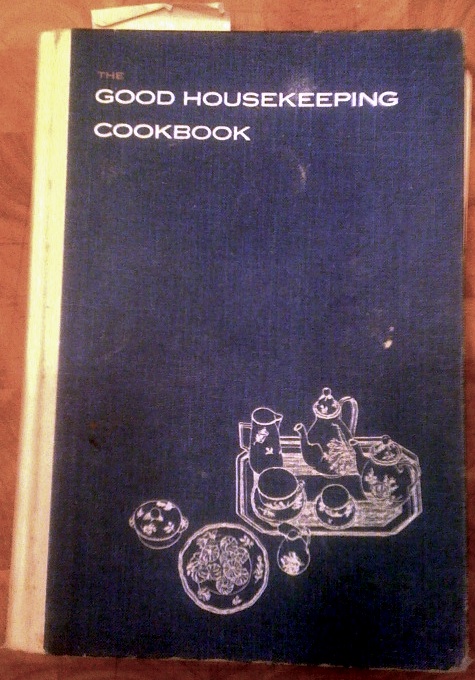
An ancient Good Housekeeping cookbook resides in the cabinet above the stove at my parents’ house. Whether it ever had a dusk jacket, I don’t know. Possibly, it was a victim of my childhood crusade against dusk jackets, a period of my life that my mother recalls grimacing every time she runs the feather duster over her shelves of first editions.goodhousekeeping I’ve never been sure why my mother has kept this volume around for so long, what with our constant moving from place to place; the book has been unshelved, boxed, unboxed, and reshelved at least two dozen times since she received it for a wedding present. She definitely doesn’t need the entire book. She only ever uses the pancake page, which has been warped and wrinkled by years of my enthusiastic stirring.

About five years ago, I discovered how glad I was that my mother retained the extraneous five hundred or so pages of the ancient cookbook. A few days before Christmas, I opened the refrigerator and freezer hoping that all the food I had already eaten that day had spontaneously reappeared so I could eat it again. This action was nothing new — I had been doing it several times a day for years, with little efficacy. But that time I noticed the apple pie, boxed and frozen, deposited sideways, squashed between the broccoli and my father’s ice cream quart collection

My shoulders slumped — how unexciting that the apple pie in the freezer would taste like all the other frozen apple pies from all the other Christmases and Thanksgivings and birthdays (yes, I had birthday pie). Since no new food had appeared, I closed the refrigerator’s doors. But a new idea had formed in my mind. I opened the cabinet and selected the ancient cookbook. It fell open to the batter-sodden pancake page, but I was in search of something new. The book’s spine creaked and cracked in protest as I forced it open to a new page, which sported the chapter heading: “Pies that Please.” How promising, I thought.

I wonder if, before the sixth day of creation, God opened the fridge and slumped her shoulders, bored by all the rocks and stars and fish he had been keeping fresh, ready for dispersal into creation. Sure, those rocks and stars and fish were all good, but their pages in God’s recipe book were warped and wrinkled by now. How about something new?

My experiment began with a moment of feverish self-doubt: my mother can’t make piecrust. As I read over the ingredient list, a nagging fear surfaced that I carried the same defective gene. What if I’m genetically unable to make pie? Flour and salt, shortening and water — these base pairs, in certain quantities and combinations, held the secret to flaky, golden-brown goodness. Could I succeed where my mother (and perhaps generations of Parsonses stricken by dough deficiency) had failed?

I pushed my chromosomal makeup out of my mind and began measuring, pouring, sifting, and cutting. I Jackson Pollocked flour all over the kitchen but managed to land two and a quarter cups of it in the correct bowl. Coaxing the Crisco into the mixture raised my blood pressure to stuffing-the-cat-in-the-cat-carrier-level, and only after several of the breaths I imagine they teach at Lamaze classes was I able to continue. Gradually, my flour/salt/Crisco mixture achieved the consistency of peas (a good sign, the recipe assured me), and I added the cold water. Now came the moment of truth. I pushed and prodded my concoction and said some desperate magic words under my breath, hoping by miraculous alchemy that the slimy mass before me would transform into heredity-denying dough.

I wonder whether God worried that her creation mixed from dust and breath might not turn out the way he expected. Would this experiment fail? Was making a being in the image and likeness of herself too complex a recipe? What if he had to start again from scratch?

The transformation worked. Where a bowl of sticky ingredients sat mocking me a minute before, a lump of dough now beckoned me to flatten it with my rolling pin. I placed the dough between two pieces of wax paper (I’m not sure where I picked up this trick — it was either instinct or the Food Network). Then I rolled out the crusts, making two circles my ninth grade geometry teacher would have been proud of.

Buoyed by my success with the crust, I decided to improvise the filling. After checking the oven temperature and baking time, I returned the ancient cookbook to the cabinet above the stove and began peeling apples. Seven or eight would do, I told myself. With a bag of brown sugar in one hand and a box of cinnamon in the other, I showered the cut apple pieces with sweetness. Then I hurried the filling into its pie tin bed and tucked in the top crust. A quick glaze of melted butter and a few knife slits on top and it was into the oven. For the next forty minutes, I paced and fretted like a father outside the delivery room.

I wonder that God gave me the ability to grow and the desire to create. God’s recipe was simple—dust and breath. The dust grows, remembering the earth and the deep things of those creation days that were called good. And the breath creates, remembering the heavens and the Spirit moving and creating and renewing.

Against all odds of genetics and pie-making virginity, my first apple pie succeeded beyond my wildest expectations. I usually take my parents’ compliments with a salt mine (they are my parents, after all), but my own taste buds confirmed their praise. I have tweaked my recipe and method since then, adding a few subtle spices and making sure to cover the crust with tin foil half way through baking. Though some are better than others, each pie is good (and only one — the famous “Lattice Crust Experiment” of 2007 — was an unmitigated failure).  And each pie pushes me to improve, to better my technique, to take the basics from that ancient cookbook and create. And create. And create.