Sermon for Sunday, June 26, 2016 || Proper 8C || Luke 9:51-62
During the summer, I am preaching without a text, so what follows is an edited transcript of what I said Sunday morning at the 10 a.m. service at St. Mark’s.
As I was preparing for this morning’s sermon, I was having trouble, and I realized the reason I was having trouble is that I was actually preparing for four sermon, and not for one sermon. So today is the beginning of a four part series that goes all the way until I start my vacation. So you have to come back for the next three Sundays to get the whole thing. The topic of this sermon series is a topic we don’t talk a lot about in the Episcopal Church, but it is something you hear a lot of in other churches and in popular culture. It is the concept of being “born again.” You’ve heard that before, right? Probably not here. Continue reading “Born Again, part 1: New Life”→
Sermon for Sunday, October 25, 2015 || Proper 25B || Mark 10:46-52
Imagine with me the beggar Bartimaeus. He is remembering the fateful day when a large crowd passed his perch beside the road from Jericho. It started like every other day, with a certain memory dancing before his sightless eyes.
I was seven and a half years old when I got sick. It was the kind of illness you don’t usually recover from, but I did. Almost. The last image my eyes captured was my mother’s face – beautiful and distressed, a smile worn for my benefit betrayed by a furrowed brow. When I returned to the land of the living, if not the sighted, I could touch her face with my fingers and know the smile and the worry lines were still fighting with each other. I could hear her singing me to sleep. I could smell her bread baking, and I could taste it, too. But I could not see. With no new picture to replace it in my memory, the image of my mother hovering over my sickbed remained with me all those years.
I was remembering the way her hair always fell across one side of her face until she pushed it behind one ear, the way her tears ran over her cheekbones, the way her smile battled her furrowed brow, when I heard it – a large crowd coming down the road from Jericho. You might think the prospect of so many people passing me by would excite me, since my only source of income was the kindness of strangers. But large crowds rarely yielded much coin in my experience. People couldn’t really stop for fear of being run into; they usually were just paying attention to each other; and they always kicked up such a cloud of dust that I was probably as invisible to them as they were to me.
Or at least those were those reasons I told myself. To be honest, I think I made their excuses for them because of how disheartened I got when so many people passed me by without noticing me. It was as if my blindness struck them blind too. But not that day. The moment I heard Jesus of Nazareth was in the party, people would have to have been both blind and deaf not to notice I was there. This was my one chance. I had heard stories of him from other beggars and from people coming down from Galilee. I knew he had the power to heal me. I believed he could restore my sight. This was my one chance. And I took it.
“Jesus, Son of David, have mercy on me!” I shouted as loud as I could. But someone hit the side of my head and told me to shut my mouth. Other voices joined the first, a chorus of shush-ers. It wasn’t enough for them that I be blind; apparently, they wanted me to be mute too. But this was my one chance, and I was not going to be deterred. I yelled again, “Son of David, have mercy on me!”
And then something happened. The tremor of hundreds of feet stamping the ground just stopped. The sound of voices died away. I could hear the echo of my own shouted words fleeing for the hills. For a moment there was no noise, save for the grunts of pack animals and the laughter of children. Then I could feel next to me a looming presence, a hand on my shoulder, a few flecks of spittle on my face when the man spoke. He smelled of sweat and old fish. “Take heart,” he said. “Get up, Jesus is calling you.”
The vision of my mother swam in front of me. I could see her mouthing the words, “Take heart.” I could see the smile gaining ground on the furrowed brow. I jumped to my feet and clung to the man’s hand as he led me away from my beggar’s nest. I counted the steps I took in case I had to make my way back there if Jesus wouldn’t help me…or couldn’t help me. Fourteen. Fifteen. Sixteen. Stop.
A new pair of hands gripped my shoulders, gentler but still strong. “What do you want me to do for you?” he asked. It was the most extraordinary question. He could have assumed I wanted my sight back. He could have assumed I wanted to leave the life of begging. He could have assumed any number of things about me. But instead of just mandating my cure, he asked me what I wanted. He engaged me in conversation. He let me take the lead.
“My teacher, let me see again.” Once more, my mother’s face danced in front of me, and her smiling mouth formed the word, “Go.” And as she spoke, her smile turned into someone else’s: a man’s smile, a man about my own age with piercing dark eyes and no furrow whatsoever in his brow. “Your faith has made you well,” he said.
I turned my head this way and that. Everything was so bright. Suddenly I felt sick to my stomach, dizzy, my balance gone. But as I started to fall, Jesus’ strong arms clenched my shoulders tighter, and he kept me on my feet. “Look at my eyes,” he said. “The vertigo will pass. Just at my eyes, nothing else.” For a long moment – a minute, five, ten, I don’t know – he anchored me with his gaze. And in that long moment, I memorized his face like I had memorized my mother’s. I had seen her face everyday of my blindness. Now I see his.
But not everyday. While he was still with us, I saw him in the flesh most days, but now that he’s here only in Spirit, I find it hard to see his face. My eyes work perfectly, but to see him now takes a different set of eyes. He said my faith had made me well. And now it’s the eyes of faith I need, the eyes that see beyond what’s in front of me, the eyes that see God’s reality swirling beneath the mundane.
And so I repeat my request: “Lord, let me see again.” Let me look again at your presence in the world around me. Let me notice again the people who are usually invisible. Let me see again your face in their faces. Let me serve again. Let me help again. Hope again. Love again.
Lord, I asked for mercy, I shouted at the top of my lungs for mercy. And mercy is all about second chances. Mercy is all about “again.” And so my first request remains the most fervent longing from the depths of my heart. I have made this my prayer for all time: “Lord, let me see again.”
Sermon for Sunday, October 18, 2015 || Proper 24B || Mark 10:(32-34) 35-45
Over the last six weeks, our Gospel lessons have been tracking Jesus’ movement. We began in the Roman garrison town of Ceasarea Philippi, then to Galilee, then south to Judea, and now we find ourselves on the road towards Jerusalem. In each of these places, Jesus performed wonders that restored people to health and wholeness. He also sparred with his opponents over various issues, and he taught his disciples many things. But one thing he taught them just didn’t sink in, and so he teaches it to them over and over again – three times to be exact – he teaches that he is walking to his death.
In Caeserea Philippi, after Peter makes his famous declaration that Jesus is the Messiah, Jesus tells his disciples that he will be condemned, killed, and after three days rise again. Peter just can’t handle this information, so he tells Jesus off. As they pass through Galilee, Jesus tells them a second time he will be betrayed, killed, and rise again. They don’t understand what he is saying, and they lapse into an argument about which of them is the greatest. Now they’re on the road to Jerusalem. The time is near at hand. So Jesus tries one more time to prepare them for what is coming.
The problem is – we skipped those verses this week. For over a month, we’ve read every verse of chapters 9 and 10* of the Gospel according to Mark, and now suddenly we skip three verses. Apparently, the framers of our lectionary don’t think we need to hear all three predictions of Jesus’ death and resurrection. I disagree. So here’s the third one, which is sandwiched between last week’s Gospel reading and the one I just read.
“They were on the road, going up to Jerusalem, and Jesus was walking ahead of them; they were amazed, and those who followed were afraid.”
(Quick aside – They’re afraid because Jesus was relatively safe in the boondocks of Galilee, but his fame has spread south to Jerusalem, where he has few friends. Apart from his seemingly clueless disciples, no one thinks he’s coming home from this trip.)
The skipped verses continue: “He took the twelve aside again and began to tell them what was to happen to him, saying, ‘See, we are going up to Jerusalem, and the Son of Man will be handed over to the chief priests and the scribes, and they will condemn him to death; then they will hand him over to the Gentiles; they will mock him, and spit upon him, and flog him, and kill him; and after three days he will rise again.’ ”
Of the three predictions, this last one is the longest and most explicit. It’s the only one that mentions his mistreatment at the hands of the Roman soldiers. In fact, all three predictions are different, but they all share one common phrase: he will be killed, and after three days he will rise again.
Even after this third most strident attempt, the notion that their Lord could ever suffer such an ignominious fate still doesn’t sink in. And once again, the disciples lapse into an argument about places of prominence when Jesus enters into glory. You can see that their current outlook is untroubled by such a mundane thing as reality. They are stubbornly unwilling to engage Jesus on such a weighty topic as life and death.
Or should I say death and life. This small distinction, this tiny flipping of two words, makes all the difference. The disciples put their fingers in their ears the moment Jesus starts talking about dying in Jerusalem, and so they miss the most important part. They miss that life comes after death. They miss the rising again.
And we miss it too. We miss the resurrection because we tend to place it in chronological order after our own physical deaths. This makes sense because the death of our bodies terrifies us, and so hoping in the resurrection gives us some comfort. Let me be clear, this chronological thinking about the resurrection is not wrong, but it’s also not the whole picture. The whole picture is drawn on the canvas of eternity. If we believe we are given the gift of eternal life in the power of the resurrection, then we already have it – even now, here, this day, long before our physical deaths. Eternity, after all, has no start date.
But this eternal life, this resurrection life, does have one kind of beginning: the day we awaken to this beautiful reality, the day we decide to participate in God’s mission of renewal, the day we choose to live. This awakening doesn’t happen just once, God knows, but again and again – because, like the disciples, we are clueless and stubbornly unwilling some of the time. How does this awakening happen? Remember, we’re not talking life and death here. We’re talking death and life. Each moment of awakening to resurrection life begins with a little death. Let me say that again: Each moment of awakening to resurrection life begins with a little death.
Here’s what I mean. Notice that each time Jesus predicts his own death and resurrection, he follows his disciples’ lack of understanding with a call for them and us to let little gangrenous pieces of ourselves die. After the first prediction, he says, “If any want to become my followers, let them deny themselves and take up their cross and follow me.” Deny yourself – in other words, let your own will die. Too often, we let the selfish or petty or abusive or apathetic or ruthless pieces of ourselves take the wheel. We lapse into these death-dealing behaviors when we are scared, which is why Jesus tells us so many times not to be afraid. Let your will die a little death, he says, so mine can come alive in you.
After the second prediction, Jesus puts a little child among his quarreling disciples and says, “Whoever welcomes one such child in my name welcomes me, and whoever welcomes me welcomes not me but the one who sent me.” Welcome the lowest of the low – in other words, let your own presumption of privilege die. Too often, we allow ourselves to get caught up in death-dealing hierarchies – caste systems built around money or race or any number of ways we can differentiate ourselves from others. Let your presumption of privilege die a little death, says Jesus, so my compassion for all life can come alive in you.
And today, after the third prediction, Jesus silences the disciples anger toward James and John when he says: “Whoever wishes to become great among you must be your servant, and whoever wishes to be first among you must be slave of all.” Serve each other – in other words, let your own complacency die. Too often, we expect life to be easy. We like to coast along, untroubled by the death-dealing evils of world around us. And to be honest, life is easy when we ignore everything that makes it hard. Jesus invites us to awaken to the power of servanthood so we can help others awaken to the power of the resurrection in their own lives. Let your complacency die a little death, says Jesus, so my mission of healing and reconciliation can come alive in you.
Three times Jesus predicts his own death and resurrection. Three times he encourages us to let parts of ourselves die little deaths in order that we might awaken again and again to the beautiful reality of resurrection life here and now. As we live into this reality, as we participate in resurrection life, remember this: our faith is not a matter of life and death. Jesus turned everything around, so our faith is really a matter of death and life.
Sermon for Sunday, October 11, 2015 || Proper 23B || Mark 10:17-31
Jesus feels drawn to the man kneeling in front of him. His heart is warmed, and he feels the stirrings of love and compassion for this frightened soul in the midst of an existential crisis. Perhaps the man recently had a parent or friend die, or perhaps he himself had experienced an accident or illness that brought death near. Whatever the trigger, the man comes to Jesus with a serious question that has obviously been plaguing him because of some unspoken dread roiling within him.
“What must I do to inherit eternal life?” he asks. Jesus lists off some of the standard commandments, and the man checks each box. That’s when Jesus looks at him with love and compassion. Here is this man in fine clothes getting dirty in the dust of the road. Here is this man with obvious wealth and power coming to an itinerant preacher with no place to lay his head. “I know what’s holding you back,” Jesus says. “It’s always something. There’s always something in the way that only you can shift. I can help. I can encourage. I can give you strength and courage. But you must decide.”
“What? What is it?” pleads the man.
“In your case: sell all you have and give the money to the poor. Then come, follow me.”
Shocked into speechlessness, the man gives Jesus a hard look, stands, dusts off his finery, and stalks away, not really understanding the source of his tears. Jesus invited this man to give away his possessions. He was holding his stuff so tightly that he couldn’t open his hands to receive what Jesus was offering him. He couldn’t let go, so he never discovered how life-changing it can be to release your grip, to uncurl your hand ready to give and ready to receive.
Jesus diagnoses this man on the spot. Jesus loves him enough not to sugarcoat what he needs to do to get past the barriers his own wealth has set up. Give it all away. Just give it all away. This action of giving is one of the more powerful steps we can take in our lives of faith in response to God’s movement in those lives. So it makes sense that Jesus invites each and every one of us, like the man in the story, to give. And as near as I can tell, this giving follows a general pattern.
First we have giving up. I know, I know, the great American sports movie teaches us differently: every single one of them follows the same pattern: upstart team or individual gets trounced by dominant team or individual. Upstart trains, learns something about teamwork or grit, and challenges the champion. The game goes horribly for our heroes until the last minute – it’s gut check time – and they decide never to give up. With renewed strength and faith, the upstart wins in the last second. That’s the narrative we are steeped in here in the United States. Never give up.
And yet, that’s exactly what our faith calls us to do. Give up. So we ask ourselves: what does God desire us to give up? Most questions we put to God are hard. But not this one. God dreams for us to have as close a connection to God as God has to us. Therefore, we have to give up all that stands in the way of such intimate connection. There’s a special word for this stuff that stands in the way: “idol.” Whatever it is, each of us has something we tend to put ahead of God. We look to that something to give us life. But since the idol will never be able to give us what we need, our lives shrivel until they are brittle and paper thin, starved because the idol provides such poor nourishment.
So God urges us to give up such idols. But that’s just step one. Step two is giving in. It’s not enough to do away with the idols. If we don’t give in – if we don’t surrender ourselves into God’s loving and sustaining care – then the power vacuum will just attract another idol to take the place of the old one. So we give in to God. We surrender ourselves to God’s love and mercy.
This giving in is so hard. It continues going against the grain we’ve been taught. Now the war movie takes center stage. Of course, we’d never surrender! But again, we must ask ourselves: to whom are we surrendering. Not to the enemy. Not to the bad guy. We surrender to our own commander. We were in rebellion all along, and now we’re coming home.
So we give up, then we give in. And then we give ourselves over to trusting God with our whole beings. It’s not enough simply to surrender. Giving over means joining God’s side. You say, “You’re in charge, Lord, not me. Of the two of us, I’m not the better decision maker, so why don’t you take the lead. I’ll follow.”
Again, giving over is no cakewalk. Our socialization is still against us. We’ve seen too many movies, and now the Teacher-Pupil archetype comes to mind – the one where the hard luck case puts trust in a mentor who turns out not to be as perfect as the hard luck case thought, and drama ensues. We are the hard luck cases, but our mentor just so happens to be as perfect as we think. (More perfect even, since we can’t begin to perceive the wonder of God.)
So we give up, then we give in, then we give over. Now we’re ready to give back. We remember the TV shows and movies in which the teenager gets a first credit card and goes on a crazy buying spree. Yep, that’s us, if given half a chance, so maybe we shouldn’t be in charge. Since we trust God more than we trust ourselves, we conclude, it’s time for God to take charge of all our stuff. We can be stewards of the stuff, but it’s not ours anymore.
Each year, God gives us stewardship of most of this stuff and keeps a small percentage to be used for God’s mission here at St. Mark’s and elsewhere. We partner with God by pledging this small percentage towards God’s mission. That percentage might be 10% or a little less or a little more. Through prayer, we can discern what’s right for each of us in our circumstances.
This giving back transitions into the final act of giving: giving forward; that is, not only financing God’s mission but participating in it with our own gifts and passions. Think of disaster films in which everyone bands together to beat the odds. Giving forward means making decisions and making sacrifices with people other than ourselves in mind. Giving forward means propelling into God’s bright future those people who think they have no future.
Just as Jesus invites the man in today’s Gospel to give away all he has, Jesus invites us to give. With God’s help, we give up our idols. We give in to God and surrender our malfunctioning wills. We give over to God our self-determination and trust God’s guidance. We give back to God all that we have, knowing that our stuff is safer in God’s hands. And we give forward for God, partnering with God in the great mission of healing and reconciliation in this world. To give up, in, over, back, forward – to give – is a great act of faith. Thanks be to God, then, that God began this entire process by giving first: giving us God’s son, God’s grace, love, hope; giving us our own deep desire to give.
Sermon for Sunday, September 20, 2015 || Proper 20B || Mark 9:30-37
Every day of my fourth grade year, my class lined up at the end of recess to go back inside. The bell rang, and we raced to our spots in the line. But the race was in vain because no matter who arrived at the door first, we always lined up alphabetically by last name. By last name. What I wouldn’t have given to line up by first name. Then (Oh happy day!) I would have been at the very front of the line. No Aarons or Abigails in my class. No. Adam would have been the first name on the list. But those days were cruel. Every morning, I stood on tiptoes to see over the twenty-three heads in front of me, and only one boy – Shane Yellin – was worse off than I.
Then, on the day when all the mothers began insisting their fourth graders wear winter coats to school, something happened. Mrs. Ida Hughes, my math teacher, challenged us to line up in reverse alphabetical order. And for one cold, drizzly, glorious day, I stood at the front of the line and only one head obstructed my view of the playground doors.
Standing at the front of the line feels good and the benefits are numerous. Being in front means the concert tickets aren’t sold out. The first baseman hasn’t tired of signing autographs. The bucket of fried chicken at the church potluck retains its full complement of chicken legs. Certainly, perks abound for those in front. Go to any shopping center in the wee hours of the morning on the day after Thanksgiving and witness the millions of Americans attempting be first in line simply to purchase new TVs for “doorbuster” prices.
Of course, these benefits are all about me. I get the tickets and the autograph and the preferred piece of chicken. I get the deal on the television. I get all these things because I got in line before you. You are behind me and someone else is behind you and countless faceless others line up behind that someone else. So we stand in our line and stare at the backs of the heads in front of us. In this linear configuration, no one can converse. No one can relate. No one can do anything more than slowly shuffle forward, both surrounded and isolated at the same time.
This isolation is the danger Jesus envisions when he places a little child among his disciples. They’ve been arguing about which one of them is the greatest (in other words, which one of them should be first in line). The prevailing linear culture has thoroughly molded the disciples. They only understand relationships in terms of hierarchy based on class, gender, and age. But they’ve been hanging around Jesus long enough to know that Jesus is thoroughly countercultural. He talks with women. He eats with outcasts. He touches the unclean. And so the disciples lapse into embarrassed silence when Jesus asks them about the content of their argument. They know they’ve provided Jesus with what would now be called a “teachable moment.”
The disciples expect something countercultural and that’s exactly what Jesus gives them: “Whoever wants to be first must be last of all and servant of all.” To illustrate the revolutionary nature of this statement, Jesus brings a small child and places the child among the disciples – not before them or after them, but among them. In Jesus’ day, this child was the last of the last. The hierarchy of the society placed children just below farm animals because you could get a lot more out of a goat than a toddler, and the goat would probably live longer. Children had no rights or protections. They weren’t even considered people until they were old enough to work.
But Jesus ignores this cruel stratification when he says: “Whoever welcomes one such child in my name welcomes me.” Jesus commands his disciples and us to welcome those whom society deems lowest of all. With this welcome comes the opportunity to see the faces and learn the stories of those who until now were at the end of the line, too far removed from us to register on our radar. And as we hear the stories of the lowest and the last, we seek ways to serve them and serve with them.
But one of the greatest mistakes of our time has been the Western presumption that we know what’s best for the people we serve: “You might not have said you need a well in your village, but we’re going to come and build one anyway.” This imperialistic attitude only perpetuates the linear model, which our service should be attempting to supplant. However, with his command to welcome, Jesus doesn’t allow us to develop a “serve first and ask questions later” mentality. Welcoming provides the framework through which service leads to the building up of relationships.
With his emphasis on relationships, Jesus changes the existing linear model into a circular one. In the line, you can’t welcome anyone because all you see are the backs of heads. You can’t serve anyone because the implied hierarchy of the line makes isolation the norm. You can only count the number of people ahead of you and nurse your own indignation over your rotten place in line. But in the circle, there is no first and no last. We can grasp hands in welcome precisely because we will be unable to quantify our position in the continuous round. And relationships have a chance to flourish because we look not at backs but at each other’s faces.
This circular model of welcome and service stands in laughable contrast to the current situation in this country. Too many incidents to count show that the tired old scourge of racism is alive and well. The drive to produce leads to longer hours, more work, and more money, but assuredly less happiness, less camaraderie. The gap between the rich and the poor grows ever wider. Each of these examples depends on the linear model continuing to thrive. And it is. So here we sit with our Lord challenging us to do something, which the loudest voices on the other side of those doors claim is utter nonsense.
To be first you must be last of all and servant of all, he says. Let go of linear relationships based on power and ambition and embrace circular relationships based on welcome and service. If you are standing near the front of the line now, start walking to the back. Grab the hand of the last person in line and form the circle. Welcome the least among us. Listen to their needs, their desires, their dreams. Form new relationships. Partner with them in service because we are only as strong as our weakest members. Jesus invites us over and over again to accomplish these things. And Jesus never issues an invitation without simultaneously offering the gifts needed to embrace it.
So to every fourth grader lining up after recess and to every businessperson lining up at Starbucks and to everyone whose ambition blinds him or her to those standing on tiptoes in the back: Give up your place in line.
Sermon for Sunday, September 13, 2015 || Proper 19B || Mark 8:27-38
This week has been a particularly tough one for our twins, Charlie and Amelia. At thirteen and a half months, we think they are cutting their molars, so their extreme fussiness is understandable. On Tuesday, I walked in the door of the kitchen, and before I had taken three steps, Charlie was toddling up to me as fast as his little legs and precarious balance would allow. He ran into me and buried his head between my knees, which is his way of saying, “Pick me up, Daddy.” I hefted him into my arms. He put his arms around my neck and his head on my shoulder. And for the next twenty minutes, I just walked around, holding him and speaking softly into his ear. It was a special moment, a physical heart to heart.
The next morning, I was preparing to write this sermon and reading Jesus’ question over and over again: “Who do you say that I am?” And this question about identity got me thinking about Charlie, about how he would answer the question if it were asked about me. Who does Charlie say that I am? I think Charlie’s answer and Peter’s answer share a lot in common.
You see, Charlie’s first word was “Dada.” Early on he used it for everything, so it wasn’t really my name, it was just what he said. Then, as the months progressed, Charlie’s collection of sounds increased, “Dada” became “Daddy,” and, for the most part, focused in on my personage. He says “Daddy” in the sweetest, high-pitched singsong that melts my heart like butter. And yet, I wonder what his toddler’s mind imagines when he identifies me.
Judging by the way he wanted to be held on Tuesday, the way he clung to me so fiercely, the way he calmed down immediately when he was safe in my arms, I think I have a lot to live up to. In his eyes, my identity must be larger-than-life. I am, quite literally, the largest person he sees regularly. And I’m not around as much as Mommy, so there’s an air of mystery to my presence, a rock star quality. I’m a super hero. I just don’t have any super powers. I can remember the exact, illusion-bursting moment in my own adolescence when I realized my parents were not the infallible super heroes I always took them for. And I wonder when Charlie and Amelia will figure that out about me.
Identity is a tricky, slippery thing. Our identities are multi-faceted. They are synthesized and refined and redefined throughout our lifetimes as we gain new skills and interests, as we adapt to new circumstances and relationships, as we deal with success and failure. For example, for nineteen years (about 60 percent of my life) “student” was the most important facet of my identity, but no longer is. The importance of one facet of identity might rise or fall in direct proportion to another. My identity as “sports fan” has fallen significantly with the rise of my identity as “father.” Identity is also a negotiation between what we think about ourselves and others’ expectations of us. If someone asks me, “Are you a golfer,” I always respond the same way. “I own golf clubs.” I don’t want that person to generate an undue expectation of me, as someone with a handicap less than the maximum.
The reality (or unreality) of expectation is where Charlie’s and Peter’s answer to the question converge. Who do you say that I am? You are the Daddy: bottle giver, tantrum calmer, crib rescuer, super hero! You are the Messiah. And while Peter doesn’t expand on this identity, his reaction to Jesus’ explanation of it shows us what Peter’s expectation is. You are the Messiah: Israel’s deliverer, Rome’s exterminator, mighty warrior, sure victor. It’s no wonder Peter takes Jesus aside to clarify things. Jesus is obviously mistaken. Had he heard Peter right? Peter had said “messiah,” not “sacrificial lamb,” not “victim.”
Bur Jesus had heard Peter. Jesus could sense the underlying expectation of such a baggage-laden identity as “messiah.” That’s why he starts speaking openly for the first time in the entire Gospel. He needs to clarify things. He needs to make sure his disciples know just what he thinks the identity of “messiah” means. If he had wanted to live into the militaristic expectation of “messiah,” he probably wouldn’t have recruited fisherman. “Look around,” he seems to say to his disciples. “I don’t have an army. I have you guys. I haven’t been fighting. I’ve been healing.”
We follow Jesus precisely because his expectation of “messiah” runs counter to Peter’s. We follow Jesus because he chose not to fight. We follow Jesus because he gloried not in destruction, but in resurrection, in new life, in deep relationship that lasts beyond death. That’s Jesus identity as “messiah.” He suffered not because suffering is good, but because suffering was the natural outgrowth of his taking on the isolating, dominating, death-dealing machinery of this world. We follow Jesus because we believe he won that fight by not fighting back, by not fighting fire with fire, but by clogging the machine with the love, grace, and peace of God.
And that brings us to our own identity as followers. “If any want to become my followers,” says Jesus, “let them deny themselves and take up their cross and follow me.” It’s quite possible this isn’t what we signed up for. It’s quite possible we expected more comforting words. Perhaps we expected Jesus to say, “Come to me, all you that are weary and are carrying heavy burdens, and I will give you rest.” Perhaps we expected Jesus to say, “Remember, I am with you always, to the end of the age.” Perhaps we expected Jesus to say, “I came that [you] may have life, and have it abundantly.”
Well, the good news is this: Jesus does say all those things. It is these promises of rest and relationship and abundant life that make us able to accept his strident expectation of identifying as his followers. Denying ourselves means letting go of our stranglehold on our own lives – our self-determination, our bootstraps mentality – in order to allow Christ to live in us. And when Christ lives in us, we find we can resist the machinery of this world. We take up the cross because from the cross Jesus beckoned everything that’s wrong with this world to come die with him. When we come to the cross, we come face to face with all the manifestations of evil, snarling in its death throes. It’s a scary place, teeming with poverty, racism, disease, violence. But this is the place our followers’ footsteps lead us because this is the place we partner with Christ to bring resurrection and new life.
Someday, Charlie is going to realize I’m not the super hero he thought I was. That expectation will crack, and our relationship will change. Some days, we follow Christ more closely than other days. Some days, the identity of follower takes us to dark places, despite our expectations. But that identity takes us there because part of being a follower is being a light-bearer to such darkness. The light we bear is the light of Christ, our healer-messiah. And our identity as followers is safe in his hands because no amount of evil or darkness will ever extinguish his light.
Sermon for Sunday, September 6, 2015 || Proper 18B || Mark 7:24-37
You might be wondering if I accidentally read two weeks worth of Gospel lessons just now. The story of Jesus and the Syrophoenician woman ended satisfactorily, and at that point I could have said, “The Gospel of the Lord.” But the appointed lesson for today barrels forward into the next story, as well, and we read about Jesus healing a man who cannot hear and can hardly speak. We could focus on either half of this Gospel reading: there surely is enough in each to fill out a sermon. But today, I’m going to break a rule of preaching and bite off more verses than I normally do because I think the Gospel writer Mark places these two stories side-by-side for a reason. And this reason centers on the strangest word in the passage, a word that itself needs to be translated because Mark chose to preserve Jesus’ original language when he wrote it down. That word is “Ephphatha”: Be opened. Openness is the key to these two encounters. And openness is one of the keys to our lives as followers of Jesus Christ.
But before we get to openness proper, we need to address the historic challenge of the first encounter in our passage. For hundreds and hundreds of years, faithful readers of scripture have had more trouble with the story of Jesus and the Syrophoenician woman than almost any other story in the Gospel. The main issue boils down to this: Jesus seems to change his mind after the woman’s response to his rather rude statement about dogs eating the children’s food. If Jesus is who he says he is, the argument goes, then how could he possibly be induced to change his mind? Wouldn’t that be tantamount to saying he’s wrong about something?
You can see why people of all stripes – scholars, clergy, laypersons – have trouble with this story. It has always made me a little spiritually itchy, as well, to be honest. And because of this trouble, people throughout history have used some (shall we say) flexible interpretive gymnastics to bend the encounter until it fits into their conception of who Jesus is. “Jesus was going heal the little girl all along,” says the most common acrobatic interpretation. “He was just testing her mother.” Another goes: “Jesus is simply moved by her plight. That’s why he gives in to her request.”
While these might be fine interpretations of the passage, they miss the simplest explanation entirely because they are not open to the possibility that Jesus might just be wrong in this case. But let’s for a moment step out of this history of interpretive gymnastics and imagine such a possibility. Let’s see if there is some good news in a story about Jesus being wrong and changing his mind.
The first thing to notice is the status of the other person in the encounter. Right away, Mark gives us three reasons why this woman would normally be dismissed in Jesus’ day and age (and perhaps ours, as well). She’s a woman. She’s a foreigner. And she has a child with some challenges. That’s three strikes, three excuses others would use to marginalize her. And this is the person who teaches Jesus something.
She comes to Jesus and implores him to cast the demon out of her daughter. He responds with what sounds like a stock retort of the day, complete with ethnic slur (and let me assure you, “dog” is the mildest translation of the word). But the woman takes the slur and turns it around, in effect saying: “Listen to me. Take me seriously. I might not have a seat at the table but I deserve to be fed.”
And then something astounding happens. I imagine Jesus standing there, dazed for a minute, then his features softening as he realizes how closed off he is being, how stuck in a cultural norm, how unlike his usual self who is always pushing boundaries and rubbing shoulders with outsiders. The woman’s response jars him out this unusual narrowness. “Good answer,” he says – not just because it gets her what she wants but because it also helps Jesus reassert his normal posture of openness.
The beauty of living a life of openness is illustrated in the next encounter. People bring to Jesus a man who cannot hear and can hardly talk. Jesus looks him over, touches him, and says, “Ephphatha”: Be opened. Immediately, the man is able to hear and speak. Jesus could have said any number of things to heal this man. Or he didn’t have to say anything at all. And yet the word he chooses is a word of openness. That’s what’s on Jesus’ mind when he heals the man – not just the mechanical action of opening his ears and releasing his tongue, but the greater reality that open ears convey, the deeper meaning of Ephphatha.
Be open. Do not let your preconceptions deafen you to new ideas. In our world today, we can pick and choose the voices who influence us, and human nature pushes us towards voices we already agree with. The arguments we expose ourselves to in such a partisan climate often pit the best of one side against the worst of the other, or else have no basis in reality in the first place. The loudest voices in the media are always the most extreme. And yet underneath that layer of bluster, there are other, quieter, smarter men and women who disagree with each other and take the time to appreciate and understand one another’s views. They may not change their minds like Jesus does in the story, but the openness exists, nonetheless.
Be open. Do not let innate tribalism keep you from getting to know people unlike yourself. We all fall into this trap. We like people who remind us of ourselves. This isn’t a bad thing at all. But it’s also not the only thing. Rubbing shoulders with people unlike us – in whatever way the differences present – has a way of broadening us, giving us greater awareness, growing in us more empathy, more solidarity. It’s no wonder that the person who reminds Jesus of his usual openness is so unlike him.
Be open. Pray for the trust that leads to openness. Open your hands to receive. Then open your hands again to give. Walk with your arms outstretched, open to embrace the call God places in your heart. Ask God to open your heart to welcome whoever walks across your threshold, to listen to experience that differ from your own, to learn what others have to teach.
I truly believe Jesus learned something that day from the Syrophoenician woman, or perhaps remembered something he had forgotten. She teaches him to embrace his openness and then returns home to a demon-free daughter. Jesus returns home, too, and meets a man who is physically closed off. Be opened are his words of healing to that man, who then cannot contain his raucous proclamation. And just as Jesus lived a life of openness to God and to those people whom most never bothered to see, Jesus gives us the same invitation today. Ephphatha. Be open.
Sermon for Sunday, May 3, 2015 || Easter 5B || Acts 8:26-40
Twice last week, I got to wear a tie. I went to the MASH gala fundraiser and to the Eastern Connecticut Symphony concert, at which several of our parishioners sang their hearts out performing Carl Orff’s Carmina Burana. The benefit was fabulous, the concert was wonderful. And I went to both wearing a tie. This may sound like a strange thing for me to report to you, but I assure you, I am going somewhere with this. Whenever I’m getting dressed, I’m faced with a wardrobe decision. Do I wear my black shirt and collar or not? If I decide not to, then I leave the house incognito. I’m still a priest, of course, when wearing a coat and tie or jeans and flip flops, but people at the concert hall or grocery store won’t be able to spot that about me on first glance. (They probably think I’m a college sophomore home on break.)
Sometimes when I’m not wearing my clergy clothes, I revel in the anonymity I have. I can take the twins to the pediatrician without people looking at me funny. Is he allowed to have kids? I can ride in an airplane and not freak out the other passengers when I white knuckle it through takeoff. (I’m not the best flier, and seeing a man of the cloth nearly hyperventilating while taxiing down the runway is not doing anyone any favors.)
The trouble is, when I consciously choose not to wear my black shirt and collar, I can fall into the trap of thinking I’m off the clock, I’m done for the day, my timecard is punched. But that’s not how it works. I get paid to be your rector and spiritual leader. That’s my job. But living as one of Jesus’ disciples, living out my baptism? That started long before I was ordained, long before I had the choice of attire. That started the moment I said, “Here I am,” when God called me into relationship. Living out my baptism, following Jesus – that’s not my job. That’s my life.
And it’s your life, too. You’re just not faced with the same wardrobe decisions. The question I have for you is this: Since your clothes don’t out you as a Christian like mine do, how do people know? What about your life is different because you signed up as a follower of Jesus? If you got into a conversation about the important stuff how long would you talk before mentioning your faith?
We share the Good News of Jesus Christ in many ways – both in word and deed. We tend to focus on the “deed” part, and I think we do it pretty well. But the “word” part is hard. The thing is, the word gives the deed context and shape. In a world as spiritually malnourished as ours has become, the interpretation of our God-inspired deeds with God-inspired words is critical. I know for a fact that people out there are hungry for some connection with something…deeper. Spiritual malnutrition leads to spiritual hunger, though most people don’t have the language to name the lack they feel. We do have that language, and it is our delight to share it.
This is what Philip does with the Ethiopian eunuch in today’s lesson. The Good News of Jesus Christ has just begun to spread, and Philip is on the vanguard. He runs up to the eunuch’s chariot and hears him reading the prophet Isaiah. The eunuch is hungry to know of whom the prophet speaks. Philip shares the good news, and then the eunuch asks my favorite question in the book of Acts: “Look, here is water! What is to prevent me from being baptized?”
What is to prevent me from being baptized? The answer is nothing. Philip baptizes him right there on the side of the road. For we who are already baptized, this question transforms. What is to prevent us from living out our baptism? The answer to this question should also be “nothing.” But it’s not that easy.
What prevents us from living out our baptism? What prevents us from sharing the Good News of Jesus Christ in word and deed? Many, many, many things. Let’s talk about four of them.
First up is apathy. If we don’t take the time to cultivate our part in our relationships with God, then sinking into apathy is a real consequence. Apathy results when we don’t take our faith seriously – when it lives in the topsoil rather than the bedrock, just one good rainstorm from eroding away. God showers us with the promises upon which faith rests, but it’s up to us to practice our faith and our discipleship so they become constant motivators in our daily lives. If we don’t, we might wake up one day and look out at the vista of all that God calls us to do and be, all whom God calls us to serve, and say, “I don’t care.”
But we aren’t going to sink into apathy because we do care. We live out our baptism by being engaged. But that brings us to our second item: lack of expertise. Once we care, we realize how dwarfed we are by the enormity of the history and tradition and biblical witness undergirding our faith. How could we possibly know enough to be able to share it correctly? Let me set your mind at ease. I studied this stuff for three years at school. I have another seven years as a priest. And I’m still not an expert. I never will be. God doesn’t call us to be experts. God calls us to be authentic versions of ourselves, sharing our faith as we have received it. Yes, we are molded by history and tradition and scripture, and that means we need to trust that God is shaping us using those instruments, whether or not we can read the Bible in its original Hebrew. When we share our faith, we don’t share a particular scholar’s view of faith. We share ourselves.
But again, this leads to our next item: fear of rejection. Sharing something as important as our faith with others makes us vulnerable. What if they stop being my friends? What if they think I’m a weirdo for my beliefs? If your faith is an integral part of who you are, then you have to be willing to risk this rejection. I’m not saying you have to launch into dissertations about Jesus apropos of nothing, but don’t hide your faith either. It’s a part of you. Who knows how you will affect the spiritually malnourished people around you if you show it, no matter the risk?
This leads us to our final item: politeness. Didn’t your parents teach you that the two things you aren’t supposed talk about are politics and religion? I say that’s nonsense. The loudest voices in the media espousing so-called Christianity are people whose brand of our religion makes me physically gag: people who seem to revel in excluding others, people who mangle scripture to suit their own twisted ideologies, people who hate in the name of God. The spiritually malnourished around us hear those voices, too. What kind of picture of Christianity do you think is forming in their minds? But imagine if you got into the conversation about the important stuff that I mentioned earlier with one of those people seeking something deeper. If you shared our wonderful, inclusive, loving expression of Christianity with him or her, what a beautiful image could replace the horrific one that’s probably there!
One of the calls to live out our baptism is to share the Good News of Jesus Christ. So many things prevent us from doing that – things like apathy, lack of expertise, fear of rejection, and misplaced politeness. But our faith matters. Our discipleship matters. Our relationship with God matters. These are the things that make us who we are. This is not just part of our lives. This is what undergirds our lives, gives them meaning. How could we not share something so wonderful, despite all that prevents us from doing so? I promise that the next time I have the opportunity to share my faith when I’m not wearing my black shirt and collar, when I’m wearing jeans and flip flops, I will, with God’s help. How about you?
Sermon for Sunday, April 19, 2015 || Easter 3B || Luke 24:36b-48
Stigma is not a happy word. If you use it in a sentence, more than likely the word “stigma” will be linked to something that people view as disgraceful or humiliating, whether that view is warranted or not. A couple of us recently read a book called The Rich and the Rest of Us by Tavis Smiley and Cornel West, who spoke of the need to lift the stigma associated with the word “poverty” if we are ever going to muster the societal will to lift those on the margins. In years past, society has stigmatized attributes of people who exhibit less capacity than most, using words like “retarded” and “crippled” to describe those with mental and physical challenges. Suffice to say that members of every minority group – no matter the difference used to justify labeling them as “those people” – have been stigmatized in one way or another. Stigmas lead to segregation and prejudicial behavior and animosity. “Stigma” is not a happy word.
And so we need to begin this sermon by acknowledging once again the countercultural irony of the Christian faith. Both last week and this week, our Gospel writers John and Luke have narrated the scene of the Risen Jesus meeting his disciples and their companions for the first time. In both narratives Jesus shows them the wounds he suffered during his crucifixion: the marks of the nails in his hands and his feet, the mark of the spear in his side. And in both narratives, his wounds lead them to recognize him and rejoice (though Luke reminds us that disbelief and wonder temper their joy). Christian tradition has given a name to those wounds: the “Stigmata,” which is just the plural form of the word “stigma.”
Here, stigma is a happy word. Or at least Jesus turns it into one. The act of being crucified was thought of as the most awful and degrading form of humiliation in addition to being a horrible way to die. In his letter to the Galatians, the Apostle Paul quotes a verse of scripture: “Cursed is everyone who hangs on a tree” (3:13). Talk about a stigma! And yet by virtue of his resurrection, Jesus turned the cross from an instrument of torture, domination and death into a symbol of redemption, selflessness, and new life. If Jesus hadn’t redefined the cross, I doubt you would wear crosses around your necks or I would have one tattooed on my back.
Jesus’ life and ministry were all about redefining what people thought was acceptable. He took the prejudices fueling certain stigmas head on and gutted them. He touched those society had stigmatized as worthless or unclean: people with leprosy, blindness, and paralysis. He ate with poor people. He befriended tax collectors vilified for being in cahoots with the Romans. He conversed with foreign women. Jesus left every town he visited having laid waste to the stigmas that separated people from one another, having done his best to show people the healing grace that reconciliation brings.
Jesus spent his life demonstrating that the stigmas, which separated people from the larger society, would never separate those same people from him. His own physical Stigmata, made by nails driven through his wrists and ankles, are a further sign that Christ was willing to go to any lengths to suffer with and for those who are humiliated, marginalized, and disgraced. But here we need to make sure we don’t get stuck on Good Friday. If we forget about or try to explain away his resurrection, then the story ends the day the nail holes were made.
That’s why Luke makes a big deal about Jesus eating a piece of broiled fish. He really was there! And the marks of the wounds – the marks of his compassion, his suffering with and for everybody – remain even in his resurrected body. But right here we can sink into a theological morass if we don’t think hard about what the wounds in Jesus’ hands and feet really mean. Here’s the problem. If we say that his Stigmata are only the marks of a humiliating death full of suffering and pain, then we are also saying that such humiliation and suffering leave their mark in the new life of the resurrection, that a legacy of disgrace can sully a new life of complete grace. Thankfully, we don’t need to go there because Jesus’ lifetime of reversing stigmas works on his own Stigmata, as well. Indeed, the fact that his resurrected self still bears the marks of his wounds gives us clues as to what our own resurrected life looks like.
On Friday, Jesus’ Stigmata are marks of failure. His blood drips from the nails, which keep his sagging body affixed to the humiliating cross. But on Sunday, those same wounds are marks of triumph. The nails are gone, but the blood remains, the blood of the Lamb that washes us clean. In the life of the Resurrection no failure is great enough on our part to swallow the enormity of the victory Christ invites us to share.
This triumph redefines his wounds so that they are so much more than simply the marks of his suffering. They are also the marks of his obedience and our redemption. And they are the marks by which his friends recognize him. In other words, he calls his friends back into relationship and back into belief by showing them these marks. Thus the life of the resurrection is one in which our relationship with Christ becomes perfect and complete. But we can begin to live this new life now, even though we are incapable of perfection or completion because, as we just said, our failures do not sully the ultimate triumph.
The Risen Christ is alive in us, propelling us toward culmination with God in the life of the resurrection. Therefore, we too are capable of demonstrating Jesus’ Stigmata. I don’t think we will actually bleed from our hands and feet as St. Francis of Assisi did, but the marks don’t need to be visible to be real. By virtue of our baptism, we have been marked as Christ’s own forever. This mark includes the promise to walk Jesus’ path as best we can. Jesus’ life and ministry reversed and gutted so many stigmas, so many flimsy reasons for separation. Jesus’ death and resurrection reversed and gutted the stigma of death with the promise of new life.
As we walk in Christ’s footsteps, hear him calling to you to continue his work. Do all in your power to reverse and gut the stigmas that continue to make people feel less than they are. Take a hard look at yourself and see what prejudices you hold. Ask where they come from. Ask who taught them to you. Ask if they are the kind of prejudices that Jesus would have blown right through. Chances are they will be. Because Jesus’ never met a stigmatized person he didn’t touch or talk to or embrace.
We are Jesus’ hands and feet in this world. I pray that when people look at you and me, they will see the mark of Christ on us.
—
The dogwood flower (pictured above) has traditionally been used as an image of Christ’s wounds, as the red tips of the petals evoke the Stigmata.
Sermon for Sunday, March 8, 2015 || Lent 3B || Exodus 20:1-17
A few people have asked me recently why we are using Rite I during Lent. For those of you who aren’t familiar with the red Book of Common Prayer, it contains two versions of our normal Sunday worship. We usually use Rite II, which includes more modern language and more overall choices than Rite I. But during Lent this year, I chose to use the older rite, which is why we’ve been saying words like “thee,” “thou,” and “beseech” over the last few weeks. Some churches choose Rite I during Lent because they think it has a more penitential tone than Rite II, but that’s not why we’re using it. Honestly, I don’t agree with that reasoning. Rather, we are using Rite I because of a single beautifully written sentence that we repeat nine times at the beginning of each service. In our normal service, Rite II, that sentence is rendered: “Amen. Lord, have mercy.” But in Rite I, we have the opportunity to pray this beautiful sentence after all but the last of the Ten Commandments: “Lord, have mercy upon us, and incline our hearts to keep this law.”
Incline our hearts to keep this law. This is the prayer we pray upon hearing the commandments, which Moses brought down from his meeting with God on Mount Sinai. When we pray these words, we ask God to tilt us in God’s direction, to orient us toward God’s life-giving path. Incline our hearts to keep this law. This is not a Sunday-morning-worship-only type of prayer. This is an all-the-time type of prayer. This prayer takes our recitation of the Ten Commandments out of Sunday morning worship and puts them on our daily radar. When we incline our hearts to keep this law we intentionally lean towards God every single day, thus signaling our desire to participate in this most important relationship of our lives.
The trouble with the Ten Commandments, however, is that most of them are simple prohibitions. With two notable exceptions, they tell us what not to do. It’s hard for us, or at least it’s hard for me, to incline my heart towards keeping God’s commands when those commands mostly call for inaction. For example, there’s nothing I can do to accomplish the commandment: “You shall not steal.” Accomplishing this commandment is all about not doing something. On the other hand, one of the notable exceptions says, “Honor your father and your mother.” Now here’s a commandment that invites positive action.
By my count two of the commandments invite such positive action, while the other eight say, “You shall not [fill in the blank].” So if we desire to incline our hearts to keep these laws, we need to reframe all the commandments so they actively engage our imaginations, affect our priorities, and lead us to closer companionship with Jesus Christ. We’re not the first to do this positive spinning, by the way. Jesus himself did it when he gave his summary of the law, as influenced by Deuteronomy 6: “You shall love the Lord your God with all your heart, soul, mind, and strength; and love your neighbor as yourself.” So let’s join Jesus in imagining how to live out these commandments with positive action, as opposed to negative prohibition.
The first two commandments begin the list for a reason: they are the most important. “I am the LORD your God…you shall you no other gods before me. You shall not make for yourself an idol.” Inclining our hearts to keep these laws means ordering our priorities again and again to place God first. Because so many other things clamor for our attention, it’s easy for us to let God slip down the list. But when we keep God at the top, the other things have a way of shaking out into the right places. The more we focus on God, the more we allow God to shape our focus on the rest of life. By looking for God always, we end up discovering what God would have us see.
The third commandment: “You shall not make wrongful use of the name of the LORD your God.” I can’t tell you how many people have apologized to me for saying “Oh my God!” or “For Christ’s sake!” in my presence. They tend to be people who aren’t very comfortable around clergy. The way I look at this commandment is this: if ever “Oh my God!” escapes my lips, I better mean it. We can transform the oft-said “Oh my God!” from a thoughtless interjection into an authentic prayer. Whenever you say the Lord’s name, in any context, make it a prayer. Take that moment in time to pause and remember whom your life belongs to.
The fourth and fifth commandments are already formulated as positive actions. “Remember the Sabbath day, and keep it holy.” In other words, take time to rest in God’s presence in order to renew your devotion. Make a commitment to lie fallow so that, like uncultivated farmland, nourishment can seep back into your souls. “Honor your father and your mother.” In other words, commit to relationships that will last. Let the wisdom of age and experience speak. Allow tradition and memory to help shape the future. (And more mundanely, for our younger members, “Do what your parents say.”)
The last five commandments all prohibit certain egregious acts. So how do we incline our hearts to keep these laws with positive action?
Number Six: “You shall not murder” becomes “Make choices that promote the wellbeing of all life.” So many of our choices feed unconsciously into the broken systems of this world that deny this wellbeing to a substantial number of people. Therefore, this commandment compels us to make all our choices consciously, so we know how they affect other people as well as the planet we live on.
Number Seven: “You shall not commit adultery” becomes “Practice fidelity in all your relationships.” Be committed to your friends and loved ones through thick and thin. Be the person in whom others confide their hopes and fears. Be reliable. Be devoted. Be loyal. And in so doing, discover how much deeper your relationships can go.
Number Eight: “You shall not steal” becomes “Strive for justice in all circumstances.” Be a force for raising up those who have had their livelihoods stolen by the greed of others. Be an outspoken proponent of fairness and equal treatment. Live with integrity.
Number Nine: “You shall not bear false witness” becomes “Always tell the truth.” Be like the child at the end of The Emperor’s New Clothes, speaking the truth even when it’s unpopular. Be honest, no matter how hard it is or how disadvantaged you end up being in a world full of lies. In the end, the truth is easier to remember anyway.
And Number Ten: “You shall not covet” becomes “Cultivate a spirit of generosity.” Be welcoming. Be hospitable. Carry what you own lightly, neither grasping nor hoarding, but remembering that nothing really belongs to us in the long run.
With this exercise in turning the prohibitions around, my intent is not to discard the Ten Commandments as we have received them. Rather, I’m working to orient us toward living each day the positive actions which the commandments lead us to. So incline your hearts to keep these laws:
Love God. Focus on God. Make God’s name your prayer. Remember the Sabbath. Honor your parents. Promote the wellbeing of all life. Practice fidelity in all relationships. Strive for justice in all circumstances. Always tell the truth. And cultivate a spirit of generosity. I don’t know a better way to live. I don’t know a better path to follow. And so I pray in the words we said this morning after the final commandment: “Lord, write all these thy laws on our hearts, we beseech thee.”

 During the summer, I am preaching without a text, so what follows is an edited transcript of what I said Sunday morning at the 10 a.m. service at St. Mark’s.
 Imagine with me the beggar Bartimaeus. He is remembering the fateful day when a large crowd passed his perch beside the road from Jericho. It started like every other day, with a certain memory dancing before his sightless eyes.

 Jesus feels drawn to the man kneeling in front of him. His heart is warmed, and he feels the stirrings of love and compassion for this frightened soul in the midst of an existential crisis. Perhaps the man recently had a parent or friend die, or perhaps he himself had experienced an accident or illness that brought death near. Whatever the trigger, the man comes to Jesus with a serious question that has obviously been plaguing him because of some unspoken dread roiling within him.
 Every day of my fourth grade year, my class lined up at the end of recess to go back inside. The bell rang, and we raced to our spots in the line. But the race was in vain because no matter who arrived at the door first, we always lined up alphabetically by last name. By last name. What I wouldn’t have given to line up by first name. Then (Oh happy day!) I would have been at the very front of the line. No Aarons or Abigails in my class. No. Adam would have been the first name on the list. But those days were cruel. Every morning, I stood on tiptoes to see over the twenty-three heads in front of me, and only one boy – Shane Yellin – was worse off than I.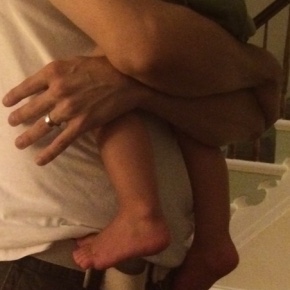
 This week has been a particularly tough one for our twins, Charlie and Amelia. At thirteen and a half months, we think they are cutting their molars, so their extreme fussiness is understandable. On Tuesday, I walked in the door of the kitchen, and before I had taken three steps, Charlie was toddling up to me as fast as his little legs and precarious balance would allow. He ran into me and buried his head between my knees, which is his way of saying, “Pick me up, Daddy.” I hefted him into my arms. He put his arms around my neck and his head on my shoulder. And for the next twenty minutes, I just walked around, holding him and speaking softly into his ear. It was a special moment, a physical heart to heart.
 You might be wondering if I accidentally read two weeks worth of Gospel lessons just now. The story of Jesus and the Syrophoenician woman ended satisfactorily, and at that point I could have said, “The Gospel of the Lord.” But the appointed lesson for today barrels forward into the next story, as well, and we read about Jesus healing a man who cannot hear and can hardly speak. We could focus on either half of this Gospel reading: there surely is enough in each to fill out a sermon. But today, I’m going to break a rule of preaching and bite off more verses than I normally do because I think the Gospel writer Mark places these two stories side-by-side for a reason. And this reason centers on the strangest word in the passage, a word that itself needs to be translated because Mark chose to preserve Jesus’ original language when he wrote it down. That word is “Ephphatha”: Be opened. Openness is the key to these two encounters. And openness is one of the keys to our lives as followers of Jesus Christ.
 Twice last week, I got to wear a tie. I went to the MASH gala fundraiser and to the Eastern Connecticut Symphony concert, at which several of our parishioners sang their hearts out performing Carl Orff’s Carmina Burana. The benefit was fabulous, the concert was wonderful. And I went to both wearing a tie. This may sound like a strange thing for me to report to you, but I assure you, I am going somewhere with this. Whenever I’m getting dressed, I’m faced with a wardrobe decision. Do I wear my black shirt and collar or not? If I decide not to, then I leave the house incognito. I’m still a priest, of course, when wearing a coat and tie or jeans and flip flops, but people at the concert hall or grocery store won’t be able to spot that about me on first glance. (They probably think I’m a college sophomore home on break.)
 Stigma is not a happy word. If you use it in a sentence, more than likely the word “stigma” will be linked to something that people view as disgraceful or humiliating, whether that view is warranted or not. A couple of us recently read a book called The Rich and the Rest of Us by Tavis Smiley and Cornel West, who spoke of the need to lift the stigma associated with the word “poverty” if we are ever going to muster the societal will to lift those on the margins. In years past, society has stigmatized attributes of people who exhibit less capacity than most, using words like “retarded” and “crippled” to describe those with mental and physical challenges. Suffice to say that members of every minority group – no matter the difference used to justify labeling them as “those people” – have been stigmatized in one way or another. Stigmas lead to segregation and prejudicial behavior and animosity. “Stigma” is not a happy word.
 A few people have asked me recently why we are using Rite I during Lent. For those of you who aren’t familiar with the red Book of Common Prayer, it contains two versions of our normal Sunday worship. We usually use Rite II, which includes more modern language and more overall choices than Rite I. But during Lent this year, I chose to use the older rite, which is why we’ve been saying words like “thee,” “thou,” and “beseech” over the last few weeks. Some churches choose Rite I during Lent because they think it has a more penitential tone than Rite II, but that’s not why we’re using it. Honestly, I don’t agree with that reasoning. Rather, we are using Rite I because of a single beautifully written sentence that we repeat nine times at the beginning of each service. In our normal service, Rite II, that sentence is rendered: “Amen. Lord, have mercy.” But in Rite I, we have the opportunity to pray this beautiful sentence after all but the last of the Ten Commandments: “Lord, have mercy upon us, and incline our hearts to keep this law.”
 Where the Wind...