Digital Disciple Preview: Virtual People (part 1 of 3)

Digital Disciple will be on the physical bookstore shelf and the virtual website shelf on May 1. You can pre-order it here. Here’s the first part of a three part preview that can also be found on my Facebook page and on Episcopal Cafe.com.

* * *

We call it an Internet “connection.” On any given day, I know that an acquaintance from high school just had a baby shower. I know that an old college friend chose the strappy sandals. I know who had one too many at a party last night. Through my keyboard, LED monitor, wireless router, and ISP, I’m connected to several layers of people—my close friends, my acquaintances, strangers with similar interests, and the hordes of people with spelling so dreadful it would make Noah Webster weep.
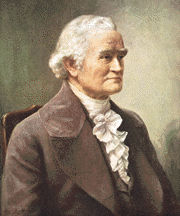
Doesn't Noah Webster look sad?

But we could just as easily call it an Internet “isolation.” While millions of little connections happen every day—from friends and relatives to subcultures and fan bases—these connections always happen remotely. I can see and hear people thousands of miles away using the warm box on my lap. But I can’t touch using Facebook. I can’t taste a friend’s tweets. And I sure can’t smell a Wikipedia entry. My senses are reduced by 60 percent. I have a contacts list on my Gmail account, but I rarely make contact. A wall of technology isolates me from you, and the more we use the Tech, the more comfortable we feel hiding behind it. We develop a dependence on what can only be described oxymoronically as remote intimacy.

Yes, we are connected, but more often than not we connect remotely. Yes, I may know your favorite bands and books, but I may never know the timbre of your voice or how heavy your footfalls are. Yes, community forms on the Internet, but how can you share a meal or look someone in the eye via an online forum?

I make the observations found in this book from a vantage point overlooking a pair of intersections. The first intersection occurs where the opposing forces of connection and isolation meet. These two forces have been around since the Garden of Eden, but never have they been as coupled as the Internet makes them. The second intersection occurs at the junction between Tech culture and the greater reality of following Jesus Christ our Lord.

Following Jesus Christ is first and foremost about connection, about the arms of love reaching from the cross to embrace everyone. The Word became flesh in Jesus Christ in order that we might see more clearly the connection that God yearns for us to have with one another and with God. The Internet offers wonderful opportunities for connection, but they always come attached with the danger of isolation. Like most things in this life, we can’t separate the danger from the opportunity; we can only hope to trend toward the opportunity while trying not to ignore the nature of the danger.

As the Internet continues to change the way we communicate and connect with one another, the opportunities and dangers grow increasingly intertwined. The trouble is that the speed of innovation has kept us from pausing, breathing deeply, and taking a hard look at technology’s effects on our lives. Consider that a hundred years ago, people dashed and dotted with the telegraph and wrote long correspondences in perfect cursive. Seventy-five years ago, they shared a phone line with half a dozen neighbors and sat in front of the radio in the evening. Fifty years ago, they had their own telephone numbers and televisions. Twenty-five years ago, mobile phones and personal computers had begun the big, boxy stage of their evolutions. Fifteen years ago, my computer spent an agonizing forty-five seconds doing a fuzzy R2-D2 impression while attempting to dial up a connection to the Internet. Ten years ago, my family got our hands on a shiny new piece of technology called a cable modem, and the connection tripled in speed. Today, broadband allows connections of ease and immediacy. The breadth and depth of content online have now matched the blazing download rate; indeed (and I’m saying this with only the slightest hyperbole), I could live my whole life virtually and never notice the lack of fresh air and exercise.

We communicate more quickly, more frequently, more globally (and often more anonymously) than ever before. The Internet, once a harebrained idea hatched in a military think tank, has pervaded our lives and our society. Removing it would be like amputating not an arm or a leg, but a central nervous system. I know I’m not alone when I confess that, while I don’t live my whole life virtually, I do almost everything online: shop, check baseball scores, read the news, watch TV, play games, chat with friends, research my sermons. I even met my wife through some combination of divine intervention and the Series of Tubes.

Happy Dancing Ewoks

(Sermon for September 5, 2010 || Proper 18, Year C, RCL || Luke 14:25-33)

The rain is so heavy that I feel like I’m driving through a carwash. I can barely see out the windshield, and I keep thinking that I’ve missed Furnace Brook Parkway. But just when I decide I need to turn around, I spot the sign reflecting green in the dim glow of my headlights. I turn left and five minutes later I park across the street from the Coffee Break Café. I make a mad dash for the dryness and warmth of the shop, but the rain still manages to soak my jeans during the ten seconds I’m out in the elements.

The moment I step into the café, however, I forget the dangerous drive. I forget the torrential downpour. I forget the soaked jeans and the English language and my name and how to walk correctly. The woman, whom I planned to meet at the café, stands before me wearing patterned rain boots, holding a steaming cup of tea, and smiling. And I forget everything about myself except for the fact that she is there to meet me – me of all people.

That was a little over five months ago. A little over five months from now, she and I will be married about ten feet over and four feet down from where I’m standing right now – right over there. Leah and I will hold hands, and Margot will direct us to look at one another and speak our vows. I will say, “In the name of God, I, Adam, take you, Leah, to be my wife, to have and to hold from this day forward, for better for worse, for richer for poorer, in sickness and in health, to love and to cherish, until we are parted by death. This is my solemn vow.”

In February, I will promise to love and to cherish Leah for the rest of my life. You might have guessed that I’m pretty excited by that prospect. And so, when I listen to this morning’s Gospel reading and hear Jesus say that to be his disciple I have to hate my wife, I’m just downright confused.

Return of the Jedi (1983) 20th Century Fox

Ever since I was a little kid, I’ve known that hate is a bad thing. In fact, I learned this lesson during my daily viewing of Return of the Jedi. Near the end of the film, Luke Skywalker finds himself standing before the twisted and evil Emperor Palpatine. The Emperor doesn’t want to kill the Jedi; he desires Luke to fall under the seductive power of the dark side of the Force. Palpatine has Luke’s lightsaber, and he tempts the young Jedi saying: “I am defenseless. Take your weapon. Strike me down with all of your hatred, and your journey towards the dark side will be complete.”

Even as a young child, I knew that Luke could not give in to his hate because then he would have been corrupted. He would have joined the dark side, and the film would not have ended with smiles and embraces and happy dancing Ewoks. I learned the lesson well. Hate is a bad thing. If you are anything like me, you were brought up learning the same lesson. So how do we encounter these words of Jesus? He says, “Whoever comes to me and does not hate father and mother, wife and children, brothers and sisters, yes, and even life itself, cannot be my disciple.” How do we obey a command that just seems so wrong?

The first thing we need to do is to make sure that we don’t ignore Jesus when his words sound wrong to our ears. When he says something that makes us uncomfortable, there is a tendency to skip over the offending words. The trouble is, skipping those bits is exactly the opposite reaction than Jesus is going for. When Jesus turns to the crowds and says these words, he employs shocking rhetoric in an attempt to make the crowd understand just what life following him looks like. In Jesus’ day, following spiritual gurus around was something of a pastime, akin today to following the Grateful Dead on tour. Most of the people making up the large crowds were following him because he was a local celebrity. When Jesus tells them that they can’t be his disciples unless they hate life itself, I imagine many of them left to find a less demanding guru.

So we shouldn’t ignore Jesus’ words when they sound wrong. But this still leaves the fact that they sound wrong. Now, please don’t interpret the rest of this sermon as an attempt to explain away Jesus’ tough words. Rather, permit me to reinterpret the word “hate,” and hopefully, when I’m done, the toughness of Jesus’ words will have remained intact.

In between last week’s passage from Luke 14 and this week’s, several verses fell through the cracks. Just before Jesus turns to the crowds and speaks today’s Gospel, Luke narrates Jesus telling a parable. In the story, all the people invited to a great dinner make excuses and fail to attend: “I have bought a piece of land, and I must go out and see it”; “I have bought five yoke of oxen, and I am going to try them out”; “I have just been married, and therefore I cannot come.” The host of the dinner becomes angry with these no-shows and sends his servants out into the streets to fill his house with all the people who wouldn’t normally be invited to a party.

Right after this parable, Jesus tells the crowds that to be his disciple they must hate father and mother and wife and children and life itself. The three people in the parable who made excuses were obviously not following this difficult command. Instead, they decided that land and livestock and spouse were more important than the great dinner. The word “hate” jolts us with its emotional connotation; but, based on the parable, I’m far from convinced that Jesus desires us to indulge in the emotion of hate. Rather, he uses the word “hate” to show that every person who isn’t Jesus is never meant to take the place of Jesus. Unlike the three people in the parable, those who come to Jesus cannot be his disciples unless they make him more important than everything else. Therefore, becoming Jesus’ disciples means putting Jesus ahead of all the other people in our lives.

Of course, this is incredibly difficult. But the incredibly difficult things that Jesus asks of us also turn out to be incredibly important. With his tough words about hating life itself, Jesus offers us protection from the most common sin in the book: idolatry. In the parable, the would-be guests make excuses to avoid the great dinner. The land, livestock, and spouse are their idols. In our lives, idols are those things that we turn to when we should turn to God. We let our parents, spouses, children, jobs, cars, computers, smartphones, and addictions invade the territory that should be God’s alone. We begin to look to something other than God for salvation. We mistake the creation for the Creator.

This is not bad just because our idolatry breaks one of the Ten Commandments. This is bad because when I set up another person as my god, my idolatry will eventually destroy both the other person and myself. If I made Leah into an idol, I would rely on her for everything. I would run her ragged trying to see to my needs. I would suck the life and the love out of her. And when there is nothing left, I would starve. Sooner or later, every idol ceases to be enough, and it’s usually not until this time that we realize our idolatry.

So let’s go back to those words that Leah and I will say to each other at our wedding in February. In all the good and bad times, I will promise to love and to cherish her. There is absolutely no way to fulfil this promise without the very first phrase I will say during my vows: “In the name of God.” God is the foundation of every healthy relationship. Loving God first is the only way to be able to love another. Cherishing God first is the only way to cherish another. We can only be Jesus’ disciples when we finally rid ourselves of any idea or notion that our ability not only to love, but to exist, comes from nowhere but God alone.

When I wed Leah, I will strive to remember that God formed us in our mothers’ wombs and God brought us into each other’s lives and God knit us together and God will continue to sustain us. God is the beginning, the middle, and the end. Cutting God out of our relationship – indeed, out of any relationship – simply ignores the reality that God is the foundation of all relationships. Cutting God out allows the sin of idolatry to creep in.

Jesus tells us that we must hate life to become his disciples. With this, he sets us the difficult task of putting him before all else. Accomplishing this difficult task means that when we cherish our loved ones, we remember that we are capable of that action because God cherishes us. When we love them, we draw upon the unrelenting outpouring of God’s love. And if we forget everything else – the English language and our names and how to walk correctly – we still remember that God somehow puts each one of us first. And so we thank God and ask for the grace to put God first. Everything else will find its proper place atop God’s sure and steady foundation.

Looking in the mirror

I don’t know about you, but I have to renew my relationship with God every single day. I have to look myself in the face in the bathroom mirror and let myself know that I still believe in God. I have to take a deep breath and remember that I am alive for one reason and one reason only — because God is still speaking and singing and loving me into existence.

Some days I look myself in the eye in the mirror and I know I don’t have it. Not today. I scratch off some dried toothpaste splatters from the mirror and take that deep breath and wonder where it all could possibly go. So quickly ’cause yesterday I had it. Yesterday, I was so full. Yesterday, I had that electricity surging up from the soles of my feet and arcing across the spaces between my fingertips. Yesterday, I had that peace in my heart that makes me want to run around the block a dozen times just to tire myself out enough that I can be still and know. And know that you are God.

Why do I have it some days and other days not? Heck, I’ve never used the word “it” more times in two paragraphs. But I use “it” now because I don’t know how to be more specific. I don’t have the vocabulary to express the utter joy I have when I discover and rediscover that I am a vessel of God’s grace, of God’s light shining in the darkness.

I do have the vocabulary to describe the days when I don’t have it, when I can’t seem to access the grace that I’m sure dances all around and within me. Restlessness. Exhaustion. Void. Desolation. Despair. I try to fill my day up so that it can end and I can sleep and I can wake up tomorrow and I can look myself in the mirror again.

In this week’s Gospel lesson, Jesus tells his disciples what’s going to happen to him. I’m going to suffer and be rejected. And I’m going to be killed. And three days later I’m going to rise again. And Peter rebukes Jesus for saying these things that couldn’t possibly happen to someone who he, Peter, has just proclaimed to be the Messiah. But Jesus rebukes him back: “You are setting your mind not on divine things but on human things.”

Then Jesus says something that makes looking myself in the eye in the mirror so very difficult: “If any want to become my followers, let them deny themselves and take up their cross and follow me. For those who want to save their life will lose it, and those who lose their life for my sake, and for the sake of the gospel, will save it.”

When I don’t have “it,” when I am desolate and the void seems so real and close and gaping wide, I forget that I gave up my life a long time ago. I gave it up, and when the world closes in I grasp at straws trying to grip that life again. I set my mind on those human things that only fill me up like junk food. And I spiral downwards from desolation to despair because my chosen cure is more of the disease.

So every single day, I have to renew my relationship with God. I have to decide to become a follower of Jesus Christ again and again and again. Sometimes, when I’m looking at myself in the mirror, I turn around and see the cross tattooed on my back. I remember that I got that cross etched into my skin because I so often lost the one I wore around my neck. My right hand reaches for the top of the tattoo and feels the raised bump of the black lines. I take that deep breath and know that God sure as hell isn’t done with me yet.

And so Jesus hands me the cross. And Jesus puts me and my cross on his back. And today — maybe not yesterday, and maybe not tomorrow, but today — I have “it.”

The invisible cross

For many years, I became queasy at the thought of having ashes scraped across my forehead — not because they are a reminder of my own mortality, not because I dislike being called to repent, but because I couldn’t square the action with Jesus’ command in the Gospel for the day. In the middle of the Sermon on the Mount, Jesus takes to task those who do things merely for show rather than for dedicated spiritual discipline. “Beware of practicing your piety before others in order to be seen by them,” he says. Don’t sound a trumpet when you give alms. Don’t pray ostentatiously on street corners so others will see you. Don’t disfigure your face when you fast. Give alms, pray, and fast in secret, “and your father who sees in secret will reward you.”ashes

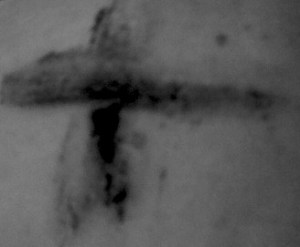
Don’t disfigure your face. These words stuck in my mind while walking to the altar rail, while watching the priest’s trembling thumb touch the powder, while feeling the gritty scrape first vertical then horizontal on my forehead, like sooty sandpaper. Why are we disfiguring our faces when Jesus just told us not to?!

I was preparing a children’s sermon when I realized I had it all wrong. As far back as I can remember, I had not seen the ashes as anything other than a disfigurement, a liturgically pretentious sign that I was a pious person. Everything changed when I tried to explain Lent to a group of five-year-olds.

“Did you know that you have a cross on your forehead,” I asked, arching my eyebrows as high as they could go. They all looked back at me with those funny, squinched up faces that kids make when they are quizzical. Several shook their heads emphatically. “It’s true,” I said, “but the cross on your forehead is invisible.”

That got their attention. They began looking at each other’s foreheads. I continued, “When you were baptized, a priest took some oil and made a cross right here” — I demonstrated on myself — “and said, ‘You are sealed by the Holy Spirit in Baptism and marked as Christ’s own forever.’

“That cross is still there, but you can’t really see it. It’s a reminder that you belong to God and that God loves you very much.” They nodded, open-mouthed. “Today is a special day because today we are going to use some special dust to make that cross appear on your foreheads again.”

On Ash Wednesday, we don’t disfigure our faces so others can see how pious we are. In fact, it’s just the opposite. By making visible again the cross that we received at Baptism, we acknowledge our impiety, our lack of repentance, our apathy to the suffering in the world. The renewed visiblity of our baptismal crosses indicts us for our indifference to our baptismal promises.

We look in the mirror and see a pair of lines, crude charcoal calligraphy. And we remember what it means to be a follower of Christ, to be sealed by the Holy Spirit and marked as Christ’s own forever. We remember that we have only a limited time on this earth to make a difference in the lives of those we meet, to show forth the love and light of God to a world too familiar with darkness. Disfigurement happens when we rub the ashes away and forget that there is still a cross written on our foreheads.

On Ash Wednesday we make that cross visible, if but for a brief time. This small, crudely drawn cross reminds us of another cross, the one that Jesus calls his followers to pick up when they decide to follow him. All too often, this cross also fades into invisibility, a wooden victim of our lethargy and misplaced priorities. During the season of Lent, we are given the opportunity to discern how to make that cross visible again.

Nets and new creations

(Sermon for January 25, 2009 || Epiphany 3, Year B, RCL || Mark 1:14-20)

In today’s Gospel, Jesus is out for a stroll along the shore of the Sea of Galilee. As he walks along, he notices the fishing boats tacking for deeper waters and trawling the shallows. He sees Simon and Andrew casting a net into the water. He sees James and John mending their nets in their boat. He calls out to them, “Follow me.” “And immediately,” says Mark, “they left their nets and followed him.” Immediately, they left their nets and followed him.

Now, I tend not to read the Bible metaphorically. Adding layers of interpretation to the words on the page usually serves to obfuscate rather than enlighten. This morning, however, I pray you indulge me one teeny-tiny metaphor. The four disciples Jesus calls in the Gospel leave their nets to follow him. They were fishermen, so working with nets came naturally to them. But, in landlocked West Virginia, we have little cause to handle fishing nets. So, I ask you, what are the “nets” to which we cling that prevent us from following Jesus? Put another way, what would be different about our lives if we left our nets and followed Jesus?

We could go into all the normal “nets” that ensnare us: grubbing for more stuff, distracting ourselves with the superficial glamour of the world, entering the wrong relationships. These certainly are nets, and they do trap us. But there is another, more insidious net that excels at holding us back from following Jesus.

This insidious net keeps us from practicing discipleship. The net entangles us when we confuse following Jesus with following the “idea of Jesus.” This is a strange turn of phrase, so let me unpack it. The “idea of Jesus” infiltrates our consciences when we forget that the events of the Gospel continue to play out today. The “idea of Jesus” disguises the person of the living Christ beneath layers of doctrine, history, and popular misconception, until he becomes a farcical shadow of himself, more akin to the Easter Bunny than the one true God. The “idea of Jesus” is so much easier to follow than the real Jesus because the “idea” makes far fewer demands on our lives and never asks us to become disciples. Dietrich Bonhoeffer says, “Discipleship is commitment to Christ. Because Christ exists, he must be followed. An idea about Christ, a doctrinal system, a general religious recognition of grace or forgiveness of sins does not require discipleship.”*

Think of it this way: A good portion of Americans love the “idea of soccer.”**  They love that there is a sport that the world plays together. They love seeing small foreign children running after a ball in the dust on TV. They love the big leg muscles and celebrity status of David Beckham. But very few Americans ever actually want to play soccer. There’s way too much running and way too little scoring for most of us.

In the same way, we often find ourselves taken with the “idea of Jesus.” There was once this cool guy who said some great stuff about love and acceptance. He collected a lot of enemies because he made friends with outsiders. He kept the wine flowing at this wild party. This “idea of Jesus” looks great on paper. But, like paper, the “idea” is flimsy and two-dimensional. The real Jesus, the living Christ, springs from the page, full of three-dimensional vigor, and he calls us to a life of true discipleship.

This is where the net comes in. If we are deluding ourselves into thinking we are following Jesus while we go about our lives as if nothing has or will change, then we are following the “idea of Jesus” instead. Following the Jesus who calls his disciples away from their nets necessitates change. Again, Bonhoeffer says, “Following Christ means taking certain steps. The first step, which responds to the call, separates the followers from their previous existence. A call to discipleship thus immediately creates a new situation. Staying in the old situation and following Christ mutually exclude each other.”**

We run back to our nets because this newness frightens us. When I moved to Alabama at age 12, no one could understand my thick Rhode Island accent, I called the water fountain a “bubbler,” a dusting of snow was a blizzard, the Red Sox weren’t on TV, and I didn’t know that saying “sir” and “ma’am” was integral to my survival. My life was different and uncomfortable and humid. I just wanted to go home. But, in the slow march of years, Alabama became home.

When we leave our nets and follow Jesus, we give up the trappings of the illusory homes we have built for ourselves. We step out of our comfort zones, and hopefully we never get too comfortable ever again. As we strive to follow Jesus, we may wonder why we never reach a new normal, why that initial feeling of discomfort persists. Then we realize that following Christ means continual renewal, constant reshaping. Paul says that if “anyone is in Christ, there is a new creation” (2 Cor. 5:17). As new creations, we are not new a single, solitary time, but every hour of every day. This newness keeps us from becoming complacent, keeps us from sitting in our boats as Jesus passes by. The discomfort propels us forward like dissonance in a Beethoven sonata. Indeed, a piece of music comprised of pleasing, consonant chords would be exceedingly boring. Likewise, following Jesus means dragging our comfort zones along behind us as we constantly step out of them.

Following Jesus is necessarily a nomadic existence. Our home is not a place, you see. Our home is a person. When we follow Jesus, we give up the trappings of our illusory homes for a true home by his side.

The flimsy “idea of Jesus” can only provide us a home built on the sand, which collapses whenever the winds and rains come. The “idea of Jesus” may bring us to church one day a week, but it will not instill in us the desire to seek Christ the other six. It will not demand that we encounter Christ in every person we meet. It will not motivate us to interrupt our net-mending to serve the poor or pray for guidance or praise God for the simple fact that we are marvelously made.

Because it makes no demands on us, the “idea of Jesus” causes us to mistake self-satisfaction for discipleship and comfort for salvation. But the real Jesus does not call us to be comfortable. He calls us to be free and invites us to use our freedom to choose a life of service in his name. If we do not actively seek to be Christ’s hands and feet in the world, if we do not take seriously our role as disciples, then we will be complicit in allowing our Lord and Savior to drift into the obscurity of legend or tall tale. As Søren Kierkegaard puts it, “Discipleship…really provides the guarantee that Christianity does not become poetry, mythology, and abstract idea.”****  Following Jesus means offering ourselves as conduits for turning the abstract into the concrete. Put another way, as the Letter of James says, “If a brother or sister is naked and lacks daily food, and one of you says to them, ‘Go in peace; keep warm and eat your fill,’ and yet you do not supply their bodily needs, what is the good of that?” (Jas. 2:15-16)

Jesus, the true Jesus, calls to us. He is not an idea or a design on a T-shirt or a cool guy who said some nice stuff once. Jesus, the living Christ, walks up to each one of us and invites us to a new life of hope and love and tears and pain and joy and freedom. He looks each one of us in the eye, says, “Follow me,” and radiates the abundant grace that allows us to do so. Join me in praying that each one of us will meet his gaze, leave our nets, and follow him.

Footnotes

* Bonhoeffer, Dietrich. Discipleship. Minneapolis: Fortress Press. 2001. p 59. (Italics mine)

** I borrowed this idea from the hilarious blog Stuff White People Like.

*** Ibid. 61-62

**** Ibid. 59 (in footnote)

To be that follower

(Sermon for August 31, 2008 || Proper 17, Year A RCL || Matthew 16:21-28)

Imagine with me the Apostle Peter, who is in Rome near the end of his life, thinking back on that day spoken of in this morning’s Gospel. *

The coals in the cooking fire still smoldered hours after the last log was cast on them. I awoke in the pre-dawn chill and warmed my fingers over the scant heat. Mine was the night’s last watch, and I muttered to myself about the senselessness of posting a sentry. But our resident Zealot,** the other Simon, had spoken persuasively about the need for vigilance, especially as Jesus’ words reached more important and more vindictive ears. As the foggy, half-light of dawn crept through our camp, I saw movement coming through the scrub from the foothills. I was about to wake the Zealot when I heard the tune of a psalm carried on the breeze, and then Jesus himself stepped out of the mist. Under one arm, he had a load of sticks and twigs, which he deposited on the coals. Blowing gently on the embers, he rekindled the fire and sat down next to me.

“Lord, you shouldn’t go off alone like that. It isn’t safe.” Apparently, I said this louder than I had meant to because our companions began to stir.

“You’re right,” he said, “It probably isn’t safe.” He turned to look at me and smiled. “But I wasn’t alone, Peter. No. None of us is ever alone.” He paused, held his breath. Then he exhaled slowly, and his cold breath mingled with the smoke from the damp twigs on the fire. He called out to those still sleeping. “Gather around, everyone. I have something to tell you.”

Once the rest of our group was seated at the fire, Jesus lifted his head and greeted us each by name. “My friends,” he said, “Yesterday, I asked you to keep my identity a secret. I asked you not to tell anyone that I am the Messiah. I know I can trust all of you, and this morning I have more to entrust to your confidence. Peter has just cautioned me about the danger of going off alone. Simon has you all standing guard through the night. I thank them both for their devotion to our safety. However, my friends, this morning I must tell you where our story is going, where my path is leading. Soon, I will abandon the safety of these hills and go to Jerusalem. Once there, I will ask you not to protect me. Men from the elders and the chief priests and the scribes will come, and they will arrest me, and they will beat me, and they will kill me. And three days later I will be raised from the dead.”

I stood up and looked down at Jesus. I didn’t know what to say. Twenty minutes ago he was rekindling the fire, and now he was talking about his own fire being snuffed out. I looked around at my companions—stunned into silence every one, even Bartholomew who always had some joke or jest on his lips. I started walking away. I needed to get away.

I thought I had everything figured out. I thought I knew what was to come. I saw him do amazing things: I saw him make the blind see and the lame walk. I saw him cleanse the leper’s skin. I saw him feed five thousand with enough to feed five. I saw him cry out in the storm and calm the waves. The words of the prophet were coming to life before my very eyes. The day before, Jesus had asked us who we thought he was. “You’re the Messiah,” I had said, and something inside me that was not myself told me I had spoken the truth.

But what kind of Messiah lets himself be led like some silent sheep to the slaughter? What kind of Messiah allows himself to be killed? The Messiah is the heir to David’s throne, the king who brings victory over our oppressors, the warrior who will sweep our enemies from our land and make us free once again. Not one who surrenders. Not a victim. Not a dead man.

These maddening thoughts crashed into me, and I dropped to one knee, my chest heaving, my cheeks moist with tears. I felt a hand on my shoulder and looked up. Jesus was there, looking down at me. “Why, Lord?” I snarled from my kneeling position. Then I stood up and shouted in his face: “Why? I trusted you. I called you Messiah and you did not deny it. I gave you my life, and for what? So that I might dig your grave?” I turned around and put my hands on my head, squeezing as if the pressure would keep my mind from flying apart. “Heavens preserve you, Lord. This must never happen to you.”

Jesus turned and looked at me or into me. When he spoke, his voice was calm, but commanding. “Get behind me, Satan! You are a stumbling block to me; for you are setting your mind not on godly things, but on human things.”

Then he walked back to camp, leaving me alone in the morning fog. “None of us is ever alone,” I heard him say, as in a distant memory. I followed him back to the fire, my thoughts as thick as the fog. Yesterday, I was Rock. Today, I am stumbling block? Yesterday, the father in heaven was revealing things to me. Today, my mind is set on human things. What happened? What changed?

I had been clinging so tightly to my own image of the Messiah that I failed to see this new, brilliant vision of the Christ in my midst. Where was his army marshalling to cast out the Romans? Where were his generals and siege towers and chariots? Of course, there were none. Instead of soldiers there were blind men with new eyes. Instead of swords and shields there were loaves and fishes. Instead of slaughter and death there was healing and life for all. I realized in that moment that I was the blind one: I missed what was there because I was looking for what was not. I was the deaf one: I had never heard Jesus properly because I was always filtering him through my own preconceptions. I vowed then and there to listen with new ears and see with new eyes.

As I reached the camp, I heard him say to our companions, “If any want to become my followers, let them deny themselves and take up their cross and follow me. For those who want to save their life will lose it, and those who lose their life for my sake will find it.”

I wanted to be that follower. But I couldn’t make it happen that cold morning. There were too many changes happening and just too much new information to process. And I couldn’t make it happen later that year. Instead of denying myself, I denied Jesus. Three times in one night. He took up his cross and I fled to save my life. But three days later, he rose from the dead, and I saw him, and that voice inside me remembered that he said he would do this. But was I his follower yet, even then?

The years bring clarity, and now I know that I was his follower even on that cold morning and on that terrifying night before his death. You see, being his follower had very little to do with how much I understood. I didn’t understand the kind of Messiah he was and yet he still welcomed me back, still loved me, no matter how much I shouted at him. Being his follower also had very little to do with how good I was at it. I denied him and yet he still welcomed me back, still loved me.

Yes, the years do bring clarity, and many things are clear to me now. Jesus never said that those who lose their life for his sake will save their life. The saving is Jesus’ job and his alone. No. He said that those who lose their life for his sake will find their life. You don’t find something without searching for it. The search gave me the space to let go of my preconceptions, to lose all those things I was holding onto so tightly—my own vision of the Messiah, my own need for Jesus to be exactly who I needed him to be. As I let go of those things, the search offered me the license to believe in Jesus without understanding everything he said or did. As my own death approaches, I see that the losing, the searching, and the finding are all somehow wrapped into one. The One I seek has already found me. The One I seek is bearing his cross with me. The One I seek is walking before me as I try to follow him.

None of us is ever alone. No matter how much or how little I think I understand, I hear Jesus’ voice inside of me saying, “Understanding will come…in time. For now, lift up that cross and follow me.”

Footnotes

* This narrative type of sermon has its roots in the ancient Jewish practice of Midrash, in which scholars took the stories of scripture and expanded them to reach new insight and new interpretive depth.

** The Zealots were a sect that favored violent encounter to achieve political ends. If they were around today, they’d be one man’s freedom fighters and another man’s terrorists. I try not to mix the accounts of the Gospel, but in this case, I borrow a bit from Luke, who assigns the category of Zealot to the other Simon. Matthew does not.