

Sermon for Sunday, November 2, 2014 || All Saints Year A
 The feast of All Saints, which we celebrate today, is about family, namely the family of God. Each saint has a special day commemorating his or her life of devotion and service, but on this day we celebrate all of them. We celebrate them collectively: not as a group of individuals who walked the way of discipleship alone, but as the glistening threads of God’s tapestry woven together to tell the story of God’s presence in creation since the time of Jesus. However, this tapestry is vast, so much bigger than the threads of particular saints could fashion, and so God weaves other threads into the warp and weft in order to complete the story. I have a thread. You have a thread. And Reggie, the beautiful six-month old collection of smiles and joy we’ll be baptizing in a few minutes, has a thread. The tapestry God continues to weave is the story of God’s family from the dawn of time. It is the story of the people of Israel. It is the story of the Gospel. And it is our story because we are all members of God’s great family. Today, we celebrate God weaving us together with all the saints into the story of this great family. And today, we celebrate bringing another person into that story, into this great family, when we baptize Reggie.
So what’s really going on in baptism? The traditional understanding tells us that baptism serves as the initiatory rite of the church and marks the cleansing of our sins. Now neither of these definitions is wrong (let me be clear), but I think if we stop there we will be prone to misunderstanding. We need to dig a little deeper. Here’s one thing to remember about baptism, and this will be on the test (there’s no test): the sacrament of baptism affirms and celebrates a state of being that already exists. The action of baptizing doesn’t create anything new; rather, the sacrament marks our participation in something God is already doing.
Here’s what I mean. At the end of the baptism service, we will welcome Reggie saying: “We receive you into the household of God. Confess the faith of Christ crucified, proclaim his resurrection, and share with us in his eternal priesthood.” However, by virtue of Reggie being born in the image and likeness of God, he is already a member of God’s family. He is already part of God’s household. He already has a thread in God’s tapestry. Thus, his baptism is an affirmation and celebration of a state of being he already possesses. Today we will celebrate his membership in God’s family so that we can see the deep truth of God’s reality: that we are all members of that family.
Participating in this deep truth is what makes baptism one of the sacraments of the faith. If you’ve taken a confirmation class or CCD in the Roman Catholic Church, then you might remember the classic definition of a sacrament: An outward and visible sign of an inward and spiritual grace. Another way to put this is that sacraments are windows through which God gives us the gift of viewing the true and eternal reality of God’s movement in creation. Sacraments take ordinary, everyday things – water and bread, for example – and use them to reveal extraordinary holiness hidden in plain sight.
When we baptize Reggie, the hidden will be revealed for a moment, and we will see the unconditional love of God embracing a soul who has never done a thing to earn that love. And we will learn once again that we can do nothing to earn it either. We can only respond to God’s unconditional love in our lives.
If Reggie has done nothing to earn God’s love, then neither has he done anything to reject it, so you might be wondering why we baptize to cleanse sins, which you’ll recall was the second part of our traditional understanding of baptism. Once again, we are affirming and celebrating a state of being that already exists.
The word “baptism” sounds all fancy until you dig down to its roots. “Baptism” simply means “to wash.” When we bathe, we scrub away all the dirt and sweat and grime that accumulates during our day-to-day lives. We have to bathe regularly because we get dirty regularly. But we baptize only once because baptism is a celebration that our sins are forgiven – not just the ones we already committed but all of our sins past and future, everything that has, does, or will separate us from God. When we wash in the waters of baptism, we join God’s reality in progress, a reality in which nothing in all creation can separate us from God’s love. The sacrament of baptism allows us to mark the beginning of our participation in this reality.
So if baptism is an affirmation and celebration of a state of being that already exists, you might be wondering if it asks anything of us at all. If we’re just jumping into a river that’s already flowing, what is our responsibility in all of this?
Well, the action of baptism takes place in a few seconds at the font behind me. We’ll pour a few ounces of blessed water on Reggie’s forehead, say the words, and that will be that. But the baptismal life continues from that moment on. The baptismal life is a sacramental life, a life in which each baptized person becomes one of those windows into the true and eternal reality of God’s movement in creation. Thus baptism invites us into deeper commitment as followers of Jesus Christ, deeper relationship with God, and deeper resonance with the Holy Spirit’s presence.
When we reaffirm our Baptismal Covenant in a moment, we will promise with God’s help to commit ourselves once again to serve God in this world. We will remember that nothing separates us from God’s love, that we are all members of God’s great family, that we all have threads woven into God’s tapestry. And we will celebrate that God invites us to live baptismal lives, committed to bearing witness to the true and deep reality of God’s presence in creation.
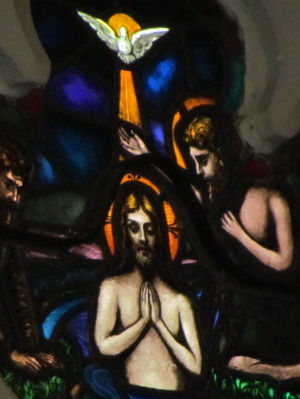
 Since this is my last sermon, it seems only fitting that today I’ll be talking about a beginning. In a few minutes, we will reorient our worship to the south side of the church. We will stand around that behemoth stone basin over there. (As an aside, I have no idea how our font didn’t sink the ship that carried if here from England all those centuries ago.) Anyway, we will stand around the stone basin, say prayers over the water, and baptize little Kaylee. But before we do, let’s have a quick session of Christianity 101: An Introduction to Baptism. It seems only fitting to do this on a day when we will witness a baptism and when we’ve just read about Jesus’ own baptism by John in the River Jordan.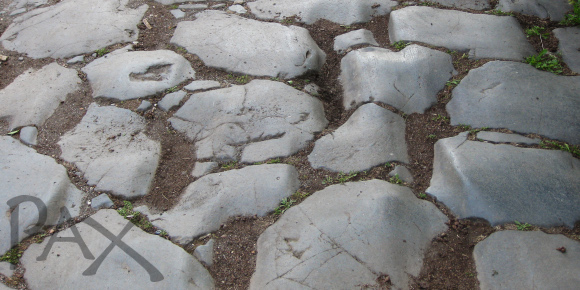
 To get to this unvarnished truth, we first have to understand how people in Jesus’ time would have heard the word “peace.” One version of the word was a simple greeting: “Shalom.” Another use was for the cessation of upheaval: “Peace, be still.” But a third use was more sinister – peace as propaganda. You’ve heard of the “Pax Romana,” the “Peace of Rome.” This was the glorious gift of Rome to the peoples fortunate enough to come under the Roman banner and Roman “protection.” Well, that’s how the Romans would have sold it. The Pax Romana really spread by the edge of the sword, and conquered peoples lived in fear and distrust of their occupiers.

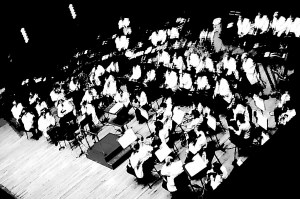 Each one of us has the music of God resounding within, but the symphony is incomplete until we have found each other, until we have joined together in fellowship as the orchestra of God. In Greek, this fellowship is called koinonia, but I’ve always thought that “fellowship” is a rather limp translation. For the sake of our metaphor, let’s translate koinonia as “harmony,” which lands much closer to the descriptive intent of the Greek word. Musical harmony is the collection of notes that adds structure, color, tone, depth, and meaning to the main tune. This tune, called the “melody” is the music of God within us. The combination of our own unique passions, trials, joys, griefs, and loves creates the harmony of the music of God.
