What are you looking for?

(Sermon for Sunday, January 16, 2011 || Epiphany 2, Year A || John 1:29-42)

The hospital was a maze. Children’s Medical Center had several buildings, and they were all connected somehow, but getting from one part of this building to another part of that building always involved multiple corridors and elevators. During the summer of 2006 between my first and second years of seminary, I was learning how to be a chaplain at this sprawling medical complex. One of the first things I learned was the hospital policy of refraining from giving directions to visitors. The hospital was just too confusing. Instead, if little Jimmy’s grandmother asked me how to get to the oncology unit, the hospital policy directed me to take her there myself and to make sure she knew her way back to the parking garage (which happened to be two elevators, three corridors, a skywalk, and two Starbucks away). In effect, hospital employees said, “Come and see” to their visitors and then accompanied them all the way to their destinations. These words – “Come and see” – make up Jesus’ second line of dialogue in the entire Gospel according to John. We’ll get to them in due time. But right now, let’s talk about Jesus’ first line of dialogue.

His first five words would not have been out of place in the labyrinthine hospital: “What are you looking for?” You might hear this question at any hospital elevator as any lost visitor stares helplessly at the building schematics printed on the wall. What are you looking for? Jesus speaks these words to two of John the Baptizer’s disciples after he notices them following him. At this point in the Gospel, Jesus has no followers of his own. He is the new guy in town. John the Baptizer owns the market on charismatic fellows who say compelling, challenging things. But John knows who Jesus is, so John encourages his disciples to begin following Jesus. Right away, Andrew and an unnamed person – quite literally – begin following Jesus.

When Jesus turns around and challenges them with his question –“What are you looking for?” – his words speak on two levels. This dual-layered dialogue is a common occurrence in the Gospel according to John. The first layer speaks to superficial, surface meaning. This layer is easy for Jesus’ listeners to access, and so they become drawn in. Then the second, deeper layer of meaning presents itself. Many of Jesus’ listeners resist this deeper level. But those who do dive deeply find rich, life-giving substance in his words.

With Jesus’ first words in the Gospel, he challenges Andrew, the unnamed disciple, and us to dive deeply to this second level of meaning. At the first level, John’s two disciples probably interpret Jesus’ question as a straightforward query into their present intentions. Do they happen to be going his way by chance or are they following him purposefully? But at the second level, Jesus’ five words penetrate to the deepest places of the human heart. What are you looking for? His question beckons an answer from those same deep places within us. The trouble is there are so many potential answers to this question that digging through them to find the ones that exist in those deep places can become problematic to say the least. Here’s what I mean.

What are you looking for?
A mid-sized sedan with good gas mileage and a high safety rating.
A doctor who understands my symptoms and actually seems to care for my wellbeing.
An assisted living facility for my parent whose mind is rapidly deteriorating.

What are you looking for?
The right greeting card to express my feelings.
A college that’s not too big but still has my major.
A quick hit to forget the day.

What are you looking for?
A boyfriend I can bring home to mom.
A scrap of meaning in a dead end job.
My car keys.

What are you looking for? John’s two disciples seem to understand that the “car key” type of answers will not suffice because Jesus’ words penetrate right into their hearts. So instead of answering his question, they ask one of their own: “Teacher, where are you staying?” Now, Jesus apparently does not hold a monopoly on dialogue with dual layers. At the first level, they want to know just what the question appears to ask: “In what house are you going to rest your head tonight?” But on that deeper second level, their question seeks a much more profound answer. Where are you staying? In Greek, the word that is translated as “staying” means quite a bit more than the English equivalent. Rather than the connotation of “staying at a hotel” or “staying on a friend’s futon,” the Greek word means to “abide” or to “continue to be present.” Thus, at the deeper level, the disciples ask Jesus where he dwells, where he abides, where he is present.

Their question, then, is the best response to Jesus’ own question. What are you looking for? Lord Jesus, I’m looking for where you abide. I’m looking for where you are present in my life. I’m looking for where you dwell in this particular situation I’ve gotten myself into.

When we receive Jesus’ question at the deeper second level, we can feel his words penetrating our hearts. We can hear his voice whispering up from the very depths of our beings: What are you looking for? Paying attention to his words rising from those depths helps us locate our own responses, the ones that originate in the same deep places of our beings. The transient, daily, car key type answers to the question fall away when we search deep within.

The best way to begin this search is with the disciples’ question: “Where are you staying?” When we ask this question, we open ourselves to finding Jesus dwelling somewhere in every facet of our lives. We open ourselves to hearing his voice whispering his presence into and out from our souls. We open ourselves, and in doing so, we turn the depths of our beings outward. The hidden deep places, where our responses to Jesus’ question lie dormant, become the pieces of ourselves that we display to the world. These pieces of ourselves are our callings from God. They are our personal, individual discoveries of Jesus beckoning us to find him in everything we do, in everything we say, and in everyone we meet.

And this brings us back to Jesus’ second line of dialogue in the Gospel according to John: “Come and see.” What are you looking for? Teacher, where are you staying? Come and see. Jesus invites us to see where he abides, where he is present in our lives. He invites us to dwell with him, no matter the situations we find ourselves in. Finding his presence means we have found those deep places within ourselves. Abiding in his presence gives us the grace to be vulnerable and to show the world the deepest yearnings that God has put in our hearts, the callings that God has blessed us to follow.

And the good news is this: “Come and see” means that Jesus will be with us, to take us where we need to go, to show us what we need to see. Just like the hospital employees accompanying a lost visitor to her destination, Jesus remains with us throughout our journeys. He dwells in our hearts whispering his question: “What are you looking for?” And when we ask him in return where he is staying, where he is abiding in our lives, he walks one step before us, saying, “Come and see.”


What Will I Become: A Decade with God’s Call

The following post appeared Saturday, January 8th on Episcopalcafe.com, a website to which I am a monthly contributor. Check it out here or read it below.

* * *

John Lennon popularized the saying that life is what happens to you when you’re busy making other plans. For followers of Jesus Christ, this isn’t entirely accurate. You see: God usually has plans for us that are fairly different from the ones that we have for ourselves. Our joy as followers of Christ happens when we listen for and then respond to God’s call in our lives. And so, to modify Lennon’s quotation: life is what happens to you when you’re busy allowing your plans to resonate with God’s.
Here’s a snapshot of three times over the last decade of my life that shows my movement from my plans to God’s, a movement that I assure you continues today. (And please, don’t misunderstand – just because God’s plan for me has so far been to become a priest, know that God’s call manifests in myriad other ways, as well.)

January 11, 2001

It is ten years ago, and I am really starting to think long and hard about what my life might look like as an adult. My senior year of high school is half over, and my college applications are finished. The days are approaching when I will hourly test the mailbox’s hinges hoping for a fat letter from Sewanee, my first choice college. The days are long gone when I dreamt of being a part-time firefighter and a part-time paleontologist. With my college letters soon to arrive at my house, it is high time to think about the future, the real future apart from the shiny red engines and dinosaurs’ fossils of childhood. And so, right before I turn eighteen, I type a few paragraphs entitled “What Will I Become?”

I believe that when a student enters his or her freshman year of college, he or she should be open to a vast array of new experiences. From my perspective, having my life planned the minute I graduate from high school is unhealthy. I am not saying that a student should not narrow his or her interests at all, but having a rigid path to walk can become detrimental.

As I prepare for my college education I have envisioned no less than four scenarios, one of which has only begun to fester in my brain. I know I would like to continue writing as I grow older, but I am practical and also know that very few writers succeed. Nevertheless, my first scenario is to major in English and hopefully have something published while I am still attending college. The second is to major in journalism and become a reporter; I would love to work for ESPN, but that is more of a dream than a reality. The third scenario is to go pre-law and attend law school. I have always been interested in the judicial process, but I am not sure I want to be a lawyer.

The fourth scenario, the one that is starting to fester in brain, is to double major in English and political science, and then perhaps still go to law school. I do not think I want to be a politician, but I would consider being someone linked to one. I am in the fledgling stages of an AP United States government class, and it absolutely fascinates me. This last scenario is beginning to excite me because it connects the other three. If I became a speechwriter or press secretary then I would have to use skills from all of my other loves. I would need the communication skills of a journalist, the writing skills of an English major, and the thought processes of a lawyer. […] I have narrowed my mindset some, but I will use the next few years to truly decide what I want to do with the rest of my life.

December 28, 2004

The acceptance letter comes and I pack up for Sewanee. Four years later, I am nearly done with the double major, though music composition has replaced English as one of the pair. Halfway through another senior year, I write again about what I will become, this time in response to an essay question on the application for Virginia Theological Seminary.

At the beginning of the second semester of my senior year of high school, I sat down at my computer and wrote out a list of possible career paths in an attempt to bring some focus to the new world that would soon open up to me. I called the list “What Will I Become?” and it included writer, journalist, lawyer, and speechwriter. With this exercise, I was trying to persuade myself that it was perfectly acceptable not to have my future planned out before I went to college. The piece concluded with this sentence, “I have narrowed my mindset some, but I will use the next few years to truly decide what I want to do with the rest of my life.” A year later, my entire perspective changed.

I was taking a humanities class the second semester of my freshman year at Sewanee, and we read the Confessions of Saint Augustine. I was truly struck by Augustine’s attempt to look back over his whole life and search for God’s movement in it; indeed, the text is one long introspective prayer. Heartened by Augustine’s example, I tentatively began to look inside myself. Over the course of the semester, “what do I want to do with the rest of my life” became “what does God want me to do with the rest of my life.” With this new paradigm, my heart and mind became open to new possibilities—or to what I thought were new possibilities. Upon further reflection, I have discovered that this new and exciting avenue, becoming a priest, is actually the earliest path open to me that I had ignored for years.

You see, my father graduated from seminary when I was six years old, and I grew up in the church. I was never the stereotypical rebellious priest’s kid; on the contrary, I always went to services, but for the first seventeen years of my life, the Word and the liturgy failed to move me. I went to church, I was baptized, I was confirmed. I believed in God through the borrowed faith of my parents. But my own faith was still nascent. The church has caused my family intense pain and overwhelming joy, and throughout my early teenage years I was always on guard in church because the painful times were ever so much more vivid in my mind. I would not allow myself to be hurt again, would not allow myself to become vulnerable; therefore, I would not allow myself to love. People would jokingly ask me if I was “going to follow in my father’s footsteps.” Heck no, I always thought, I know what he has to put up with. The pain that kept my faith locked away also kept me from seeing my true calling.

However, on a Sunday morning in October of 2000, something miraculous happened, something that I have been trying to put into words ever since. But mere words are inadequate when the power of the Living God becomes involved. To put it the best I can, I had a moment with God, in which I felt connected to both the enormity of God’s movement in the world and the intimacy of an intense feeling of personal love…. A little over a year later, with Saint Augustine’s example newly in my mind and this transforming experience of God’s love still reforming my heart, I discerned that I was called to the path that has always been only one step away.

December 3, 2007

Another acceptance letter comes, and I attend seminary. Three years later, during my final senior year, I write again about what I will become, this time within a fortnight of the event when “What will I be” will turn into the “What I am.”

A few weeks ago, I decided to try on the outfit I am planning to wear to my ordination. I unzipped the suit bag and laid out the trousers and jacket. I put on my brand new (quite stiff, still) clergy shirt and collar. Then I added the suit, shoes, and belt. As I approached the mirror, I hesitated. I wasn’t sure who I would see looking back at me. A hand, then an arm, then my body appeared in the reflection. I looked me up and down. I folded my hands. I tried to raise one eyebrow and failed. I unbuttoned the jacket and stuck my hands in my pockets. I smiled. There I am, I thought.

As I approached the mirror, I was afraid that I would not see the me I have always been because I was decked out in the attire of the me I am becoming. But as I assumed a stance, a gesture, a facial expression that are uniquely mine, I realized that the mere trappings of the calling to which I have responded will not override the me that continues to respond to the call. When God called me to the ordained life, God called me. God called a person with both gifts and limitations, both experience and baggage. As I looked at my reflection, I did not see a necessarily better me, but the me that shows outwardly my striving to accept God’s call.

As I thought that, I felt my gut twinge with the same feeling I used to have when a fly ball was hit to me in center field. Go and catch it, my gut used to say. Now it says, Look at the way God has moved in your life. Now what are you going to do about it? In many of the places in the bible where our new translations use the word “heart,” the text really says “gut.” In my gut, I know I am called to serve God because I get that same feeling when I contemplate my future. In my gut, I sense the utter enormity of the One I am called to serve. In that deep place, at the very core of my being, I know that the me I am and the me I am becoming are both the me that God has called. Indeed, God’s call created the me I am.

Today

Three more years, the first three of my ordained life come and go. I sit at my computer reading the words I wrote over the past ten years, and I hear echoes of the person I used to be, echoes that somehow became solid, sunk down into my soul, and now fortify the call that God continues to breathe into my life. Another decade spans out ahead of me: marriage in less than two months, a parish in which to serve God, a PhD, followed, perhaps, by a post helping students learn the art of preaching. Some of these surely are part of God’s plan for me, but, even so, I must not allow my plans to become idols that pull me away from God. I must continue to listen and strive to resonate with God’s call. And I must keep myself open to all of God’s glorious possibilities by wondering: what will I become tomorrow?

The Expendable Crewman

(Sermon for Sunday, December 26, 2010 || Feast of St. Stephen ||Acts 6:8—7:2a, 51c-60)*

In 1999's Galaxy Quest, Guy Fleegman (far left) is an actor who once portrayed an expendable crewman on the show. When the cast finds themselves on a real space ship fighting real aliens, Guy is convinced he's going to die "to prove the situation is serious."

There’s an old joke about Star Trek concerning “expendable crewmen.” When members of the main cast beamed down to a planet, the away team always seemed to include one extra person whom the audience had never seen before. Predictably, the writers killed off this extra a few minutes later to show the dire urgency of the crew’s predicament. Seemingly, Luke (the writer of the Acts of the Apostles) and the writers of Star Trek have this in common. Luke introduces Stephen in chapter six, and he’s dead by the end of chapter seven. The patron saint of this church appears in all of two chapters of one book of the Bible. And his death shows that the situation for Jesus’ followers is, indeed, dire. Could the founders of this church have possibly named our parish after an expendable crewman?

At first glance, Stephen sure looks like a prime candidate for this expendable crewman status. We know nothing about him besides the fact that he was among the first seven deacons chosen by the apostles. Also, his feast day happens to be the day after Christmas, which is like having your birthday and Christmas right near each other and only getting one set of presents a year. And furthermore, the framers of our lectionary readings effectively gutted Stephen’s story. We just heard the beginning and the end, but we missed Stephen’s epic sermon in the middle. These three reasons all but confirm Stephen’s expendable condition. I might as well stop right now because Stephen was never part of the main crew anyway.

But wait just a minute. Let’s look a little bit closer at this by going backwards through my three reasons for Stephen’s supposed expendability. If you look at your bulletin, you’ll notice that we skipped from verse two to verse 51 of chapter seven of the Acts of the Apostles. The stitching up of the hole between these verses happens so seamlessly that you’d never ever notice. Here’s what I mean: “And Stephen replied, ‘Brothers and fathers, listen to me. You are forever opposing the Holy Spirit, just as your ancestors used to do.’ ”

Did you catch the break between verse two and verse 51? Stephen says, “Brothers and fathers, listen to me,” and then he launches into a beautiful and concise summary of a sizable chunk of the Hebrew Scriptures. He recounts the stories of Abraham and Joseph and Moses. Finally, he arrives at David and Solomon and the building of the Temple. All the while, Stephen teaches about the history and traditions of Israel, and his audience is the very group of people, who are supposed to be the most knowledgeable about those topics.

Now, I can’t find hard data to support this, but I’m pretty sure that besides Jesus, Peter, and Paul, Stephen has more dialogue than any other person in the narratives of the New Testament. And all in the space of two chapters! He seems less expendable now for sure. Stephen’s epic sermon (which I’m assigning as homework for next week – just kidding) serves as a link between Stephen’s witness as a follower of Jesus and the oldest traditions of the Hebrew people. His accusers brought him to the council on trumped up charges of blasphemy against the very tradition that his speech confirms. But buried in his sermon is something that shows that Stephen, though a courageous Christian witness, doesn’t quite have everything figured out.

Nine times during the speech that we didn’t read this morning, Stephen refers to the folks in the old stories as  “our ancestors.” We all come from Abraham, our common ancestor, Stephen says. Our ancestors were enslaved in Egypt. Our ancestors made the golden calf. Our ancestors brought God’s holy tent into the land of promise. Nine times, he claims kinship with his accusers and with the angry council members.

But then, when the reading we heard this morning picks up again, Stephen switches. “You stiff-necked people,” he says, “uncircumcised in heart and ears, you are forever opposing the Holy Spirit, just as your ancestors used to do. Which of the prophets did your ancestors not persecute?” When Stephen accuses his accusers of persecution, he removes himself from the group. Because he is now being persecuted himself, he claims no complicity in the sins of “your” ancestors, who, of course, are his, as well.

With this switch from “our” to “your,” Stephen severs the connection he had with his accusers and the council. A few minutes later, they violently drag him out of the city and stone him to death. Of course, their act of murder is the greater sin. But by removing himself from the corporate sin of their common ancestors, Stephen ignores the negative effects, which that sin has on his life. He turns a blind eye to the fact that the sins of the ancestor have somehow shaped, or better yet, misshaped him.

And this is where we come back to reason number two for Stephen’s supposed expendability. His feast day is today, the day after Christmas. Many saints have their feast days on the anniversaries of their deaths, but we don’t know on what day Stephen died. There is, however, a blessing hidden in this seemingly unfortunate placement of Stephen’s feast. Stephen’s death and Jesus’ birth are linked by virtue of our calendar. In both Matthew and Luke, the Gospel writers take great pains through lengthy genealogies to plant Jesus squarely in the line of Israel’s succession going back to Abraham and beyond. And in his birth in that little town of Bethlehem, the town of king David, Jesus marks the culmination of the tradition of David, as well as the other folks Stephen mentions in his sermon.

Thus, Jesus’ Incarnation happens as part of Israel’s history in order to redeem Israel’s history. By removing himself through his judgment of the council from the negative pieces of that history, Stephen removes himself from the need for that redemption. Of course, no one, not even a man “full of grace and power” (as Luke names Stephen) is above the need for redemption. Even the first martyr of the church, for whom our parish is named, is misshapen by the corporate sin of this world.

The good news is this: through Jesus’ Incarnation as a flesh and blood person and through his death, which Stephen’s martyrdom recalls, Jesus accomplished that redemption and gives us the chance to be reshaped into new and better forms. And this is where we come back to reason number one for Stephen’s supposed expendability. We know next to nothing about this man who died for the love of his Lord. But we do know that, at the end of his life, he did not add to the world’s cycle of violence by wishing vengeance on his attackers. We do know that he loved and served people in need as one of the church’s first deacons. We do know that he was a man “full of faith and Holy Spirit.”

And finally, we do know, that whatever his misshapenness and his sin, whatever his success and his witness, Stephen’s life and death find redemption in the love of God, made known in the birth, death, and resurrection of Jesus Christ our Lord.

* At church, I preached this text to three gracious and attentive women at the 8:00am service and decided it didn’t work read as a manuscript. So, at the 10:00am, I preached this content without the text and it worked so much better.

Names

(Sermon for Sunday, December 19, 2010 || Advent 4 Year A || Matthew 1:18-25)

When my mother discovered that she was going to have a second child, she began thinking up names for the tiny person growing within her. Since she didn’t know until I was born if I were going to be a boy or a girl, she tried all manner of names on for size. She spoke them loudly and softly, lovingly and reprovingly. She paired them with my sister Melinda’s name. She let them roll off her tongue, and she wrote them down to see how they looked on paper. Finally, she settled on a boy’s name – a real winner. Lying in bed one morning, she struck up a conversation with my father: “I think we should name him ‘Tristram.’”

My father sat bolt upright in bed. “Absolutely not,” he said. And so with a mixture of brainstorming, cajoling, and bargaining, my parents settled on “Adam,” thinking the name to be a good, strong one. (Just a side note: if I had been a girl, and I’m not making this up, my mother would have named me “Meriwether.”)

Sometimes, I wonder what my life would be like if my dad had agreed with my mother’s initial offering. “Tristram” is certainly less common than “Adam,” not that “Adam” is on a top ten baby name list. “Tristram” comes from the word “sad” in Latin or “tumult” in Gaelic. The variant “Tristan” was one of King Arthur’s knights, the subject of stories and songs, and Wagner’s great opera. You know where “Adam” comes from. When God sculpted the dust into a form and breathed life into the body, what God made was my name. Originally, my name wasn’t a name at all; rather, “Adam” – ha adam – was the word for “human being.” “Man of earth” might be the most expressive translation, though my friends who studied Hebrew in seminary took to calling me “dirt boy.”

Would my life be any different if I had been named “Tristram” rather than “Adam?” Could I have traced a different path with a different name? Does a name really matter in the grand scheme of things? Judging by today’s passage from the Gospel according to Matthew, the answer is “yes.” The right name is significant enough for an angel to tell Joseph just what to call the child growing in his fiancé’s womb. But just one name won’t do: Matthew recalls a second name for this child from the words of the great prophet Isaiah. And these names – Jesus, Emmanuel – these names are more than just names. They are mission statements. They are explanations of the life that God sent God’s only Son to live.

The angel in Joseph’s dream tells him to name Mary’s child “Jesus,” because “he will save his people from their sins.” “Jesus” (Iesous) is the Greek way of writing the Hebrew name “Yeshua,” which we render in English as “Joshua.” In the Hebrew Scriptures, Moses grooms Joshua to be his successor because Moses knows that he’s not going to reach the Promised Land. After Moses dies, Joshua leads the people of Israel out of the wilderness, which had encompassed them for forty years. This hero of the old stories, which were told at the Temple and around the dinner table, finishes the work of bringing the people into the Promised Land. Forty years from God’s initial rescue of God’s people from slavery in Egypt, Joshua helps God close that chapter of Israel’s history.

God saves Israel. This is the mission statement found in Joshua’s name, which means “God saves.” The life that Mary’s child will live years after Joseph gives the boy Joshua’s name accomplishes the same mission. Jesus, the angel says, “will save the people from their sins.” Jesus takes the people out of the new wilderness in which they are wandering. This new wilderness takes up no space on a map. There is no Promised Land a month’s hard trudging through the desert. Rather, the wilderness from which Jesus saves the people is the emotional, psychological, and spiritual desolation that they wrought for themselves. They created deserts around and within themselves through misplaced priorities and apathy toward the less fortunate and worship of all manner of idols, including the very law that was supposed to connect them to God.

Sound familiar? The desolation that the people of Jesus’ time brought upon themselves is the same desolation that affects people today. Our idols might be shiny and new, but our deference to them is unchanged. Notice, however, that the mission statement found in Jesus’ Hebrew name is not “God saved,” but “God saves.” With his resurrection, Jesus signals to people of all times that nothing in all creation – not even death – can keep God from bringing people back to God. We are some of those people. Nothing in all creation can keep Jesus from being in relationship with us. When we embrace this joyous truth, we can participate with Jesus in turning our desolate deserts into Promised Lands.

This constant relationship, this promise kept through the power of the resurrection, brings us to the mission statement found in Jesus’ other name: Emmanuel. Matthew helps out his non-Hebrew readers by translating this name right there in the text. Emmanuel means “God is with us.” Just as God was with Moses and Joshua and the rest of Israel during their forty-year journey through the wilderness, God was still with the people of Israel during their own self-imposed desolation. After all, God is the God of the desert and the Promised Land. But their desolation kept them from seeing the truth that God was with them. In Jesus’ life, the reality of Emmanuel – God with us – found flesh and blood. 17th century poet Richard Crashaw describes Jesus’ Incarnation in this way:

“Welcome all wonders in one sight!
Eternity shut in a span!
Summer in winter! day in night!
Heaven in earth! and God in man!”

After centuries of captivity, after the life-giving words of the prophets had begun to fade from the collective memory, God’s people needed the immediacy, the physicality of the Incarnation to bring them back to God. This flesh and blood reality of God-with-us shocked some folks out of their desolation. They told others and those others told more, and pretty soon, followers of Jesus Christ were spreading to the ends of the earth his good news of abundant life lived for God.

But just as  “God saves” is not simply a past event, “God-with-us” emanates from Jesus’ life on earth through the presence of the Holy Spirit down to us. His “eternity shut in a span” breaks free of the constraints of time, and so we too can encounter Emmanuel in our lives. Jesus promises to fulfill his name’s mission statement even after he ascends to heaven. In the very last line of the Gospel according to Matthew, Jesus echoes this name when he says, “And remember, I am with you always, to the end of the age” (28:20).

Every moment of every day, we have the opportunity of encountering the presence of God-with-us. We have the ability to participate with the God who saves in turning our desolation into a place of springs, where the “wilderness and the dry land shall be glad” and “the desert shall rejoice and blossom” (Isaiah 35:1). In the very names of our Savior Jesus Christ, we find the good news of God for all people. When we discover the presence of Emmanuel and embrace the forgiveness and salvation of Yeshua, of Jesus, we can then begin to ask God what our missions shall be. We can pray, “O God, what would you have our names mean?”

The Pews in the North Transept: A Remembrance

The following post appeared Friday, December 3rd on Episcopalcafe.com, a website to which I am a monthly contributor. Check it out here or read it below.

* * *

photo credit: Lara Shine

There were a couple of pews in the north transept of the chapel. They were set perpendicular to the main body of pews and a bit apart from the others. Only one corner of these pews had a view of the altar, while the whitewashed wall that marked the beginning of the chancel blocked those sitting in the rest from witnessing the consecration of Holy Communion. A set of upperclassmen always sat in those sideways pews. If we had been in high school rather than seminary, they would have been the aloof, cool kids who wore t-shirts adorned with the names of bands you had never heard of and who only participated in school-spirit building events ironically.

It wasn’t until the second semester of my first year that I decided to try to sit in one of those pews, too. Some vestige of high school social dynamics must have awakened in me to prompt me to sit there: I would be cool and aloof by association if I planted myself in one of those sideways pews. I finally stocked up enough courage to try, and, much to my surprise, the upperclassmen had no problem with me sitting in close proximity to them. Apparently, they were cool and aloof enough to allow my greenness and exuberance for chapel services to invade their territory. At least, that’s what I thought at first. It turns out that those upperclassmen were just nice, welcoming Episcopalians with perhaps more than their share of the liturgical equivalent of gallows humor.

They ushered me, a lowly first year seminarian, into their pews. Pretty soon, I was the upperclassman sharing the pew with new folks starting their turn in the never-ending three-year cycle of Episcopal seminary. From that pew in the corner, I participated in several hundred worship services, mostly Morning Prayer and Eucharist, with an ordination thrown in here and there.

I remember one Tuesday morning during Lent when we hunkered down in those pews for another epic recitation of the Great Litany. Much to the joy of our attention spans, however, the student who was leading the Litany didn’t realize that only a small portion of it appears in the Hymnal 1982. Needless to say, we got out of chapel much earlier than we expected that morning.

I remember a sermon delivered by a beloved Old Testament professor, who had recently become the proud father of a beautiful little girl adopted from China. He preached about how his daughter toddled along next to him as he mowed the lawn, all the while pushing a plastic lawnmower of her own. We are like my little girl, he said. God allows us to push the lawnmower, but really God does the work.

I remember my only sermon in the chapel’s pulpit – five minutes on Philip and the Ethiopian eunuch. I had seen the pulpit shake and sway when particularly rotund and fiery preachers tested its structural integrity. I had no such worry, being neither very heavy nor very fiery.

I remember the first time I stood up behind the chapel’s altar, the table that I could barely see from my chosen pew. I stood there in that place of mystery, while my liturgics practicum professor led us through how to celebrate the Eucharist. Never do something with only one hand, he said. Pray with the authentic voice that God gave you. If you have glasses, make sure the book is at the right height. His practical advice took away none of the mystery; rather, it gave me the ability to share the mystery with others. Still, on the day of my first Eucharist, I was so flustered that I couldn’t tell which cruet held the wine and which held the water.

I remember being proud of my own austerity when I eschewed the kneeler cushions, thus proving I had no idea what the concept of kneeling was all about. I remember putting on my crisp new cassock and surplice for my first Sunday in the choir. I remember playing the guitar at Evening Prayer. I remember practicing baptism on a cabbage patch kid.

Mostly, though, I remember the air in the chapel. It was heavy air, full of stained glass light and the comforting residue of the prayers of thousands of students who came before. That air hit me the first time I entered the chapel as a prospective student on a chilly January morning in 2005. I breathed in the substance of the holy, communal life that the seminary desired for each student – the life made up of words and bread and wine and water and song and, yes, mistakes. For three years, I added the breath of my prayers to that airy substance. And from that pew in the corner, I sat and knelt and stood, while God continually breathed life into me, making me the person God yearned for me to become.

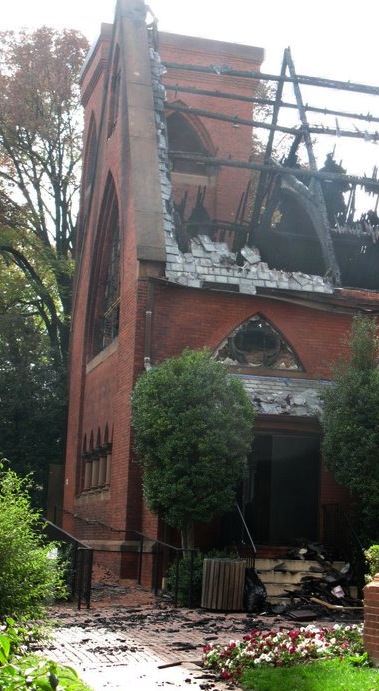
A month ago, the chapel burned down. A friend called me about forty-five minutes after the blaze began to tell me the sad, shocking news. I’ve seen pictures of the charred, unstable structure that still remains. I’ve seen the news stories online. I’ve read the Facebook comments of dozens of seminary friends, who each changed their profile pictures to an image of the east wall of the chapel – the wall that famously read: “Go ye into all the world and preach the gospel.” All of these things tell me that the chapel is gone. But I don’t think that reality will truly hit me until I visit the holy hill of the Virginia Theological Seminary and see for myself the place where the conflagration released the residue of all those prayers into the sky.

Four Bags of Saline

I first posted this Advent reflection on the site Day1.org, which is having a Advent/Christmas Blog tour.

* * *

On Tuesday afternoon, I contracted a viral infection that systematically began evacuating the contents of my stomach, intestines, gall bladder, and liver as quickly as possible. Every half hour I scurried from my fetal position on the couch back to the restroom where I’m sure the neighbors and the folks in the next county could hear my wretched retching. After about four hours of agony, my fiancé finally convinced me to go to the Emergency Room. Severely dehydrated, I accomplished the weak-kneed feat of maneuvering down the stairwell and out to the car, all the while clutching a white, plastic wastebasket like a shipwreck survivor clinging to a life preserver.

With my fiancé supporting me, I stumbled into the ER at about eleven at night. The woman behind the counter took my information and fitted me with a bar-coded bracelet. Another woman took my vital signs and then told me to take a seat in the waiting area. I don’t know how long we waited. My sense of time was reduced to half-hourly dashes to the restroom followed by several, sweat-drenched minutes sitting on the tile floor heaving with exhaustion. Sometime after my fourth trip to the restroom, a nurse mercifully called me back. I sat in a wheelchair as an orderly navigated me to a bed in the hallway of the overcrowded emergency department.

The nurse poked an IV tube into the back of my right hand and fed into my bloodstream the same anti-nausea medicine they give to chemotherapy patients. Then she hooked up a bag of saline, and I watched through half-lidded eyes as the saline began dripping from its elevated place into the tube. My fiancé read the words on the machine to me: 500 milliliters per hour. The equipment was making the saline drip at a proscribed rate – the bag would be empty in two hours. With the anti-nausea medicine suppressing my urge, I now had a new way to measure the time.

One empty bag of saline later, I was showing marked improvement. A little color had returned to my cheeks, and I was thirstier than I had ever been. The nurse allowed me ice chips and promised a popsicle later on if I continued to feel better. I crunched down a Styrofoam cup’s worth of ice and then collapsed back on the bed in the hallway. While I sucked on the ice chips, the nurse hung another bag of saline, and sped up the distribution of the liquid into my body. Now I was receiving 1000 milliliters an hour, or one full bag.

A second empty bag of saline later, I received the promised popsicle, and my fiancé correctly guessed the punch line to the truly horrendous joke stamped on the popsicle stick (How does thread get to school? On a spool bus). After I finished the popsicle, the nurse propped me back in the wheelchair for a ride to the radiology department for a chest x-ray. The doctor wanted to make sure that my gastric pyrotechnics hadn’t torn my esophagus. The short trip wore me out, and I dozed off and on through my third bag of saline, also pushed into me at 1000 milliliters an hour.

By the end of bag three, I just wanted to go home and crawl into my own bed away from the bright fluorescence and constant beeps and blips of the ER. My doctor had other plans, however, and instructed the nurse to hang a fourth bag of saline. This time, she turned off the machine controlling the dispersal of the IV into my arm. The bag would finish not in one hour or two like the other bags, which were “pushed” into me, but at the undefined rate of gravity.

I knew that eventually the fourth bag of saline would empty. I knew that I would be allowed out of the ER for the blissful comfort of my own bed and sleep uninterrupted by illness or beeping monitors. I just didn’t know when. This is the same quandary that the season of Advent invites us to explore. We don’t know when Jesus will return, but we know that he will return. Now, we live in a culture dependent on the constant, steady, and unwavering march of time. We punch in time cards at work. The train leaves the station at 7:12 sharp. The firm expects so many billable hours. Time is money. So when Jesus himself says, “But about that day and hour no one knows, neither the angels of heaven, nor the Son,* but only the Father,” his words run smack into our conception of time. How could we not know when something will happen? How could we not know when to begin our preparation for the big day?

By not putting a date and time on his return, Jesus pushes us to celebrate the much more important fact that his return will happen. He understands human nature too well. By initiating the expectation of return without a time frame, he delivers us the perfect set of variables to make us practice constant vigilance. When I knew the saline bag would run out in one hour, I had no need to watch it. The 1000 milliliters ticked by one after another in predictable, rhythmic progression. But when the nurse turned off the machine during the fourth saline bag, I had to keep looking up at it to see how quickly gravity was doing its work.

I knew the bag would empty, but I wanted to be sure I knew exactly when those last drops would fall so that I could leave the hospital. In the same way, during the season of Advent, we practice our awareness of God’s presence in our lives so that we can more readily identify the signs of Christ’s reign breaking into the world. During the season of Advent, I invite you to turn off the machines that push the IV. Let gravity take over. Know that the “when” is less important than the “what.” Jesus is coming; indeed, Jesus is always here, as well. When we worry less about the when, we can begin to see the presence of God happening all around us. So turn off your clocks. Forget marking off days in your Advent calendar. And just live with the grace-filled knowledge that Christ is coming.

Shaking Off the Dust

(Sermon for Sunday, November 21, 2010 || Christ the King, Year C, RCL || Colossians 1:11-20)

Ever since I bought my piano a little over two years ago, a stack of music has sat atop the instrument gathering dust. Bach, Mozart, Beethoven, Chopin, Brahms, Debussy – the keyboard works of these great composers continues to fulfill the lackluster role of impromptu lamp stand. To make matters more pathetic for this stack of music, the lamp, which I purchased at the same time as the piano, was bulbless until a few weeks ago when I finally remembered to pick up a bulb at the grocery store.

You might wonder why I bought a piano at all, if I never get around to tickling the ivories. Good question. At the time, I had grand designs, which have since descended through the realm of simple designs and the land of hope and settled comfortably in the valley of pipe dreams. Perhaps, my future children will learn the instrument one day and redeem their father’s purchase. Recently, my fiancé has sat down and played for a few minutes here and there. But mostly, the piano simply takes up space. And the stack of music atop the instrument gathers dust.

But this stack of music gathering dust isn’t really music at all. The books of Beethoven’s sonatas and Chopin’s waltzes and Debussy’s preludes are simply bound pages adorned with groups of five lines and thousands upon thousands of cryptic markings. We might call these pages by the name of “sheet music,” but the “music” exists wholly apart from these “sheets.” Only when a person, who is trained to decipher and articulate the cryptic markings, sits down with the intention of translating the notes into sounds does the music ever have a chance of happening.

Our lives follow this same pattern. We have the capacity to make beautiful music with our lives, but mostly we keep our lids closed, content to exist as furniture taking up space. Mostly we keep our covers closed, content to sit in a stack of unread books. Mostly we sit around gathering dust.

Of course, this manner of existence is not the life that God yearns for us. Today, on the final Sunday of the church year, we celebrate the reign of Christ. We give thanks for the reality that Christ is our sovereign, our ultimate authority. And in our celebration and thanksgiving, we acknowledge that Christ does not reign over a world full of inanimate furniture and closed books. Rather, Christ reigns precisely to pull and push and prod us out of the state of dust gathering.

To start shaking off the dust, we must first examine just what we mean when we claim that Christ reigns. As the One who reigns over us, Christ is our ultimate authority, but we encounter trouble when we link Christ’s authority to the paltry earthly authority we encounter on a daily basis. Certain people have authority over us based on their roles. Teachers and principals have authority over students. State troopers have authority over motorists. Judges have authority over those indicted of crimes. This earthly authority has its roots in a punitive system, where citizens cede a portion of their personal sovereignty to certain offices in order to make the society function more smoothly. People recognize that if they break the rules of the society, the Authorities have the right and the ability to punish.

Detail from "Descent into Rivendell" (2003) by John Howe, who is the best Tolkien illustrator of all time.

We may use the same word, but Christ’s authority is of a wholly different sort than the kind we encounter in our principals, state troopers, and judges. Far from being simply punitive in nature and bound by office or title, Christ’s authority arises from Christ being the author, the writer of the great script of creation. Think of it like this: before J.R.R. Tolkien put pen to paper, Middle-Earth had no ability to capture the imagination of readers. But over forty years, Tolkien authored story after story, character after character, slowly building a world of dark forests and misty mountains inhabited by elves and hobbits and wizards. Tolkien is the authority behind Middle-Earth because he authored the fantasy world into existence in the minds of his readers.

In his letter to the Colossians, Paul speaks of Christ’s authorship in similar terms: “In [Christ] all things in heaven and on earth were created, things visible and invisible, whether thrones or dominions or rulers or powers – all things have been created through him and for him. He himself is before all things, and in him all things hold together.”

As the author of all things, Christ has reigned since before the first things were created. And the script of creation continues because Christ has never stopped writing. And now Christ has authored our lives into being. We are small stories that help make up the great script. At the end of the Gospel according to John, the narrator concludes: “But there are also many other things that Jesus did; if every one of them were written down, I suppose that the world itself could not contain the books that would be written” (John 21:25). What the narrator doesn’t say is that all the other things Jesus did have been written down. Christ, the author of each of us, wrote those things down in us. We are the books that the world itself cannot contain.

The problem is that too often we are the books sitting atop the piano gathering dust. Too often, we fail to remember that we are not our own authors. Too often, we fail to acknowledge that we are not in charge of our own lives. Today, we proclaim that Christ reigns in each of us. Christ is in charge of our lives because Christ continues to author us into being. The author has written the words of life within us, the special words unique to each of us. When we begin to seek for those special words, when we look inside ourselves and begin to read the story of how Christ reigns in our lives, we start to shake off the dust.

Like the sheet music, we are just closed books until we begin to participate in the telling of our own stories. As the author of each of those stories, Christ has penned a work about himself, a work which we proclaim in the living out of our stories. We could choose to stay atop the piano gathering dust, but what kind of forlorn existence does this entail? How could we read the words of Christ in the lives of those around us if we remained dusty, closed books? There is far too much love and grace in the pages of our lives for us to waste them by staying closed. There is far too much that Christ is doing for us not to participate in Christ’s reign. There is far too much beauty to bring to the world for us not to let the author spill the words of life from our stories into creation.

And so, as one book trying to shake off the dust, I ask you: how does Christ reign in you? What words has the Author of each of us written in your hearts? Or, to use the words that close Mary Oliver’s poem “The Summer Day”:

“Tell me, what is it you plan to do
With your one wild and precious life?”

What a Good Boy, What a Smart Boy, What a Strong Boy

The following post appeared Tuesday, November 2nd on Episcopalcafe.com, a website to which I am a monthly contributor. Check it out here or read it below.

* * *

When you listen to the Gospel, you might notice the trend that folks rarely answer questions directly. Instead, the responder either completely ignores the question or says something so profound that the question ceases to matter. Most things Jesus says in the Gospel fall into one of these two categories. Think about how often someone asks a question, and Jesus responds, “Well, let me tell you a story about that. Once there was a farmer…” Before Jesus enters the scene, however, John the Baptizer finds himself under interrogation, and he does just a good a job as Jesus in not answering questions with the expected answers. His unexpected responses to the folks interviewing him (as recorded in John 1) show John’s understanding of his identity, which helps us understand ours, as well.

The priests and Levites come to John and ask him a series of questions, the first being “Who are you?” This question seems to have an obvious answer: I’m John from over yonder, my parents are so-and-so. But that’s not what John says. Instead of saying who he is, he explicitly says who he is not. “I am not the Messiah.” And what’s more, he’s quite emphatic about it: “He confessed and did not deny it, but confessed…” By his answer, John seems to know what they are getting at, so he makes sure with his first response that any gossip about his messiah-ship is highly overrated.

So they try again: “What then? Are you Elijah?” He says, “I am not.” They try once more: “Are you the prophet?” “Nope.” John steadfastly refuses to play into any expectations these priests and Levites have about his identity.

I wonder to what degree our identities are based on the expectations of others? It’s not necessarily a bad thing for others to have expectations for us, of course. A community (family, church, team, circle of friends) plays a significant role in the development of our identities, and expectations are a natural part of that role. But if those expectations begin to suffocate us or make us begin to dislike the people we are becoming, then there is something wrong.

In the film Dead Poets Society, Neil Perry has a passion for acting. When he sees the flyer for auditions for A Midsummer Night’s Dream, he says, “For the first time in my life, I know what I want to do. And for the first time, I’m going to do it!” He throws himself into the role of Puck, and he’s good, he’s really good. But his father expects him to be a doctor and thinks this acting business is nothing more than a dangerous whim. Neil defies his father’s wishes and continues rehearsing for the play. After Mr. Perry discovers him at the theatre, he furiously tells Neil that he is not going to let Neil ruin his (Neil’s) life. Neil feels suffocated and trapped: he has found his calling as an actor, he has found himself. But Mr. Perry is stifling this identity with his expectations for Neil’s future. That night, Neil commits suicide.

Expectations like Mr. Perry’s can smother us. They can make us feel less worthy, less capable, less adequate because our worth and capability and adequacy fall outside the limits defined by those expectations. In their song “What a Good Boy,” the Barenaked Ladies lament:

When I was born, they looked at me and said,
‘What a good boy, what a smart boy, what a strong boy.’
When you were born, they looked at you and said,
‘What a good girl, what a smart girl, what a pretty girl.’
We’ve got these chains hanging round our necks,
People want to strangle us with them before we take our first breath.

When we feel smothered, stifled, or strangled by expectations, troubling questions form in our minds. What if I’m not a smart girl? What if I’m not a strong boy? What if I don’t measure up? Then another question compounds these: Will they still like/love/accept/welcome me? These expectations that help shape our identities now morph into ultimatums. They signal the possible breaking of a relationship: This is who I am, and if you don’t like it then fine. And the door slams shut. In this scenario, we begin to define our identities by focusing negatively on the rebellion against expectations rather than by stating positively who we are.

Expectations themselves are neutral things. They surely can be used to spur us to excellence or to inspire us to continue to grow and discover who we are. But they can also be used to deny our self-worth or sense of belonging. When John the Baptizer refuses to be defined by the expectations of the priests and Levites, he is holding onto the identity he has as the voice crying out in the wilderness.

The priests and Levites are unable to pin their expectation on John, but they can’t go back to their bosses empty-handed, so they press John asking: “What do you have to say about yourself?” The Baptizer answers with a quotation from the prophet Isaiah: “I am the voice of one crying out in the wilderness, ‘Make straight the way of the Lord.’ ” Even here, when they ask him deliberately about himself, he answers by pointing ahead of himself. Their concern is based on his seeming lack of authority to baptize, for he is not the Messiah or Elijah or the prophet. But such trifles don’t worry John. He states dismissively: “I baptize with water.” And then he points ahead of himself again: “Among you stands one whom you do not know, the one who is coming after me.” Everything John says about himself, he is really saying about Jesus. He only speaks in terms of Jesus; he deflects questions about himself, preferring to point to the one “who ranks ahead of me because he was before me.”

Rather than playing into their expectations, John flourishes in his identity as an arrow pointing to Jesus. To change the metaphor, he shines because he lives fully into his own particular, God-given identity. Like the moon, he has no light of his own, but he reflects the light of Jesus who is coming after him. Even as we struggle with the expectations of others and with discovering our own identities as God’s children, I can think of no greater joy than to be a moon to Jesus’ sun, reflecting the light of Christ.

Esperanza

(Sermon for Sunday, October 17, 2010 || Proper 24 Year C RCL || Luke 18:1-8)

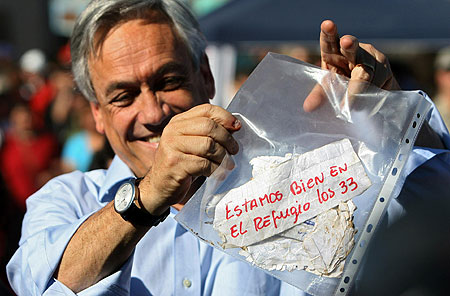
On August 25, 2010, a crucifix traveled 2,300 feet down into the earth. The Apostles’ Creed tells us that Jesus, after he suffered and died on the cross, “descended to the dead.” This crucifix, this representation of the cross supporting the weight of the crucified Lord, descended to the living. Twenty days had passed since the mine collapsed, trapping 33 miners nearly half a mile beneath the soil of the Atacama region of Chili and nearly ten weeks from rescue.

(image from mirror.co.uk)

Backing up to August 5th, the day of the collapse, a single thought began to spread from the miners’ families to the community to the city to the country to the world: Oremos por nuestros hermanos, “Pray for our brothers.” On August 22, a note scrawled in red marker came to the surface: “We are fine in the shelter, the 33 of us.” The message was a glimmer of hope. And over the next several weeks, the glimmer turned into a beacon of hope shining in the depths of the earth.

That crucifix, that image of the suffering Christ, which descended to the living, was a physical representation of the hope that was already present in that shelter half a mile down. The persistent, unceasing prayers of the world – from the pregnant wife of miner Ariel Ticona to the bus driver coming off a double shift in Boston – sustained the hope of the miners. And so, in a fit of divine synchronicity, the Gospel reading for the Sunday following the miners’ rescue would, of course, begin like this: “Jesus told his disciples a parable about their need to pray always and not to lose heart.”

Rarely, if ever, in the Gospel does the writer tip his hand while introducing a parable. Every once in a while, the writer will explain a parable once the story is over. But most often, parables stand alone, with neither introductory material nor closing explanation to help the reader. Indeed, Jesus seems to enjoy speaking in parables for the simple fact that parables make his audience dig deep into his words and find meaning for their lives by searching for meaning in his stories. So, when Luke prefaces Jesus’ parable today with the story’s apparent meaning, we’d be justified in being a bit indignant toward our Gospel writer. Luke doesn’t give us the chance to figure this parable out for ourselves. He tells us the meaning of the parable like a teacher going over the answers to a test before passing out the exam.

But while our indignation toward Luke might be justified, I think we should let him slide just this once. He has our best interest in mind, after all. Luke doesn’t want us to miss the meaning of this story because living out this parable makes our lives fundamentally better. Living out this parable helps us live lives full of God. “Jesus told his disciples a parable about their need to pray always and not to lose heart.” To pray always and not to lose heart. In other words, the story is about praying always and never giving up, or to put the meaning in positive terms, to have the stamina and fortitude to pray persistently and to hope all the time.

We’ve seen over the last seven weeks in Chili that prayer and hope are linked together. In the midst of disaster, prayer and hope rose to the surface and sustained the people affected by the mine’s collapse. Now, let’s be clear. We use the word “hope” for simple, everyday situations such as “I hope the train is on time” or “I hope this week’s episode of Glee is better than the rest of the season, which has been pretty dreadful.” This everyday use of “hope” is of a different magnitude than the hope we are talking about here.

Hope (you might call it capital “H” hope) is the active component of not losing heart. In a world that excels at distracting us from following Jesus Christ and seducing us with the ease of apathy, hope keeps us relying on God to direct us down the right paths. Hope in God allows us to take the long view of our own futures, trusting that God, like a master chess player, has already seen twenty moves ahead. Hope in God opens us to possibilities for our lives that the urgent need of now simply dismisses offhand. Hope in God tells us that God will never lose heart in us, and therefore, we should never lose heart in God.

Hope is the active component of the heart’s steadfastness, and prayer is the active component of hope. Prayer nurtures hope by reminding us that, despite the world’s distraction and seduction, God is present. The Catechism at the back of the Book of Common Prayer says this about prayer: “Prayer is responding to God, by thought and by deed, with or without words.” Notice how this definition adds much needed depth to the popular understanding of prayer. The popular understanding simply makes God the recipient of our prayers: if I pray for my cat to stop scratching me, and the next day she does anyway, I am liable to think that God is not present. But the Catechism’s definition goes back a step in the process of prayer. Prayer is “responding to God.” Therefore, each and every time we pray, we are participating in the life-changing act of acknowledging that God is present in our lives. God calls prayer forth from us. We respond by praying. Each time we enter this exchange of call and response, God fuels our hope with God’s steadfast and eternal presence.

This is why Jesus tells the disciples a parable not just about the need to pray, but the need to pray always. A continuous life of prayer, of response to God, offers us continual awareness of God’s presence. This awareness leads to hope, which, in turn, enables us to live lives open to all of God’s possibilities and to trust in God’s directing creativity.

The widow in the today’s parable exemplifies this need for continuous perseverance and dedication. She keeps coming to the judge, and, in the end, her persistence pays off. Her unwavering commitment to obtaining justice moves the judge, who grants her request simply to get her out of his hair. If she had gone to court once, been dismissed, and never returned, the judge wouldn’t have given her a second thought. But her persistence changes her situation.

This persistence, this dedication to a life of prayer changes our situations, too. Like the persistent widow, our commitment to prayer signals our commitment to respond to God in every situation. The more we commit to prayer, the more apt we are to invite God into our lives and our decision-making. And opening ourselves to God’s presence allows us to soak up the hope that radiates from God’s movement in our lives. Seen from this angle, prayer works very much like food. If your mom or your husband calls you downstairs for meatloaf, you don’t call back, “No thanks. I ate last month.” Prayer leads to openness and trust and hope in God only when we integrate prayer into our daily lives.

The miners surviving 2,300 feet below the surface fed off of the hope generated by God’s presence, a presence proclaimed by the vast multitude of prayers descending on Chili from around the world. Upon his rescue, miner Mario Sepulveda spoke haltingly about his own persistence and hope: “I was with God and I was with the devil, but God won. I held onto God’s hand, the best hand, and at no point in time, how do I explain this, at no point in time, did I doubt that God would get me out of there.”

Sepulveda’s persistent awareness of God’s presence allowed him to survive for 69 days beneath the earth. The parable of the persistent widow teaches us that a life of prayer leads to hope, and hope leads to renewed lives lived in the fullness of God. I invite you to enter into a life of prayer, to find the hope that proceeds from that life, and finally to share the joy of our hope in God with everyone you meet. This happened in Chili: Elizabeth Segovia, wife of trapped miner Ariel Ticona, did not lose heart that her husband would be rescued. She joined her prayer with the prayers of millions. And halfway through the seven-week ordeal, she gave birth to a beautiful baby girl. And she named her “Esperanza,” which means “Hope.”

Note

Quotations and dates for the mine rescue from CNN.com.

Vision and Action

Sermon Notes for Sunday October 3, 2010 || Proper 22, Year C, RCL || Luke 17:5-10

(This Sunday was our first family service, at which I preached a sermon without notes. I gleaned the sermon out of the following brainstorm, which also made for the basis of the sermon for the early service.)

I’m really glad I got to preach this Sunday because the prospect of preaching makes me sit down and think long and hard about the words I am going to say, about the words I believe God is calling me to say. This week I sat down with our Gospel passage from Luke and thought long and hard about faith. And very quickly, I realized that – even with all my schooling and sermons and work in the church – I hadn’t really thought all that much about faith. I knew I had faith. I knew that my doubts didn’t cancel out my faith. I knew that God’s faith in me gave me the ability to have faith in God. But when I dug a little bit deeper, I found myself at a loss for words about how faith works in my life.

My confusion mirrored that of the disciples in this morning’s Gospel. Right before the passage we read today, Jesus tells them that if someone wrongs them seven times in the same day, they should forgive all seven times. The disciples don’t think they have enough faith to do something like that, so they say: “Increase our faith!” Jesus’ responds that a tiny amount of faith is enough to do amazing things. I must confess that the words about the mustard seed and mulberry tree have always seemed rather quaint and comforting, but with no real applicable meaning – like words your great aunt cross-stitches into pillows. But this week, the statement vexed me.

Jesus seems to be saying that an increase in the quantity of faith is not necessary – you can’t get much smaller than a mustard seed, after all. By using such an exaggeratedly small thing, Jesus says that measuring the amount of faith is unimportant. Indeed, thinking of faith as a unit of measure makes no sense. I wouldn’t say, “Last year I had 25 faith, but this year I have 27.” Faith isn’t a statistic.

So when the disciples ask for an increase in faith, I think that Jesus makes the hyperbolic statement about the mustard seed in order to make the disciples see that it’s not an increase in the quantity of faith that matters, but an increase in what faith does. When my thinking brought me away from the static notion of quantity of faith, I realized that I needed to bring my focus back to two simple concepts having to do with faith. First, faith in God sharpens our vision. Second, faith in God motivates our action.

I’ve had blurry vision since middle school. My parents brought me to the optometrist, who noticed my nearsightedness right away. He prescribed glasses, which I hated wearing, as any eighth grader would. Indeed, my desire to keep people from knowing I needed glasses was so great that I skipped trying out for the high school baseball team. I couldn’t see fly balls without my glasses, but I was unwilling to put them on.

You’ve probably noticed that at some point during the fourteen years since my original diagnosis of myopia, I’ve gotten comfortable wearing glasses. And now I finally have a pair that, thanks to Doctor Who, I know are pretty fashionable. But there is another sort of lenses that I fail to put on just as often as I did with my glasses in middle school. These are the lenses of faith. My glasses sharpen my vision of objects in the world around me. The lenses of faith sharpen our vision of the God who is present in and around all things.

Indeed, my glasses don’t give me the ability to see; rather, they give me the ability to see well. When we put on the lenses of faith, we see the world with clearer eyes. Our sharp vision allows us to see God’s directing movement between us and those people, places, and things with which we interact. We stand forever in God’s presence and God moves with us down the paths of our lives. Faith sharpens our vision to catch glimpses of this movement.

Here’s an example. I was standing in Boston’s North Station not too long ago during morning rush hour. I was trying to figure out from which track my train would depart. As I stood there looking up at the departures board, several trains unloaded their passengers at once. I watched as hundreds of people queued up on the platforms and, as one, began trudging toward the glass doors of the station. As they reached the doors, I was spellbound. The intricate, random choreography of the morning commuters was beautiful. They crisscrossed and hurried and meandered and loped along. And not one person ran into another. They passed me as I stood still, and I felt like I was watching a slow motion scene from a film. Each of these people was connected to me and to one another. I could all but see the wispy threads of a tapestry linking us. Faith sharpens our vision. That morning at North Station, the lenses of faith helped me see clearly the reality that God connects each of us to one another.

But sharp vision isn’t quite enough. When we see the world through the eyes of faith, we become aware of how we can participate in God’s work in the world. When I saw clearly my connection to all the people at North Station, I remembered once again that I am called to serve God in all people. Thus, the first thing that faith does – sharpen our vision – leads directly into the second thing that faith does. Faith in God motivates our action.

In many of the stories about Jesus healing various people, Jesus speaks of their faith making them well. Now if we subscribe to the “quantity” notion of faith, we might be tempted to think that Jesus healed these folks because they reached a certain statistical threshold on the faith scale, which qualified them for healing. But the mustard seed reminds us that the quantity of faith is less important than the action of faith. The healing stories, therefore, are really about people whose faith motivated them to the action of seeking out Jesus in the first place. The Gospel writers recorded those healings because of the sometimes heroic, sometimes simple action of faith.

Again, when Jesus says, “If you had faith the size of a mustard seed,” he is not speaking about quantity. We do not have a collection of faith in the same way that we have collections of baseball cards or teapots or old comic books. Faith is not something we can store up in a safe deposit box. Rather, we have faith the same way we have energy. Energy propels us to run and work and play; faith propels us to love and serve and forgive. Indeed, faith is the energy that motivates us to participate in God’s work in the world.

And like energy, faith unused can begin to fade away. Like Langston Hughes’s “Dream Deferred,” unused faith can “dry up like a raisin in the sun.” This is why we come to worship. This is why we meet one another at the table for the nourishing food of Christ’s Body and Blood. This is why we do spiritual practices that keep us in contact with God and with other faithful people. God gave us faith to motivate us to love and serve God. As exercise is to energy, our participation in God’s work is to faith. And the more we allow our faith to motivate our action, the more resilient is our faith when we are confronted with difficult and demanding situations.

Faith in God sharpens our vision. Viewing the world through the lenses of faith shows a deeper layer of reality, the eternal reality of God’s presence. Then faith in God motivates us to act, to live lives full of God’s love and grace, to bring God’s gifts to other people and call God’s gifts forth from those people. Faith in God motivates us to participate in God’s healing and reconciling work in the world. Faith is not a static thing. Faith is not a statistic. Faith is the great gift from God that shows God’s faith in us. Faith is the catalyst that kindles all of our other God-given gifts to shine. Thanks be to God for faith.