5 Years: The County Fair

This June is the 5th anniversary of Wherethewind.com, and we are celebrating by looking back at some of the best of the last five years of this website. Today we have a post from the first couple months of the blog. I was at a county fair in West Virginia with a couple of friends and the following encounter happened. (Originally posted August 12, 2008)

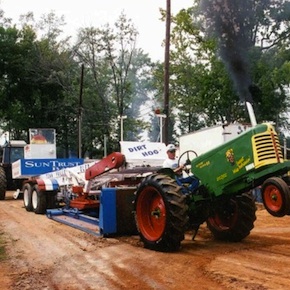
tractorpull2The smells of sweat and fried dough hung in the air, mixing with the burned oil of the tractor pull. He was sitting with hands clasped, wearing a plaid shirt with the sleeves rolled up and a challenge on his deeply lined, leathery face. She was standing, looking all the world like a Grant Wood painting, and thrusting matchbook-sized pamphlets into the hands of passersby. I walked by out of reach, but I couldn’t help looking at the booth, one of many at the county fair. “How sure are you of going to heaven? Are you 50% 75% 100% sure?” read the banner. My friend wondered aloud about how one arrives at a 75% surety of heaven. I chuckled, but I was unable to keep walking by the booth. On the table, a wooden contraption with three small doors read: “Do you know the three things God CANNOT do?”

I stopped. The Grant Wood painting saw my furrowed brow and handed me a pamphlet. It looked like a doll’s magazine. A smiley face decorated the cover along with the words: “Have you accepted Jesus Christ as your personal Lord and Savior?” I closed my hand around the pamphlet and pointed to the three doors. I tried to keep the incredulity out of my voice, but I failed miserably: “So, what are the three things God can’t do?” I said.

She opened the first door: “God CANNOT lie.” She opened the second door: “God CANNOT change.” She opened the third door: “God CANNOT let people into heaven who have not been born again.”

We talked for fifteen minutes. I told them I did not disagree with the first door, but that I preferred to state the sentiment in positive terms: “God always tell the truth” or “God is trustworthy and faithful.” I said that a “lie” is the absence of the “truth,” and that I’d rather talk about God’s goodness shown in God’s truthfulness than to try to hook people with the trappings of sensationalism. After five minutes, the man commented that I was very intelligent. I took that as a compliment, but I have a sneaking suspicion it was not meant as such.

As our conversation continued, I realized we weren’t conversing. We were sparring. I’ve never had a taste for theological pugilism, but I was already three rounds deep, so I kept jabbing and blocking. I’ve had this same conversation with county fair proselytizers, but never as an ordained person. After the man commented on my intelligence, he asked me what I did. I said, “I’m a priest.” Without another word, he thrust another pamphlet in my hand. It was about how Roman Catholics aren’t real Christians and are going to hell.The same thought kept jumping to the front of my mind: “People like these, no matter how pure and ardent their intentions, make my job harder.”

It didn’t matter that I wasn’t a Roman Catholic. It didn’t matter that I agreed with the man and woman several times during our bout. The only thing that mattered was that I didn’t buy into the way they framed the Christian faith–as a bottom-line venture whose only goal is to “save souls” by following the instructions in the smiley-face doll-sized magazine. Surely, there’s more than that. Surely, the abundance of what God has done and is doing is more important than a “what’s behind door number 3″ marketing scheme concerned with what God CANNOT do.

As I walked away, I wondered what had been accomplished during our boxing match. In the Gospel according to Matthew, Jesus says that when two or three are gathered in his name, he will be in the midst of them. Were we gathered “in his name” or in our own names, intent on KOing the other’s theological stance? Was Jesus there? Was I 50% 75% 100% sure of his presence? Looking back, Jesus was there, but he was not in my corner and he was not in their corner. He was there trying to get us to leave the ring.
Five Years Ago

Five years ago today, I navigated to WordPress.com and sat for an hour just staring at the computer screen. I had recently received some advice from an editor at a publishing company that I might consider starting a “weblog,” whatever that was. My seminary thesis  reader, Brian McLaren, had put me in touch with this editor (for the life of me, I can’t remember his name), and I’m so glad he did. The editor gave me the best practical advice imaginable for a young writer.

“You need to write,” he said. Sounds obvious, doesn’t it?

kite.png

“You need to write every day,” he continued. “And that means you need someone or something to be accountable to.” Then he turned me on to the idea of blogging, which was still not quite mainstream in 2008. Thank you, Mr. Editor! (Was it Kevin? Ah well. I really can’t remember.)

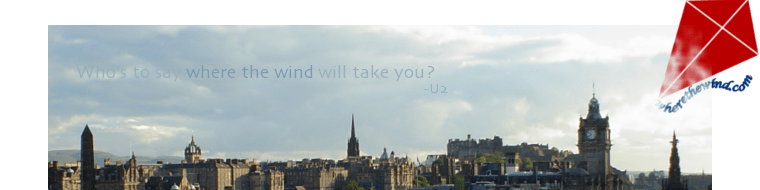
So there I was, five years ago today, staring at my computer screen. I was stuck trying to make a decision– namely, what to call my blog. I tried many names, also things I can’t remember now. I was listening to music, and in the moment of greatest despair that I would never come up with a name I was satisfied with, U2’s song “Kite” came on.

“Who’s to say where the wind will take you?
Who’s to say what it is will break you?
I don’t know which way the wind will blow.”

blogheaderaug09d.png

The words Bono was singing bore into me. It was like I was hearing them for the first time ever. The chorus hung in the air. I could have grabbed the word “wind” and held it in my hand. As I looked at the words in my mind’s eye, they reformed into a verse from the Gospel According to John: “The wind blows where it chooses, and you hear the sound of it, but you do not know where it comes from or where it goes.” So says Jesus to the Pharisee Nicodemus. This encounter is one of my favorite in the Gospel. In it, Jesus shatters Nicodemus’s preconceptions — his entire worldview, in fact — and rebuilds it with himself (Jesus) at the center. Over the course of the Gospel, we see Nicodemus first tentatively and then boldly step into his own re-creation.

blogbannerbricks.png

For Nicodemus, and for me, it starts with the wind of the Spirit (which, handily, is the same word in ancient Greek). The words from U2’s song shimmered with meaning from the Gospel, and I knew I had found the name of my blog.

Ever since, these words have guided me. I do not know where the wind will take me. But I believe that wherever it is, God will be waiting when I get there. The last five years have confirmed this belief over and over again. Through the blog, I made connections with The Christian Century and EpiscopalCafe. Then, about a year and half in, I came to the attention of the United Methodist Publishing House, and my second book with them comes out this summer! The blog is also partially responsible for the way I met my wife (as well as giving her mother something to find when she googled me). Above all, this website has kept me writing and reflecting on how God is moving in my life and how I am moving in God’s.

blogbannerdd5.png

Over the month of June, I plan to have a five year anniversary celebration for wherethewind.com. I will re-post some of my favorite entries, along with ones that marked significant moments and connections. (If you have a favorite post you’d like me to re-issue this month, let me know!) I look forward to the next five years of wherethewind.com, and I’m so profoundly grateful to all of my readers for taking this journey with me.

I leave you today with some of the first ever words I posted on this website, five years ago today.

Adam, a follower of Christ,

to all those who find this blog through the Series of Tubes.

Grace to you from God our Father and the Lord Jesus Christ!

The Apostle Paul really nailed the beginnings of his letters, so I thought I’d borrow his intro formula to begin my blog. Paul journeyed all over the Mediterranean following the little dotted purple and blue and red lines you see on the maps in the back of your study Bible. I’m afraid I can’t afford the airfares to Thessalonica or Ephesus, so I will have to rely on the Interwebs to make a new set of dotted lines from my MacBook to your computer. Since you’re probably in modern day Scranton or Lubbock rather than ancient Greece, I think the Internet is the way to go.

[…] Who’s to say where the wind will take me? Who’s to say where the Spirit is leading me? In this blog, I will reflect on the movement of God in my life, the movement that dances on the wind of the Spirit. I invite you to follow my reflections and discern how God is moving in your own life.

blogbannermay2011c.jpg

Faith-ing

Sermon for Sunday, June 2, 2013 || Proper 4C || Luke 7:1-10

Here’s a common situation in this day and age. For one reason or another – say, you’ve got to figure out how many packages of plastic cups to get for a party – you find yourself needing to do long division. Your phone’s battery is dead, so the calculator app is gone too. You flip over your shopping list and put pen to paper, and then you stop and realize that you have no idea how to do long division. You learned in fourth grade, but (wow) was that a long time ago. Has anyone else had that experience?

So, if basic math escapes us sometimes because we haven’t thought about it in a long time, I’d hazard a guess that we sometimes also lose sight of the basics of being followers of Jesus Christ.

Today, I’d like to get back to the basics. I’m going to talk about faith – specifically about how faith works in our lives. Hopefully, at the end of this sermon we will all rejoice that, while faith seems like an abstract, ephemeral concept, faith is in truth the fuel that fires our lives.

To start this little discussion about faith, we need to clear up one minor issue. In the English language the word “faith” is a noun. This grammatical construction makes it normal for us to ask a question like “Do you have faith?” Faith here is the object of your possession: “Yes, I have faith.” This sounds like completely correct and acceptable English, right? The trouble is, while faith is a noun, it should be a verb. I should be able to say “I’m going faith-ing today” or “We faith-ed yesterday and we’re going to faith again tomorrow.” But those sentences sound really strange, don’t they? I wish they didn’t. The word “faith” is a noun but whenever you use it, I hope you will remember it should be a verb.

Here’s why. We can possess things like concert tickets and hiking boots, but such possessions just sit on the counter or in the closet until we need to use them. If we have faith in the same way we have concert tickets, then we run the risk of storing our faith in the kitchen cupboard until we think we need it. But faith doesn’t work like that. Faith cannot be stored up or hoarded. We might get into situations where we say, “If I just had a little more faith…” But this turns faith into a commodity, something we can trade for something else. That’s not how faith works.

Thinking of faith as a verb removes it from the kitchen cupboard and puts it in our actions. We cannot store up or hoard our actions like we can our possessions. Rather, each action tumbles into the next in a never-ending stream. The problem we run into here is that, since the word faith isn’t actually a verb, we have trouble imagining what faith as action looks like. You know exactly what I mean when I say, “I saw someone running on my way to church this morning.” But you’d have difficulty conjuring up the image if I said, “I saw someone faith-ing on my way to church this morning.”

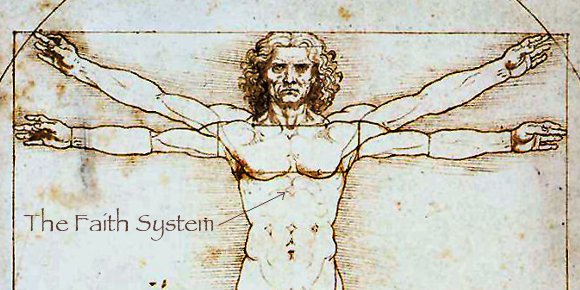
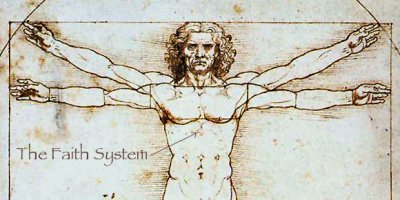
VitruvianMan(featured)Because of this difficulty, I’d like to invite you to imagine with me a reality that we don’t often think about. When God created animals, God gave us all sorts of biological systems that allow us to live. The respiratory system lets us breath, the circulatory system cycles our blood through our bodies, the digestive system turns food into nutrients. There’s the nervous system, the endocrine system, the lymphatic system and so on. But we were made in God’s image and likeness, which means we have one more system that other animals don’t have. We have a spiritual one to go along with all our biological ones. We have a faith system.

The faith system works a lot like our muscular system. We all have muscles (yes, even scrawny guys like me). We need our muscles to do simple tasks like getting out of bed, standing up, even smiling. We also need our muscles to do more difficult tasks like running a marathon or lugging a couch to a third floor walkup. Exercising hones and strengthens our muscles, making them more durable and less likely to fatigue. But whether we exercise or not, our muscles still put in work day in and day out.

So, too, with our faith system. The faith system spurs us to seek out life-affirming relationships, to support one another in our daily walks with God, to reach out to those in need, to welcome anyone into our midst, and to share with them the good news of God’s love. The faith system also sustains us through dry, desolate periods, giving us enough endurance not to give up quite yet. Like our muscles, our faith can get weary and fatigued. But also like our muscles, we can exercise our faith to hone and strengthen it, to make it more a part of our actions and less a thing sitting on the shelf in the kitchen cupboard.

If we’re going to exercise our faith, then we should figure out exactly what we mean when we say the word. We’ve already said how faith is a noun that should be a verb. Faith then is the action that happens when we participate in our relationships with God. Faith borrows the best parts of trust, confidence, and humility and molds them into our response to God’s presence in our lives. From trust, our faith borrows the willingness to give ourselves over to the power of another. From confidence, our faith borrows the courage to take the leap into God’s waiting arms. And from humility, our faith borrows the recognition that God (and not we ourselves) initiates the action that results in the giving ourselves up to God.

In today’s Gospel lesson, the Roman centurion actively engages his faith system. He trusts that Jesus can help him. He has courage actually to do something about that trust. And he shows his humility when he sends friends to Jesus to tell him he need not come all the way to the house to heal the slave. The centurion displays such strong faith that even Jesus is amazed. But no matter how strong or how weak our faith is, we each have a faith system that God gave us so we would be able to join God in relationship. The more we exercise our faith system – the more we act out our faith – the deeper can we go in our relationships with God.

Imagine if we exercised our faith in the same way we exercise our muscles. Going to the gym once doesn’t do much, but going every other day can work wonders on our bodies. God yearns for us to have this kind of dedication to our lives of faith. When we are serious about exercising our faith systems, we build time into every day to be in prayer with God. We start with faith and allow it to motivate all our other actions. We take part in the act of worship, both on Sunday mornings and in the moments of our days when our faith shows us special signs of God’s presence that our eyes alone might not see.

I invite you today to remember that faith is a noun but should be a verb. Faith is not a commodity or a possession. Faith is the active component of our relationships with God. God loves us and we love God. What could be better than cultivating that love everyday? What could be better than exercising our faith system so that we resonate deeper and deeper with God’s movement in our lives?

Come (May 31, 2013)

…Opening To…

Be thou my vision, O Lord of my heart
Naught be all else to me save that thou art
Thou my best thought by day or by night
Waking or sleeping thy presence my light (Ancient Irish Hymn)

…Listening In…

Come, let us sing to the LORD; let us shout for joy to the Rock of our salvation. (Psalm 95:1; context)

…Filling Up…

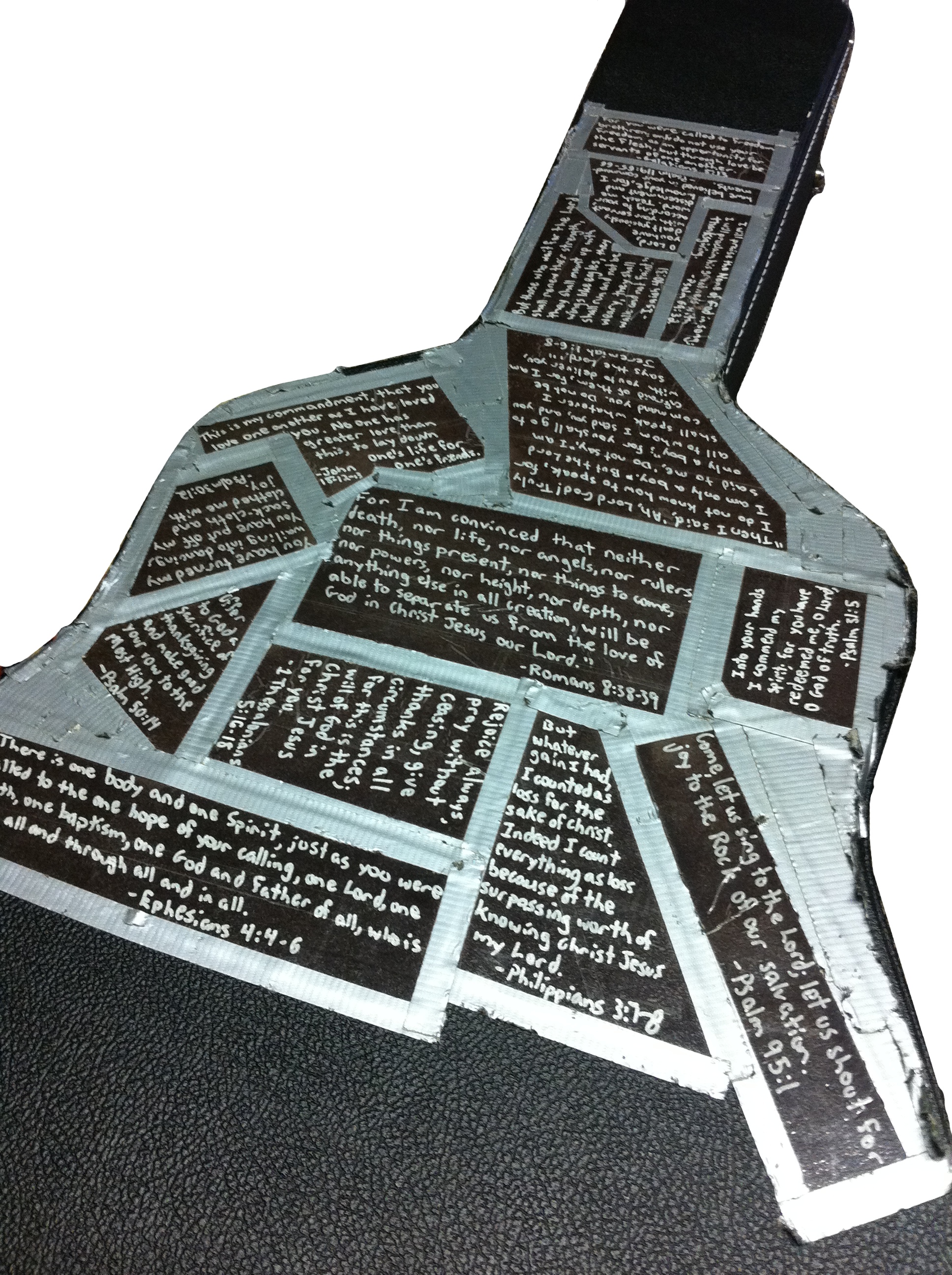
Today is the final day of the Guitar Case series and the last day of Devo180 before the summer hiatus. Appropriately, we are finishing it with a verse of praise. (Also, as a bonus, you can click here to see a picture of the guitar case in question. You’ll notice that I never finished the project and now I don’t really use this guitar much anymore. So I guess it is finished!)

Today’s verse begins one of the numerous psalms of praise found in the book of Psalms. We’ve talked a lot about the psalms of lament, so much so that you might have forgotten that those aren’t the only ones in the book. But there are – and psalms of praise are another sizable group.

Psalm 95 is a psalm of invitation, and that’s what makes it so special. Notice that it doesn’t start with “Sing to the LORD about such-and-such” as other psalms do. Rather, it begins with a wonderful word: “Come.” This is a special word in the lives of the people who knew Jesus well; he invited many of them with a similar statement: “Come and see.” He says, “Come unto me, all you who bear heavy burdens.” And this is a special word in our lives:

“Why don’t you come and hang out with us?”

“Is Mommy coming home soon?”

“Come on, (fill in local sports team here)!”

The word “come” is so special because it signals an invitation, a welcome, an opening to hospitality and new relationship. No wonder then, that this psalm is one of praise! “Let us sing to the LORD,” it continues. “Let us shout for joy to the Rock of our salvation.” I can think of no better invitation to offer than one that brings new people into the joy of singing to the LORD.

…Praying For…

Dear God, you are the rock of my salvation and the joy of my song. Help me to open myself up to new relationships and accept invitations from those who invite me into their lives. In Jesus Christ’s name I pray. Amen.

…Sending Out…

I leave this moment with you, God, but I take with me your word, which settles deep in my soul and speaks life into my being.

There is One (May 30, 2013)

…Opening To…

Be thou my vision, O Lord of my heart
Naught be all else to me save that thou art
Thou my best thought by day or by night
Waking or sleeping thy presence my light (Ancient Irish Hymn)

…Listening In…

There is one body and one Spirit, just as you were called to the one hope of your calling, one Lord, one faith, one baptism, one God and Father of all, who is above all and through all and in all. (Ephesians 4:4-6; context)

…Filling Up…

It’s the second to last day of our Guitar Case series, and, as luck would have it we have two more verses. Today’s verse comes from Paul’s letter to the Ephesians, but I encountered it originally in the Episcopal service of baptism. Indeed, these are some of the first words you hear when you attend a baptism in an Episcopal Church.

Baptism, which comes from the Greek word that means “to wash,” is the outward sign (getting wet) of the inward grace of claiming the identity of a member of God’s family. Therefore, it’s pretty wonderful to say these words from Ephesians before we get to the watery part. These words are all about One-ness. We may each be individual units with brains and appendages and many layers of skin, which separate us one from another. But this surface-level autonomy masks a greater truth, which Paul uncovers with these words. We are not discreet units. We are not autonomous individuals. We are pieces of a vast network of interconnections (The Internet? No, but close.)

The spiritual truth that underlies all reality is that we are connected through the love of God, which is a connection that cannot be severed or disrupted by anything in all Creation. We are part of the one body. The one Spirit connects us. We subscribe to the one hope, which is fulfilled by the one Lord. We share the faith, we proclaim our sharing with baptism. And the One God is the presence that binds all this one-ness together. So rejoice that you aren’t alone. You may feel like an autonomous, isolated unit. By you’re not. None of us is. We’re one. (Hey, I think U2 said that in the early 1990s…I guess there are worse folks to crib from!)

…Praying For…

Dear God, you are the source of all unity in this world. Help me to recognize my connection to other people and live into the responsibility that such a connection entails. In Jesus Christ’s name I pray. Amen.

…Sending Out…

I leave this moment with you, God, but I take with me your word, which settles deep in my soul and speaks life into my being.

Surpassing Value (May 29, 2013)

…Opening To…

Be thou my vision, O Lord of my heart
Naught be all else to me save that thou art
Thou my best thought by day or by night
Waking or sleeping thy presence my light (Ancient Irish Hymn)

…Listening In…

Yet whatever gains I had, these I have come to regard as loss because of Christ. More than that, I regard everything as loss because of the surpassing value of knowing Christ Jesus my Lord. (Philippians 3:7-8a; context)

…Filling Up…

Immediately before the verse above, Paul sounds like he is bragging. “If anyone else has reason to be confident in the flesh,” he says, “I have more: circumcised on the eighth day, a member of the people of Israel, of the tribe of Benjamin, a Hebrew born of Hebrews; as to the law, a Pharisee; as to zeal, a persecutor of the church; as to righteousness under the law, blameless.”

Here Paul gives his listeners his résumé. If he were writing today, perhaps he would say: “Graduated summa cum lauda from Harvard, interned for a supreme court justice, partner by age thirty – oh, and I own a yacht.” Perhaps Paul is boasting a bit, but in the end, he gives us his résumé for exactly one reason: to toss it in the dumpster.

All those things that seemed so important before Paul got literally knocked to the ground seem utterly insignificant after he meets Jesus on the road to Damascus. He finds a new priority, and every other priority pales in comparison.

Does this make everything besides “the surpassing value of knowing Jesus Christ my Lord” completely unimportant? Of course not. Rather, one piece of the value of knowing Christ is the clarity that our relationship with Jesus brings to our other priorities. When we put our relationship with Christ first, when that is our primary priority, we develop a foundation upon which to organize the rest of our priorities. And we find that not all of things we once valued should be pursued. And perhaps, we will find new things to value, things that Christ himself prioritized.

…Praying For…

Dear God, your relationship with me is beyond value. Help me to order my life with you at its center. In Jesus Christ’s name I pray. Amen.

…Sending Out…

I leave this moment with you, God, but I take with me your word, which settles deep in my soul and speaks life into my being.

Pray Without Ceasing (May 28, 2013)

…Opening To…

Be thou my vision, O Lord of my heart
Naught be all else to me save that thou art
Thou my best thought by day or by night
Waking or sleeping thy presence my light (Ancient Irish Hymn)

…Listening In…

Rejoice always, pray without ceasing, give thanks in all circumstances; for this is the will of God in Christ Jesus for you. (1 Thessalonians 5:16-18; context)

…Filling Up…

There are four days left in our survey of verses that found there way onto my old guitar case during my college years of 2001-2005. Today’s passage from the last chapter of Paul’s First Letter to the Thessalonians is one that has stuck with me for quite a long time. When I was a sophomore I read a short story by Wendell Berry that I think was entitled “Pray Without Ceasing.” (It was either called that or that was the theme.) And I discovered those words came from Paul.

A few years later, when I was in seminary, I discovered that the first letter to the Thessalonians is probably the oldest piece of Christian writing that still exists, so the words from these verses became even more special. Before anything else that we still have was written, Paul urged people to rejoice always and to pray without ceasing. If people took him seriously, that means that while the rest of the New Testament was being written, there were people praying ceaselessly during its composition. What a cool thought!

It wasn’t until a few years after that realization that I discovered one last thing about these verses. I had always thought “praying without ceasing” was really hyperbole – Paul stressing the importance of prayer by telling people to do it all the time. I didn’t realize that it was actually possible. Then I read a description of prayer from the Episcopal Book of Common Prayer (BCP). The BCP says this: “Prayer is responding to God, by thought and by deeds, with or without words.”

This sentence completely changed how I think about prayer. If prayer is not just talking to God about stuff, but instead is anything we do to respond to God, then it is possible to “pray without ceasing.” To do so is to cultivate a constant awareness of how each of our actions is done as some kind of response to God’s action in our lives. Each action we take or thought we think puts us in either greater or lesser resonance with God’s movement. By cultivating this constant awareness, we are praying without ceasing.

…Praying For…

Dear God, you encounter me in the words of the scripture and these encounters continue throughout my life. Help me to be sensitive to your movement throughout all facets of my life so that I can better respond to your call. In Jesus Christ’s name I pray. Amen.

…Sending Out…

I leave this moment with you, God, but I take with me your word, which settles deep in my soul and speaks life into my being.

Sacrifice of Thanksgiving (May 27, 2013)

…Opening To…

Be thou my vision, O Lord of my heart
Naught be all else to me save that thou art
Thou my best thought by day or by night
Waking or sleeping thy presence my light (Ancient Irish Hymn)

…Listening In…

Offer to God a sacrifice of thanksgiving and make good your vows to the Most High. (Psalm 50:14; context)

…Filling Up…

There are fourteen verses written on my old guitar case, which means we have five to go. Today’s verse is one of the verses that we use in the Episcopal Church for something called the “Offertory Sentence” (which is what we read right before bringing up the bread and the wine to be blessed). One day during college, I finally heard this verse in the midst of its natural habitat – the rest of Psalm 50 – and hearing it there completely changed my understanding of it.

Psalm 50 is about God indicting the people of Israel for simply going through the motions of worship and the practice of the law, but not letting those motions and practices invade their hearts and change them into better followers of God. By the last third of the psalm, God gives evidence of all the ways the people have strayed, which proves how empty their animal sacrifices have been.

I don’t want those animal sacrifices, God says. I don’t need to be fed. Those animals are mine anyway. What I want is the sacrifice of your thanksgiving. These are the key words of the psalm. At first glance, they don’t make much sense really. How is giving thanks a sacrifice? Or perhaps a better question is this: what are we sacrificing when we give thanks? I’m glad you asked!

Every time we thank God for something – an ability, an event, another person, ourselves – we are acknowledging that God is the shaper of that gift. God is the force behind and beneath and within that gift. This acknowledgement is the first step in removing from ourselves the delusion that we are somehow responsible for our own gifts and relocating them to their proper source, which is God. So, in the end, we are sacrificing our pride, which is the presumption that our gifts and abilities come from ourselves rather than God.

When all is said and done, the act of giving thanks is part of the practice of humility. And humility involves the sacrifice of all the delusions and presumptions that stoke our self-importance, our vanity, and our pride. When we give thanks, we properly attribute our giftedness to God’s movement, and then we find that movement swelling up from deep within us, propelling us to serve.

…Praying For…

Dear God, you invite me to locate my gifts in you. Help me to let go of my pride and find your presence within me that animates all my gifts. In Jesus Christ’s name I pray. Amen.

…Sending Out…

I leave this moment with you, God, but I take with me your word, which settles deep in my soul and speaks life into my being.

Into Your Hands (May 24, 2013)

…Opening To…

We limit not the truth of God to our poor reach of mind,
To notions of our day and place, crude, partial, and confined;
No, let a new and better hope within our hearts be stirred;
The Lord has yet more light and truth to break forth from his word. (George Rawson)

…Listening In…

Into your hands, O Lord, I commend my spirit; for you have redeemed me, O Lord, O God of truth. (Psalm 31:5: context)

…Filling Up…

A verse from Psalm 31 comes next on my guitar case. It might be classified as one of those psalms of lament that I keep talking about on devotiONEighty. But Psalm 31 varies from classic lament psalms in one specific way: rather than moving from sorrow to timid statement of faith to the desire but not the ability to praise (which is the standard format), Psalm 31 is more of a roller coaster ride. It begins with a statement of faith: “In you, O LORD, have I taken refuge…” Then the middle of the psalm sinks into lament: “Have mercy on me, O LORD, for I am in trouble; my eye is consumed with sorrow, and also my throat and my belly.” Then it rises once again, finally concluding with these words: “Be strong and let your heart take courage, all you who wait for the LORD.”

I’m so glad that the psalmist put such a roller coaster ride into words. The poetry of this psalm speaks deeply to those who grieve, giving them both the permission to feel sorrow and the expectation to find comfort. And while it falls just five verses into the twenty-four verse poem, the verse above forms the centerpiece of the psalm. Notice the way the verb tenses work across the sentence. In the first half of the verse, we find a present tense action verb, rendered above as “commend.” In the second half, we find a present perfect action verb, rendered above as “have redeemed.” In English, this means that God accomplished the redemption at some unspecified time before the writer commends his or her spirit to God. I’m not a Hebrew scholar, but I’m pretty sure the verbs work in a similar way in the original language.

While studying verb tenses might not get your blood flowing, the progression this verse evokes is incredibly important for our faith in God. I would be utterly incapable of commending my spirit to God if God had not already initiated some sort of relationship with me (in this case, in the form of redemption). This commendation of spirit is the very action that fuels the rest of the roller coaster psalm: there are ups and downs, but the entire varied experience of the psalmist exists within the palm of God’s hand. And in that, I find comfort.

…Praying For…

Dear God, you are holding me in the palm of your hand. Help me to feel the support of that hand, a solid and holy ground for my feet. In Jesus Christ’s name I pray. Amen.

…Sending Out…

I leave this moment with you, God, grateful for the opportunity to reflect on your word and looking forward to discovering its impact on my life.

Not Even Death (May 23, 2013)

…Opening To…

We limit not the truth of God to our poor reach of mind,
To notions of our day and place, crude, partial, and confined;
No, let a new and better hope within our hearts be stirred;
The Lord has yet more light and truth to break forth from his word. (George Rawson)

…Listening In…

For I am convinced that neither death, nor life, nor angels, nor rulers, nor things present, nor things to come, nor powers, nor height, nor depth, nor anything else in all creation, will be able to separate us from the love of God in Christ Jesus our Lord. (Romans 8:38-39; context)

…Filling Up…

I find hope and peace in the words that make up the next verses from my old guitar case. They also happen to be one of the selections suggested for funeral services. These are Paul’s soaring words about the love of God that show the infinite and eternal lengths to which God goes to remain in relationship with us.

Nothing – not even death – can separate us from the love of God in Christ Jesus our Lord. Think about that statement for just a minute. We might survive because we metabolize nutrients and breath air and replenish our water supplies. But we live because of the love of God. The love of God is the foundation of existence; it is the thing from which we cannot and will not be separated. Not even dying will separate us from that love because life happens with so much grander scope than death could ever hope for.

This is the truth that we discover in Christ’s resurrection. This is the truth that lives in our guts and ripples along with tremors of grief when a loved one dies. This is the truth that is the salt in our tears. This is the truth that mingles with our sadness and leavens it with a hidden hope that God’s love will enfold the grieving as that has already enfolded the deceased. That’s why we read these verses at funerals. They speak of true reality. And they speak good news.

…Praying For…

Dear God, you are in the midst of all life, both our dim life on earth and our bright life in heaven. Help me to open a space for grief to reside and then allow you to fill it with your presence. In Jesus Christ’s name I pray. Amen.

…Sending Out…

I leave this moment with you, God, grateful for the opportunity to reflect on your word and looking forward to discovering its impact on my life.