
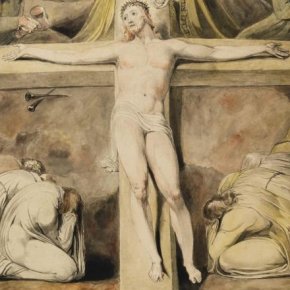
Sermon for Sunday, April 13, 2014 || Passion/Palm Sunday, Year A || Matthew 26:31–27:54
 If you’ve spent any length of time in the Episcopal Church, you know the sermon comes after the Gospel reading. But because of the nature of our Gospel reading today, I hope you will allow me to flip that convention around. The Passion Gospel we will read in a few moments has the lyric substance of an epic poem; the depth of one of the works of a Russian master – Dostoyevsky, say; and the emotional weight of the entire book of Psalms: all in the space of an average magazine article. So rather than preaching after we listen to the performance of this momentous work of faith and story-telling, I thought I’d talk with you now, before we listen. I plan, in the next few minutes, to give you something of a listening guide: a few keys to listening faithfully, and a few things to listen for.
Before we begin the reading, I invite you (during the silence/hymn) to acknowledge all the things that are clamoring for attention in your mind: the sports practice after the service, the spring break vacation that needs packing for, the unpaid bills, the house that’s still on the market, the impending surgery, papers that are due, deadlines at work. Acknowledge each thing and then gently push it aside; breathe it away for the time being. Clear a space within; within your mind, within your heart. And invite God to fill that space with the truth of Christ’s Passion.
Also before we begin reading, just a note for our performance practice today. I will be narrating, Craig will be reading the parts of Jesus and Peter, and Sarah will be reading the parts of everyone else. That is, except for the place in the story when Pontius Pilate addresses the crowd. That part is yours. I know many people feel uncomfortable voicing this part. Saying, “Let him be crucified,” feels like the worst kind of betrayal. Speaking aloud those words always causes a deep sorrow to well up in me, and I bet many of you feel it, too.
Even so, I hope you will still say the words when it comes to your turn. I know they are hard to voice, painful to say aloud, but they are also necessary. Cathartic, even. Saying those words today – “Let him be crucified” – allows us to give voice to a year’s worth of our own sin, our own willful separations from God, both small and great. In those four words, we identify with the jealous leaders who brought Jesus to the Roman officials. We confess our complicity in this sad desire to separate ourselves from the source of grace and healing. We say those words today. We live with them rattling around in the hollowness inside us this week. As they reverberate within, their echo is like a mirror held up to our willful separation. We see ourselves for the lonely, despairing people our choices often make of us. For a week, we live with those words on our lips. Then, a week from today, we replace them with fresh words of praise, with shouts of triumph, with good news about God’s eternal embrace heralded by Christ’s resurrection.
Before we move on to our proclamation of Christ’s Passion, here are a few things I invite you to listen for. First, listen for things you might never have heard in this reading no matter how many times you’ve listened to it. Small things like Jesus’ own non-violence; Simon Peter’s weeping; Judas’s repentance; the warning of Pilate’s wife; the service of the unnamed person who gave Jesus wine to drink; the final witness of the Roman centurion.
Second, notice how often Matthew, our Gospel writer, puts truth on the lips of those in charge of Jesus’ execution. When Pilate washes his hands of Jesus’ death, the rioting crowd responds, “His blood be on us and on our children!” And in a way, it is – not as evidence of murder, but as a cleansing agent, as a way of removing the very sin the rioting crowd is committing. We are “washed in the blood of the lamb.” Notice also the soldiers who hail Jesus as king. They do it in mocking, as a despicable game, but even so they speak the truth. Notice finally, the words of the chief priests as Jesus hangs from the cross, also said in cruel jest. These words include, “He trusts in God.” This trust is independent of their desire for corroboration of that trust. This trust is Jesus’ own brand, which goes well beyond saving his broken body and finds its home on the other side of Easter.
After you empty yourself to allow God to fill you with the witness of Christ’s passion, and while you are listening for those small details Matthew gives us, I invite you to enter the story yourself. Taste the tang of fear in the air. Feel the crush of bodies clamoring for blood. Listen to the jeers. See Jesus standing silently, absorbing the cruelty of the world in order to bring it with him to the cross in order for its power to die.
And as you stand with Jesus’ enemies, here them speak the truth unbeknownst to themselves. Allow that ironic truth to well up within you. And believe. Set your heart on the one who went willingly to torture and death. Set your heart on the one who suffered for us. Set your heart on the one who died on the cross. Because he has set his heart on you.

 The prayers have all been prayed. The farewells to the deceased have all been said. The dirt has been cast on the shining, glossy coffin. The low murmur of voices mingles with the whisper of the wind through the long, cemetery grass. The new widow rises from the velvet-covered folding chair, the triangle of the blue field and white stars of the American flag peeking out from under her arm. A line of black-clad people forms, and they begin to file past her. You watch her receive with grace each well-meant, but well-worn sentiment. You join the line, and soon it’s your turn. You grasp her hand in both of yours and wait for the words to come.
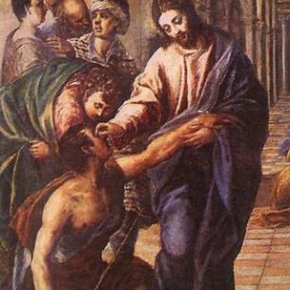 “Let me see some I.D.”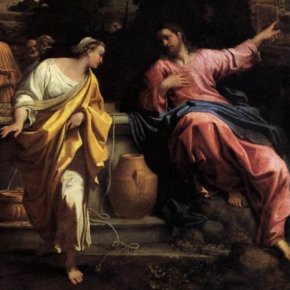
 Last week I talked about the fact that we crave certainty, but in this life we will never achieve it. Jesus knows this, and so he offers us something even better than certainty. He offers us the gift of himself. Today, I’d like to talk about that gift. I’d like to talk especially about what we think we need in order to accept such a gift. Specifically, I’d like to talk about four things we think we need and the one thing we actually need. We’ll use Jesus’ wonderful conversation with the Samaritan woman to explore these things we think we need to accept the gift of Jesus.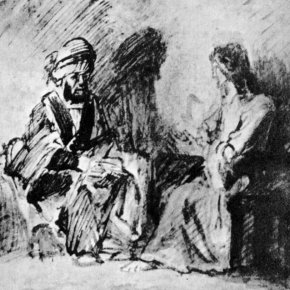
 Full disclosure: the chapter of the Gospel I just read to you easily makes my Top 5 list of favorite passages of scripture. Nicodemus is my favorite recurring character in the entire Bible. Even the name of my website – wherethewind.com – has its roots in this chapter. I love John 3; I’ve read these words many hundreds of times over the years. I barely needed to look at the Gospel book while reading just now, because these words have carved out a space within me. I know them by heart. I knew what they said before I even sat down to work on this sermon. I was certain of their content; just as certain of their content as Nicodemus is of his knowledge at the outset of his conversation with Jesus.
 We consume about a quarter of the world’s energy, and yet we make up only one twentieth of the world’s population. Several of our most popular ways to die involve over-consumption of food or drink or drugs. I mean, have you seen how they deliver French fries at the restaurant Five Guys? They fill a cup with a fairly generous, but not outrageous, serving and then dump three or four more scoops into your bag! Who could possibly eat all those fries?
 “At last Aragorn stirred. ‘Gandalf!’ he said. ‘Beyond all hope you return to us in our need! What veil was over my sight?”
 “Be perfect, therefore, as your heavenly Father is perfect.” Sounds like a tall order, doesn’t it? Sounds like naïve idealism at worst and hopeless hyperbole at best. Sounds like one more command of Jesus that we could never live up to. I mean, it’s hard enough turning the other cheek and walking the extra mile and loving our enemies, but now he wants us to be perfect on top of all of that? Doesn’t he understand that to be perfect there could never have been a time when one wasn’t already perfect? Doesn’t he understand that one cannot become perfect? Either you are or you’re not…and we’re…not.
 When I was a little kid, I wanted to grow up to be a fireman. Well, a fireman and a garbage man. Well, a fireman, a garbage man, and a baseball player. Well, a fireman, a garbage man, a baseball player, and a paleontologist. I wanted to be a baseball playing, dinosaur-fossil finding, fire fighting trash collector. And you know what? That didn’t happen. Something even better happened. I got to be someone whose job it is to walk with people during the most important moments of their lives and point out God’s movement in those moments. I got to be a priest. And I got to be your priest.
 So – did you know you are made of glass? It’s true! Now, of course, I don’t mean that you’re made of glass in the idiomatic way; it’s not that you’re easily offended or that your baseball career was cut short because you have a “glass arm.” Nor do I mean made from actual glass that once was sand.
 Where the Wind...