

Sermon for Sunday, October 11, 2015 || Proper 23B || Mark 10:17-31
 Jesus feels drawn to the man kneeling in front of him. His heart is warmed, and he feels the stirrings of love and compassion for this frightened soul in the midst of an existential crisis. Perhaps the man recently had a parent or friend die, or perhaps he himself had experienced an accident or illness that brought death near. Whatever the trigger, the man comes to Jesus with a serious question that has obviously been plaguing him because of some unspoken dread roiling within him.
“What must I do to inherit eternal life?” he asks. Jesus lists off some of the standard commandments, and the man checks each box. That’s when Jesus looks at him with love and compassion. Here is this man in fine clothes getting dirty in the dust of the road. Here is this man with obvious wealth and power coming to an itinerant preacher with no place to lay his head. “I know what’s holding you back,” Jesus says. “It’s always something. There’s always something in the way that only you can shift. I can help. I can encourage. I can give you strength and courage. But you must decide.”
“What? What is it?” pleads the man.
“In your case: sell all you have and give the money to the poor. Then come, follow me.”
Shocked into speechlessness, the man gives Jesus a hard look, stands, dusts off his finery, and stalks away, not really understanding the source of his tears. Jesus invited this man to give away his possessions. He was holding his stuff so tightly that he couldn’t open his hands to receive what Jesus was offering him. He couldn’t let go, so he never discovered how life-changing it can be to release your grip, to uncurl your hand ready to give and ready to receive.
Jesus diagnoses this man on the spot. Jesus loves him enough not to sugarcoat what he needs to do to get past the barriers his own wealth has set up. Give it all away. Just give it all away. This action of giving is one of the more powerful steps we can take in our lives of faith in response to God’s movement in those lives. So it makes sense that Jesus invites each and every one of us, like the man in the story, to give. And as near as I can tell, this giving follows a general pattern.
First we have giving up. I know, I know, the great American sports movie teaches us differently: every single one of them follows the same pattern: upstart team or individual gets trounced by dominant team or individual. Upstart trains, learns something about teamwork or grit, and challenges the champion. The game goes horribly for our heroes until the last minute – it’s gut check time – and they decide never to give up. With renewed strength and faith, the upstart wins in the last second. That’s the narrative we are steeped in here in the United States. Never give up.
And yet, that’s exactly what our faith calls us to do. Give up. So we ask ourselves: what does God desire us to give up? Most questions we put to God are hard. But not this one. God dreams for us to have as close a connection to God as God has to us. Therefore, we have to give up all that stands in the way of such intimate connection. There’s a special word for this stuff that stands in the way: “idol.” Whatever it is, each of us has something we tend to put ahead of God. We look to that something to give us life. But since the idol will never be able to give us what we need, our lives shrivel until they are brittle and paper thin, starved because the idol provides such poor nourishment.
So God urges us to give up such idols. But that’s just step one. Step two is giving in. It’s not enough to do away with the idols. If we don’t give in – if we don’t surrender ourselves into God’s loving and sustaining care – then the power vacuum will just attract another idol to take the place of the old one. So we give in to God. We surrender ourselves to God’s love and mercy.
This giving in is so hard. It continues going against the grain we’ve been taught. Now the war movie takes center stage. Of course, we’d never surrender! But again, we must ask ourselves: to whom are we surrendering. Not to the enemy. Not to the bad guy. We surrender to our own commander. We were in rebellion all along, and now we’re coming home.
So we give up, then we give in. And then we give ourselves over to trusting God with our whole beings. It’s not enough simply to surrender. Giving over means joining God’s side. You say, “You’re in charge, Lord, not me. Of the two of us, I’m not the better decision maker, so why don’t you take the lead. I’ll follow.”
Again, giving over is no cakewalk. Our socialization is still against us. We’ve seen too many movies, and now the Teacher-Pupil archetype comes to mind – the one where the hard luck case puts trust in a mentor who turns out not to be as perfect as the hard luck case thought, and drama ensues. We are the hard luck cases, but our mentor just so happens to be as perfect as we think. (More perfect even, since we can’t begin to perceive the wonder of God.)
So we give up, then we give in, then we give over. Now we’re ready to give back. We remember the TV shows and movies in which the teenager gets a first credit card and goes on a crazy buying spree. Yep, that’s us, if given half a chance, so maybe we shouldn’t be in charge. Since we trust God more than we trust ourselves, we conclude, it’s time for God to take charge of all our stuff. We can be stewards of the stuff, but it’s not ours anymore.
Each year, God gives us stewardship of most of this stuff and keeps a small percentage to be used for God’s mission here at St. Mark’s and elsewhere. We partner with God by pledging this small percentage towards God’s mission. That percentage might be 10% or a little less or a little more. Through prayer, we can discern what’s right for each of us in our circumstances.
This giving back transitions into the final act of giving: giving forward; that is, not only financing God’s mission but participating in it with our own gifts and passions. Think of disaster films in which everyone bands together to beat the odds. Giving forward means making decisions and making sacrifices with people other than ourselves in mind. Giving forward means propelling into God’s bright future those people who think they have no future.
Just as Jesus invites the man in today’s Gospel to give away all he has, Jesus invites us to give. With God’s help, we give up our idols. We give in to God and surrender our malfunctioning wills. We give over to God our self-determination and trust God’s guidance. We give back to God all that we have, knowing that our stuff is safer in God’s hands. And we give forward for God, partnering with God in the great mission of healing and reconciliation in this world. To give up, in, over, back, forward – to give – is a great act of faith. Thanks be to God, then, that God began this entire process by giving first: giving us God’s son, God’s grace, love, hope; giving us our own deep desire to give.
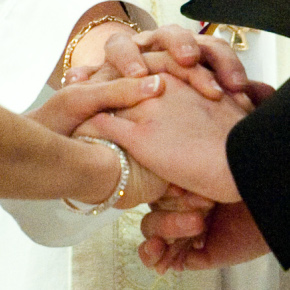
 “Those whom God has joined together let no one put asunder.” By the end of this year, I will have said these words eleven times after hearing the marriage vows of eleven couples. Jesus says these words in today’s Gospel lesson. And he says many other words about marriage and divorce, about fidelity and desire, and about relationships with the most vulnerable. Beneath these words, no matter how hard they are to hear or to speak, beneath these words shimmers Jesus’ surpassing dream for all creation – that none of us and no part of that creation will ever truly be alone.
 The ministry intern at St. Mark’s preached yesterday, so I have no sermon to offer to the Internet this morning. Instead, I held on to the following for just such an occasion, and I am glad to share it today. In August, I attended a training event called
 Every day of my fourth grade year, my class lined up at the end of recess to go back inside. The bell rang, and we raced to our spots in the line. But the race was in vain because no matter who arrived at the door first, we always lined up alphabetically by last name. By last name. What I wouldn’t have given to line up by first name. Then (Oh happy day!) I would have been at the very front of the line. No Aarons or Abigails in my class. No. Adam would have been the first name on the list. But those days were cruel. Every morning, I stood on tiptoes to see over the twenty-three heads in front of me, and only one boy – Shane Yellin – was worse off than I.
 This week has been a particularly tough one for our twins, Charlie and Amelia. At thirteen and a half months, we think they are cutting their molars, so their extreme fussiness is understandable. On Tuesday, I walked in the door of the kitchen, and before I had taken three steps, Charlie was toddling up to me as fast as his little legs and precarious balance would allow. He ran into me and buried his head between my knees, which is his way of saying, “Pick me up, Daddy.” I hefted him into my arms. He put his arms around my neck and his head on my shoulder. And for the next twenty minutes, I just walked around, holding him and speaking softly into his ear. It was a special moment, a physical heart to heart.
 You might be wondering if I accidentally read two weeks worth of Gospel lessons just now. The story of Jesus and the Syrophoenician woman ended satisfactorily, and at that point I could have said, “The Gospel of the Lord.” But the appointed lesson for today barrels forward into the next story, as well, and we read about Jesus healing a man who cannot hear and can hardly speak. We could focus on either half of this Gospel reading: there surely is enough in each to fill out a sermon. But today, I’m going to break a rule of preaching and bite off more verses than I normally do because I think the Gospel writer Mark places these two stories side-by-side for a reason. And this reason centers on the strangest word in the passage, a word that itself needs to be translated because Mark chose to preserve Jesus’ original language when he wrote it down. That word is “Ephphatha”: Be opened. Openness is the key to these two encounters. And openness is one of the keys to our lives as followers of Jesus Christ.
 My tenth grade English teacher, Mrs. Lewis, disliked linking verbs – passionately disliked linking verbs. She disliked linking verbs so much that she would count the number of times we students used the words “is” and “was” (and all the others) in our papers and deduct points if we exceeded more than one or two per paragraph. She nursed a particular vendetta against the word “become,” if memory serves. Do you know how hard it is to write a paper with next to no linking verbs? (I just used one in the last sentence, and you probably didn’t even notice.) Now we students grumbled about this strict grading procedure every time we wrote an essay, but Mrs. Lewis stuck to her guns. And God love her for it, because I count Mrs. Lewis as one of the teachers that made me the writer I am today. (Dang! I just used another linking verb.)
 Today we complete our long, five-week march through the sixth chapter of the Gospel according to John. We read every last word, some of them multiple times. Jesus fed the crowds – five thousand strong – with one person’s groceries. He walked on water to meet his companions across the sea. He spoke to the crowds at length, hoping to move them past their rumbling tummies to the deeper craving for the “bread of life”; that is, the sustenance of abiding relationship with him. But the people don’t get it. They aren’t ready to hear what he has to say. And yet, Jesus keeps pushing. He keeps extending the metaphor, making it more explicit, until he’s talking about eating and drinking his own flesh and blood.
 Homo sapiens. That’s what Carl Linnaeus, the 18th century biologist, called the human species. All living organisms in his influential system of taxonomy are given two Latin names, a genus and species. There’s Canis lupus – dog.* There’s Felis catus – cat. There’s Macropus rufus – red kangaroo. And then there’s Homo sapiens – modern day human. The “sapiens” distinguishes us from other extinct species of hominid like Homo habilis and Homo erectus. Carl Linnaeus used the word “sapiens” to describe our species because, like any good Enlightenment thinker, he prized the human abilities to gain and retain knowledge, to question and understand, to solve problems, and to discern. Sapiens, after all, comes from the Latin word that means “wisdom.”
 It’s great to be back with you after three weeks away. I spent much of my vacation traveling to Massachusetts, North Carolina, and Tennessee. I visited a friend going through an agonizing medical issue and reconnected with an old friend from college. I got to shoot a bow and arrow, which I haven’t done since I earned the archery merit badge about twenty years ago. And I got to hang out with the now one-year-old twins and their mother a lot. It was a good vacation. But I’m glad to be back with you ready to preach a sermon about six of my favorite words in the Gospel. Those six words are: “I am the bread of life.” Embedded in these words are three things that so often dance beneath the surface of what Jesus says: a promise, an invitation, and a mission.
 Where the Wind...