
Sermon for Sunday, March 20, 2016 || Palm/Passion Sunday C || Luke 19:28-40; Luke 23
 In our lovely, little town of Mystic, today is a day of parades. There’s one this afternoon that will get all the press – the St. Patrick’s Day parade will attract throngs of green-clad people to Main Street to watch and revel at a charming small town spectacle. The Highland Pipe Band will set the tone as they march off from Mystic Seaport towards downtown. Hundreds of people on floats, in cars, and on foot will follow, not to mention the real reason to go to parades, which is the fire engines. They say everyone is Irish on St. Patrick’s Day, and the same extends to Mystic’s parade four days later.
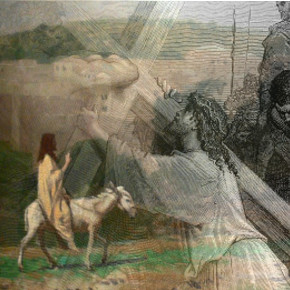
In addition to our town’s parade, we here at St. Mark’s remember not one, but two more parades today. In the first parade, a baby donkey walks down the Mount of Olives towards Jerusalem. A man rides on its back, and people hail him as the “king who comes in the name of the Lord.” In the second parade, the same man staggers out of Jerusalem under the weight of the cross, and people deride him with mocking shouts: “If you really are the king, then save yourself.”
These two parades – separated by less than a week’s time in Luke’s Gospel – couldn’t look more different. In the first, Jesus rides triumphantly into Jerusalem with “the whole multitude of the disciples” praising God. In the second, Jesus stumbles his way to the place called The Skull, whipped and beaten, too exhausted to carry his own cross the entire distance.
But if we take a deeper look at these two parades, we discover they aren’t as different as they appear on the surface. In both parades, Jesus subverts expectations. He could have ridden into Jerusalem on the back of many a more respectable beast, but he chose a baby donkey. Why? Well, for starters there was Zechariah’s prophecy to fulfill:
“…Shout aloud, O daughter Jerusalem! Lo, your king comes to you; triumphant and victorious is he, humble and riding on a donkey…” (9:9)
But beyond prophetic fulfillment, Jesus chose this humble farm animal to show the incongruity inherent in people’s expectations of their king. They wanted a warrior. They got a healer.
Jesus’ walk to Golgatha continues this subverting of expectation. “Save yourself,” people jeer. “If you are who you say you are, then break out of here and dispatch these Roman soldiers as you go!” What they don’t realize, however, is that Jesus has no interest in saving himself. He wants to save them.
In both parades, a vulnerable Jesus turns his face towards danger and death instead of running the other way. He had been saying for the entire journey south that Jerusalem was where everything was going down. This was high noon, and Jesus purposefully left his six-shooter at home. He rides into the city weaponless, with his deputies cringing and looking for likely hiding places. He chooses this utter vulnerability because it illuminates his innocence, the fact that he is put to death for no just reason. The second parade, the one to The Skull, happens because he continues defenseless. Pontius Pilate is just looking for an excuse to release him, and surely Jesus could have provided one. But no. Jesus is staring down the power of death itself, and he’s not about to blink.
Indeed, in both parades, Jesus has a grander agenda than anyone realizes. He is a king, but of a realm so much bigger than any physical location. He is locked in battle, but his enemy is so much larger than an intransigent religious establishment or even the entirety of the Roman Empire. He is going to die, but new life that triumphs over death will be the ultimate conclusion. The Pharisees want him to quiet his disciples. But Jesus says: You’re setting your sights too small. “If they were silenced, the very stones themselves would shout out.” The thief on the cross just wants to be remembered. But Jesus says: You’re setting your sights too small. “Truly I tell you, today you will be with me in Paradise.”
These two parades show the beauty and glory of Jesus for who he is: the messiah who fulfills God’s promises in unexpected ways; the healer-king who puts himself squarely between us and the power of death; the savior who yearns for us to stop setting our sights so small.
There was a fellow way back in the fifth century who did just that. Like his Savior, he set his sights big – like entire island big. He had been captured and taken to that island in his youth and he had been made a slave. After many years in servitude, he escaped and returned to his homeland. He might have expected to live out his days in comfort after the trials of his youth, but Jesus is in the business of upending expectations. What’s incredible and beautiful is that this man listened to Christ’s call, and went back to the place of his captivity. Just like his Savior, he turned his face towards danger and death, despite his vulnerability. And he enlightened an entire island with the Good News of Christ. His name was Patrick, and a parade in his honor happens at one o’clock today. Hmm. Maybe all three parades have more in common than I thought.
—

 This is a sermon about grace. I’ve been wanting to share with you my definition of grace for a while now, but the time didn’t seem right. Then after spending time with Megan Palmer’s family two weeks ago, preparing for and leading Megan’s service last weekend, and having the stomach flu most of this past week, the time to talk about grace has finally come. Maybe I was waiting for a moment when I was sure I had recently experienced it. But before we talk about grace, I need to tell you about my dad’s sense of humor.
 Last fall, I had to renew my passport before my trip to Haiti with Tim Evers. I had originally gotten my passport in advance of a choir trip to England back in college in 2003, and that first document was still valid when Leah and I went to South Africa for our honeymoon in 2011. But they’re only good ten years, so in the fall of 2015, I found myself stapling an unsmiling picture to an application I picked up at the post office. I filled in all the information – name, address, social security number. I checked the box marked “U.S. Citizen,” dropped the package in the mail with the processing fee, and a few weeks later, received my new passport.
 Right now, the bedtime ritual at home goes something like this: bath time around 6:15; diapers and pajamas at 6:30; stories, snuggles, and songs until 6:45; and then, blessedly, sleep. We rotate through many beloved and well-worn bedtime books: Goodnight, Moon; Time for Bed; Guess How Much I Love You; The Going to Bed Book. Leah and I can recite every one of these and more. But I tell you, I can’t wait until Charlie and Amelia are old enough to ask us to make up bedtime stories.
 Every year on the Sunday before Lent begins, we read this Gospel lesson. We call it the story of the Transfiguration, which is a fancy way of saying “something turning into something else, usually a more beautiful something else.” And if we stopped there with the label we apply to the story, we would get something out of it to strengthen our faith. We would see some evidence that Jesus was really whom he said he was, since his face changed and his clothes dazzled and two famous dead prophets came round for a chat. But I don’t think this evidence is really what Luke means for us to get out of this story. I don’t even think the term “Transfiguration” applies to Jesus. Rather, since the whole story is told from the disciples’ perspective, I think they are the ones who are “transfigured.” I’ll explain what I mean by that in a minute, but first I’d like to tell you about my fifth grade science fare project.
 We’ve all heard those words from the Apostle Paul a hundred times. “Love is patient. Love is kind.” I read them at my sister’s wedding. Perhaps you had them read at your own. Statistically speaking, if you go to a wedding there’s a better than average chance you’ll hear First Corinthians 13. Now, it is true beautiful chapter can stand apart as an ancient ode to love. But when we sequester these verses to the marital service alone, we miss how Paul uses them in the greater context of his letter. We miss how love is the corrective for the issues facing the church in Corinth. We miss what love is for. So let’s put these famous words back in context, and with a little help from Harry Potter, we’ll remember a thing or two about love.
 I love my mother with all my heart. For thirty-three years and five days, she has never wavered in her steadfast love for me, support of me, and delight in me. She delivered me in the middle of a Maine snowstorm; she endured through my advanced childhood self-centeredness; and she never let her own demons keep her from being my nurturer, advocate, mentor, and friend. I get my love of reading from her. I get my precociousness from her. And I get my ability to be quiet and listen from her. When I had my first ever bona fide moment with God, it was my mother who held me and rocked me – her seventeen-year-old baby boy – while I bawled my eyes out, overwhelmed by the immensity and clarity of it all.
 “You are my Son, the Beloved; with you I am well pleased.” Whenever I read this beautiful verse of Scripture, my lungs expand with more air than normal. I take a deep, cleansing breath, and I remember the truth of these words, and I lament how easy it is to forget them.
 Where the Wind...