The county fair

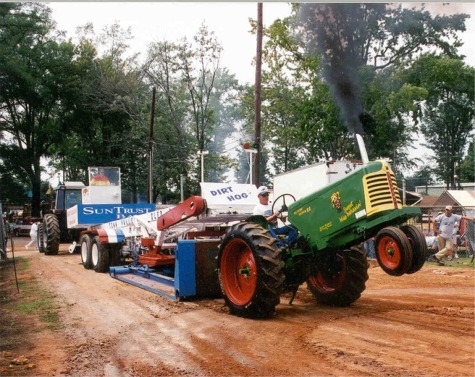
The smells of sweat and fried dough hung in the air, mixing with the burned oil of the tractor pull. He was sitting with hands clasped, wearing a plaid shirt with the sleeves rolled up and a challenge on his deeply lined, leathery face. She was standing, looking all the world like a Grant Wood painting, and thrusting matchbook-sized pamphlets into the hands of passersby. I walked by out of reach, but I couldn’t help looking at the booth, one of many at the county fair. “How sure are you of going to heaven? Are you 50% 75% 100% sure?” read the banner. My friend wondered aloud about how one arrives at a 75% surety of heaven. I chuckled, but I was unable to keep walking by the booth. On the table, a wooden contraption with three small doors read: “Do you know the three things God CANNOT do?”
I stopped. The Grant Wood painting saw my furrowed brow and handed me a pamphlet. It looked like a doll’s magazine. A smiley face decorated the cover along with the words: “Have you accepted Jesus Christ as your personal Lord and Savior?” I closed my hand around the pamphlet and pointed to the three doors. I tried to keep the incredulity out of my voice, but I failed miserably: “So, what are the three things God can’t do?” I said.

She opened the first door: “God CANNOT lie.” She opened the second door: “God CANNOT change.” She opened the third door: “God CANNOT let people into heaven who have not been born again.”

We talked for fifteen minutes. I told them I did not disagree with the first door, but that I preferred to state the sentiment in positive terms: “God always tell the truth” or “God is trustworthy and faithful.” I said that a “lie” is the absence of the “truth,” and that I’d rather talk about God’s goodness shown in God’s truthfulness than to try to hook people with the trappings of sensationalism. After five minutes, the man commented that I was very intelligent. I took that as a compliment, but I have a sneaking suspicion it was not meant as such.

As our conversation continued, I realized we weren’t conversing. We were sparring. I’ve never had a taste for theological pugilism, but I was already three rounds deep, so I kept jabbing and blocking. I’ve had this same conversation with county fair proselytizers, but never as an ordained person. After the man commented on my intelligence, he asked me what I did. I said, “I’m a priest.” Without another word, he thrust another pamphlet in my hand. It was about how Roman Catholics aren’t real Christians and are going to hell.The same thought kept jumping to the front of my mind: “People like these, no matter how pure and ardent their intentions, make my job harder.”

It didn’t matter that I wasn’t a Roman Catholic. It didn’t matter that I agreed with the man and woman several times during our bout. The only thing that mattered was that I didn’t buy into the way they framed the Christian faith–as a bottom-line venture whose only goal is to “save souls” by following the instructions in the smiley-face doll-sized magazine. Surely, there’s more than that. Surely, the abundance of what God has done and is doing is more important than a “what’s behind door number 3” marketing scheme concerned with what God CANNOT do.

As I walked away, I wondered what had been accomplished during our boxing match. In the Gospel according to Matthew, Jesus says that when two or three are gathered in his name, he will be in the midst of them. Were we gathered “in his name” or in our own names, intent on KOing the other’s theological stance? Was Jesus there? Was I 50% 75% 100% sure of his presence? Looking back, Jesus was there, but he was not in my corner and he was not in their corner. He was there trying to get us to leave the ring.

Sally has six tangerines

(Sermon for August 3, 2008 || Proper 13, Year A RCL || Matthew 14:13-21)

“We have nothing here.”

This is the disciples response to Jesus’ preposterous notion that they might possibly find enough food to feed all these people—five thousand men plus countless women and children. They followed Jesus here to this desert to be near him, to feel his compassion and his healing touch. They followed Jesus here and now the evening has come and the crowd is restless, hungry, pressing in. The place is deserted: there’s no vendor anywhere. The hour is late: there’s no time to search. The crowd is massive: there’s no food anyway, not even for the disciples.

“We have nothing here.”

The disciples rummage in empty rucksacks, hoping that a further perfunctory exploration of their food stores will mollify Jesus. “They need not go away,” he had said. “You give them something to eat,” he had said. But they aren’t expecting us to feed them; we’re under no obligation. Furthermore, we can’t give what we don’t have! And…

“We have nothing here!”

To punctuate their point, they turn over the last rucksack and shake it… “Oh, except for a few loaves and a couple fish.” They count them: five squashed loaves, two dry fish. They trace figures in the air—so that’s one loaf per thousand men and two-fifths of a fish. They raise doubtful eyebrows when Jesus asks them to bring him these pitiful scrapings from the bottom of that last rucksack. They start chuckling, but their laughter dies when they look at Jesus’ face. They’ve seen that look before. They know what it means. They bring him the loaves. They bring him the fish. And they wait, incredulous but expectant.

“We have nothing here.” The world suffocates us with this lie so often that we forget we ever knew how to breathe. You will have no friends until you wear this catalogue. You will have no transportation until you drive this luxury car. You will have no romance until you purchase this diamond. You will have no beauty until after your gastric bypass.

“We have nothing here.” Suffocation leads to apathy and apathy leads to hopelessness. And hopelessness drives away from us any thought that we can participate in changing the world.

“We have nothing here.” These are hopeless words, empty words, words incapable of carrying promise or releasing imagination. These words stifle creativity and leave no space for the deep breath of blessing.

But Jesus invites us to take this deep breath with him when he says: “Bring them here to me.” The disciples take him the measly offering: five loaves and two fish. With no thought about how comically small an amount of food this meal is, Jesus looks up to heaven and blesses the offering. Then he breaks the bread and cuts up the fish. He hands the blessed food to his disciples, and they give it the crowds. And they keep giving away the food and giving it away and giving it away. All the people have their fill, and the disciples gather up quite a bit more than they began with.

This is, of course, not how math usually works. Math usually works like this: Sally has six tangerines. She gives Joe two of her tangerines. How many tangerines does Sally have? Four. Right. But the counterintuitive nature of Jesus’ blessing learned a different kind of math. Sally has six blessings. She gives Joe six of her blessings. How many blessings do Joe and Sally have? 12? 36? I’m unsure of the exact equation, but the mathematics of Jesus’ blessing always add and multiply; they never subtract or divide.

When Jesus offers blessing, say, in the form of bread broken and shared, Jesus offers himself. When we take him in, Jesus nourishes us with his blessing so we can bring that blessing to others. When we sing, we can lift our voices in one great song. When we tear down our walls, we can share our lives with one another. When we serve God in the world, we can demonstrate that every human being deserves to be treated with dignity and respect. And blessing will spread and grow and multiply. When we share Jesus’ blessing in the form of our gifts and talents, we participate in Jesus’ divine math and discover that Jesus never exhausts his blessing.

The disciples fail this math lesson when they say, “We have nothing here,” because they do, in fact, have something! They have five loaves and two fish, which is seven more than nothing. In Jesus’ day, seven was a number of perfection, a number that signaled completion. So, the disciples miss another math class: 5+ 2 = Completion. They had the exact amount they needed, once Jesus’ blessing got hold of the food. But the disciples were too busy worrying about the nothing they thought they had to notice the something they had.

We have something here.

We have five loaves and two fish. Sure, they are a bit squashed and bit a dry. But we have them. Jesus, what can you do with them? You can bless them and break them and share them, and your nourishing sustenance can overflow through this deserted place.

We have something here.

We have a group of people who have come together to praise your name, O LORD, and to share in your blessing. They are fewer than, perhaps than there has been in years past, but they are here. Jesus, what can you do with them? Your blessing flows into and out of our hearts. Your gifts inspire us and your love moves us to serve in your name. And your nourishing sustenance overflows through this gathering.

We have something here.

We have all the good gifts Christ has given us. We have the grace and the energy to use those gifts to serve God in this world, this world that tries to suffocate us with the lie that we have nothing. But this lie vanishes when we take that deep breath of blessing, which comes from the Spirit of Christ. Christ blesses us in the breaking of the bread, and when we share that blessing it spreads and grows and multiplies. Thanks be to the God who blesses us to be blessings in the world.

We have something here.

For the sake of ten (part 3 of 3)

This relationship which God has extravagantly blessed us with challenges the understanding of God’s immutability. Indeed, in the story, it seems (at first glance at least) that Abraham is swaying God’s mind. Many, if not most, ancient and medieval Christian thinkers assert that a facet of the divine is changelessness. This makes sense because the perfect cannot be changed; if it could, it would not be perfect. However, I think that assigning platonic categories of perfection to God is a silly exercise because God is beyond our concept of perfection.* God is more than perfect because God subsumes the category of perfection into God’s being. That is why God can send a son to earth against all the rules of fashionable Greek philosophical discourse of the time. God is other, but God is present at the same time. What we call Providence, as theologian Paul Tillich says, is the intermingling of our actions and inactions with God’s directing creativity. Part of this directing creativity is responsiveness to prayer. Tillich says that “every serious prayer contains power, not because of the intensity of desire expressed in it, but because of the faith the person has in God’s directing activity—a faith which transforms the existential situation”  When Abraham says “Far be it from you to do such a thing” (which might more expressively be translated: “How dare you!”), he is engaging in this kind of prayer. The relationship he has with God, more than the words, is the important factor in the exchange.

While it might seem that Abraham is using his close connection with God to sway God’s mind, God seems to let the exercise go on to expand Abraham’s mind concerning justice, righteousness, and sin. Abraham’s thought experiment is flawed to begin with because there is no way to separate the righteous and sinful.  Even in generations to come when it was possible to be “righteous under the law,” people kept the temple in business by sacrificing to restore their righteousness. Later, Paul reflects this reality when he says, “There is no one who is righteous, not even one” (Romans 3:10). But Abraham’s seems to say, “For argument’s sake, let’s say there’s a clear distinction between the righteous and the sinful.” God humors him thus far.

Next, Abraham makes an outrageous claim that would make any level-headed person cry foul. He says, “Shall not the Judge of all the earth do what is just?” Abraham is outraged that the righteous would be swept away with the wicked. However, he is perfectly content with the wicked remaining unpunished if even ten righteous people are found in the city. Surely, this is not justice—the wicked go unpunished for the sake of the righteous, the wicked don’t get what they deserve! Now, we all know the end of the story—Sodom gets utterly destroyed. But leaving that aside for a moment, let us pause and reflect on God’s mercy as this story elucidates it. Mercy is not getting what you deserve. It seems that as Abraham lessens the number of righteous needed to save the city, the mercy (rather than the justice) of God expands to greater and greater levels. If only ten are found, you won’t destroy the city? Heck, what about one? We never get that far, but it is not unimaginable. By the end of the story, it seems that the ten righteous are on vacation, and the city is destroyed anyway. But the extravagant claim about God’s mercy still stands, though Abraham can’t see it because of his preoccupation with justice.

This story is finally about two things that relate to each other. The first is the human inability to comprehend God and God’s action in the world. The second is the realization that humans are always in the presence of God, participating in that same action. C.S. Lewis says: “The freedom of God consists of the fact that no cause other than Himself produces His acts and no external obstacle impedes them—that His own goodness is the root from which they all grow and His own omnipotence the air in which they all flower”  Our incomprehension stems from the actions of God having God’s freedom as their basis and warrant. We are in God’s presence because of God’s goodness. We participate in God’s freedom even when (or especially when) we question God as Abraham does. We participate in God’s goodness when our actions bring about the justice, mercy, and grace of God. And we participate in God’s omnipotence when we are blessed with those briefest of glimpses of God’s directing creativity, which spur us to greater action and greater love.

Footnotes

* A fair number of 20th century theologians say something similar, though I doubt they use the word “silly.”

For the sake of ten (part 2 of 3)

Thinking we understand the ways of the world, and of God, for that matter, is a major cause of all kinds of unrest. I have been a student for nineteen years and one piece of learning that has quietly crept up on me as the years rolled by is this: there sure is a heck of a lot I don’t know. Most of my personal failings come from me thinking I know things that I don’t know. Recognizing that I do not know something is, I believe, one of God’s repetitious lessons in humility. I know so little about the world that I can see and feel and touch. If I know so little about what is actually knowable, how could I ever presume to know anything about God? About why God does what God does? And for that matter, whether or not why is even an appropriate question when God is involved?

These musings stray into the territory of an apophatic* understanding of God, but I assure you, I will not quite get there. One needs only to look at the story this reflection concerns to know that God, while supremely unknowable from our end, makes God known to us in both ordinary and mysterious ways. Indeed, Abraham talks to God!  The simple fact that there are two characters in the scene—Abraham and God—illustrates the immanence of God in our midst. It is when we turn this around and realize that it is really we who are in God’s midst that the transcendence of God smacks us square in the forehead. God is beyond our knowledge, but because of God’s grace we are not beyond glimpses of the recognition that we think, move, act, love, live in the presence of God. This is revelation, of which Jesus Christ is the most perfect example.

We live in the presence of God whether we recognize it or not. However, as our eyes adjust to the holiness around us, the injustice of the world becomes more apparent and more intolerable. Questions such as why do we suffer? and why are the good punished and the evil rewarded? and why does the world seem to be in inexorable decline socially and environmentally? abound when we link our experience of our Creator with our moral compasses. C.S. Lewis, in The Problem of Pain, begins with a discussion of religion in general. He says that the roots of religion are two-fold: the universal, uncanny, dreadful, unexplainable something that he calls experiencing the “numinous”; and the emergence of morality. The Jewish people, he continues, were the first to combine these two things when they discerned that their God both prompted them to live a life of good morals and helped them along the way. As the understanding of God as a necessarily “good” being grew, the aforementioned questions became more prevalent. Indeed, if we were without our understanding of God as a beneficent Creator, then there would be no problem associated with injustice or pain. They would simply be neutral facts, as indistinguishable from their natural counterparts as colors in the dark. However, we are blessed with the revelation that our God is good. This is both a comforting and a vexing thought. Abraham takes the vexation head on. In doing so, he accuses God of premeditated capriciousness and also shows just how poorly he, Abraham, understands the concept of justice.

“Will you indeed sweep away the righteous with the wicked?” says Abraham. Here Abraham wrestles with what might be termed “Divine inscrutability.”** What looks like capriciousness to humans, goes one interpretation, is God fulfilling God’s inscrutable plan. This quickly becomes the “It’s God’s will” argument. However, this progression is inherently flawed. There is obviously a paradox happening somewhere when inscrutability and knowledge of God’s will are mentioned in the same breath. These two approaches seek to answer the “why” question (why did God let this happen? etc). Inscrutability says, “I don’t know why.” The God’s will argument says just that—“It’s God’s will,” no matter what happens. The latter is a very limited understanding of our relationship with God. While the “will” of God certainly exists, it is not the organizing principle by which we live. That is, instead, reserved for the “Word” of God, which is both the foundation of existence and the incarnate being of Jesus Christ. Affirming this premise does not answer the “why” question, but supersedes it with the person of Christ, who is present with us in our pain and suffering. The inscrutability of God is maintained because we can never fully know God, but our questions are answered by a relationship with Jesus Christ (rather than an explanation).

to be concluded.

Footnotes

* This is a five dollar seminary word that means something like: “You can never know anything about God, so quit asking.”

** Inscrutability is a funny word. You can be inscrutable, but can you just be scrutable? In think you can in Europe.

For the sake of ten (part 1 of 3)

Abraham stares after them as they make their dusty way down into the valley. They are men to his eyes, and yet, in the shadow-stretched twilight they appear indistinct, almost shadows themselves. But not shadows; for these beings shine. They shine with the borrowed light of the one who remains with Abraham on the hilltop overlooking the candlelit city of Sodom. Abraham watches them until their shadows mingle with those of the scrub and gorse bushes. He stands there, mystified—for they have just predicted that Sarah (his Sarah!) would get pregnant. Ha. She’s far too old, her joints too arthritic, her bones too brittle to stand the strains of pregnancy. And yet. And yet they had seemed so certain. She had laughed, but it was no joke. I thought I understood the ways of the world, ponders Abraham, as the shining beings melt into the candlelight of the city.

I thought I understood the ways of the world. Perhaps not, if it is true that Sarah can still bear children. Confusion. Abraham shakes his head, as if this act would jostle loose such a silly, irrational thought as Sarah becoming pregnant. He looks down at Sodom again. And here’s another example of irrationality, he thinks. Anger kindles in his chest as he remembers the abuses that have reached his ears, the abuses committed by the people of that city. But yet—how could God destroy that place if there were righteous people there. Surely God could not be that unjust.

Abraham shakes his head again, this time with suppressed incredulity, and lifts his eyes from the twinkling lights below. He turns and approaches the third being, the one who has remained with him on the hill when the others ventured down to the city. Seen peripherally, the being is generally man-shaped. But as Abraham moves near, he perceives how inadequate a container the man-shaped body is for such an abundance of light, harmony, and awe. Abraham suppresses a shudder. He opens his mouth, but closes it again, unsure whether he wants to question or accuse. The being knows the confusion in Abraham’s mind, knows that such cognitive dissonance is the birthplace of revelation.

All at once, Abraham finds his words: question and accusation combine into indictment tinged with desperate plea for understanding. “Will you indeed sweep away the righteous with the wicked?” He presses on, not waiting for the LORD (for, of course, this is who the luminous being on the hilltop is) to respond. “Suppose there are fifty righteous within the city; will you then sweep away the place and not forgive it for the fifty righteous who are in it? Far be it from you to do such a thing, to slay the righteous with the wicked, so that the righteous fare as the wicked!” Abraham points a quivering, accusatory finger, and his pitch rises as the cause of his mental distress tumbles from him: “Far be that from you! Shall not the Judge of all the earth do what is right?” Tears form at the corners of his eyes; he slumps over, chest heaving with the exertion of voicing the thoughts that have been building ever since the three men approached his tent.

The LORD waits for Abraham to recover and then responds quietly, certainly: “If I find at Sodom fifty righteous in the city, I will forgive the whole place for their sake.” Abraham hears these words and is mollified—almost. What about 45? 40? 30? 20? What about—and here Abraham raises both hands, fingers splayed—ten? “For the sake of ten I will not destroy it,” says the LORD. And then the LORD leaves Abraham with his thoughts. Abraham returns to his place to find Sarah, her deep eyes reflecting dancing firelight, lost in the same thought: I thought I understood the ways of the world.*

to be continued.

Footnotes

* This and the upcoming two posts are pieces of a reflection on Genesis 18.

Alphabet soup (Bible study #3)

Well, I never thought I’d say this, but Google has failed me. I just gave up on a massive search to find how many English words the translators of the New International Version (NIV) used to translate the Bible.* Although I did not meet my main objective, I did discover a few helpful things:

  • There are some really nutty people on the Interwebs writing about biblical translations (especially ones who think the King James Version–which was translated 397 years ago–is still the cutting edge in biblical scholarship and modern translations are leading us along the path to destruction).
  • It’s difficult to find reputable biblical scholarship on the Series of Tubes.
  • Some Christians are just plain mean.

So, with full knowledge that I am continuing to add my voice to the wacky/sad/puzzling/repellent world of Internet biblical scholarship, I will offer my two cents on which translation to use when studying the Bible.

Cent #1: Use them all.

Cent #2: Get an Interlinear Bible.

While the New Revised Standard Version (NRSV) is the primary version I read (because my church uses it during worship), I consult multiple other translations to see how they render the Hebrew and Greek texts.**  Every translation is an interpretation because the biblical languages do not fit nicely and cozily into our grammatical system.

The ancient Hebrew language exists in another universe from modern English. Ancient Hebrew thrives on ambiguity and nuance and feeling. There are often assumed words left out. There is no standard word order. There are no vowels, for that matter. Translating ancient Hebrew is like painting a picture, not solving a math problem. So different translators will come up with different translations.

While Greek is both more exact than Hebrew and more closely related to English, translators still face challenges. Some of the writers of the New Testament nearly flunked Greek 101, so their sentence structure is often confusing. Other writers aced their Greek classes and like to show off, writing compound-complex (oh, so complex!) sentences with so many nouns, adjectives, and verbs that sorting out which goes with which is troublesome. Ironically enough, the writer of the Letter to the Hebrews has the best Greek in the New Testament.

So, with the biblical languages proving to wiggle and squirm while we try to smoosh them into English,*** and with the biases of unbiased translators sneaking into their translations, reading a range of English translations is the way to go. Use the NIV for a Protestant outlook and the New Jerusalem Bible for a Catholic one. Use the NRSV for a mainline Protestant view and the New Living Version for a conservative Protestant one. Always read the King James for its poetry–they really knew how to write English in Shakespeare’s day. There are books you can buy called “Parallel Bibles” that line up several translations next to one another. There are also several good websites that put passages in parallel for you. Check out Bible Gateway for all your conservative Protestant versions and The Unbound Bible for mainline ones.

Okay, that cent turned into about a buck fifty, but my other cent will be short. Interlinear Bibles have text in the original languages with English translations under each word. Even if you don’t know the original languages, you can use this resource to compare words. Often the same Greek word will be translated with three or four different English words. Your Interlinear will show you this. On the other hand, several Greek words will be translated into the same English word. Your Interlinear will show you this, also. I’ve had sermon ideas light up and be snuffed out when I return to the original text. It’s always enlightening and even fun to piece together your own translation using an Interlinear and several English translations.

So, there’s my take on the alphabet soup of biblical translations. Remember that studying the Bible is about encountering God through the text. When you combine several different resources, these encounters can become more fruitful and they can further deepen your relationship with God.

Footnotes

* The reason I couldn’t find how many words the NIV uses is that (when I first conceived this post) I mixed up the NIV with Today’s English Version (or Good News Bible) which limited the number or English words in the translation. Originally, this version was produced for non-native English speakers. So, Google didn’t fail me…Adam = epic phail.

** A few chapters of Daniel are written in Aramaic, but for clarity’s sake, I will more often than not refer to Hebrew and Greek as the languages of the Bible.

*** I’m pretty sure “smoosh” is a technical term.

Pick your periscope (Bible study #2)

Biblical scholars have an especially silly sounding word they use for “passage from the Bible.” It is pericope, and if you type this into Microsoft Word, Bill Gates will try to change the word into periscope, because (apparently) the latter is much more frequently used. ‘Pericope’ may look like a three-syllable word (like periscope without the ‘s’), but it has four syllables and rhymes with calliope.* If you are at a Bible study and drop the word ‘pericope’ your companions will probably stare at you and wonder how you got your hands on the Anchor Bible Commentary.

Pericopes are important because they define the amount of text you are going to study. The word is a mash-up of two Greek words meaning “to cut around,” so when you pick a pericope you are figuring out how much text you want to swallow at one go. If you pick too little, you may be in danger of ignoring the context of the bit you pericopized.** If you pick too much, getting your head around it all may be a difficult task. (SPORTS ANALOGY ALERT) Think of it like this: American football games (and for that matter real football games) are time-constrained. The viewer knows just how long a regulation-length game will be. This makes the last few minutes exciting.*** Conversely, cricket (a sport only comprehensible if you were born in a Commonwealth country) can go on for three or four days–though I’m convinced most of that time is spent making crumpets and talking about the weather.

Okay, so how do you choose a pericope? First, I wouldn’t take more than about twenty verses. The fewer the verses, the more in-depth you can go, though I’d probably put a minimum at around four or five. If you’re Bernard of Clairvaux you can write a treatise on a single instance of a word in the Bible, but you’re not, so don’t. If the story you are reading is longer than twenty verses, focus on a particular section of the story each session until you’ve covered the whole thing. It is amazing what you can discover about God in just a few verses of the Bible; if you bite off more than you can chew, you’re likely to miss something exciting and revelatory.

Second, don’t be swayed by chapter breaks or section headings. The chapters were added in the late middle ages and the headers by the publisher of your particular edition of the Bible. Needless to say, neither is original to the text. Now, the chapters usually do a pretty good job breaking up the text, but they aren’t batting a thousand.**** For example, most scholars identify a large pericope from John 15:1 to 16:4a, so the chapter break is misleading. As for the headers, if it were up to me, I’d tell you just to go out and buy a Bible without them (like this one). While they are handy if you are looking for a passage, they often serve to sway a reader’s interpretation before she even gets to the text.

Third, look for transitional words like “immediately” or “the next day.” Mark uses the word immediately about 579 times, and it often serves to signal a new section. Actually, he uses it 41 times, but that’s still 2.5 times a chapter, which is a lot.

Fourth (and this can be a bit tricky when reading in translation) look for any literary structures the writer is employing in a particular section. For example, if the writer uses the same three words to begin three consecutive sentences, they are more than likely related. (This is call anaphora).  We’ll talk about some of these structures in later posts, but for now, if you see one in action, you’ve identified a pericope!

Honestly, though this is an important step in biblical study, choosing pericopes is usually really easy because the biblical writers are really good at what they do. And modern scholars spend way too much energy and way too many pages in their commentaries quibbling over whether this verse goes with this or that pericope. If you take one thing away from this post, remember that choosing a pericope is like eating a healthy serving size. Too little and you’ll still be hungry. Too much and you will have gorged yourself to the point of not remembering everything you ate. Choose a portion you can chew and digest. Let the passage of the Bible fill you. Let the words of the Bible nourish you. And let God encounter you every time you pick up the book for study.

Footnotes

* (1) That strange little organ-like instrument they use in the circus or (2) the Greek muse of epic poetry, who is probably a bit miffed that we now use her name to identify a strange little organ-like instrument they use in the circus.

** I just made up this word, so please don’t use it if you are writing anything a professor will see. Remember, professors think they are the only ones allowed to make up words.

*** You may be quick to point out that the last 2 minutes of American football games take a half hour to play. Good point. My mother makes the same one when she calls my father and me up for dinner and we say there’s two minutes left in the game.

**** Sorry, I forgot to warn you about that sports metaphor.

Musings upon the occasion of a sprained ankle

One day in April, I sprained my ankle, and in the process remembered I’m not finished being created:

The disc cut through the breeze and rose steadily into the air as the ground beneath my racing feet sloped away. I leapt for the Frisbee, it eluded my grasp, and I began falling. However, my leap had carried me farther down the sloping field than I anticipated, and my left foot connected with the turf a split-second later than it intended to. Within the next three or four split-seconds, my ankle collapsed under the weight of the rest of my body, which quite naturally followed my foot back to earth. My first thought (as my foot and calf played tug-of-war with my ankle’s ligaments) was: “Not again.” But this fatalism was short-lived, for it dissolved into much anguished rolling around, grass-pulling, and sobbing.

Ultimate Frisbee has now joined soccer, racquetball, and basketball on the list of sports that have put out contracts on my left ankle over the last nine years. Each time, my ankle swelled so I couldn’t see those two knobby protrusions of bone that everyone has, and each time, as the ankle healed, the bruise filtered down my foot, making my toes look like grapes. As I write this, my foot is wrapped in ice, and I long for the days of purple toes. And they will come in time, next week perhaps, if I keep icing and popping Ibuprofen. They will come because the body heals. And the body heals because I’m not finished being created.

The cells divide, the tissues repair, the ligaments rebound. The swelling dwindles, the toes un-purple, the strength returns. This process happened the first three times, and it has begun again. I am being created as I sit here, just breathing and sitting. I breathe in and the air floods my lungs and my lungs separate the oxygen and the oxygen feeds my heart and my heart pumps my blood and my blood carries energy to my ankle where the cells are busy dividing. Each cell division begins with breath, which is the mark of the One who continues to speak creation into existence.

It is the same with the trees, whose canopies I can see from my prone position: last week they proclaimed their constant creation as new buds reached for the sun. It is the same with the birds, whose gossip I can hear past my window: this morning they proclaimed their constant creation as they rummaged for supplies for expectant nests. It is the same with each human being, who refuses to remain exactly the same as she was yesterday or he was the day before that. The One who creates me, who (surely knowing I’d have a knack for spraining my ankle) gave my body the ability to heal, is creating still with the simple ingredients of life and light and love. I’m not finished yet. The world isn’t finished yet. This I believe.

Weapons-grade interpretation (Bible study #1)

In the 2004 film Saved, Hillary Faye (after misinterpreting some advice from Pastor Skip) snatches the pregnant Mary from the street, pulls her into a van, and attempts a hasty and ill-conceived exorcism on her. Mary struggles free, and Hillary Faye calls after her: “Mary, turn away from Satan. Jesus, he loves you.” Mary turns around and says, “You don’t know the first thing about love.” As Mary walks away, Hillary Faye chucks a Bible at her,  yelling: “I am filled with Christ’s love!” Picking up the recently hurled volume, Mary says, “This is not a weapon, you idiot!”

I think of this scene every time I begin the daunting and often humbling task of biblical interpretation. When I read the Bible, I breathe in the words of ancient men and women who had powerful and life-changing encounters with God, encounters which transformed their lives and altered the way they looked at the world. When I read the Bible, I am reminded that God still encounters people today and that studying the Bible makes me more aware of how God is moving in the world. When I read the Bible, I read how my life must change so that I can resonate more resoundingly with God’s presence.

At least, that’s how it works on the good days. On the bad days, I open up the PDF of the Bible I have on my laptop, search for a keyword, take a sentence completely out of context, and slam it down the throat of whoever is annoying me with an interpretation that is different from mine. On the bad days, I affix a trigger and barrel to my Bible and shoot verse-bullets at people who disagree with me.

Thankfully, my bad days are few and far between. But there are enough Christians in the world that there are always a couple bad days happening, a couple of bible-guns taking aim. And sadly, there are a few very vocal Christians who have built Heavy Water Reactors out of their Bibles and are constantly turning out weapons-grade interpretation.

Here are some warning signs to consider if you suspect WGI in your neighborhood:

  • Someone holds up a closed Bible while telling you what it says.
  • Someone says, “The Bible says…” and then strings together single verses from four different books.
  • Someone tells you that you should hate a particular group of people based on Scripture.
  • Someone says that if you don’t agree with his or her interpretation you are going to hell.

The vocal proponents of weapons-grade interpretation abuse the Bible for their own ends. Their agendas lead to irresponsible and destructive readings of the Bible, readings which prove rather than inform. The most dangerous way to read the Bible is to think you already know what it says. Let me say that again: The most dangerous way to read the Bible is to think you already know what it says. This leads to a closed book, closed minds, and closed hearts.

But biblical study should expand our hearts, not constrict them. It should open our minds to the wonders of God, not shut them in endless loops of refrigerator magnet theology. Good Bible study begins with a willingness to learn something new and enough humility to be surprised. Responsible Bible study doesn’t seek ammunition for attack, but nutrition for growth.

Over the next several weeks, I plan to post about the mechanics of biblical interpretation so as to foster responsible study for myself and others. I will ask questions such as these: How do we choose what piece of the Bible we are going to study? What should we be aware of when we read the Bible in English? What is the literary content of the passage? How does the passage function in its historical and societal contexts? How has the history of interpretation of the passage colored our understanding of it?

Tackling these questions is a step toward dismantling biblical Heavy Water Reactors. Weapons-grade interpretation damages our relationships with God and keeps people from seeking such relationships. I pray that the sad, unconscionable tradition of using the Bible as a weapon ceases so that the Good News of Jesus Christ can ring out undistorted.

Competing for spots in my imagination

The day before I returned to VTS for my senior year, I went searching for something in the cupboard under the stairs. The light flickered and hiccupped, casting faint shadows on the cramped, box-strewn floor. The winter coats and old military uniforms brushed me heavily like a gas station carwash. I pulled and pushed boxes of books and elementary school projects out of the way. With a dozen or so boxes disgorged from the closet, I found what I was looking for. Three plastic tubs. Three dusty plastic tubs, each nearly two decades old. I carried them into the living room and lined them up. I slit the packing tape off the first one, opened it, and was met with piles of my childhood.

I began sifting through the legos, pulling out flat black and grey pieces and every human figurine I could lay my hands on. After several hours of collecting, lego pieces littered my living room floor like an abstract mosaic. I fitted the black and grey pieces into a grid and sorted the figurines into groups—knights and pirates, naval personnel and more knights. Another hour and my creation was finished: a lego chess set, complete with knights on horseback and kings in mail and helm.

I spent every rainy day of my childhood and some of the sunny ones building with legos. For many years, I followed the instructions meticulously: each piece went in its place, and when I was finished, I had duplicated the image on the box in three dimensions. At some unidentified point after I had hit double-digits in age, I began straying from the directions. Eventually, the sets I kept prison-like in their own boxes began to mingle. Soon, I had three plastic tubs (they were neither old nor dusty yet) piled high with anachronistic castle legos and futuristic space legos and realistic city legos, all together, all competing for spots in my imagination. I put the directions away and just began to build, to create.

Until the day before returning to seminary, I had not created anything with legos in nearly a decade. But the act of creating infused me with joy. I created videos in high school. I created music in college. And as I began to contemplate God’s movement in my life, I accepted God’s invitation to enter more fully into God’s creation.

Thinking about the call to serve God might prompt one to ask the question: why was I created? But I think this is a faulty question. To reach a better understanding of call, the question should be asked in the present tense: for what am I being created? God’s call in my life is a continuously present reality, always pushing my self-defined limits of possibility. The very act of calling assumes an act of creation, for accepting a call is simply the acknowledgment that God is already at work molding me into a better servant, a better giver, a better lover. I think this is why Paul says that whoever is in Christ is a new creation—new creations that are ever new because of constant and continual creating.

I believe that God has barely begun to create me. This thought comforts me when I realize how much I still have to learn and chastens me when I think I have everything figured out. I have perceived enough of the edge of the expanse that is the life with which God has challenged and blessed me to know that only with God’s help can I respond to God’s call. This call in me is nascent; I am still being formed, still being created. But God has known me since I was in my mother’s womb. Christ is with me until the end of the age. And the Holy Spirit moves my life, always pushing those limits of possibility. I hope that through God’s love and grace, the work God has begun in me is a good one. I hope I can respond to God with a reflection of that love and grace. I hope I continue to catch glimpses of God’s creating movement in my life.

God has invited me to participate in God’s creation. I can comprehend nothing so joyful, nothing so humbling as this. Those three old dusty plastic tubs are back in the cupboard under the stairs. The flickering light is off and the winter coats hang undisturbed. But I am still creating because God is creating me.

(This post originally appeared in the Fall 2007 issue of “The Call” newsletter of the Society for the Increase of the Ministry (SIM), a not-for-profit group that supports Episcopal Seminarians as they move from lay to ordained leadership in the Church. I thank God for this organization, and I thank SIM for generously supporting me, both in prayer and scholarships. Check out SIM’s website.)