Generous engagement: The two things you’re not supposed to talk about (part 1)

With a mere eight days left before the presidential election and with a friend to whom I really can’t say no coaxing me to step into this quagmire, I find my thoughts turning to the intersection between faith and politics. This is not just any intersection — this is the intellectual version of what my seminary friends call “dysfunction junction,” which I imagine gives 1 in 10 drivers in Alexandria, Virginia symptoms of PTSD. At that intersection, Braddock Road, Quaker Lane, and King Street all cross, and many vehicles trying to brave the passage do not make it out unscathed.

With the image of dysfunction junction planted firmly in my mind, I turn it to faith and politics, while the collective cry of grandparents everywhere echoes that those are the two things one is not supposed to talk about. I plan to talk about the political dimension of Jesus’ message in the next installments of this series, but first I must clear something up from a political science perspective, and here it is:

The phrase “separation of church and state” appears nowhere in our official political documents. Media Pundits and Joes Six-Pack alike invoke these five words everyday, but all they serve to do is reduce a much more complicated relationship into a morass of error and misunderstanding. Religion is mentioned exactly once in the U.S. Constitution. The First Amendment states: “Congress shall make no law respecting an establishment of religion, or prohibiting the free exercise thereof…” That’s it. That’s all we’ve got. First things first: the amendment deals specifically with congress. Churches can seek to impact the government all they want; the amendment concerns the power of congress, not the curtailment of the voice of the church.
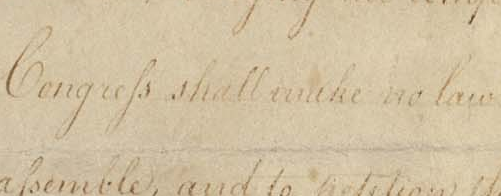
Now, over the years, the Supreme Court has decided myriad cases by interpreting these two clauses of the First Amendment. The court gets involved simply because there is no complete wall of separation between church and state, as much as Thomas Jefferson wanted one. In 1963, the Court set a standard by which the government can indeed infringe on someone’s free exercise of religion as long as the government has a “compelling interest” and the resultant action is the “least restrictive” it can be (Sherbert v. Verner). My constitutional law notes from college have 33 religious cases cited, and those are just the important ones. The court has looked at issues such as school prayer, expulsion for religious motivations for failing to salute the flag, blue laws, drug use in religious ceremonies, wearing of religious symbols on military uniforms, displaying religious imagery on government property, polygamy, school vouchers, tax exemptions…*

All this to say that the government entangles itself in the religious establishment, no matter how much it tries not to. And the religious establishment, especially in the decades since the rise of the religious right, is unafraid to wade into the waters of politics. So, while the “separation of church and state” may be a nice shorthand for keeping us out of the messy business of theocracy, the phrase does not describe how our system functions.

People of faith should not fear to let their religious beliefs guide their political decisions. Rather, inviting God to be a part of your political decisions can lead to a more generous, sensitive engagment among those with whom you disagree. Of course, if invitation is corrupted by a toxic expectation that God is going to rubber stamp everything you decide is right, then this generosity and sensitivity will disappear. A prayerful reflection of the values Jesus teaches and the life he calls us to lead, along with a prayer for a discerning heart, help us to act responsibly and effectively in the political sphere.

With that sticky business about the separation of church and state cleared up, we can turn to the political message of Jesus’ teaching. Stay tuned for the second installment of “The two things you’re not supposed to talk about.”

Footnotes

*It would make for an extra boring post if I went into the actual legal stuff in here, and I’m not qualified to do so anyway. I have a Polical Science degree, not a JD. Suffice to say, the government (usually) tries hard not to break its own rules, but sometimes it does. Most of us just don’t notice most of the time.


Rambling in the presence of God

(Sermon for October 19, 2008 || Proper 24, Year A RCL || Exodus 33:12-23)

Moses is a bit of a rambler. I know, because I am a bit of a rambler, as well. If Dr. House were performing a differential diagnosis on “anxiety,” rambling would be the first symptom written on the dry-erase board. In my case, anxiety-induced rambling usually happens when I am attempting to converse with a woman I find attractive. In especially acute attacks, my rambling begins to sound like the dialogue in a Jane Austen novel. Much to my own chagrin, I tend to use phrases like “would that you were amenable to my ardent affection” and “how diverting it must be to tarry in the presence of such loquacious interlocutors.”

Now, Moses is already married to the lovely Zipporah (whom he met at the well) so he doesn’t have to worry about accidently quoting Pride and Prejudice in conversation. Rather than rambling in the presence of women, Moses’ anxiety leads him to ramble in the presence of God. No one could fault him for being anxious. After all, the people of Israel have been grumbling about the good old days in Egypt ever since they stepped on the far bank of the Red Sea. The daily delivery of manna and quail and the water gushing from the rock don’t seem to have curbed their discontent. And just last week, they melted down all their jewelry to make a nice, little pet god, which, of course, broke one of those pesky commandments. Needless to say, Moses has his hands full. Add to all this the anxiety caused by a heart to heart with the LORD, and Moses breaks down into an acute rambling attack.

The way the book of Exodus structures the conversation we heard this morning makes this rambling difficult to notice. This is one of those instances where the Bible overuses the third-person singular pronoun “he” so that you’re never quite sure who’s talking. Here’s Moses’ first ramble:* “See, you have said to me, `Bring up this people’; but you have not let me know whom you will send with me. Yet you have said, `I know you by name, and you have also found favor in my sight.’ Now if I have found favor in your sight, show me your ways, so that I may know you and find favor in your sight. Consider too that this nation is your people.”

And the LORD says to Moses: “My presence will go with you, and I will give you rest.”

But Moses apparently doesn’t hear this, because he is already halfway into his next ramble:* “If your presence will not go, do not carry us up from here. For how shall it be known that I have found favor in your sight, I and your people, unless you go with us? In this way, we shall be distinct, I and your people, from every people on the face of the earth.”

The LORD responds: “You have found favor in my sight, and I know you by name.”

I imagine Moses hearing this and slumping to the ground, allowing the full weight of his calling and all of his anxieties to wash over him. He lets the LORD’s words sink in. He shudders at their impact. He looks up, and his next frenetic ramble dies on his lips. Instead, he says, “Show me your glory, I pray.”

And the LORD says, “I will make all my goodness pass before you, and will proclaim before you the name, ‘The LORD.’”

So, after the LORD takes the necessary precautions to keep Moses from overexposure, the glory of the LORD passes Moses by. Moses, safe in the palm of God’s hands, feels the presence of the LORD. Moses’ anxious rambling ceases. Secure in the knowledge that he is in the LORD’s presence, Moses begins his work anew.

These are anxiety-ridden days. The presidential election is heading into the ninth inning. Unemployment is up and home-ownership down. The stock market graph looks like a heart monitor in the ICU. Add to all this the anxieties of work, school, and family, and rambling is going to be the least of our symptoms.

Thankfully, Moses is not the only person with whom God has the kind of conversation we’ve been discussing this morning. Oftentimes, when we come to God in prayer, our minds are already starting the sixtieth lap at Talladega. We just can’t slow down, can’t shift into a lower gear. We get frustrated because our prayer time becomes just another opportunity to review the grocery list and dwell on the need to get the oil changed and wonder how big a hit the investment portfolio took today.

But in our frustration, we fail to realize something. The grocery list, the oil change, the portfolio—these are just as good a place to start as any. Rather than seeing these things as intruding on our prayers, we can see them as entrances into authentic conversations with God. I don’t think God expects us to shut off our anxiety when we enter into prayer. Quite the opposite. God expects us to offer our anxieties as prayer.

Moses rambles about the people and finding favor in God’s sight and the nation of Israel. Rather than addressing any one manifestation of anxiety directly, the LORD speaks to the very core of Moses being: “My presence will go with you, and I will give you rest.” In other words, God says, “Moses, you are still going to lead the people. I’m not going to let you off the hook. But, remember, please remember that I am with you, and you can find rest in me.”

When we offer our anxieties to God in prayer, we acknowledge that the sources of those anxieties have power over us and keep us from being the people God calls us to be. But God whispers to the very core of our beings: “My presence will go with you, and I will give you rest.”

Moses continues to ramble. So God reminds Moses of the relationship they share. The LORD knows Moses’ name and Moses hears God speak that special, holy, intimate divine name that the Israelites wrote down but never spoke aloud. In revealing this special name to Moses, God invites Moses into a deeper relationship.

When we offer our anxieties to God in prayer, God gives us the opportunity to notice that God has heard what our hearts have been divulging. Through all our rambling, God is speaking God’s name to us, inviting us to that deeper relationship, in which trust begins to mitigate anxiety.

Finally, Moses stops rambling. He realizes that God is with him, bearing him up as the waves of anxiety crash over him. Moses asks to see God’s glory. All the goodness and the glory of the LORD pass him by. When we acknowledge the anxieties weighing on our hearts, we can begin to hear God speaking peace to us in the midst of those anxieties. And we, too, can settle into the cleft of the rock, rest in the palm of God’s hand, and feel the presence of the LORD pass us by.

Footnotes

* This is one of those times when reading a sermon doesn’t give you the effect of the delivered message. To get said effect, read Moses’ bits like Dr. Cox from Scrubs. He is a rambler, also.

Once there was a man who found a pearl…

So, the United States is mired in the worst financial fiasco since I was four years old. Because of my early developmental stage back then, I was more concerned with fire trucks than the Dow Jones Industrial Average. Now, I still get pretty excited when I see a fire truck, but the economic crisis occupies my mind with far more regularity. Every news cycle seems to have a direr story than the one before, the presidential candidates talk about little else, and the crisis is the number two topic at coffee hour right now (after college football, which, of course, is more important, especially when my team is ranked #2 in the AP).

With the Dow taking a nosedive and 401Ks across the land going on the South Beach diet, can you think of a better time for churches to start their fall stewardship campaigns?

I know the previous sentence sounds sarcastic, but it’s not. Of course, I wish we had never gotten into this mess in the first place. But we’re in it now, and the best thing we can do is take hard looks at our priorities. The economic crisis is forcing us to reevaluate how we allocate our resources. The first step in this evaluation process is realizing “our” resources are not ours at all.

Jesus tells this parable: “Again, the kingdom of heaven is like a merchant in search of fine pearls; on finding one pearl of great value, he went and sold all that he had and bought it” (Matthew 13:45-46).

A bishop I knew a long time ago used to tell a story about this passage from the Gospel according to Matthew. I was very young, so I might get some of the details wrong and I might embellish others, but it goes something like this:

Once there was a man who found a pearl. This pearl was the most magnificent specimen. Indeed, only in the wildest dreams of clams did a pearl like this one exist. It was the size and weight of a golf ball, but no one would think to compare the two. The pearl was in a class by itself. It shone with a light all its own. The light might have hid some imperfections if the pearl had had any. But it didn’t. The pearl, thought the man, was, quite simply, perfect. The trouble is, the pearl was in a glass case and very visible alarm wire crisscrossed the case and a wrinkled shopkeeper hovered over the case. The man opened his wallet, thumbed through the small bills in the billfold and pondered his several credit cards. He pulled out one especially shiny card and, pointing to the pearl, tried to hand the card to the shopkeeper. The shopkeeper raised her eyebrows and shook her head.

So the man went home. He wandered through his house, into the garage, and onto the deck. He gathered up everything not nailed down and sold it all—his car, his computer, his beloved grill. He went back to the shop. Not enough, the shopkeeper’s look told him.

So the man sold his house. Not enough. He cashed out his stock options. Not enough. He even gave up his mint-condition Nolan Ryan rookie card. Not enough. The man stared plaintively at the shopkeeper. Then his eyes wandered down to the pearl. He knew somehow that obtaining this pearl was why he was alive, what he was made for. He didn’t know how he knew, but, looking at that pearl, he just knew. He looked back up at the shopkeeper. “What about me?” he said, “What if I give myself?”

The shopkeeper smiled, brought a jangling set of keys to eyelevel, and began searching for a key. She found it, unlocked the case, and slowly lifted the pearl off of its bed of velvet. “Here you go,” the shopkeeper said. “And by the way,” she continued, “you were willing to give up everything for this pearl. Your house and grill and baseball card are still mine, but I want you to look after them for me. And remember, you are mine, too.”

This story has been with me for quite a while, and I share it because I think it centers the discussion of stewardship better than anything I can come up with myself. To understand the importance of stewardship, we must first acknowledge that everything we have comes from God, and is, in fact, still God’s. We are just holding onto God’s stuff for a while.

Indeed, a steward is someone who manages the assets of another. So when we talk about stewardship in a Christian context, we are saying that we are blessed with abundance from God, and we are striving to use that abundance justly and wisely. When we think of Christian giving—of time, of talent, of monetary resources—we should really tack on another word. We should think of it as “Christian giving back.”

Stewardship always entails some form of giving. Stewardship has at its base a certain kind of giving that we do every Sunday. When we celebrate the Eucharist, we are literally “giving thanks,” for that is what Eucharist means. By starting with thanksgiving, we acknowledge that our gifts, our lives, our livelihoods come from God. Stewardship must start with an “attitude of thanksgiving.”

The reevaluation of our allocation of resources begins with humbly acknowledging that we are not the owners of the stuff we accumulate and gratefully giving thanks to God for what God has given us to look after. In the end, this all comes down to trust. The financial crisis in which we are currently embroiled is predicated on untrustworthy practices; indeed, we don’t even know how much certain things are worth any more because of deceit and mistrust. But God is trustworthy, and God has entrusted us with God’s stuff. How will we respond?

Activating praise

Every weekday morning, I walk into the fellowship hall at church to find four delightful ladies chatting over coffee. I shake their hands and pat their shoulders. They welcome me with smiles and critiques of my thinness (along with doughnuts, their remedy for such a physique). If I yawn even once, they launch into mock interrogations of the previous night’s activities. I have known these ladies for two months only, but already I love them, for their warmth could instill no other feeling.

At the appointed time, we move from coffee and doughnuts in the hall to silence and prayer in the chapel. My four delightful friends form the core of worshipers for daily Morning Prayer, a tradition as old as any other in the Anglican Church. This morning, I was checking my email in my office when they shooed me into the chapel, where my rector asked me to lead our morning’s devotion.

“Lord, open our lips,” I prayed.

“And our mouth shall proclaim your praise,” came the response.

These words, so familiar from years of praying the Daily Office,* tasted fresh and alive with new meaning this morning. Notice the progression these two lines demonstrate. We cannot proclaim God’s praise until God opens us up. God is the cause. Our proclamation is the effect. Indeed, God activates our praise. We do not call God to us when we come together in prayer; God calls us to prayer. God is not standing on the doorstep with hands in pockets waiting to be buzzed in. God is already inside prompting within us the desire to gather. Lord, open our lips. Only when God has done this will we be ready or able to proclaim God’s praise.

These words at the beginning of Morning Prayer remind us that we do not have a boxed-up God or a God carved in a piece of wood. Our God does not exist for our convenience. Our God is not a mute receptacle for our cares and concerns. Our God lives a life of radiance and moves with graceful unpredictability through a world which tries its best to forget who deserves credit for creation. God’s radiant life is complete within that life, but, in a wonderful incongruity, God also moves in and through our own little lives. This movement activates our prayer. This movement gives us the desire to praise God. Our mouth shall proclaim your praise because you, Lord, have deigned to open our lips.

In Mere Christianity, C.S. Lewis comes to a similar conclusion when discussing our connection with the life of the Trinity: “An ordinary Christian kneels down to say his prayers. He is trying to get into touch with God. But if he is a Christian he knows that what is prompting him to pray is also God: God, so to speak, inside him. But he also knows that all his real knowledge of God comes through Christ, the Man who was God — that Christ is standing beside him, helping him pray, praying for him. You see what is happening. God is the thing to which he is praying — the goal he is trying to reach. God is also the thing inside him which is pushing him on — the motive power.”

God both motivates our pray and receives it. When we pray, “Lord, open our lips,” we acknowledge that we would not even be entertaining the notion to praise God if God were not prompting us toward such a notion. Thus, our prayer is our ultimate expression of God’s sovereignty, which (from an anthropocentric perspective) is our inability to control God. When we view prayer as our response to God’s movement, we are less likely to see God as the proverbial divine genie-in-a-bottle or ATM. We are more likely to come to God humbly, overwhelmed by the proposition that the Creator of all that is would desire our mouths to proclaim any sort of praise.

The four delightful ladies with whom I share Morning Prayer understand this gift of God’s presence better than most. They are there every day, expressing their joy that our radiant God moves in their midst, activating their praise.

Footnotes

* “The Daily Office” is a technical term for the various daily times of prayer, which grew out of the monastic tradition of praying the hours. In the Episcopal Church, Morning and Evening Prayer are the predominant pieces of the Office, with Noonday prayers and Compline (nighttime prayers) a close second.

Not FEMA trucks

I’ve been rereading C.S. Lewis’s The Screwtape Letters in preparation for a class I will be teaching at my church. The book is a series of letters from one of Hell’s executive level devils sent to a junior tempter who is tasked with corrupting the soul of a new convert to Christianity. In Letter #14, Screwtape is alarmed that Wormwood’s “patient” is showing signs of becoming humble.

This is not as dire as it may seem, says Screwtape, because the true meaning of humility is easy to conceal. He counsels Wormwood: “Let [your patient] think of it not as self-forgetfulness but as a certain kind of opinion (namely, a low opinion) of his own talents and character…. By this method thousands of humans have been brought to think that humility means pretty women trying to believe they are ugly and clever men trying to believe they are fools.”

You can see just how handy this kind of self-deception could be for those who work against God (who Screwtape calls “the Enemy”). If people are deluding themselves in such a way as to take less than full advantage of their gifts, then Screwtape and his boss are winning. And here’s the main point: thinking yourself less talented than you are does not lead to humility, but to dereliction of duty.

God pours out on each one of us a collection of gifts and talents. If we don’t use them due to a case of misplaced modesty, then we are not fully living the lives that God’s abundance makes possible. We’d be like those FEMA trucks held back from the hurricane zone, full of uneaten food and unused supplies. Humility has nothing to do with a low opinion of your talents. Humility has everything to do with the proper attribution of and thanksgiving for those talents to God, the provider of all good gifts. And the best way to give thanks to God for your talents is to use them in the service of others—giving of yourself out of the things God has given you. Indeed, the only way to thank God properly for your gifts is to use them and use them fully, with no hindrance from a false understanding of humility.

So, come to the Lord in prayer and ask God what are those gifts and talents God has poured out on you. Be humble by acknowledging that those gifts and talents have a source, and you aren’t it. But do not sell yourself short. God gives gifts so they can be used to glorify God. Any cropping of your talents for the sake of that false understanding of humility lessens your ability to reflect the glory of God out into the world. Give thanks to God for all the opportunities God has given you to reflect that glory and serve God with that life of yours, so full of gift, talent, and promise.

Emptying

(Sermon for September 28, 2008 || Proper 21, Year A RCL || Philippians 2:1-13)

For the first several weeks after moving into my townhouse, about half my stuff littered the living room floor. I had put away my clothes and shelved my books. I had arranged my furniture and replaced the light bulbs with those curlicue ones. I had set up my TV and hung a handful of pictures. But this mass of extraneous stuff persisted. There were sealed boxes and boxes whose contents had thinned as I randomly put things away. But even these boxes lingered, some with single items remaining in their depths. Every time I came home I dodged the crate of office supplies, stepped over the plastic filing cabinet, and wished everything would gain just enough sentience to find a place to go that wasn’t the middle of my living room. The objects of my wish, of course, remained stubbornly inanimate.

The number of times I’ve moved has reached the double digits now, and I have discovered a universal law: for every five boxes you pack, one will remain unopened until your next move. These extra boxes are (a) shoved unceremoniously into the closet under the stairs or (b) stacked in the garage where the car should go or (c) pushed next to the couch with decorative afghans thrown over them and turned into end tables. Currently, my one-in-five-boxes, so recently cluttering my living room, are now lined up against the wall in the guest room awaiting their fate.

I have all this stuff. I can’t possibly need it all. I can’t possibly use it all — the nearly empty boxes, the still sealed boxes, the hanging bags, duffel bags, laundry bags, garbage bags, trunks, suitcases — not to mention all the stuff that used to be in these containers that I did unpack. Most of the stuff seems to exist simply to take up space.

So, when I read in today’s lesson from Philippians that the same mind that was in Christ Jesus should be in me, I find I’m in a bit of a bind. Paul praises Jesus for doing something that my accumulation of stubborn inanimate objects shows I’m unwilling to do. “Jesus,” says Paul, “who, though he was in the form of God, did not regard equality with God as something to be exploited, but emptied himself, taking the form of a slave, being born in human likeness.”

The Greek word translated “something to be exploited” might be better translated as “something to be grasped” or even “something to be hoarded.” Even though he was in the form of God, Jesus let go of his station. Even though he was part of all the might and majesty and magnificence of God, he did not hoard them. Even though he shared the most precious thing in the universe — equality with God — he shared himself with us by emptying himself. By taking on the form of a slave. By being born in human likeness.

Then he humbled himself, and became obedient to the point of death — even death on a cross. Then God exalted him and gave him the name that is above every name. All this happened because Jesus was willing to let go of his grasp on his divine form. All this happened because Jesus refused to hoard the incomprehensible harmony of light and love and grace that is our God. All this happened because Jesus emptied himself.

And I am supposed to have the same mind that was in Christ Jesus? Surely, Paul, you ask too much this time.

If I am unwilling to relinquish my stuff, even the stuff in the boxes that won’t see the light of day until I move again, how much more unwilling am I to empty my heart and mind of all the stuff that diverts me from following the Lord. Indeed, the boxes and bags and furniture function merely as physical reminders for all the clutter encumbering my soul. If one in five boxes remains unopened after a move, what percentage of my soul remains sealed off after moving through life? How much of my heart is unusable because of all the stuff piled so high? With my mind distracted by the detritus of the day, when will I have time to contemplate the works of God?

Where is this mind of Christ Jesus that neither grasps nor hoards, but seeks to empty? How do we obtain this mind? How do we grasp it? Right here. Right here is where the imitation of the mind of Christ begins. We can’t obtain it. We can’t grasp it. We can only resonate with Jesus’ self-emptying by beginning to empty ourselves. We can only come to some lowly analog of the mind of Christ when our own minds let go of the persistent accumulation of distractions. This emptiness is unlike any other instance of emptiness out there. This is not the emptiness of a bare pantry or the emptiness of thirty miles after the fuel light comes on. This is expectant emptiness, purposeful emptiness, holy emptiness. This holy emptiness makes room for the grace of God to expand within us. Our internal houses, once the storage depots for the stuff of the world, transform into the sanctuaries they were always meant to be. The emptier we become, the greater is our opportunity to discover true fullness.

This wonderful paradox is at the heart of our life of faith. Paul says that God is at work in us, enabling us both to will and to work for God’s good pleasure. As we begin the slow process of self-emptying, we realize that God has been at work in us all along: rearranging our internal furniture, removing the clutter, and unsealing those parts of our souls we packed away. Truly, we’d never have been able to start emptying ourselves without God first tidying up the place. When we empty ourselves, we are ready to respond to God. We are eager to serve others. We are prepared to give of ourselves because we know the fullness of God expanding within us has no bounds.

I invite you to join me in an experiment this week. Each night before you go to sleep, focus your mind and heart in prayer. Identify something in your life that is taking up too much space within you, that is cluttering up your internal living room. Perhaps this something is trouble at work or doubt about your financial future or concern for a loved one. Give this something to God in prayer. Ask God to inhabit the space vacated by this offering. Do this every night. Each time give something else to God. Allow more space for God to move in your life. Soon you will empty yourself of enough clutter to notice that God has been at work in you all along, enabling you both to will and to work for God’s good pleasure. Thanks be to God.

Tabula rooster (Bible study #6)

For the first time in my life, a rooster woke me up this morning.

Before I go any further, let me say that I was none too pleased by this event. Everything I know about roosters comes from cartoons and various other early childhood media, and the aggregate sum of that knowledge boils down to two facts: (1) roosters are boy chickens and (2) roosters crow at sunrise. Now, according to the U.S. Naval Observatory Astronomical Applications Department, sunrise was at 7:09 this morning at longitude W80.0, latitude N38.7 where I happen to be on retreat. So, either the cartoons lied or the rooster was jet-lagged because that darn bird woke me up at 5:30.

As an aside, I’ve always thought clock-radios to be rather neutral devices, but the one in my room mocked me with its diabolical red numbers.

At first, I didn’t know what was making the noise. It was guttural, gravelly — like the rooster version of Tom Waits. Then, as sleep traitorously fled from me, I took stock of my position as it related to the unknown sound. I was in bed. I was in the middle of farm country. I was awake before I should be. The sound was not my alarm. Taking these four items into account, I deduced the encroaching noise was the call of a rooster — an overzealous rooster fiend — but a rooster, nonetheless.

So, what’s all this have to do with the Bible? Well, not much, in truth. I needed to vent. However, as I am writing this post, I realize that taking stock of my position helped me identify the rooster’s crow. In much the same way, taking stock of my position in relation to the various texts of the Bible facilitates a more authentic encounter with those texts.

Why does that one story make you angry? or sad? or joyful? or indifferent? What memories does that other story stir in your heart and mind? Maybe your grandmother recited the twenty-third Psalm to you every night as you fell asleep. Maybe that gesticulating street preacher quoted a verse at you while explaining that your bare legs condemned you to hell.  Maybe you were on the verge of mental collapse and you threw your Bible to the ground and it flopped open to Romans and you read and you were filled. Maybe you cannot read Paul because the slave owners justified their action with his words.*

Simply put, our positions, our baggage influence our readings of the text. None of us can achieve a state of Tabula Rasa when we open our Bibles; nor should we try. I don’t believe God wants blank slates to write words on. God wants us — in all our history and tragedy and comedy — wants to rearrange our baggage into those words of life. We bring ourselves to the texts of the Bible. All those positive and negative memories and emotions bubble up. Quelling them for the sake of “scholarship” or “study” makes no sense. The Bible should be too much a part of our lives to keep our lives from being a part of the Bible.

When you pick up the Bible, acknowledge that your position and your baggage do, in fact, influence your reading. Ironically, this acknowledgment will make you less biased in the long run because you will begin to see why a story strikes you a certain way and not just that it does. Chronicling your past associations with a particular text offers one way to chart your growth in your life of faith. The text does not change, but you do. What changes happened? How does the constancy of the text bring those changes to light?

Take stock of your position when you open the Bible.  Let the text encounter you — not the person you think you should be in order to be worthy of the Bible’s holiness nor the unobtainable Tabula Rasa, but the person you are in all your human particularity and messiness. Through the power of the Holy Spirit, the text will speak to this honest, baggage-ridden person. Where the text and your baggage intersect, you will have found your story in the Bible. You will know you aren’t alone in your experience for there are no new stories. There are just new people telling them, new combinations of baggage which add depth and innovation, new ways to proclaim that old, old story.

Who knows? Maybe the next time I read the Passion narrative and come to Peter’s denial of Jesus, I’ll think of that overzealous rooster fiend at longitude W80.0, latitude N38.7.

Footnotes

* In his wonderful and provoking book Jesus and the Disinherited, Howard Thurman speaks of this in his own family.

** In the 4th study in this series, I spoke of a dual reading of the text — once with your context and the historical context and once in the light of a “holy naivete.” I think this holy naivete is different from the blank slate mentality. In the former, you let go of your baggage in order to set it into sharper relief in your reading. In the latter, you delude yourself into thinking you have nothing to offer the encounter.

For once I didn’t disengage

Detachment. Recently, I’ve been giving in to the feelings of this my most famous and well-documented coping mechanism. Friends will tell you that I barely left my room during my second year of seminary except to go to classes and meals. Some days were better than others. I could stomach watching a football game in the common room or going to a birthday dinner at the Mexican restaurant. But on the worst nights — ones in which I had been invited out and had even made a vague commitment to going — I got dressed in going out clothes, laced up my going out shoes, paced the room, argued with myself, grasped the door handle half a dozen times, manufactured some phantom nausea, and put my pajamas back on. I hated myself for those nights. Back then I was coping with the loss of a long-term relationship; I dealt with the decoupling by detaching myself from everyone else, too. I know — not the healthiest of coping mechanisms. Indeed, I needed a coping mechanism for my coping mechanism. But more on that in a moment.

Before you start calling in a crack squad of psychotherapists, this recent bout with detachment is nowhere near as severe. Like Spinal Tap’s amps, the detachment a few years ago went up to eleven. This time, the severity is at about a two or three. But enough of the shadow of that previous time hovers in my memory, making me all too aware of the dangers of detachment. Back then, a loss of relationship made me pull away. Ironically, a similar set of responses is happening as I form new relationships at my new parish. Of course, with the new relationships come the ending or transforming of other relationships. Suffice to say, the constellation of relationships in my night sky is changing, and something in that change is causing me to fall back on my erstwhile coping mechanism.

Enter this week’s lesson from Paul’s letter to the church in Rome. Paul discusses various practices that some find objectionable and others find completely acceptable. Each group thinks they are the ones who are truly honoring God. Paul tells them that both sides are giving thanks to God by different actions, so neither has a right to pass judgment on the other. In this context, Paul writes a verse of surpassing beauty and profundity: “We do not live to ourselves, and we do not die to ourselves. If we live, we live to the Lord, and if we die, we die to the Lord; so then, whether we live or whether we die, we are the Lord’s.”

As I contemplate my recent relapse into old patterns of detachment, I realize that these words have been with me from my first week at my new parish. Since the beginning of August, I have been a part of three memorial services — liturgies during which people come together to mourn and laugh and grieve and celebrate the life of a loved one who has died, and in so doing, celebrate the resurrection of Jesus Christ. At the beginning of each service, the priest intoned these same words from Paul’s letter to the Romans. Each time I heard these words in the last month, I got that spine-tingling feeling that happens when God drops an ice cube down your back to remind you that God’s still there.

These words of Paul speak the beautiful and profound truth that we belong to God, or as the Episcopal burial office puts it: “We are the Lord’s possession.” This reminds me that however much I may feel the need to detach, to disentangle myself from life or friends or responsibilty, God never severs the relationship with me. Hearing Paul’s words during those special memorial services kept me from disengaging in the midst of all the changes and chances my life had been through in recent months.

This is why “church” is so important. In the context of the community of faith, the Lord spoke words of renewed invitation to me. I’m sure you’ve heard the popular epithet that describes someone as “spiritual, but not religious.” I think I understand some of the cultural and sociological forces that have contributed to the emergence of this category. One of these forces, sadly, is a misunderstanding on the societal level of what “religion” means. In the modern era, the terms “religion” and “church” took on the connotation of “edifice” — of imposing structure and immutable establishment.

But “church” has very little to do with a building and much to do with a people gathered. While structure and doctrine have their necessity, “religion” does not mean structure and doctrine. When you get right down to it, “religion” means “reconnection.” Re-ligio. Just look at the word and think of all the football players (most recently Tom Brady of my beloved Patriots) who have had surgery for torn ACLs.  An ACL tear is repaired by reconnecting the torn ligaments to the muscle and bones of the knee. Likewise, “religion” is all about reconnecting us to the One who holds us all in possession. And “church” is all about celebrating that reconnection with one another.

The musical Rent offers a stark view of the reality of our society and shows the utter need for these resources of connection and relationship. Near the end of the show, after the characters have dispersed and gone their separate ways, Roger and Mark sing about that special Christmas Eve last year when their group of friends came together to celebrate life and love. They sing: “What was it about that night? Connection in an isolating age. For once the shadows gave way to light. For once I didn’t disengage.” Opening themselves up to that connection with others leads them to joy and pain and life and death and the grittiness of a love that has survived all the assassination attempts by the forces of isolation.

When I begin to let myself detach from those around me, I must remember that God has already repaired the torn ligament and banished the shadows of isolation. I am the Lord’s possession. I am the Lord’s when I die. And I am the Lord’s while I live. I just need to make sure I’m living while I am alive, to make sure that I stay connected to those around me and celebrate the love of the God who knits us all together.

Getting lost in the stacks (Bible study #5)

One of the easiest missteps people make when sitting down to study the Bible is mistaking the Bible for a book. I know it looks like a book — it has folios stitched together and a cover enclosing the whole bound volume. But whatever its resemblance to a book, it is not one. It is many. The word “Bible” began its career as the Greek phrase ta Biblia which means “the books.” Therefore, the Bible — all visual cues to the contrary — is, in point of fact, a library.

Here’s what I mean. What we call the Bible is a collection of all sorts of writing: transcribed oral tradition, history, prophecy, poetry, gospel, correspondence, sermon, song, vision, law code, genealogy, novella, advice column, propaganda, shopping list, architectural schematic. And these are just the ones I could come up with off the top of my head. The history of how the particular collections of what I will from now on rather lamely refer to as “texts” came together to form our modern day “Bible” is beyond the scope of this post. Suffice to say that from history down to shopping list, each text somehow relates an encounter between God and God’s people. God’s people found the particular encounters that make up the texts revelatory and important, and they, in many a Spirit-filled decision, collected those texts together into the library that has become the Bible.

So, what’s all this have to do with studying the Bible? After picking your pericope, figuring out what type (or genre) of writing the passage comes from can help you begin to unpack it. You’d expect to find dialogue in a Gospel because the genre of Gospel is narrative.* You’d expect to find poetry in the collection of psalms because psalms were originally liturgical song. (Indeed, attached to many psalms are directions for the accompanying instrumentation.) But what if you found poetry in the Gospel. What would that tell you? Perhaps, the writer is reaching back to an earlier tradition and putting that liturgical song on the lips of a character. Check out Mary’s song in Luke 1, influenced clearly by Hannah’s song in 1 Samuel. Check out Jesus’ words from the cross in Matthew and Mark, which come from Psalm 22.

Being sensitive to the various genera found in the biblical library gives us the opportunity to compare the myriad ways biblical writers explored their encounters with the living God. One writer finds God in the proportions of architecture, another in correspondence with the churches he has founded, another in the list of the generations of God’s family going all the way back to Abraham and before. Putting these different experiences in conversation with each other shows us the wonderful range of expressions of the life of faith.

So delve into the library of the Bible. Get lost in the stacks of the Hebrew Scriptures. Run your fingers along the volumes of Paul’s letters. Find one of those rolling stepping stools and reach the dusty top shelf of Revelation. Be aware of the different kinds of writing in the Bible, the various encounters of the people of God. And remember that you, yourself, are part of the greater story still being written, still being added to those last, unfilled shelves.

Footnotes

* Actually, as far as scholars can tell the form of “Gospel” as narrative is unique to Christian literature. Other ancient texts call themselves “gospel” but they tend to be something closer to news reports about various glorious victories for the Roman Empire. The fact that Mark calls Jesus’ message “Gospel” could be an ironic coopting of Roman phraseology — a literary “nah-nah-na-nah-nah,” if you will.

A Fragile euXarist

He wore a grey t-shirt sporting the American flag, shorts, and velcro sandals. When we entered the apartment, he was sitting on one of those big exercise balls and staring through the blinds into the yards beyond the fence. His supervisor greeted us at the door and called out to him to welcome us visitors. The young man at the door — bleached-blond, tattoed, pierced — looked more like a roadie for Alice Cooper than a 24-hour supervisor for a man with Fragile X syndrome.*

My friend had asked me to accompany her to visit her brother and bring him communion. He is not able to get to church much, she had explained, because of his condition, but the Eucharist means a lot to him. She had also explained that Fragile X is a genetic mental impairment that, in her brother’s case, manifested in cognitive disabilities and, on occasion, uncontrolled violent behavior. He will repeat the same phrases over and over again, she had said, and he’ll probably ignore you this visit — he usually ignores strangers.

She and I sat on the futon in the small living room, and she attempted to engage her brother in conversation. I kept my communion kit (which looks like a camera bag) slung across my back, and I leaned forward to catch what they were saying. Instead of talking with his sister, he continued to stare out the window and converse with his supervisor about the comings and goings of various neighbors. After a few minutes, he stood up and I realized how big he is — he could have played power forward at Duke, I’m sure. He went over to the dining table and sat down again, musing about his dinner options. He wanted french fries with ketchup. My friend was patient, and every time she tried to engage him, he responded a bit more. After a while, I could tell that the two siblings had started playing an old game — she knew he was listening and now he was just pretending to ignore her. His responses to her queries, randomly nonsensical moments ago, were now humorously nonsensical. We all laughed about french fries and ketchup and about the lady in the apartment upstairs.

After a few minutes at the dining table, he wandered back to the exercise ball, produced a pack of bent playing cards, and began to shuffle them. My friend asked him if wanted communion. He started staring out the window again. She turned to me and suggested I start unpacking my kit. I unzipped the bag and took out the corporal — sort of a liturgical placemat. On the corporal, I placed the paten (plate) and chalice (cup). As I set out the vessels and tipped some wine into the chalice, he stopped shuffling and started watching. He picked up the Bible and leafed through it while I turned the pages in my prayer book. As I prayed the prayer of consecration, I found myself unconciously emphasizing the simple words in the prayer — words such as food and drink and life. I finished the prayer, my friend and I prayed the Lord’s Prayer with her brother, still holding my Bible, looking on, and then I broke the Bread. I brushed his hand as I gave him the Body of Christ, and, in that touch, I could feel the presence of Christ in our midst. He was there, as he had been our whole visit, and he made himself known in the sharing of his Body and Blood.

After sipping from the cup, I cleaned up the kit and repacked it. I found myself wondering how much my friend’s brother had understood of what we had just done. Then I stopped short. How much had I understood? I said the prayers. I laid my hands on the bread and wine. I asked the Holy Spirit to sanctify the gifts. But even with all my schooling and all my study, I still don’t know exactly what happens in those holy moments of sharing in Christ’s Body and Blood. I don’t know how Jesus indwells those elements with his Spirit. I don’t know how ordinary bread and wine are changed to something that connects us bodily with the grace of our Lord Jesus. But I know that connection exists, that relationship is real. I felt it when my friend, her brother, and I shared that Holy Eucharist.

We do not have to understand fully to participate in the life of Christ. In fact, living a life in Christ is not about understanding at all. It’s about following, about having faith that Christ is one step ahead of you, guiding you. As Paul says, right now I know only in part, but I will know fully, even as I am fully known. God is the one who understands. God is the one who, indeed, stands under and holds up everything that we hold true and good. Living a life in Christ cultivates that deep relationship with God that both brings some understanding, but also (and happily) removes the need to understand.

There’s a phrase in one of the postcommunion prayers in the Episcopal prayerbook: “Almighty and everliving God, we thank you…for assuring us in these holy mysteries…” I’ve asked myself many times how a mystery can be assuring. Mysteries usually thrive by keeping you wondering. But I think that’s the very point. If we understood everything about God there is to understand, God wouldn’t be God, and we’d be deluding ourselves. That was the problem with carved gods and graven images that were both worshiped and controlled. God reveals God’s very majesty and glory in the fact that the mystery abides. And the assurance comes when we cross that fine line between wondering and being lost in wonder.

I still wonder how much my friend’s brother understood about what we were doing. But I know now that understanding is a distant second to sharing — the sharing of the presence of Christ in our midst. My friend’s brother hugged her when we got up to leave. We said goodbye to the roadie-supervisor. As I left the room, I glanced back, and for a split-second, I saw Jesus balancing on that exercise ball.

Footnotes

*For more information about Fragile X syndrome, click here.