Voices

Sometimes, when I’m praying with a small group — say, the ladies at Morning Prayer whom I have mentioned before — I stop speaking aloud and listen instead. Starting with the woman closest to me, I try to pick out each voice.

Our Father, who art in heaven, she begins. Her voice is measured, calm, the sound of warm milk being poured into a glass for a child who can’t fall asleep. Hallowed be thy name. I imagine her voice checking off ingredients as she pulls baking powder and brown sugar from her cupboard. Her apron has a floury hand print below the pocket, into which she replaces the battered heirloom of a recipe card. I can taste the flaky crust of her apple pie.

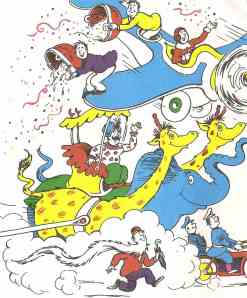
And to Think That I Saw It on Mulberry Street, by Dr. Seuss, 1937

Thy kingdom come, thy will be done. I shift my focus to the dear heart across the aisle. Her voice is honey and love, the sound of grass on a hillside when you’re having a picnic and have to weigh down the napkins with the salt and pepper shakers. On earth as it is in heaven. I imagine her voice reading Dr. Seuss and Shel Silverstein to laughing children who sit cross-legged on mats and never want naptime to come. At the end of each page, she makes sure all of the children have seen the pictures. I laugh, too, when the airplane drops confetti near the end of ” And to Think that I Saw It on Mulberry Street.”

Give us this day our daily bread. I strain to hear the woman next to her. Her voice is soft but durable, the sound of late afternoon rain watering patchwork fields and seeping into the clay. And forgive us our trespasses, as we forgive those who trespass against us. I imagine her speaking comfort in the ICU, her words keeping time with the pinging heart monitor. She holds a frail hand in both of hers, careful not to disturb the needle and tape and gauze and drip-drip of the IV bag. I stand in the doorway with my stomach in my throat and watch her care.

And lead us not into temptation. The last lady is easy to pick out because she is always a few words ahead of everyone else. Her voice is crystal, weightless, the sound of water splashing out of a bucket as it is rises haltingly from the depths of a stone-lined well. But deliver us from evil. I imagine her voice distributing presents on Christmas morning after all the adults have gotten coffee and hot-cross buns. She thanks her grandchildren for their gifts of pipe cleaner and popsicle stick ornaments. I wait for her to call my name and shake a present in my direction.

My focus dissipates, and I join the four woman for the conclusion. For thine is the kingdom, and the power, and the glory, forever and ever. Our voices mix into one voice — warm milk and rain, windswept grass and splashing water, and my voice, which always sounds strange to me when I hear it on a recording. We raise that voice as one to the One that gave us voice. And after our Amen we fall silent.

And we listen.

The Japanese tattoo

You may be tempted to take away from the following story this advice: “Don’t get a word from a language you don’t speak tattooed onto you.” By all means, please do take this advice. But also keep reading because I don’t plan to make my non-tattoo specific point until later in the piece.

I had a friend in college – a tall, good-looking fellow, who probably could be cast as the Norse god Thor in a future Marvel Comic film adaptation if he grew his hair out. Over the course of four years of college, this friend got half a dozen tattoos. The ink was spread across his body, and there seemed to be neither rhyme nor reason to his choices. Like moles or scars, the tattoos appeared to be distributed randomly between his torso and various appendages. About once a semester, he would walk up to the lunch table, put down his tray, and grin until we realized he got a new tattoo.

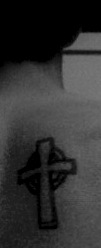
This is my tattoo. Notice, it's not a foreign word. However, I don't think I'll ever fully understand its significance.

On one such occasion, he rolled up his sleeve and showed us the fresh ink just below his left shoulder. Upon the skin, still red and raw from the thousand tiny stab wounds he suffered for this new art, a vertical line connected three horizontal ones. “It means ‘Life’ in Japanese,” he said through his grin. Thankfully, he was too enthralled with his own left arm to see my eyes go wide, like I had just realized I left the oven on. I looked down and started arranging the French fries on my plate into the same Japanese character, while my inner censor struggled to purge my speech of all the correctional thoughts racing through my mind.

Now, I took two years of Japanese in college, and that character was written in black Sharpie on my mental 3×5 cards. “It means ‘Life’ in Japanese,” he said, and my first wide-eyed thought was, “Well, sort of…” The character means, “to live” in the sense of “I live in West Virginia.” Literally, it means, “to inhabit.” Needless to say, I’m glad my inner censor won that day, because Thor could easily have pummeled me if I had educated him in the nuances of the Japanese language.

Ever since that tattoo-related event, I have distinguished living from inhabiting. Too often, I merely inhabit: I wake up, I take a shower, I microwave a bowl of oatmeal, I ignore Sportscenter until the Red Sox highlights come on, I make sure I have my keys before I lock the front door. I do everything…vaguely. I yawn my way through the bleary-eyed hours. I flip on the autopilot switch and read a magazine in the cockpit of my existence.

Surely, this “inhabiting” isn’t what Jesus meant when he used the word “life.” I am the way, the truth, and the life. I came that they may have life, and have it abundantly. When Jesus promises us abundant life, he is not talking about our existence. We do not “exist” abundantly. When we enter into Jesus’ life, we find this abundant living. But living doesn’t just happen. Living is deliberate. If we do not claim abundance, it will just sit there, like the pack of hot dogs that’s been in my fridge for six months.

The danger of “inhabiting” rather than living is (usually unbeknownst to us) lapsing into dronehood, into the drab cycle of shower/oatmeal/Sportscenter/keys. But God did not create us to be drones; indeed, God sent God’s only son to us because we had become drones – slaves to the poor imitations of life that we had cultivated to golden-calf-status.

Receiving the abundance that Jesus’ promised snaps us out of dronehood. When we choose to live rather than merely to inhabit, a new world of possibility opens up for us. The complete joy that is key to an abundant life paints our days with vibrancy and vitality. Even those things that established our routine get a new coat of joy.

I suspect Henry David Thoreau was struggling with dronehood when he decided to go Walden Pond in 1845. There he wrote these words: “I went to the woods because I wished to live deliberately, to front only the essential facts of life, and see if I could not learn what it had to teach, and not, when I came to die, discover that I had not lived. I did not wish to live what was not life, living is so dear; nor did I wish to practice resignation, unless it was quite necessary. I wanted to live deep and suck out all the marrow of life.”

It is my prayer that each one of us lives deep, that we live and not merely inhabit, that we suck out all the marrow of the abundant life that Jesus promises us.

Inspiration (Davies Tales #3)

The irony was unbearable. A theology paper about the Holy Spirit due in less than twenty-four hours, and Aidan Davies had less than nothing. No topic. No thesis statement. No inspiration. No inspiration for an essay about the Spirit, the source of in-SPIR-ation. Davies snorted and shook his head. I hate irony. He focused again on the glow emanating from the screen in front of him. He and his laptop had been engaged in a staring contest for the better part of the morning, and the blank document on the screen was winning handily. He reached into the empty bag of pretzels, forgetting about the last half dozen failed attempts to discover untapped sources of pretzel crumbs from the bag’s darker recesses. No thesis statement. No inspiration. And now no pretzels either.

Davies stood up abruptly. Black spots appeared in the corners of his eyes. He swayed and grasped the back of the chair to steady himself. He shut his eyes, willing the oxygen to double time it to his brain. A deep yawn built in his chest, which he exhaled in a frustrated groan. Then he stretched, and his fingertips brushed the ceiling of his dorm room. He looked up and pushed the square tile with his middle finger. He knew that by evening he wouldn’t be tall enough to touch the paneling above him. No oxygen in my brain. No inspiration. And I’ll be getting shorter for the rest of the day.

Davies looked down at the screen. “You win,” he said aloud to the blank document before shutting the laptop with perhaps more force than normal. He stuffed the computer into his messenger bag and cast around for his trainers. He laced up his shoes, slung the bag over his shoulder, and stalked from the room. He didn’t know where he was going. He had only a vague notion that he might walk a bit before lunch. He passed Mark Riley’s room, whose door was ajar as usual. Mark looked up from a comic book (He calls them ‘graphic novels,’ Davies reminded himself) and said, “Where you off to, brother?”

Davies poked his head into the room, “I dunno. It’s just this Holy Spirit paper. I’ve got—” He cupped his hand into a zero. “Zilch.”

“Same here,” Mark said grinning. “That’s why I’m doing some background reading.” He held up the graphic novel and tapped the title: The Spirit. Davies grinned back, appreciating Mark’s ability to justify his procrastination.

Leaving the dormitory, Davies drifted up the twisting sidewalk. He inhaled the perfume of freshly-cut grass and felt the early spring sun warm his hair. He wandered past the library, down the stairs behind the academic building, and across the parking lot. He watched a pair of squirrels zig and zag up a tree trunk before losing them in the budding canopy. He followed his shadow to the sporting field, its rolling expanse dotted with the stragglers of the flocks of migrating geese.

The moment he stepped onto the field, the geese took flight. Davies watched them until he could no longer distinguish their honking from the ambient noise of lunch hour traffic. As his eyes lost the geese to the distant clouds, a sharp breeze reminded Davies that winter hadn’t quite given up yet. He watched the breeze spiral through the trees, the new leaves spinning and dipping with their unseen partner. Words echoed across Davies’s empty mind: “The wind blows where it chooses, and you hear the sound of it, but you do not know where it comes from or where it goes. So it is with everyone who is born of the Spirit.”*

Wind and Spirit, Davies thought, remembering his Greek class from the first semester of seminary. They’re the same word. When Jesus tells Nicodemus about the wind, he could be talking about wind or Spirit or both. Wind and Spirit act the same: you can’t see the wind until it moves the leaves. You can’t see the Spirit until it interacts with us. You notice the Spirit when you see the change, the movement in our lives.

Davies raced back up the hill, his messenger bag bumping his back with each stride. He reached the bench outside the administration building and put his hands on his head. His breath came in ragged gasps as his lungs and heart protested the sprint after a winter of idleness. Several minutes later, he was able to catch his breath. Catch your breath. What a strange phrase. It’s not like a baseball or anything. More words echoed in Davies’s mind: “Jesus breathed on them and said to them, ‘Receive the Holy Spirit.’ ”**

Breath and Spirit, Davies thought, reaching all the way back to high school Latin. Respiration comes from the same root as Spirit. When Jesus breathes on the disciples, they ‘catch’ the Holy Spirit. Every time I take a breath, the Spirit is breathing life into me. The Spirit is always with me, changing me, moving me, giving me life. ‘Giver of life’ – that’s what the Creed says.

Davies sat down on the bench and opened his laptop. No staring matches this time. He looked up at the leaves pirouetting in the wind. He took a deep breath. And he began to write.

Footnotes

* John 3:8

** John 20:22

Everyone’s heart

(Sermon for May 24, 2009 || Easter 7, Year B, RCL || Acts 1:15-17, 21-26)

Their starting lineup is down a man. While football and soccer teams play with eleven on a side, the apostles need an even twelve. No prime numbers for those apostles. Maybe they need twelve to break into four teams of three for Friday night Cranium.* Or, more plausibly, they need twelve to parallel the tribes of the people of Israel and several other biblical allusions. Whatever the reason, they have an open slot. Peter culls down the candidate pool by limiting applicants to those “who have accompanied us during all the time that the Lord Jesus went in and out among us, beginning from the baptism of John until the day when he was taken up from us.” Taking this criterion into account, the selection committee proposes two names: Joseph called Barsabbas and Matthias.

Then the eleven pray to God for guidance, beginning with “Lord, you know everyone’s heart.” Lord, you know everyone’s heart. What a profound statement of faith – five words that speak to the apostles’ trust in God. Lord, you know everyone’s heart. This one, brief sentence guides their decision-making process in three substantial ways. They acknowledge God’s presence in their endeavor. They understand that making choices involves more than purely mental exercise. And they show humility in the face of a life-altering decision.

Now, I’ve said it before and I’ll say it again: we routinely ignore God’s presence because God is always present. We forget that God is in charge of not just the miraculous, but also the mundane. Our failure to recognize God’s presence is understandable. How many of us note the sound of the engine in the car until there’s an ominous sputtering? How many of us note the reliable glow of the bedside lamp until the transformer blows outside? We adapt to routine. We organize our lives into predictable patterns. But God’s movement in our lives is the very framework upon which our patterns hang, so that movement is often difficult to perceive. On the other hand, like the electricity, we’d notice if God weren’t there.

The apostles combat the tendency to ignore God’s foundational presence by invoking God’s knowledge of their hearts as they make a decision. Lord, you know everyone’s heart is shorthand for, “Lord, you are present in all that we do, and your presence sustains the world we live in and the life we live.” With these words, the apostles invite God into their decision-making process. This invitation may seem superfluous if you believe the assertion that God is ever-present. Indeed, God doesn’t need an invitation to be present in our lives. But we often need to invite God in to remind ourselves to be present to God. Our invitation functions, strangely enough, as an RSVP, as a response to God’s presence. The apostles know this. They know that the Lord is already present, but the invitation prepares their hearts to respond to God’s movement.

Lord, you know everyone’s heart, they pray. The apostles know that making a life-altering decision involves more than mental exercise. I’m sure you’re familiar with the old adage: “Don’t let your emotions cloud your judgment.” To put this cliché in more expressive terms: “Don’t let your wild, unrefined feelings derail your completely rational higher brain functions.” This advice is, of course, flawed from the start. You may be able to solve an algebra problem using your mind alone, but the rest of human experience is up for grabs.

Every decision we make has both mental and emotional components, and we ignore the emotional at our peril. When the apostles pray, Lord, you know everyone’s heart, they combine the mental verb “know” with the feeling word “heart.” They understand that God made separating heart from head so difficult precisely because our decision-making process should not attempt the separation. God gave us minds to temper our emotions and hearts to provide our minds with the fuel of hope and imagination. God infused our biology with such checks and balances, so we tragically limit ourselves when we shelve our feelings in favor of our thoughts. Only by mingling the two can we make faithful decisions.

The apostles know they are in God’s presence. They employ both their hearts and their minds as they make their choice. And they show humility in the midst of a life-altering decision. This humility is key to the whole decision-making enterprise. Every one of my choices affects more than just me, and those effects ripple into the future in permutations that my brain is unequipped to process. I don’t know how my decisions will affect others, let alone myself. Furthermore, I don’t even know myself well enough to make good decisions. Lord, you know everyone’s heart. If God knows what’s in my heart, then that makes one of us.

Humility comes in when we acknowledge our limited awareness of ourselves and the world around us. If our interior lives are clouded in mystery, how much less can we understand the trajectory of our decisions in the wider world? Inviting God into the decision-making process opens us up to the One who truly knows us. The humble prayer begins, “Lord you know my heart, and you know it much better than I do.” Confessing our shallow understanding of our own inner selves sets us on the path to faithful decisions.

The apostles pray, “Lord you know everyone’s heart.” They invite God into their decision, thus gaining attentiveness of God’s presence in their lives. They do not let their heads dominate, but mingle their hearts and minds in order to use all their faculties to choose. And they humbly acknowledge that they do not alone have the depth of awareness necessary to make a faithful decision.

The apostles choose Matthias to fill out their number. With a full complement of apostles, the Holy Spirit descends on them and they create the Church. Then they begin to spread the Gospel from Jerusalem to the ends of the earth. I invite you to imitate the apostles’ prayer when you are faced with a decision. Invite God into your dilemma. Allow your heart and mind to cooperate. And be humble in the midst of the unknown, trusting that God’s knowledge of your hearts far surpasses your own. Lord, you know everyone’s heart. Thanks be to God.

Footnotes

* Instead of Cranium, I said, “three tables for Thursday morning Bridge” at the early service.

Love gets its uniform dirty

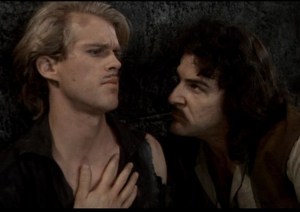
Last post, I began with an illustration from The Princess Bride, and it seems once you get me going, I have trouble stopping. Here’s another one. At the beginning of the film, Buttercup commands the farm boy, Westley, to do several menial tasks – polish her horse’s saddle, fill buckets with water, fetch a pitcher. Each time, he responds, “As you wish.” In time, Buttercup realizes that “As you wish” is Westley’s way of saying “I love you.” This discovery, of course, leads to a sunset kiss, a leave-taking to seek fortune across the sea, a supposed death, and (eventually) a harrowing reunion, a second separation, another supposed death, a rescue, and (finally) an escape together from the homicidal schemes of the evil prince.

“As you wish,” says Westley before doing Buttercup’s bidding. Too remove any mystery from where this post is going, let me put it bluntly: his actions display his love. He serves Buttercup, and the love that prompts this service stirs in her, as well, though the words “I love you” are never uttered.

You see, saying “I love you” is all too easy – just three little monosyllables. Subject, verb, object. Meaning it is the hard part. I could say, “I’m going to eat eighty-seven hotdogs in twenty minutes,” but (unless I conveniently morph into a hundred pound Japanese man) there’s no way I mean it. But you could drive one of those Wide-Load trailers with half a mobile home on it through the gap between what we say and what we mean.

Too often, the abused wife returns to her husband because “he says he loves me.” Too often, the college freshman wakes up crying the next morning, after being duped by “I love you.” Too often, “I love you” hurts more than it heals. The abusive husband and the manipulative scumbag weaponize the phrase, with no thought to its destructive consequences and their own dormant culpability.

This is where action comes in. This is where service separates truth from manipulation. You may be tempted to say that action is needed to prove that a spoken “I love you” is real. (If this were the case, there would still be myriad jousting tournaments throughout Christendom.*) Rather, active service is a spontaneous symptom of love, and one that often removes the necessity of speaking the words aloud.

Note the dirt stains on Dustin Pedroia, reigning AL MVP.

Loving and serving – we really mustn’t separate the two. Love expresses itself not in poetic protestations, but in holding the beloved’s hair back when she’s bent over the toilet with stomach flu. Love waits all night in the hospital room, visits the prisoner, builds affordable housing, donates mac & cheese. Love gets its uniform dirty.**

The Baptismal Covenant is the Episcopal playbook for turning love into action. One of the promises echoes Jesus’ great commandment: “Will you seek and serve Christ in all persons, loving your neighbor as yourself?”

Will you serve? I will, with God’s help. How will you serve?

Will you love? I will, with God’s help. What will your love impel you to do?

God has given gifts to each of us so that we might enrich the lives of those around us. The ability to love is one such gift. The desire to serve is another. Paired with these gifts are those sets of talents unique to each one of us. When we combine our unique giftedness into that sacred body of which Christ is the head, there are no limits to what we can accomplish.

On Sunday morning, God nourishes us when we share the body and blood of Christ. Then God orients us toward the door at the back of the church and the world waiting beyond. We pray, “And now, Father, send us out to do the work you have given us to do, to love and serve you as faithful witnesses of Christ our Lord.” God sends us out to love and to serve. I pray that we can, with God’s help, respond, “As you wish.”

Footnotes

* I’m sure we could come up with some modern analogs. However, I beg you to concede the point.

** Have you ever noticed that there are certain baseball players who, no matter what, end the game with grass and dirt stains all over their uniforms?

“If we only had a wheelbarrow…”

princessbrideThe situation looks hopeless. The odds are twenty to one against, and one-third of their party has just been revived after being mostly dead all day. Westley, Inigo, and Fezzek peer furtively at the newly improved defenses of the castle gate. They have only Westley’s brain, Inigo’s steel, and Fezzek’s strength against 60 men. “If I had a month to plan I might come up with something,” says Westley. Then, half to himself, “If  we only had a wheelbarrow, that would be something.” It turns out, upon second thought, they do have a wheelbarrow; and, upon third thought, a fire-resistant cloak. With this rather odd pairing of materials, they break into the castle, save the princess, steal the prince’s beautiful horses, and make a daring escape. On the walltop over looking the castle, the three heroes make their plan. Here’s the progression as I see it: they state the problem (breaking into a castle guarded by sixty men); they say what they do not have (a month to plan); they re-examine their assets (a cloak and a wheelbarrow); they overcome the problem even though their assets are meager.*

A similar progression, with an all-important extra step, happens when Jesus feeds the five thousand people (as told in Chapter 6 of the Gospel according to John). A large crowd is following Jesus because they like a good spectacle. Jesus has just healed the man at the pool of Bethzatha, so the crowd knows they won’t be disappointed. Jesus goes up the mountain with his disciples and looks down, surveying the vast multitude spread out below him. They could ignore the crowd, and, judging by Philip’s response to Jesus’ question the disciples probably wanted to. But Jesus does not give them that option. Instead, he states the problem: “Where are we to buy bread for these people to eat?” Philip (characteristically for this Gospel) answers a different question than the one Jesus asks. He says what they do not have: “Six months wages would not buy enough bread for each of them to get a little.” Then Andrew re-examines their assets: a little boy has five barley loaves and two fish. Notice how wildly inadequate this amount of food is for so many; I bet Andrew felt foolish even bringing it up.

But Jesus seems to think this very foolishness is just the sort of thing needed to solve such an intractable problem. So he takes the loaves and fish and then adds the all-important extra step in the progression. He gives thanks. He gives thanks even though he has a loaf per thousand people. He gives thanks even though the situation seems impossible. He does not let the apparent meagerness of his resources dictate whether or not he offers thanks to God. He gives thanks, and the crowd eats, and the disciples gather up twelve full baskets. The crowd is looking for a spectacle and they get such a grand one that they try to take Jesus and make him king.

Let’s take another look at the giving thanks. The special word for The Lord’s Supper or Holy Communion is “Eucharist.” (N.B. “Eucharist” comprehends the entire Sunday worship experience, but we are focusing here on the second half, the meal.) When we worship God by sharing this meal, we pray to Christ to somehow enter the bread and wine. Then we break the bread and share the cup, thus sharing Christ with each other. And our eyes are opened to the reality that the love of Christ is inside us and is made known in the sharing of community and love with each other.

The fancy word “Eucharist” is a much less fancy word if you happen to be both from Asia Minor and two thousand years old. This strange looking word simply means “to give thanks.” So, when we come together to share the meal, we are coming together to give thanks to God for all the blessings God has bestowed upon us. The fact that this intentional thanksgiving happens in a community reminds us that we must share our blessings just as we share the body and blood of Christ. And it is the very dwelling of Christ in us and we in him that sustains us as we share with others.

When I give thanks to God for the blessings and gifts God has given me, I must remember that thanksgiving is the catalyst for sharing. If I do not share my gifts with others, then I have not truly thanked God for them. Let me say that again, make it plural, and italicize it so you don’t miss it: If we do not share our gifts with others, then we have not truly thanked God for them

Sometimes, these gifts may seem meager or inadequate. But those are the times we must remember that Christ is there with us, giving thanks for us, and breaking us so he can share himself through us.

Footnotes

* The Princess Bride (1987); dir. Rob Reiner. Watch this film ASAP if you’ve never seen it. In fact, just go home right now and watch it. I’ll lend you my DVD.

Sensuous

Episcopalians are often accused of being too brainy, too intellectual. We think too much. We get caught up in the space between our ears and forget about that throbbing muscle in our chests. These accusers are correct up to a point: we do not check our brains at the door. Jesus asks us to love the Lord with all our mind, as well as our heart and strength. But our intellectual engagement with faith is only half the story.

You see, worship in the Episcopal Church is quite sensuous. Don’t get me wrong – I’m not talking about the Harlequin romance definition of the word. Our worship is sensuous in that we employ all our senses to encounter the presence of God. We hear the Word of God read and proclaimed. We see the stained glass and changing seasonal color palates. We smell the incense puffing from the thurible.* We taste the bread and wine. We touch one another in the handshake or embrace of the peace of the Lord.

To engage all of our senses, we use things in our worship. We use candles, books, and bowls. We use bread, wine, and water. These things are all incredibly – laughably – ordinary. Nothing about a loaf of bread is inherently special. Hand me a loaf of bread, and I might feed the birds or save it and make French toast tomorrow morning. (Actually, if you know me, the most likely scenario is that I’ll eat the loaf right then and there.)

breadaisleSo, how does the loaf of bread, which was one of a hundred bar coded loaves at the grocery store, transform from a laughably ordinary carbohydrate delivery system to a holy vessel of Christ’s presence? The bread moves from its ordinary location on the shelf in the store to its new, strange location on a linen-draped table in a church. The bread behaves quite normally, sitting there waiting to be eaten.

But the table and the action done to the bread and the people watching the action are not normal. The table is abnormal because it has several tablecloths covering it, some ornate, some plain. The action is abnormal – whoever talks about a loaf of bread before they start slicing it? And the watching is abnormal – unless you’re in the studio audience for Iron Chef, who joins dozens of others in watching someone prepare a meal?

So the bread is laughably ordinary. But the situation is not. The juxtaposition between the normal loaf of bread and the strange way it is being treated invest the ordinary with new meaning. This new meaning turns the bread into a symbol. Now, before we go any further, I want to dispel from your mind any notion of the phrases “it’s only a symbol” or  “it’s merely symbolic.” Symbols are woefully misunderstood things in American culture – like soccer and irony. A symbol is an object that points beyond itself to a deeper truth. Too often, “sign” and “symbol” are used interchangeably, but they are not synonymous. A stop sign lets you know you are supposed to brake at an intersection, but that’s all it tells you. The red octagon doesn’t compel you to ruminate on why you should stop. But a symbol – the cross, for instance – stirs within us all of the historical and theological and emotional resonances of the truth to which it points.

Okay, so the bread is a symbol. It connotes the bounty of harvest, the fruits of the earth, the goodness of creation, the nourishment of our bodies. And when we put it on that table, and a priest (in the presence of God’s people) asks God to indwell that bread with the Spirit of Christ, the bread becomes a special sort of symbol called sacrament.

God moves within us, spurring us to love, praise, act, pray, serve. Outward connections with our inward spiritual lives are called sacraments. These special symbols take the ordinary things we’ve been discussing – bread, water, even our own actions and personhoods – and set them ablaze with physical and emotive evidence of the presence of God.

When we participate in the sacraments, we ourselves become sacramental symbols of God’s movement. Our service to God points to the deeper truth of God’s creation of and love for the world. Worship nourishes us for our role as bearers of God’s image, as vessels of the light of Christ. We enter church as normal, ordinary people, like the loaves of bread on the grocery store shelves. We leave church transformed by our sharing in the presence of Christ with one another. Over time – months, years, lifetimes – the transformation helps us to realize that what we mistook as “normal” was really quite miraculous and extraordinary.

All of the normal, everyday things we use in church gather new meaning when we employ them to worship God. The candle becomes the light of Christ. The bowl becomes the vessel for the waters of baptism. The bread and wine become the Body and Blood. Likewise, we – as sacramental beings – discover new meaning for our lives when we come together to worship the Lord.

Footnotes

*The metal censer on the chain that you swing to disperse the perfumed smoke; sort of like a liturgical yo-yo.

Unless I had been calling to you

Eustace and Jill Pole are trying to escape a mob of bullies at the Experiment House, their ghastly boarding school. Jill has been crying, and the bullies can smell tears from hundreds of yards away. From their hiding spot, the two targets hear the angry shouts of the searchers. Eustace looks at Jill and wonders aloud if they might be able to escape to That Place. He begins calling out, “Aslan, Aslan, Aslan!” Jill follows his example: “Aslan, Aslan, Aslan!” The bullies draw near, and Eustace and Jill scramble through the laurels and up a steep slope. The weathered old door in the wall is always locked, but this time – miraculously – the knob turns. And the two children step into Aslan’s country.

Immediately after they arrive, Eustace falls off a cliff, but a lion arrives just in time and blows him to safety in Narnia. The lion – naturally – frightens Jill Pole. She tries to slip away, but the lion begins questioning her. Her showing off caused Eustace’s fall, she confesses. For that display of pride, the lion gives her a task to perform. “Please, what task, Sir?” asks Jill. “The task for which I called you and him here out of your own world,” says the lion. This response puzzles Jill. Nobody called them. They called out to – Somebody – a name she wouldn’t know. Wasn’t it she and Eustace who asked to come?

aslan “You would not have called to me unless I had been calling to you,” says the lion.

The lion is Aslan, and the task on which he sends Jill and Eustace makes up the story of The Silver Chair, one of The Chronicles of Narnia by C.S. Lewis. This exchange between Aslan and Jill Pole from the beginning of the tale illustrates most vibrantly the foundational principle of a life of prayer. You would not have called to me unless I had been calling to you.

The Catechism* in the back of the Book of Common Prayer states: “Prayer is responding to God, by thoughts and by deeds, with or without words.” When I first read this definition, I was flabbergasted. I had never thought of prayer as anything more than asking God for stuff. God, please give me a kitty that doesn’t scratch me. God, please help us win our soccer game. God, please make Grammy not sick anymore. Now, please don’t misunderstand, I am not condemning this form of prayer. There are many kinds of prayer, and they all have fancy names like adoration, oblation, intercession, petition – you get the idea. Rather, the popular definition that prayer is “asking God for stuff,” is several bricks up from the foundation.

That foundation is, of course, God. More precisely, the foundation of prayer is God’s presence in our lives and call upon our hearts. “Prayer,” says the Catechism, “is responding to God.”** Think of prayer as a phone call. We never dial the number: we only have the option to answer the phone when it rings. When we choose to answer, we enter into the relationship that God yearns for us. Prayer is another word for our part in our relationships with God.

Of course, the phone call is not a perfect metaphor because God is always present in our lives and always calling upon us to serve God in the world. In this context, Paul’s directive to “pray without ceasing” seems less unrealistic. Our striving to respond to God’s perpetual call in our lives is prayer. The collection of our words and deeds that emanate from our relationships with God is prayer. Anything we do in response to God’s movement in our lives is prayer. While prayer comprehends the kneeling-beside-the-bed-at-bedtime image that many associate with prayer, the act of praying is so much more expansive.

Monastics down through the ages have understood this. Even the lowliest jobs at the monastery – peeling potatoes or weeding fields – were prayer. Monks prayed many times a day in their chapels, but the labor they performed in the meantime was prayer, too. While we don’t have strict priors delegating our labors, we can still import the monastic example into our lives.

Look at your day, your week, your year. How do your engagements and actions display your response to God’s movement in your life?  As a student, God calls you to learn about yourself and the rest of God’s creation. As a member of a family, God calls you to love and enjoy and forgive your parents and siblings. As a servant of God, God calls you to discover and enact that one way in which you can better the lives of those around you. When we respond to God in all these areas of our lives, we pray. We affirm our relationships with God. We live the abundant lives that Christ gives to us.

“You would not have called to me unless I had been calling to you,” says Aslan to Jill Pole. “We love because he first loved us,” says the writer of the First Letter of John. Likewise, we pray because God first called us – called us into the expansive, abundant relationship with God. What will our response be?

Footnotes

* Also called “An Outline of the Faith,” an Episcopal F.A.Q. Most people know it as the thing you read when the sermon is really boring.

** Italics mine.

Be-ing

As I’ve mentioned before, I’ve been working on a Confirmation class recently, and the lessons keeping popping up here on the blog. Here’s 1000 words on theology, using three phrases from the Nicene Creed as a framework.

nicaea…of all that is, seen and unseen

What I’m about to write ignores the fact that the Nicene Creed was originally written in Greek and then translated into Latin and then translated into English. Don’t panic – the following is about the current English grammatical structure of the phrase, which is influenced by, but not chained to, the original language.

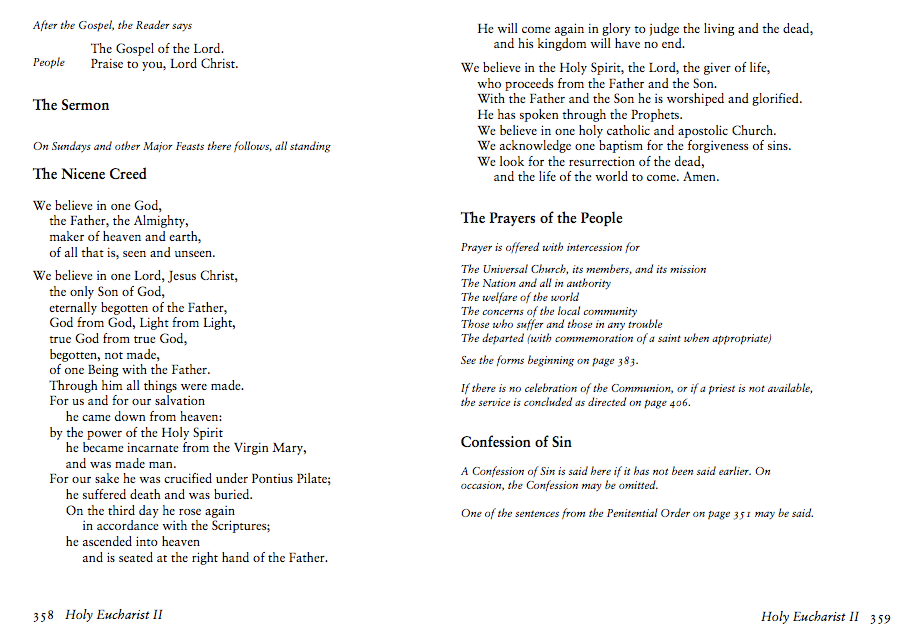
Do you see that little comma between the words “is” and “seen”? Yes? Good. Now, think back to all the times you’ve ever heard the Creed recited during church and ask yourself if anyone has ever acknowledged that comma. No? Didn’t think so. The sentence usually sounds like this: “…maker of heaven and earth, of all that-is-seen-and-unseen.” But the sentence actually reads: “…maker of heaven and earth, of all that is, [slight pause] seen and unseen.” I imagine you are now rolling your eyes at my disconcerting attention to inane details.

This detail may seem inane at first, but I assure you, it’s not. For now, let’s ignore the phrase “seen and unseen” because it gets entirely too much attention when Creed-speakers unwittingly barrel through the defenseless little comma. With what are we left? “Maker…of all that is.”

Maker…of all that is. This “is” is the most important linking verb in the history of linking verbs, and probably other verbs, as well. We believe that God made all that is. Put another way, we believe that God is the very ground of our “is-ness” – or, to use a not made-up word, our “being.” [Disclaimer: The rest of this section assumes the reader knows the unwieldy conjugation of the verb “to be.”] In Exodus 3, Moses asks God what God’s name is. God responds: “I AM WHO I AM.” This awkward English rendering of the Hebrew preserves the root of God’s divine name, which is the verb “to be” (hayah in Hebrew). When Moses asks God what God’s name is, God responds with something like, “I have being and I bestow being and that’s all you need to know.” Look at the word “being.” Now add a hyphen: be-ing. The noun “being” is disguised as a present participle verb, a verb of continuing action. This points to the eternal continuity and abiding presence of God, who is the very ground of be-ing.

All grammatical gymnastics aside, the point is this: God created all that is, and creation’s existence depends on God’s continuing presence. As small bits of that creation, we receive our be-ing, our identity, our life from the foundation of that be-ing, the Holy One we call God.

Through him all things were made

“We believe in one Lord, Jesus Christ… Through him all things were made.” Okay, since I failed to return to the original Greek in the last section, I feel I must make up for it. John begins his Gospel account with this poetry: “In the beginning was the Word, and the Word was with God, and the Word was God. He was in the beginning with God. All things came into being through him, and without him, not one thing came into being. What has come into being in him was life…”

You’ll notice that word be-ing from the last section crops up several times in just these few sentences. We said that God is the foundation for be-ing, and now we discover that the “Word” is responsible for translating that be-ing into life. Here’s the Greek bit.

The “Word” is the translation of the Greek word logos, from which dozens of English words take their root. Every time you see –ology at the end of a word (zoology, biology, epidemiology), that ending comes from the Greek logos. “Logic” also springs from this root. When something is “logical” it is ordered, it makes good sense. This is a good entrance into one understanding of logos. John says that the Word was in the beginning with God and through the Word all things were made. This “Word” is the “logic” behind creation, the “organizing principle” through which creation has come into being. In Genesis, God speaks creation into being (“Then God said, ‘Let there be light’; and there was light.”). God uses words to organize creation, and John identifies “The Word” as God the only Son, who is incarnate in Jesus Christ.

So, the “Word” is creation’s logic or organizing principle. Creation, therefore, is not haphazard or accidental. You might be tempted to ask a question about “Creationism vs. Evolution.” But the unhappy dichotomy between these two positions breaks down when we see creation as both organized and continuous. My college chaplain was fond of saying: “If God stopped speaking, the world would stop turning.” The implication is this: the “Word,” the logic of creation continues to underpin and give life to all that is.

…he became incarnate from the Virgin Mary and was made man

As I said above, John identifies “The Word” as God the only Son, who is incarnate in Jesus Christ. “Incarnate” means “become flesh” (the –carn in the word is the same root as in the word carnivore, “meat-eater”). John’s use of “Word” connects to a strain of thought coming out of the Hebrew Scriptures. The “word of God” appears whenever a prophet is granted a new prophecy (The word of God came to so-and-so…). The Hebrew word for “word” (davar) means much more than the stuffy English equivalent. We think of “word” as something on a piece of paper or something spoken aloud. In Hebrew, however, the “word” is something that happens to people. It is an event, an action that calls for further action. When John uses the Greek form of “word” (logos), he purposefully links it back to this Hebrew understanding. The “Word” becoming flesh and dwelling among us is the ultimate example of the “Word” happening.

Here’s the thing to remember: the “Word,” through which God speaks creation into be-ing, is life-giving. Without the “Word,” life would not exist. When the “Word” became flesh in Jesus Christ, God gave us the gift of seeing how life is meant to be organized, meant to be lived. This means that the words Jesus speaks provide for us the means by which to organize our lives in order to be in deeper touch with God. The “Word” became flesh and lived among us. And now the “Word” continues to speak life into the world, disclosing the glory that is full of grace and truth.

Harmony

Ecce Quam Bonum! These three Latin words are carved in moss-covered stones and lintels of doorways across the campus of my alma mater, the University of the South in Sewanee, Tennessee. Ecce Quam Bonum! “Behold, how good!” These words begin Psalm 133, and they speak of the desire for joyful, harmonious fellowship with our brothers and sisters: “Behold, how good and pleasant it is, when brethren live together in unity!”

The lectionary for the Second Sunday of Easter joins this psalm with three readings, each of which speaks of community and fellowship. In the Acts of the Apostles, Luke paints a happily-ever-after picture of the apostles and their companions, in which the “whole group of those who believed were of one heart and soul” (4:32). In the First Letter of John, the writer says, “We declare to you what we have seen and heard so that you also may have fellowship with us; and truly our fellowship is with the Father and with his Son Jesus Christ” (1:3). In the Gospel, the risen Jesus appears to the disciples as a group, grants them peace, and breathes the Holy Spirit upon them. Thomas is not with the disciples at the time, so as a group they seek him out and tell him the good news. A week later, when Thomas has returned to the fellowship, Jesus once again appears, and Thomas believes.

At church this Sunday, we are baptizing a beautiful newborn, and I can’t think of better lessons to accompany the joyous occasion. The sacrament of Baptism celebrates the inward movement of God in a person’s life by outwardly welcoming that person into God’s family the Church. Hmm… I know that definition sounds incredibly boring and academic, so let me try again, this time with a musical metaphor.

The music of God plays in each one of our hearts. Sometimes the music is soft, a half-whispered lullaby, barely discernible over the din of the world. Sometimes the notes crescendo to a deafening fortissimo that knocks us, weeping, to our knees. Most often, the music sounds as the percussive TUB-thp of our hearts — a rhythm that, if you listen closely, beats in time with the rest of the performing forces of creation.

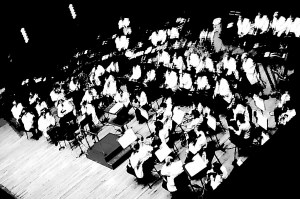
orchestraEach one of us has the music of God resounding within, but the symphony is incomplete until we have found each other, until we have joined together in fellowship as the orchestra of God. In Greek, this fellowship is called koinonia, but I’ve always thought that “fellowship” is a rather limp translation. For the sake of our metaphor, let’s translate koinonia as “harmony,” which lands much closer to the descriptive intent of the Greek word. Musical harmony is the collection of notes that adds structure, color, tone, depth, and meaning to the main tune. This tune, called the “melody” is the music of God within us. The combination of our own unique passions, trials, joys, griefs, and loves creates the harmony of the music of God.

In the sacrament of Holy Baptism, we welcome another violin or French horn or bassoon into the orchestra. We await eagerly the subtle changes in timbre that the new life will bring. Together, we play the koinonia, the harmony, of the music of God to a world so accustomed only to noise and clatter. The movements of our symphony resonate with the movement of God in this world. This is the sacrament of Holy Baptism: new sound, new harmony, new resonance in the symphony of the music of God.

Behold how good and pleasant it is when brethren live and sing and make music together in unity.