The Living Among the Dead

NOTE: DevotiONEighty is off this week. It will return next Monday, April 8th.

(Sermon for Saturday, March 30, 2013 || The Easter Vigil || Year B || Luke 24:1-12)

I doubt they slept much the last two nights, the women who rose early on the first day of the week to minister to their dead Lord. Every time they shut their eyes, I’m sure they saw the silhouette of Jesus’ cross in the distance, his limp body all but unrecognizable because of his torturous hours hanging there. And because dead bodies never, ever look like the lives ones they were a moment before; especially Jesus’ body, he who was so full of abundant life that he was just giving of his abundance to anyone who asked. No, I doubt these women slept much, though if they did finally fall into fitful slumber, it was because they cried themselves to sleep. When all you have left is your tears, you’d want to hoard them; but that’s when they flow all the more freely.
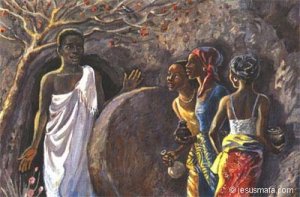
"Women at the Tomb" (Jesus Mafa - click for more info)
“Women at the Tomb” (Jesus Mafa – click for more info)

I’m sure the tears began again when they awoke early on the first day of the week. New grief is like that. Each morning you wake and remember again that your loved one is gone, and again the pain stabs you anew, just as fresh as the first time. But even in the midst of their grief, these women took up their burdens of fragrant spices and trudged out into the darkness, so they could arrive at the tomb at first light.

But these brave women, who are ready to care for the body of their Lord, to do their duty out of love and compassion, are making the happiest mistake in the history of mistakes. They are prepared to wash and anoint a lifeless body, but what they find is no body at all. They find an empty tomb, save for a discarded burial shroud. Their grief threatens to overwhelm them because the duty they were planning to perform – the one they had been clinging to since his death – is gone now, too. They didn’t think they could be more desolate, but they were wrong. The empty tomb magnifies their desolation.

But into this scene of despair and grief comes the sudden presence of two gleaming messengers. They enlighten the woman as to their mistake: “Why do you look for the living among the dead? He is not here, but has arisen.” Then they remind the women what Jesus had said about himself while they were all still in Galilee.

The women remember Jesus’ words, and first one, then another, then another breaks out into a tentative smile. “Could it be true?” they ask each other.

“Yes, yes, yes it could.”

“Jesus never lied to us.”

“How could we forget his words?”

Then one repeats the messengers’ question: “Why are we looking for the living among the dead?”

This question echoes down through the centuries, and we find ourselves asking it when we read the beginning of the final chapter of Luke’s account of the Gospel. Why do you look for the living among the dead? How often in our day-to-day lives could we hear the gleaming messengers asking us this question? How often do we trudge down the well-worn path to life-defeating things hoping this time – maybe this time – something life-affirming will happen?

Perhaps you’ve had a string of boyfriends who were real losers. Your friends tell you so at every opportunity, but you’ve got a blind spot for bad boys. They treat you with no respect. From time to time they’ve even called you a name that I can’t say during this sermon. And yet you meet another one and all the signs are there, but you dive in headfirst anyway. To you the gleaming messengers say, “Why do you look for the living among the dead?”

Perhaps you’ve been sober for three months. Your sponsor hands you your chip and slaps you on the back. You’ve got a couple of other three-month chips in a drawer somewhere, but that’s not on your mind right now. On your way home from the meeting, you run into an old buddy from back in the day. The next morning, you stagger to the drawer and toss the newest chip in. Maybe you’ll get another one in a few months time. To you, the messengers say, “Why do you look for living among the dead?”

Perhaps you work through your family vacation because you’ve got too many projects on your plate. Or you spend every waking hour mindlessly surfing YouTube and Facebook. Or you derive your self-worth only by what others say of about you. To you – to all of us – the messengers say, “Why do you look for the living among the dead?”

The Resurrection of Jesus Christ spurred this question all those centuries ago. The women made the happy mistake of looking for a dead Christ, when the Risen One was alive again. They brought to the tomb their grief, their tears, and their emptiness. And they left them there because the power of the Risen Christ outshone any desolation left in them.

When we look for life-affirming answers in the midst of life-defeating things, we replicate the women’s happy mistake, but with none of their good intentions. When we look for the living among the dead, we are trudging the well-worn path to the newly hewn grave where a dead messiah awaits. That way is full of tears and lifelessness.

But the good news of the Resurrection is this: when we arrive at the tomb, at rock bottom, at the ends of our ropes, we will find the Living Christ shining radiantly in the midst of our dead messiahs. We will find his empty tomb, which is ready to receive all of our muck, all of our bad choices, all of our life-defeating tendencies. When we deposit all of our dead ends there, we can leave the tomb unencumbered, and chase off after the Risen Christ, fresh, free, and born anew.

So why do you look for the living among the dead?

He is not here, but has arisen.
Racing to Meet Us

(Sermon for Sunday, March 10, 2013 || Lent 4C || Luke 15:1-3, 11b-32)

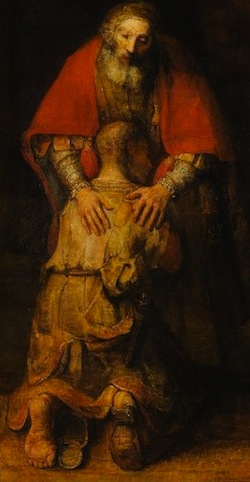
"Return of the Prodigal Son," Rembrandt
“Return of the Prodigal Son,” Rembrandt

After I finish this opening bit of the sermon, I’m going to ask for a show of hands, so please listen to see if you remember this illustration from your youth. You arrive at school one day – perhaps you are a month or two into, let’s say, the seventh grade. That morning before school, you looked in the mirror and grimaced at the half dozen new pimples, which had colonized your forehead during the night. You tried to comb your bangs over the spots, but your hair just wouldn’t stay, so you resigned yourself to the fate of being called “pizza-face” all day. So you walk into the school wishing your forehead were in a less conspicuous area of your body, but you know it’s not, so instead you concentrate on making your entire self less conspicuous.

Halfway through the day, everything is going fine – better than expected even. No one has mentioned your acne; you really haven’t talked to anyone all day, except your best friend at lunch. But then on the way back to class, the day takes a turn. You and your classmates are waiting outside your fourth period room when someone brings up the hot TV show that everyone’s watching. (In my day, it was Dawson’s Creek, but I’m sure you can come up with one.) The show was on last night and something terribly important and life altering happened to the main character. Everyone’s discussing the episode and you just smile and nod, hoping against hope that no one asks your opinion because your mom doesn’t let you watch that show, but your classmates don’t know that and if they did, they’d have another reason to make fun of you.

But, of course, someone does ask, and you stammer out something generic about the show, but it’s obvious you don’t watch. Your classmates start laughing, and you can feel your face getting flushed, which only makes the pimples redder. You will the teacher to open the classroom door, but she doesn’t, so you race off to the bathroom to be alone with your shame.

So don’t be ashamed to admit it – show of hands, how many of you remember a day similar to this one back when you were in that Lord of the Flies–esque jungle known as middle school? …Yeah, that’s what I thought.

You want to know the worst thing about that feeling of shame from long ago? The feeling of shame is still there; hidden perhaps, but there. The context may be different. The constellation of catalysts may be more grown-up. But the disease of shame has – from a tender age – infected each and every one of us.

You can blame Adam and Eve if you like. They are the “Patient Zero” of this disease. After they eat the fruit of the tree, they notice their nakedness, so they cover themselves up with primitive garments. When God comes to them in the cool of the evening, Adam says, “I heard the sound of you in the garden, and I was afraid, because I was naked; and I hid myself.” Here we have the first documented case of the disease of shame. Adam and Eve hide from God because they are ashamed of their nakedness.

Shame, then, is the feeling that prompts us to want to hide – from God, from the world, and especially from ourselves. The disease of shame invades the secret places within us and then starts whispering incessantly: you aren’t good enough. You aren’t worthy. You are defective. How could you possibly think you measure up? And the worst of all:  You are a mess and a failure. How could you possibly think God or anyone else could ever love someone as shameful as you?

I’m sure these debilitating thoughts were running through the mind of the younger son as he fed the pigs. In today’s Gospel lesson, Jesus tells the famous and beloved story of the young man who squanders his inheritance in a far off land. He is destitute when a famine hits, so he hires himself to a pig farmer. On those days when the hollowness of hunger is worst, he longs to eat the pigs’ slop. Jesus chose his details well, for there isn’t a much more shameful position than for a good Jewish boy to be anywhere near such unclean animals. Jews were never to eat pork, let alone touch the pig. And here is the younger son, cut off from his family, wallowing in the mud, hungry, unclean, and ashamed.

You can hear his shame whispering to him, can’t you? How could you possibly think your father will take you back as his son, you worthless swine? His shame convinces him that all of his mistakes, all of his bad choices, all of his ruinous living amount to too much for his father to forgive. Another whisper: How could you possibly be reconciled with all this disastrous baggage?

The younger son agrees with his shame and decides that his father would never bring him back into the family, but that maybe his father’s generosity would extend to hiring him on as a laborer. So he sets off for home. And then something happens that the younger son doesn’t expect, something that his shame had convinced him was impossible. When he is still a speck on the horizon, his father sees him coming and races to meet him. His father runs flat out, as if he can’t bear one more minute estranged from his son. When they meet, the son begins his prepared speech, but his father isn’t listening. He’s already preparing a welcome feast because his son was lost and is now found.

How many of us have let the voice of shame drive us into hiding? How many of us still have the disease of shame eating away at our capacity to give and to receive love? How many of us have let our shame convince us that we are unworthy of God’s attention? I’d hazard to guess that we’ve all been there, feeling like the pimply kid in seventh grade or like the younger son among the pigs.

Perhaps your shame starts whispering when you look at all your bills and realize your salary will barely cover them. Or when you can’t bring yourself to acknowledge the presence of the homeless man on the street in Boston. Or when you say something hurtful to your spouse during an argument. Or when your colleagues don’t think to invite you to lunch. Or when your date stands you up. Or when you look in the mirror.

Whatever the source of your shame, please believe that God our Father is running flat out to meet you in the midst of it. Your shame might tell you to hide. Your shame might tell you that you aren’t worthy of God’s effort. But your shame is lying to you. There is no shame big enough to scare God away. You will never be so defective that God stops desiring to repair you. You will never be so lost that God can’t find you. And when God finds you, you can participate with God in beating your shame into submission. With your shame healed, you might find you are willing to ask for help when trying to make ends meet. Or you might find yourself serving the homeless man at the Long Island Shelter. Or you might look in the mirror and see beauty rather than shame looking back at you.

So the next time your shame threatens to engulf you with its incessant negative whispering, look to the horizon. See the dawn break. See the sunlight racing toward you. And know that God has already run out to meet you in the midst of your shame. God has already enfolded you in a compassionate embrace. And God has already welcomed you back into God’s family, as a beloved child who was lost and has been found.

With My Arms Spread Wide

(Sermon for Sunday, February 24, 2013 || Lent 2C || Luke 13:31-35)

(Most sermons are better if you listen to them rather than read them. This one is especially so.)

Imagine with me a letter written by Simon the Pharisee some years after the events described in this morning’s Gospel reading.

henSimon, a servant of the Lord God, to Judith, my dearest sister and confidant: Peace to you and your house.

I know it’s an inside joke between us that I only write to you when I am vexed or need to process something, but in this case, I write with a more urgent need. Yesterday in the marketplace something happened that has shaken me to my bones. Not only that, but after all these years, this event has caused me to let go of a secret I had been holding onto so very tightly. I need to tell you the truth about myself before you hear others slander me. I hope after you read these words you do not think less of me; rather, I hope you might consider joining me in my new-found freedom. But I get ahead of myself.

Here’s what happened. I was walking with my colleagues, Eli and Reuben, when we witnessed a strange scene. A small boy, no bigger than your grandson, snatched a loaf of bread off a baker’s cart. The boy must have been on his last legs because as soon he turned to run away, he dropped to his knees, nearly fainting. The baker had the boy by the arm when a woman picked up the loaf of bread and handed it back to the hungry child, saying, “Go and eat your fill, young one, and may the blessing of the Lord Jesus Christ be upon you.”

Then she reached into her purse to pay the baker for the bread. But before she could pull out a coin, Eli and Reuben rounded on her. I’ve never known them to be the most zealous persecutors of the followers of the Way, but something about this exchange riled them up. They dragged the woman to the ground, hollering the whole time about her blasphemy. Her trial, conviction, and sentence were the work of a moment, and before I knew what was happening, Eli had a chunk of rock in his hand ready to throw.

I didn’t plan to do it. I didn’t mean to do it. But in the instant after I realized what Eli was about to do, I found myself standing between him and the woman, arms wide, protecting her with my body. It was too late for Eli to stop, and I took the impact of the stone on my left shoulder. “If you’re going to stone her,” I yelled at them, “then you’ll have to stone me, too.”

What I’m trying to tell you, dear sister, is that, for these long years, I have been a follower of the Way of Jesus Christ. But until yesterday, my fear of being disowned by everyone I know convinced me to hold tightly to the secret. Now that my true devotion lies unmasked, I feel suddenly free to share my story with you – and not just free, but full of joy.

You see, you never know on what day your life will change. If you did, then you might be more prepared. You might wear a clean shirt or wash your face beforehand. The day my life started to change was a day similar to yesterday. I was out in the marketplace with a couple of colleagues. Jesus and his disciples were making a scene: throngs of people were clamoring for his attention, and talk of miraculous healing was in the air. You might recall I had met Jesus previously when he came to dinner at my house. That first meeting troubled me because he was so different than the country bumpkin I expected. This second meeting replaced my uneasiness with the seeds of new conviction.

At the time, we Pharisees were tired of Jesus upsetting the apple cart. He had been in our region quite long enough, and we wanted him gone. So we concocted a story about Herod wanting to kill him. The tale seemed plausible enough; after all, Herod had beheaded Jesus’ cousin John and then just continued on eating his dinner. Perhaps Herod did want Jesus dead. Either way, that’s what we told him. And I was completely unprepared for his response. Maybe he was calling our bluff. Or maybe he had no fear for his own life. He told us his plans – and they did not involve fleeing – and then told us to go tell Herod.

But his bravery wasn’t what enthralled me. It was what he said next. A haunted look played across his face as he lamented Jerusalem. I’ll never forget what he said: “How often have I desired to gather your children together as a hen gathers her brood under her wings, and you were not willing.”

Before I could arrange my face into the shocked expression appropriate for a Pharisee, my heart commandeered my body. It was the strangest sensation. Something deep inside me fluttered at his words, like one of the chicks in the hen’s brood. The fluttering stirred up three words that echoed in my depths. “I am willing.”

From that day on, I kept track of Jesus. My three words – “I am willing” – played over and over again in my mind. But I didn’t make the leap yet because I couldn’t chase his image of the hen and her brood out of my mind. What an odd animal to identify with. Why not something bigger? Something with teeth and claws. Something worthy of his fearlessness. Why a defenseless hen? A chicken, for God’s sake?

Later that year, I got my answer. I watched as he was crucified. I heard the dull thud of the hammer striking the nails. He was raised up on the cross, chest bared, arms wide. And as I watched and wept, all I could see was that mother hen, defenseless, spreading her wings wide to protect her brood, giving her life for theirs.

I was his from that moment on. I believe that he rose again and that his Spirit is with us to help us live a life full of God his Father. It feels good to write that down. Dear sister, it has taken me all these years to say it, but the words are there on the page now, never to be erased.

I might have said “I am willing” on that day of our second meeting, but as they say, the spirit is willing, but the flesh is weak. So what made me abandon my well-worn lie yesterday? I had gotten comfortable living as his secret follower, even though I knew that meant I was cutting myself off from so much of what being his follower means. Something about the events yesterday brought to my mind the image that so haunted me.

Eli raised the rock, ready to strike the woman who had helped the little boy, and I found myself getting in the way. If I had had time for rational thought, I doubt I would have done it. Perhaps my long years as Jesus’ secret follower finally spurred me to action. My brain didn’t have time to get in the way, so my heart interceded. And since my heart belongs to Jesus Christ, he propelled me to take a risk, to take a chance, secure in the knowledge that I am always and forever standing under the shadow of his wing. In that moment, I knew Christ was alive in me. He used me as the mother hen, defenseless, chest bared, arms wide, ready to absorb the blow. If I hadn’t known I was secure under his wing, I wouldn’t have had the strength to protect someone under mine.

And so this is my prayer for all my days hence: Lord Jesus Christ, sustain my faith so I can be vulnerable. Be my sheltering wing so I can take risks. Help me spread my arms wide as you did on the cross so I can fully and truly embrace others with your love.

My sister, I bare my heart to you in this letter not to convince you to become a follower of the Way like I am, nor to make you worry for my safety. I have written these words simply because I am not afraid anymore. Jesus Christ is alive in me. Therefore, I am resolved to live my life under the shadow of his wings, with my arms spread wide.

* Special thanks to Barbara Brown Taylor for her words about this passage found here. They unlocked this sermon for me.

Trouble in River City

(Sermon for Sunday, January 27, 2013 || Epiphany 3C || 1 Corinthians 12:12-31a)

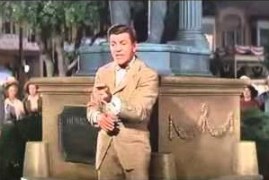
rivercityWe got trouble. Right here in Corinth. With a capital “T” and that rhymes with “P” and that stands for “pool.” Wait a sec. That’s the trouble in River City in The Music Man. Let me try again. We got trouble. Right here in Corinth. With a capital “T” and that rhymes with “G” and that stands for “gifts.” Spiritual gifts, that is. And while the con artist Harold Hill makes up the trouble in River City in order to sell marching band instruments, the Apostle Paul is intensely earnest in his diagnosis of the trouble in Corinth. The trouble in Corinth was certainly Trouble with a capital “T.”

Last week, Margot hinted at this trouble when she mentioned the Corinthians bickering over the dramatic spiritual gifts God had showered on the community. Our second lesson today picks up right where last week’s left off, and now we see Paul lay out the trouble plainly. The new church in Corinth has many problems – rival groups trying to assert dominance, questions about marital relationships, even issues concerning what to wear and what to eat. But none seems as contentious as the trouble Paul addresses in today’s reading.

When you boil Paul’s words down, you find that the trouble he sees is, in the end, the most common trouble of all – people not valuing one another. The very commonness of this trouble wrenches it from the dusty pages of scripture and puts it front and center in our lives. The capital “T” Trouble of people not valuing one another happened back then in Corinth. But just look around this world today – in our society’s discourse, in our communities, even within our own families – and you’ll see the effects of people not valuing one another.

But let’s start with the trouble in Corinth, the trouble that began over their spiritual gifts. Paul goes to great metaphorical lengths to teach the Corinthians that they are all part of the same body. Each part of the body has value, no matter if your part is the hand or the foot, the eye or the ear. Apparently in Corinth, certain people had been made to feel that their contributions to the body just didn’t matter, that because they were “feet” and not “hands” they had nothing to offer. I can only imagine how angry Paul got when he heard about such hurtful nonsense.

Paul first addresses these people who were being denigrated. Don’t believe what they tell you, he says. Just because you don’t fit their exact specifications for membership in the body doesn’t make you any less of a member.

Then Paul addresses the other side. (In certain other letters he doesn’t seek to cover up his anger, but here he manages to keep his indignation just below the surface.) To the ones engaging in the denigration, Paul says: “The eye cannot say to the hand, ‘I have no need of you.’ nor again the head to the feet, ‘I have no need of you.’ On the contrary, the members of the body that seem to be weaker are indispensable, and those members of the body that we think less honorable we clothe with greater honor.”

This has always been the way of God, hasn’t it? To lift up the lowly, to shield the easy targets of denigration and devaluation, to bring people together as one body. But even in those early years of the church, when everything was fresh and new and exciting, even then the brokenness of human nature reared its ugly head. Even then, the forces of division (you might say the forces of evil, of Satan) tried to halt the spread of God’s good news. In today’s lesson, the good news is that all people have value. All people belong to the body. I can think of nothing that the powers of darkness and division would abhor more than this simple truth, which Paul reminds the Corinthians and us.

After Paul speaks to these two sides of the trouble, he circles back to the issue, which sparked the trouble in the first place – the gifts God had showered on the people of Corinth. How utterly broken their community must have been if the forces of division had been able so easily to turn God’s gifts into sources of strife. But that is what they became. So Paul lists a sample of the gifts again and notes that no one has all of the gifts. That’s not how this whole “body” thing works. Each member has a gift to share, he says to the Corinthians, so you will not tell people they have no value just because they don’t display the gifts you think they should.

(Next Paul tells them and us about the greatest gift of all, which is an antidote for the trouble in Corinth, but we won’t read that part until next week. I’ll give you a hint, though. The gift is love, and the passage is one you’ll be familiar with if you’ve ever been to a wedding. But I’ll let Margot tackle that next week.)

For now, let’s stick with the capital “T” Trouble because we haven’t yet seen how this trouble exists now in our society, in our community, and in our homes. Remember, the root of the trouble is the utterly broken human tendency not to value one another. We witness this brokenness in our political discourse when partisan differences degenerate into personal attacks. We witness this brokenness in our community when our children can’t go online without fear that a cyberbully is waiting to tear them down – anonymously. We witness this brokenness in our homes when relationships of trust and respect erode into ones of suspicion and convenience. In each of these instances, the other is not valued for one reason or another and the body is broken.

Let’s dwell for a moment on the example of marriage. With our second anniversary approaching in a few weeks, I’ve had extra cause to thank God for the gift of my wife Leah. But along with this wonderful gift I am also aware of the scary capacity, inherent in my own brokenness, of failing to put in the effort to make sure she knows that she is valued. So many marriages fail because of this kind of inattention, and with God’s help, I am determined never to give her cause to question her value.

Remember, the good news is that all people have value. All people belong to the body. Each of our relationships is a microcosm of this great reality. Our relationships are opportunities to show one another how much we value each other, and by extension, how much God loves us. Being active members of Christ’s body means participating with God in healing the brokenness that keeps us from valuing the other.

So this week, I challenge each of you, and I challenge myself, to act on the reality that we are members of Christ’s body, each with our own inherent value. Seek out your partner – your spouse if you are married; a friend, sibling, or relative if you are not. Sit down with that person. Look her right in the eye. Hold his hand. Dwell in a moment together where nothing at all matters except your connection to one another and your joint connection to God. Say a simple pray of thanks for that person’s presence in your life. And then let her know how much you value her. Tell him how valuable he is – not because of what he has done or not done – but simply because of who he is.

If you are having trouble in this relationship, perhaps this will be the chance for a new start, with God inviting you once again into the reality that each of you has inherent value as a person. If you are not having trouble in this relationship, perhaps this will be the chance to add a recurring practice to your interactions that will confirm your value to each other. Either way, I offer this challenge to you as a way to participate more deeply in your own relationship with God.

As we notice and celebrate the inherent value we see in each other, we will be working with God to heal the brokenness of this world. And we will be helping to fulfill the prayer we prayer every week: “Thy kingdom come, thy will be done on earth as it is in heaven.” Because, is heaven not the place where each of us will finally and forever know in the deepest recesses of our souls that we are truly valued, that we are truly loved.

You are my Beloved

 (Sermon for Sunday, January 13, 2013 || Epiphany 1C || Luke 3:15-17, 21-22)

tide2013Last Monday evening, I sat down to watch a very entertaining football game. Now, I know up here is Pats’ country, so many of you probably didn’t even realize the college football championship game was going on. But I grew up in Tuscaloosa, Alabama, so I was ready for my Crimson Tide to take it to the Notre Dame Fighting Irish. (Which they did, by the way.) Because I was watching a live sporting event, I didn’t have the opportunity to fast forward through the commercials. One commercial aired several times, and I became more and more uncomfortable every time I watched it.
The commercial is for a new smartphone, the “Droid DNA.” The thirty-second spot begins with a man being strapped to a chair. A lab-coated technician secures the phone to the man’s chest, and over the thirty seconds of the commercial, the phone “rewrites” the man’s DNA. A mechanical voice announces that the man’s “neural speeds” are increasing and his brain is upgrading to a “quad-core processor.” At the end of the commercial, a voiceover says, “Introducing Droid DNA by HTC. It’s not an upgrade to your phone, it’s an upgrade to yourself.”

Now, perhaps I was uncomfortable with the idea of a phone taking the place of my brain because ever since I wrote Digital Disciple I have been fighting this tendency tooth-and-nail. Or perhaps I was uncomfortable because by the end of the commercial, the man looked like one of the Borg on Star Trek. These two surely played a part. But I think I was uncomfortable mostly because the commercial let me know something about myself that I didn’t know before. According to the commercial, I am due for an upgrade. I am deficient in some way, and only the Droid DNA smartphone will make up for that deficiency.

This is how marketing campaigns work. They tell us ways we are defective, and then they try to sell us products designed to improve those defects. Truck commercials tell men they aren’t manly unless their vehicles can haul a couple tons of dirt. Toy commercials tell kids they won’t be happy unless they receive the hot new toy for Christmas. And don’t get me started on commercials aimed at women. Judging by the ads, women in this country have hair that isn’t shiny enough; bodies that aren’t the right shape; the wrong handbags, clothes, shoes, and earrings; too many wrinkles; and not enough diamonds.

All this must be true, right? I mean, we are bombarded with our supposed deficiencies everywhere we turn: the TV, magazines, Internet ads, the sides of buses. Then we repeat them over and over again until they seem like truth. And pretty soon, it’s not just the marketers, but everyone getting in on the fun. And that’s when the boy feels deficient because he hasn’t played the video game all his friends are talking about. That’s when the girl feels defective because she doesn’t quite fit the clothes her friends have started to buy. That’s when the parents feel substandard because they can’t afford the tuition at the “best” college. At one point or another, our society as a whole started believing in our supposed deficiencies, hence why Americans aren’t very happy people.

But we have been deceived.

Today’s Gospel reading uncovers the deception and offers the supreme truth that has the potential to scrub away all the battering our self-esteem has taken over our supposed deficiencies.

At the beginning of his ministry, Jesus is baptized. After he rises from the water, he prays, Luke tells us, and the heavens open. And the “Holy Spirit descends” on Jesus in “bodily form like a dove.” The voice of God speaks from heaven: “You are my Son, the Beloved; with you I am well pleased.”

Now, you might be wondering what these words have to do with counteracting our supposed deficiencies. After all, God is talking to Jesus, not to us, right? Of course, God would be well pleased in Jesus, who has no deficiencies.

Ah, yes, we who have been programmed to think of ourselves as hopelessly deficient beings wouldn’t possibly presume to think that God might be talking to us as much as God is talking to Jesus. But we would be wrong.

Remember that the Holy Spirit descends on Jesus like a dove. This same Spirit dwells within each one of us, animating us and speaking life into our souls. Thus, we are connected to the God who spoke those words to Jesus. But we are not just connected to God. Hear what Paul says to the church on Rome: “For all who are led by the Spirit of God are children of God. For you did not receive a spirit of slavery to fall back into fear, but you have received a spirit of adoption. When we cry, ‘Abba! Father!’ it is that very Spirit bearing witness with our spirit that we are children of God, and if children, then heirs, heirs of God and joint heirs with Christ” (8:14-17).

Not only are we connected to God, we are God’s children, and not only God’s children, but heirs right alongside Jesus. So God’s words at Jesus’ baptism are not just for Jesus. They are for us, as well. You are my son. You are my daughter. You are my beloved. With you I am well pleased.

With you I am well pleased. Notice that God loves Jesus, God is pleased with Jesus, even though Jesus has done nothing yet to earn God’s love and pleasure. At this point in Luke’s Gospel, we are at the very beginning of Jesus’ ministry. All of his miracles, his sermons, his death and resurrection – they are all ahead of him. Before any of that happens, God showers upon him God’s love and pleasure.

Likewise, you and I who are joint-heirs with Christ have never done anything in our lives, nor will we do anything in our lives, to earn God’s love and pleasure. They are ours intrinsically. They are ours because we are God’s. And because we cannot earn God’s love and pleasure, we cannot do anything to lose them either. They are part of what makes us who we are – the best part of what makes us who we are.

At Jesus’ baptism, God took the opportunity once for all time to tell all of God’s children that we are loved and that we are a delight to God. We can ignore these fundamental truths. We can choose to think they don’t apply to us. But we cannot undo them, no matter what.

That God chose Jesus’ baptism in the River Jordan as the opportunity to reveal these truths to us is simply wonderful. What is the one thing in this world that is more prevalent than advertising targeted at our supposed deficiencies? That’s right. Water.

So the next time you take a shower, the next time you wash your hands, the next time you take a drink or get stuck in the rain, I invite you to feel the water touch your skin. Remember your own baptism. Remember that all of our supposed deficiencies, which teach us to think we are defective or substandard, are no match for the fundamental truth that God has built into the fabric of life. You are God’s children. You are God’s beloved. And with you, God is well pleased.

Magnify the Lord

(Sermon for Sunday, December 23, 2012 || Advent 4C || Luke 1:39-55)

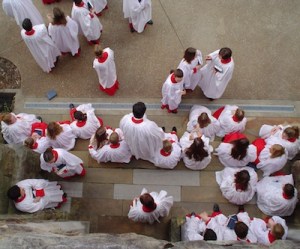
choirWhen I was in college, I never had time to watch TV or play sports or go on wild spur-of-the-moment car trips. I was too busy singing. The University Choir rehearsed four times a week and sang every Sunday morning during the church service. When I joined freshman year, I could barely piece two correctly pitched notes together, but the choir director, God bless him, would take anyone who was willing, including me. Four years and hundreds upon hundreds of hours of singing later, my voice managed to match pitch most of the time, and hey, it didn’t sound too bad.
The choir spent more time on one particular song than any other, a song that has found a special place in my heart. We sang the song once a month at the service of Choral Evensong, and every month we sang a different arrangement. But each arrangement had the same words, and those words always began with “My soul doth magnify the Lord, and my spirit hath rejoiced in God my Savior.”

These are the opening lines of Mary’s song, the Magnificat. We always sang them with the Elizabethan translation (with all the doths and haths) because the best musical versions are set to the old text. I must have sang 20 or 25 different settings during my time at Sewanee, and with each one, a single image from this opening line delved into me and settled deep within. I’d like to share that image with you this morning.

“My soul doth magnify the Lord,” sings Mary. What happens when you use a magnifying glass, like a microscope, perhaps? Say we are back in freshman biology lab and the instructor passes around a tray of slides. You and I (you all are my lab partner for this illustration, by the way)…You and I take one of the slides and pass the tray on to the group beside us. Next you take our pipette and squeeze one tiny drop of clear liquid onto the slide. We hold the slide up to the light and squint. We see nothing but a bit of water on glass.

But then I place the small pane of glass underneath the microscope, and you put your eye to the lens. You click into place the scope marked “30x magnification” and fiddle with the focus dial.  And what was a moment ago just a drop of clear liquid is now a squirming mass of single-celled organisms, each dancing and stroking its way through the ocean that is the drop of water. How could we miss so much life happening in miniature? How could we ever think the drop of water was simply empty, clear liquid?

When we magnify, we take something difficult to see, and we make it more visible. “My soul doth magnify the Lord,” sings Mary. Mary’s soul is the magnifying lens, and she trains her soul on the God who has blessed her with the Christ in her womb. This brings up two questions. First, if God is so big, then why does God need magnification? Second, what is this “soul” Mary uses as her magnifying glass?

Well, to answer the first question, I’ll admit the whole microscope metaphor breaks down when we bring God into it. But the need for magnification persists because, let’s face it, sometimes God is hard to see. How many of us have ever had a time when we looked for God and found next to no evidence of God’s presence? How many of us have cried out to God and felt like our cries have fallen on deaf ears? This past week, in the wake of the Newtown shooting, how many of us have asked the question, “Where is God in all of this?”

It’s so close, so raw that we have no answer for this question—at least, not right now. We have only glimpses. We can only catch God out of the corner of our eye. We can only nibble around the edges of sense. In a month or two, or in a year or ten, I have hope that we will look back on this week and say, “Oh, that’s where you were, God. You were right there all along.” But right now, we have trouble seeing God. And so we need magnification. “My soul doth magnify the Lord,” sings Mary.

The soul is our magnifying glass, which begs the question: what is the soul? Now, this question is a whole other sermon – or possibly a multi-volume dissertation – so we’ll be brief. Please excuse the poetic language I’m about to employ – poetry is really the only way to speak briefly of such things as the soul.

Our souls are the places within us that are continually in contact with God, whether we are aware of the connection or not. The constancy of this connection happens because the soul is the piece of eternity around which God shapes each one of us. Each piece of eternity resonates with the eternal nature of God. The nature of God is also creative, which is why each piece of eternity comes wrapped in a unique, newly created person. The soul, then, is the deepest part of us, the one that makes us who we are and the one that connects us to God. This soul is the lens for our magnification. “My soul doth magnify the Lord,” sings Mary.

When Mary sings this, she signals both her joy that she is in God’s midst and also her willingness to partner with God to make God more fully known. God could easily be fully and visibly present to each of us all the time, but I wonder if the reason God is not lies in God’s desire to make our souls resonate even more fully with God. This resonance happens when we participate in God’s act of making God known, when we make God visible to other people, when we magnify the Lord.

Because the soul is the piece of each of us where our individuality resides, God has given each of us a unique way to magnify God’s presence. Perhaps yours is your passion for ministry with people who have no homes. Perhaps yours is your devotion to your children’s wellbeing. Perhaps yours is your singing voice or your ability to listen to other people’s fears or your overwhelming capacity to see the goodness in all people. Each of these gifts rises up from the cores of our beings, from our souls, and through them we magnify the Lord.

So in the next couple of days, as we celebrate the Incarnation of God’s greatest gift to us, the birth of our Lord Jesus Christ, I invite you to spend some time in conversation with God and perhaps also with a trusted confidant. Ask how your own particular soul might best serve to magnify the Lord. Ask what special gift God packaged with your own unique piece of eternity. Ask how your life can be a reflection of Christ’s Incarnation.

“My soul doth magnify the Lord,” sings Mary. So do each of ours. Thanks be to God.

A Most Ingenious Paradox

(Sermon for Sunday, December 2, 2012 || Advent 1C || Jeremiah 33:14-16)

I’ve never been good at staying up until midnight on New Year’s Eve. I always seem to nod off at about 11:35, or in recent years, much earlier. There was one year back in my wild college days when I managed to keep my eyes open for Dick Clark’s countdown, but now that he’s gone, I won’t ever have that pleasure again. So maybe some of you can fill me in on last night’s frivolities. Who took Dick Clark’s place? It was Ryan Seacrest, wasn’t it? Show of hands – how many of you stayed up until midnight last night to watch the ball drop in Times Square?

No one?

Did I print the wrong sermon?

No, I didn’t. The world at large won’t celebrate the New Year for another month. And the world at large is already celebrating Christmas, or to be more precise, perpetual Christmas Eve, with all the hustle and bustle of shopping and the butchered covers of  “O Holy Night” playing in the mall, and the newspaper circulars I could weight train with. The world at large, as it so often does, has everything backward.

For us followers of Jesus Christ, today is New Year’s Day, and Christmas doesn’t happen until we tick the next four Sundays off the calendar. Today begins a period of deep-breathing, of collective Lamaze, if you will, while we wait and watch with the Virgin Mary as she comes to full term. This is the kind of breathing that the world at large can’t participate in, because the world at large never stops to catch its breath. So what is today, this New Year’s Day, this Day of Deep Breath? Today is the first Sunday of Advent, the beginning of the church year. Over the next three and a half weeks, we have the wonderful opportunity to breathe into the quiet spaces within ourselves and allow God to fill those cavities with the perpetual hope that marks this pre-Christmas season.

That’s what this sermon is about, by the way: hope. Advent is about anticipation, expectancy, keeping our eyes open, and hope fuels these things. But hope has always been a tricky concept to convey, so we’ll try to tease out its meaning a bit in the next few minutes as we talk about what this wonderful season of Advent, this season of deep breathing, has in store for us.

piratesWhen discussing hope, we first must acknowledge the fundamental paradox of our lives as followers of Christ. This is, as the Pirates of Penzance sing, a “most ingenious paradox.” [“A paradox, a paradox, a most ingenious paradox. Haha haha…”] The pirates’ response to the paradox is to laugh, which isn’t a bad place for us to start either because laughter keeps things light, and this sermon could easily get very, very heavy.

So what is this most ingenious paradox of the Advent season and of our lives as followers of Christ? Well, rather than tell you straight out, I think I’ll illustrate by using the most beloved of Advent songs, which we won’t actually be singing until next week. “O come, O come, Emmanuel, and ransom captive Israel, that mourns in lowly exile here until the Son of God appear…”

The name “Emmanuel” is a special one. First appearing in Isaiah’s prophecy, the angel who comes to Joseph in a dream gives this name to the unborn child in Mary’s womb. Emmanuel means “God with us.” Do you see the paradox yet?

O come, O come, Emmanuel. O come, O come, God with us. O come, O come, One who is already here, One who is closer to us than we are to ourselves. O come, O come. This is the paradox – we wait for and anticipate the One who is already and forever with us. My father has often said, “The best way to prepare for the coming of Christ is never to forget the presence of Christ.” This is the paradox that we live into as followers of Jesus and celebrate especially in this Advent season.

And this paradox shows us why hope is such a difficult concept for us to get our heads around. You see, hope is faith projected into the future. Hope is the willing expectation that the bounds of possibility are far wider than we can perceive. The trouble is that the times when we most need to be hopeful, the times when hope really is the only thing that can sustain us, are often the same times that faith is in short supply or when those boundaries of possibility feel impossibly narrow.

Today’s reading from the prophet Jeremiah comes during one of those narrow times. Things are looking bleak for the people of God because they haven’t been acting like the people of God for some time. By coincidence, I actually just finished reading the entirety of Jeremiah last week, and man, is it a depressing book. One tragedy after another befalls the people of Jerusalem: siege, famine, betrayal, assassination, murder, all culminating in the worst tragedy of all – being carted off en masse to Bablyon and the desolation of exile from their homeland.

But in the midst of this darkest of dark periods in the history of God’s people, the Word of the Lord comes to Jeremiah and says, “The days are surely coming when I will fulfill the promise I made to the house of Israel and the house of Judah. In those days and at that time I will cause a righteous Branch to spring up for David…In those days Judah will be saved and Jerusalem will live in safety.”

In the midst of the darkest of dark days, through Jeremiah God affirms God’s promise. There isn’t much hope in the book of Jeremiah, but here, in these few verses in the middle, we get a tiny whiff of hope.

But even a tiny whiff of hope is still hope. Hope of any size or strength is still hope – full, effective hope. Here again, is our paradox. Hope sustains us with the promises of God fulfilled at some future time that we cannot see in the midst of desolation. But at the same time, God is the One catalyzing the hope within us, the tiny whiff of hope, which is all we can manage right now. And so we pray, “O come, O come, God with us. You are here, O God, but come just the same because this tiny whiff of hope is wavering. O Come, O come, Emmanuel.”

How many of us have found ourselves in this situation, in this dark day of desolation? Perhaps yours happened on the day your mother died and you realized that you would never again hear her voice on the telephone? Perhaps yours happened when your son was diagnosed with severe autism and the life you had mapped out for your family took a sharp turn? Perhaps yours happened when you lost your job, or when you didn’t get accepted to the college you had your heart set on, or when you had sunk so low into depression that your bed became an island in a vast sea of nothing. Perhaps today, New Year’s Day for the Church, you are in the midst of your dark day, your time of exile.

Whether you are or whether you are remembering when you were or whether you are dreading when you will be again in that dark day, I invite you on this First Sunday of Advent, to take a deep, cleansing breath. Let that breath fill the quiet spaces within you. Feel God breathing into you that tiny whiff of hope, an embryonic hope, as small as those cells coalescing in Mary’s womb. The hope growing in Mary’s womb will be with us soon, in three and a half short weeks. But, as our most ingenious paradox goes, Jesus Christ, our Emmanuel, is forever with us, and he’s breathing hope into our desolation, he’s breathing vastness into our narrowness, he’s breathing promise into our faith. Rejoice. Rejoice. Emmanuel comes. Rejoice. Rejoice. God-with-us is here.

The Enduring Miracle

(Sermon for Sunday, November 11, 2012 || Proper 27B || 1 Kings 17:8-16)

The widow of Zarephath has come to the end of her rope. I imagine that over the last several weeks, the amount of flour in her jar has diminished at a much faster rate than she hoped, despite careful rationing. She looks at her son, a boy who should be growing big and strong, but lack of nourishment has stunted him. She can count his ribs, and the hollowness of his cheeks shows too much of the skull underneath. She would cry for him, but there’s a drought on; and with a drought on, there’s no water; and with no water, there’s nothing to drink; and with nothing to drink, there can be no tears.

In the early days of the drought, her son whined and cried because he wasn’t used to the pangs of hunger. He didn’t know that emptiness could hurt so much. But with each passing day, the pangs hardened into a constant ache, and his whines and cries hardened into silence. The widow herself would like to whine and cry too, but they wouldn’t do any good, so she is content to cry without tears and watch the flour in the jar dwindle to nothingness.

With one day’s flour left, she leaves town to search for firewood, so that she can make the last of the cakes that have been sustaining them since the drought began. She laughs humorlessly because, while there’s barely anything left to cook, there’s plenty of firewood to choose from, since the dry heat has baked the scrubby trees to kindling. With an armful of sticks and branches, she turns to head back to town, when a man stops her and asks her to do an impossible thing – to bring him a little water and a scrap of bread.

“I have only enough for my son and me to eat a final meal before we die of hunger,” she says to the man, who is Elijah the prophet.

“Don’t be afraid,” says Elijah. “Just believe me: God has promised me that your jar of flour won’t run out.”

“You’re talking miracles,” she says.

“Perhaps I am,” he says, looking her in the eye.

She looks up to meet his gaze. “Miracles don’t happen to people like me.”

Elijah moves to her, takes the sticks from under her arm, and puts his other arm around her. “Yes, they do,” he whispers. “You just have to know where to look.”

I imagine that each one of us here can think of a time or two in our lives when we felt like the widow of Zarephath, when we were in the middle of a personal drought, when we were at the ends of our ropes. I imagine that during those times we stopped looking for miracles because God didn’t seem to be anywhere around.

Now, there’s a common misconception that miracles are these big, flashy events that disrupt the natural flow of existence in order to change things for the better. Perhaps some are. The ones that get the most press definitely are. But this is only one small subset of the miraculous. The miracle like the one that happens to the widow and the ones that happen to us when we are at the ends of our ropes are different, and it is this second type of miracle that I want us to focus on.

When God did the first of the big, flashy miracles (otherwise known as the making of Creation), God built into the very fabric of life this second type of miracle. These enduring miracles never draw attention to themselves, so I would bet that most of us miss them most of the time because we are looking the other way.

So by this point, you’re probably wondering just what this enduring miracle that God built into the very fabric of life is. I’ve been hesitant to tell you thus far because I fear it’s going to sound fairly anticlimactic, even though in truth it’s one of the best things God ever made. But maybe I should just get it over with. Here goes: The enduring miracle that God built into the very fabric of life is that there is always a little more inside of us than we realize.

God made each one of us to be like the jar of the widow of Zarephath. When she is at the end of her rope, when she and her son are nearing death by starvation, she reaches into her flour jar and finds a little more – enough to live another day. The next day there’s a little more – enough to live another day. And the day after that. And the day after that. Each day, she reaches into the jar and finds just a little more life.

God’s enduring miracle is that you and I are like that jar. When we are in the middle of personal droughts, when we are at the ends of our ropes, God’s enduring miracle triggers, and we find that there’s just a little more inside of us to keep us going. Sure, we would like life never to have personal droughts or ends of ropes, but we live in a fallen world. And so God gave us the enduring miracle.

There’s always a little more inside of us than we realize. Think of the soldier up in the mountains of Afghanistan, cowering behind an old rock wall that is quickly disintegrating as bullets eat away at it. His courage has fled him, and all he can think to do is crouch in fear and hope the enemy runs out of ammunition before one of their rounds finds his flesh. His buddy didn’t make it to the makeshift barricade in time, and now he can hear his friend’s soft, agonizing whimpers in between the reports of the AK-47s. Then, from somewhere deep inside of him, from that hidden place that God secreted away within him, a last gasp of courage floods him. He grits his teeth, flings himself from the safety of the old rock wall, and pulls his buddy to safety. That’s God’s enduring miracle: a little more courage than he realized.

Or think of the daughter who is watching her father drift off on the tides of Alzheimer’s. Last year, she and her brothers made the decision to move him to a nursing home after the third time that he left the gas burner on the stove running for more than a day. Her brothers all live out of state, so they rarely visit. But she goes to the home every day to see her father. At first, he called her by name. Then he called her by her long deceased mother’s name. Then he called her no name at all. Now he doesn’t even notice her coming into the room. But still she comes. Every day, she thinks she won’t be able to walk into the room. And every day, she does. That’s God’s enduring miracle: a little more determination, a little more love than she realized.

Inside each of us is a jar like the widow’s. When we are at the end of our ropes, God works a miracle on that jar, filling it with just a little more courage or determination or love or faith or hope or whatever we need to sustain us for today. So when you are feeling empty of the one thing that you need to keep you going, look within and witness God filling your jar with enough of that something, enough of that enduring miracle that God built into the fabric of life. Miracles do happen to people like the widow and to people like us. We just have to know where to look. There’s always a little more inside of us than we realize.

On the Road

(Sermon for Sunday, October 28, 2012 || Proper 25B || Mark 10:46-52)

He can’t see them, but he knows they are coming. As he sits by the roadside, he tastes the dust cloud stirred up by their approach. He feels small tremors in the ground caused by their steady, tramping steps. He hears the snorts and bellows of animals, the jingle of bells, the laughter of people. He smells fresh bread and wet animal hair. He can’t see them, but he knows they are coming.

They begin to pass him by, a large crowd: cajoling, telling jokes and fish stories, brushing his knees with rough, hand-spun garments. They begin to pass him by, Bartimaeus, the blind beggar. They begin to pass him by, and he is as invisible to them as they are to him. They are walking on the road to Jerusalem; he is sitting by that road—just sitting, waiting for a coin or a cup of water. But soon some people mention Jesus as they pass him, and in a few moments, Jesus transforms Bartimaeus from this passive sitter by the road into an active follower on the road.

Bartimaeus probably sits in the very same spot by the road every day. Other beggars probably know that is Bartimaeus’s spot. He probably sits down by the road early in the morning and spreads his cloak over his crossed legs, making a basket to catch whatever travelers’ spare from their purses. I’m sure Bartimaeus can hear the coins jangling from their hips. By the sounds different amounts of money make, I bet he can tell how much people will toss onto his cloak. Too few coins in the purse—or too many—and he will get nothing. Bartimaeus sits by the road, waiting for that dull thud of coin on cloak. Day by day, from dew-laden morning to scalding midday to shadow-stretched evening, he sits by the road, waiting.

You might notice that I keep saying that Bartimaeus sits by the road. At first glance, Mark telling us this innocuous detail sounds like the blocking for the scene; if Mark were directing this encounter for the stage, he would plop Bartimaeus down next to, but not on, the road. Now, Mark is usually in a hurry to tell his story, but in detailing the blind beggar’s location, he slows down and sets up a profound encounter with Jesus. Before we get to that encounter, let’s go back to the seemingly insignificant detail of Bartimaeus sitting by the road. I’ll tell you about the road part now, and I promise I’ll get to the sitting part in a bit.

In Mark’s Gospel, road turns out to be a very significant word, indeed. At the beginning of his Gospel, Mark quotes the prophet Isaiah: “See, I am sending my messenger ahead of you, who will prepare your way; the voice of one crying out in the wilderness: ‘Prepare the way of the Lord…’” Now, you might be confused here because, unless you were translating that passage into Greek on the fly, you didn’t hear me say the word road. Let me try the same passage again: “See, I am sending my messenger ahead of you, who will prepare your road; the voice of one crying out in the wilderness: ‘Prepare the road of the Lord…’” Not as poetic, perhaps, but the point is in the original language way and road are the same word. So Bartimaeus is sitting next to the way, which we might think of as the way of the Lord. I suspect that some of you are now thinking: come on, Adam, you got all that from Mark telling us Bartimaeus is sitting by the road? Isn’t that a bit of a stretch? If you’re thinking that, just bear with me for another couple of minutes.

Okay, so Bartimaeus is sitting by the road. He is just sitting—no movement, no motion, just monotony. All too often, we are sitting by the road, too. We sit by the road when we let opportunities to serve our neighbors go by. We sit by the road when we choose not to forgive others and when we reject the forgiveness of others. We sit by the road when we rely only on ourselves and not on God to move our lives. The road is the way of Jesus Christ. When we sit by that road, we know the road is there, but we choose not to journey down the road in the company of our savior. We just sit—no movement, no motion, just monotony.

But Bartimaeus’s monotony is about to end. As he sits by the road, he hears that Jesus of Nazareth is passing by. He shouts out and Jesus halts the moving crowd. Jesus stands still and calls the blind beggar forward. While Jesus takes no physical actions at all in this story, his mere presence catalyzes Bartimaeus into action. First he shouts out from his sitting position by the road. He shouts out again because he hears that Jesus is near. When Jesus calls to him, he throws off his cloak. He literally tosses his cloak aside, probably scattering coins in all directions. Then he springs up, he jumps to his feet and comes to Jesus. Each of these actions portrays an exuberance that cannot be controlled, an excitement that cannot be contained. The very presence of Jesus, even a Jesus who just stands motionless, causes Bartimaeus to leave his motionless sitting position by the road.

Imagine how odd the scene would be if Bartimaeus were politely to ask if he could talk with Jesus rather than shouting at the top of his lungs while people tried to silence him. Imagine how odd the scene would be if Bartimaeus were carefully to fold his cloak and set the garment aside before calmly standing up. No, these staid actions won’t do. The exhilaration Bartimaeus feels at being in Jesus’ presence translates into such evocative actions as throwing off his cloak and springing to his feet.

When Bartimaeus, in all his enthusiasm, comes to Jesus, Jesus asks him what he wants. I hear Bartimaeus say his next line with breathless excitement: “My teacher, let me see again.” And with a word, Jesus immediately renews his sight. When Bartimaeus regains his sight, does he go back and sit down cross-legged by the road with his cloak over his legs? Does he go back to a life of no movement, no motion, just monotony? No. Mark tells us that Bartimaeus follows Jesus on the road. Bartimaeus is now following the way of the Lord. The very presence of Jesus transforms Bartimaeus from a passive sitter by the road to an active follower on the road.

We follow that road when we take the opportunities to serve our neighbors, and when we forgive others, and when we accept forgiveness from others, and when we rely on God and not only ourselves to move our lives. This road is the way of Jesus Christ. When we follow the way we participate in God’s movement, in God’s motion, in God’s majesty. We know the way we are to follow by the presence of Jesus on the road. Like Bartimaeus, the presence of Jesus causes us to shout out and refuse to be silenced. The presence of Jesus causes us to throw off our cloaks and spring to our feet. The presence of Jesus causes us to be healed and follow Christ on the way.

When the power, when the passion, when the presence of the living God, of Jesus Christ, of the Holy Spirit erupt in and around us, we cannot stay sitting by the road for long. This eruption of God’s love and grace in Jesus Christ flows into and out of us; God heals each of us and gives us the strength to spring up and follow on the way.

The Overstuffed Life

(Sermon for Sunday, October 14, 2012 || Proper 23B || Mark 10:17-31)

During my time in college and seminary, I spent seven years living in dorms. Over that time, I lived in five different dorm rooms, and you know what? They all came with a bed and a dresser and an end table and a desk. The beds weren’t always long enough for my six-foot frame and one of the dressers had several sticky drawers, but those were minor complaints. For the most part, I loved living on campus. And the best part about living in a dorm was that I could fit everything I owned – everything – in my car. At the end of the school year, I could pile all of my stuff into my 1992 Mazda Protégé and just drive away.

Then, after seminary, I moved into a rented townhouse in West Virginia. There was no bed, no dresser, no end table, and no desk. So my dad and I drove a borrowed Chevy Suburban to an IKEA near Baltimore and came back with the SUV full of cheap furniture (some assembly required). Gone were the days when I could just throw all my stuff in the back of the car and drive away. I now owned enough stuff that when I moved here to Massachusetts, I had to rent a 14-foot U-Haul.

Then, Leah and I got married, and all of a sudden our apartment had my stuff and her stuff and our stuff. As I sat in the living room pondering this sermon, I looked around and made a mental note of what size U-Haul we would need the next time we move. Let’s just say it’s much bigger than 14 feet.

Reading this morning’s Gospel, I get a bit wistful for the time when I could pile all my stuff in a subcompact car. Now that I have a Subaru Forester, I bet I could fit all of my college-aged stuff and all of Leah’s college-aged stuff in the roomy SUV, though the cello might need to go on the roof rack. And then we could just drive away. We’d be unburdened by everything we have accumulated since: the piano, the couch, the TV, the dining room table, the chairs, the queen-sized bed, the full-sized bed, the bicycles, the bookcases, the books, the DVDs, the dishes…the Kitchen-Aid. (Well, maybe I could find a space in the Forester for the Kitchen-Aid, since Leah makes a mean apple pie.)

I read this morning’s Gospel, and thoughts of such a free lifestyle, unburdened by all that extraneous stuff sounds so appealing. But, of course, whenever I envision such a life, I’m romanticizing it. As I finish mentally storing the essentials in the back of the Forester, I remember that plenty of people live with just the essentials – or not even them – and they don’t have the option to live comfortably in a one-bedroom loft in an apartment community in Weymouth.

I’ve met many such folks at the Long Island Homeless Shelter. With many of you, I’ve served them chicken parmesan and ice cream. I’ve sat there listening for the handful of Spanish words I know while Deb Viscomi carries on with a group of laughing gentleman. I know a young couple – probably about mine and Leah’s age – who do live out of their car. Whenever I see them, their faces always show a potent mix of hope and desperation that breaks my heart. And confronted with their reality, I feel chastened that I could ever romanticize the notion of throwing all our stuff in the car and just driving away.

So you can see my confusion (a confusion that I’d be willing to bet you share) when we read Jesus’ words to the rich man in today’s lesson. The man wants to know how he can inherit eternal life. He says that he has kept all the commandments since his youth. Then Mark’s Gospel tells us: “Jesus, looking at him, loved him and said, ‘You lack one thing; go, sell what you own, and give the money to the poor, and you will have treasure in heaven; then come, follow me.’ When he heard this, he was shocked and went away grieving, for he had many possessions.”

The standard confusion with this story that trips many of us up is the logical progression that would lead this man to sell all of his possessions, give the money to the poor, and then end up being in poverty himself, thus adding to the overarching problem. That’s where I’ve been stuck for a long time, hence the first half of this sermon being about me wondering if I could every truly do this radical thing that Jesus proposes to this man. The trouble is I don’t want to water down Jesus’ words, and, at the same time, I don’t want to wind up down such a confusing logical progression.

So perhaps, I might ask for your charity to bend this story just a little bit, with the proviso that when I’m done I hopefully will have stayed true to an undiluted presentation of Jesus’ message.

The man’s ostensible reason for coming to Jesus is to learn what he must do to inherit eternal life. But Mark tells us that he kneels before Jesus, which is curious behavior. Throughout the rest of Mark’s Gospel, everyone who kneels before Jesus is seeking healing. So, could it be that this man, unbeknownst to himself, is looking to be healed of something?* Since he has kept all the commandments since his youth, his healing doesn’t have to do with obedience to the law. So Jesus gives him another diagnosis. “Your possessions are holding you back,” he seems to say. “You are up to your eyeballs in stuff; therefore, you cannot see the need surrounding you.” This man who kneels before Jesus, not seeking to be healed, but sure in need of healing, has the malady of an overstuffed life, a life cluttered to the extent that he cannot see what is truly important.

After getting rid of your possessions, Jesus continues to prescribe: give the money to the poor, then come and follow me. Here Jesus tells him and us the two things that the man isn’t doing because of his overstuffed life. He isn’t helping the poor (which was a cultural imperative in Israel from time immemorial) and he isn’t following Jesus.

When Jesus heals the blind men in passages before and after this one, he restores their sight with a touch and a word. But to heal an overstuffed life, Jesus can only give the man the prescription to let go of the things that distract him from what really matters. The man can respond positively or negatively. Jesus loves him either way, which is a point that Mark states quite clearly. The man in the story goes away, “shocked and grieving, for he had many possessions.” We can only hope that over time, Jesus’ prescription nestled into his soul and he found his way back to the one who loves him.

When I think of all the stuff cluttering up my life, all the stuff that has no hope of ever fitting in my car so I can just drive away, I wonder hard just what my material possessions are doing to my spiritual life. How often do I abandon Jesus, shocked and grieving, because I am too tethered to my stuff to remember why following him is the most important part of my life? How often do I need to kneel before Jesus to be healed of an overstuffed life?

As we approach the weeks in which our stewardship team asks us to pledge our time, talent, and treasure for the coming year, I invite you to sit in your living room and imagine just how big a U-Haul you would need to fit all of your stuff. Pray about the ways in which your material wealth serves as a barrier to your spiritual health. Kneel before Christ and asked to be healed if you feel your life is overstuffed. And take joyful notice that the abundance in your life has less to do with your material goods and ever so much more to do with the relationships you cherish, the service you render, and the God who loves you no matter what.

* Thanks to David Lose, whose discussion of this passage brought the healing nature of the story to my study.