

Sermon for Sunday, September 21, 2014 || Proper 20A || Matthew 20:1-16
 My twins are not quite two months old, and yet I wonder when they will first look at the other and feel jealous. It might be my imagination, but I swear I’ve seen a barely perceptible glint in my daughter’s eye while she’s rocking away in the mechanical swing and I’m holding her brother – a barely perceptible glint of envy. Her eyes haven’t settled on a color yet, but I would swear in those few moments that they were green.
I can’t imagine there is conscious thought about it, but some instinct of survival tells her that her brother is getting something that she’s not getting, that he’s privy to a better bargain than she, while he’s in my arms and she’s in the swing. They aren’t quite two months old, but I’m pretty sure I’ve seen a primitive, pre-cognitive jealously rear its ugly head.
Of course, in a year or two, full-fledged active jealousy will come along. She will be playing with a toy and he will decide that toy is far more interesting than the one he is playing with. The green glint will flash across his eye; he’ll push his sister down and take her toy. At that point, he won’t be able yet to distinguish the horrible emotion he felt in that moment of envy, but he’ll feel it nonetheless.
Fast-forward a few more years, and the first day of middle school will come. They will step into school and immediately they will be bombarded by an overwhelming array of new and different ways to compare themselves to others, new and different ways to feel less than those around them, new and different ways to be envious. Someone will be wearing the sneakers he wanted to get, but – wretched parents that we are – we won’t want to spend the money because he’ll just grow out of them next month anyway. Someone will be wearing her hair the way she wanted to get it cut, but (darn it) if her hair just wouldn’t style that way. Too curly, the hairdresser will say.
I see these opportunities for jealousy in my children, and I also see the ancient nature of jealousy in our sacred texts. The first murder in the Bible happens because of Cain’s jealousy of his brother Abel’s sacrifice. Later, Joseph’s brothers sell him into slavery because they are jealous of his status as their father’s favored son.
Jealously is one of those primal emotions that shows up in our earliest texts and lurks within each of us from an early age. Think back – when was the first time you remember feeling jealous? Someone else had the new Barbie doll. Someone else got picked for the team ahead of you. Someone else had a fruit rollup at lunch and all you had was a lousy vanilla pudding.
It’s this notion of “Someone Else” I want to focus on for the next few minutes. I’d venture to say that a goodly portion of the world’s problems has come about because of “Someone Else Syndrome.” This syndrome attacks on a global scale. Poverty, hunger, access to basic medical care and clean water – they all have their roots in the jealous guarding of resources. After all, there is enough food in the world to feed everyone. And yet some have too much and some have none at all. The Someone Else Syndrome attacks on a personal level, as well. Infidelity, covetousness – even bullying – have their roots in our incessant primal need to compare ourselves to others.
The Someone Else Syndrome is so prevalent in society, now and in Jesus’ time, that he addressed it in one of his parables, the one we read today about the landowner who invites workers into his vineyard. At the beginning of the story the landowner negotiates the appropriate daily wage with those who start out early in the morning. He hires more throughout the day, and the last enters the vineyard with not more than an hour left to work.
Up to this point, none of the workers has experienced Someone Else Syndrome yet, but it attacks with the first disbursement of wages. The latecomers receive the full daily wage, which prompts the original workers to expect quite a bit more. They compare themselves to the latecomers: “We worked twelve hours in the heat, while they only worked one. Could we possibly get nearly two weeks worth of wages for one day of work?”
But they are disappointed. They get to the front of the line and receive the same as everyone else. Now, if none of the workers were privy to the pay scale of the others, would the original workers have been jealous? Of course not! They would have received what they were promised and gone about their merry way. The simple fact that they compare themselves – and unfavorably so – to others makes them think they got a raw deal. The Someone Else Syndrome strikes, and jealously blazes up within them.
This Someone Else Syndrome strikes us, as well, all the time. Some of you might have been afflicted by it at breakfast this morning when your spouse nabbed the last of the orange juice. Or when you got to church and someone else was in your pew. I’m sad to say that each of us has a terminal case of Someone Else Syndrome. There is no known cure. But there is a treatment. The treatment involves dedication in prayer, practice of selflessness, and cultivation of the antidote for jealousy.
That antidote is generosity. Generosity comes in two forms. First, generosity flows from us when we share freely out of our abundance, when we don’t let our relentless comparisons to others trick us into thinking our resources are scarcer than they really are. Second, generosity compels us to desire good things for other people, independent of whether we get them, too.
The Someone Else Syndrome makes us think in zero-sum terms; that is, because someone else has something, we can’t have it, and therefore we must feel envious. But the generosity treatment exposes the lie of zero-sum thinking. A generous heart rejoices in the blessings others have received, and this joy leaves no room for jealously to strike. Someone else had the new Barbie doll; well, I’m glad to see her so happy. Someone else got picked for the team ahead of you; well, he was having a bad morning and that just made his day. Someone else had a fruit rollup at lunch and all you had was a lousy vanilla pudding; well, I’m not sure what to say about that one. It seems my generosity treatment is still in the early stages.
But you get the idea. Generosity flips the Someone Else Syndrome on its head. We are all connected to one another, so when one person is blessed, we all are. When we practice generosity, even as the Someone Else Syndrome tells us to be jealous, we access the source of all blessing. We access the love of God, which is the very thing that connects us to the Someone Else we’re supposed to be jealous of. The more we practice generosity, the closer God will draw us to all the Someone Elses in our lives. And the more joy we will share together, in community, in friendship.
So this week, I invite you to start actively combating the Someone Else Syndrome we’ve all had since childhood. Ask God for the strength to practice generosity, to rejoice at the fortunes of others, to share the joy of their triumphs and then to bear with them the pain of their defeats. Don’t let the Someone Else Syndrome cut you off from one of the greatest gifts God has given each of us, but which we fail to receive so much of the time. This gift is the joy made manifest by God’s love connecting each of us, one to the other. This gift is the capacity to rejoice no matter who is the object of good fortune. This gift is a heart overflowing with generosity.

 Imagine with me the Apostle Peter in prison in Rome near the end of his life. He is talking to his cellmate, a new convert to the Way of Jesus Christ.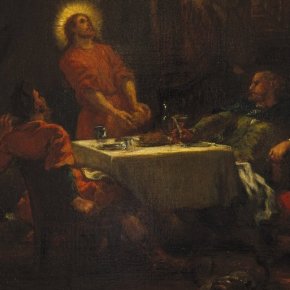
 “For when two or three are gathered together in my name, I am there among them.” I’ve always heard these famous words of Jesus as an astonishing promise, as a steadfast assurance that Christ is present in our midst no matter what. If you’ve ever been to a church gathering where only a few people showed up, I bet someone said, rather wistfully, “Well, when two or three are gathered…” I’ve said the same many times as a way to remind myself that what we’re doing when we gather as the church, as the body of those whose faith and action is motivated by the life, death, and resurrection of Jesus Christ, is important, no matter the size of the group.
 I’ll tell you all the truth: I’ve been struggling lately. The day the twins were born, about a month ago now, life took a dramatic turn. I knew this tectonic shift in life was going to happen, but I sure wasn’t prepared for it. At times over the past month, I have felt helpless. I have felt frantic. I have felt desperately inadequate. The learning curve for new parenthood is steep, and I’ve had to adjust my expectations about how fast I catch on. I’ve always been a quick study, but in this particular case, there’s no substitute for the exhausting daily grind of caring for the twins. I guess what I’m trying to say is that I knew it was going to be hard, but my definition of “hard” has never reached the superlative level of caring for multiple newborns.
 For as long as I can remember, my father has worn a cross beneath his clothing, resting on his skin close to his heart. So when my parents gave me a cross of my own to wear when I was in my early teen years, I was thrilled. I was going to be just like Dad, wearing my cross all the time, even in the shower! The trouble was I kept losing it. I couldn’t wear the cross all the time because I played soccer, and there was a “no jewelry” rule. So it would get lost in the depths of my soccer bag (which was not a place for the faint of heart). The chain broke once, but I managed to find the cross beneath the seat of my car. Then during my freshman year of college the chain broke again, and I lost the cross for good.
 Good morning! It’s good to be back after three weeks away. I know I’ve only been next door, but it seems like another world when newborns are filling all your waking (and the few sleeping) moments. I seriously thought about skipping this sermon entirely and just showing you baby pictures for the next ten minutes, but then I realized lemonade on the lawn might be a better venue for that. So, let’s get down to the sermon.
 Dear Baby Boy and Baby Girl,
 Okay, to start off: I’m not going to preach this morning about my rapidly approaching fatherhood. But I just want to point out God’s divine sense of humor in us reading in the Hebrew Scripture a story about the birth of twins. Rather, this morning, I’m going to preach about God’s persistence and God’s extravagance. To do this, I’d like to talk about the second of my three days of Godly Play training.
 I confess: I have babies on the brain. I hope you’ll forgive me another sermon that springs from my impending fatherhood. I promise that in the years to come not all my sermons will generate from this experience. But it’s all I can think about right now, so naturally, in a Gospel lesson crammed with various fabulous sermonic content, I would gravitate to the verse about babies. Jesus says, “I thank you, Father, Lord of heaven and earth, because you have hidden these things from the wise and the intelligent and have revealed them to infants; yes, Father, for such was your gracious will.”
 As I contemplate my impending fatherhood, the story of the binding of Isaac, which we read a few minutes ago, has taken on new meaning for me. I’ve always struggled with this story, and, if you’ve ever read or heard it, I’m sure you have, too. This reading from the Hebrew Scripture brings up so many questions: why would God ever test someone in such a barbaric way? How could God be so apparently abusive? How could Abraham even think about going through with it? If the angel hadn’t stopped him, would Abraham actually have killed his son? What would that prove?
 Where the Wind...