
Sermon for Sunday, September 27, 2026 || Proper 21A || A Reading attributed to Meister Eckhart
Today is the fourth of five Sundays in our Season of Creation. So far, we have remembered that humans are part of nature, we have asked the Earth for forgiveness for human exploitation, and we have embraced the spiritual practice of awe. Today, we are going to deepen that practice with an exercise in awareness and gratitude. And we’ll begin with a foundational principle of our faith: because God created all things, all things are sacred. Every element of Creation bears the potential for sacramental encounter with God through the holy offering of our awareness. That’s why we call it “paying” attention. We put in the currency of our attention and receive a hundredfold the blessings of God. These blessings then spur our gratitude, which triggers a desire for greater awareness, which delves a deeper well of gratitude. Through God’s grace, this virtuous cycle turns us into mystics in our own backyards.
A few weeks ago, we saw the exercise of awareness bring Moses into God’s presence on the Mount of Horeb. Moses has brought his father-in-law’s flock beyond the wilderness when he encounters the burning bush. The book of Exodus narrates the scene like this: Moses “looked, and the bush was blazing, yet it was not consumed. Then Moses said, ‘I must turn aside and look at this great sight, and see why the bush is not burned up.’ When the Lord saw that he had turned aside to see, God called to him out of the bush, ‘Moses, Moses!’” Did you catch that? Moses notices the bush, but he doesn’t pass it by with a mere glance. He intentionally “turns aside” to “look at this great sight.” God does not speak to Moses until God sees Moses turn aside to bear witness to the burning bush.
This encounter is a sacramental moment. A sacrament is a window into the holy, a window that looks upon the deeper reality of God’s presence in and through Creation. In the Church, we name seven specific liturgical moments as sacraments, the two most important being Holy Baptism and Holy Communion. Today, when we baptize Emily and James, we will be looking through that sacramental window into God’s reality. We will celebrate the reality of their original belovedness, the reality that these two children have done nothing to earn God’s love. Rather, God’s love is the basis of their identity. And we will celebrate that we as the church receive the great blessing and duty to help raise these two children so they feel God’s love in their very bones and so they grow up witnessing God’s love in the lives of everyone they meet. That’s the sacrament of Baptism, a ritual washing with the living water of God’s grace so we know that nothing can separate us from the love of God in Christ Jesus our Lord.
Now, while the official sacraments of the Church are restricted to certain liturgical actions, living a life of sacramental awareness offers infinite possibilities. Remember, a sacrament is a window into the reality of God that undergirds all of Creation. So when we gaze upon something with sacramental eyes, we are practicing our awareness of how that thing bears the sacred stamp of God’s creativity. This is what Meister Eckhart, the 14th century priest and mystic, is getting at in our reading today. Here it is again in full:
Apprehend God in all things,
for God is in all things.
Every single creature is full of God,
and is a book about God.
Every creature is a word of God.
If I spent enough time with the tiniest creature—
even a caterpillar—
I would never have to prepare a sermon,
so full of God
is every creature.
I don’t have a caterpillar, so I’m going to keep preaching. Notice Eckhart’s assumption of God’s presence. Rather than the old saw that “seeing is believing,” Eckhart flips it around: “Believing is seeing.” Eckhart believes God to be present in even the tiniest bit of Creation, and so by attending to that tiniest bit, he steps into God’s presence, which was always there waiting for him in the first place.
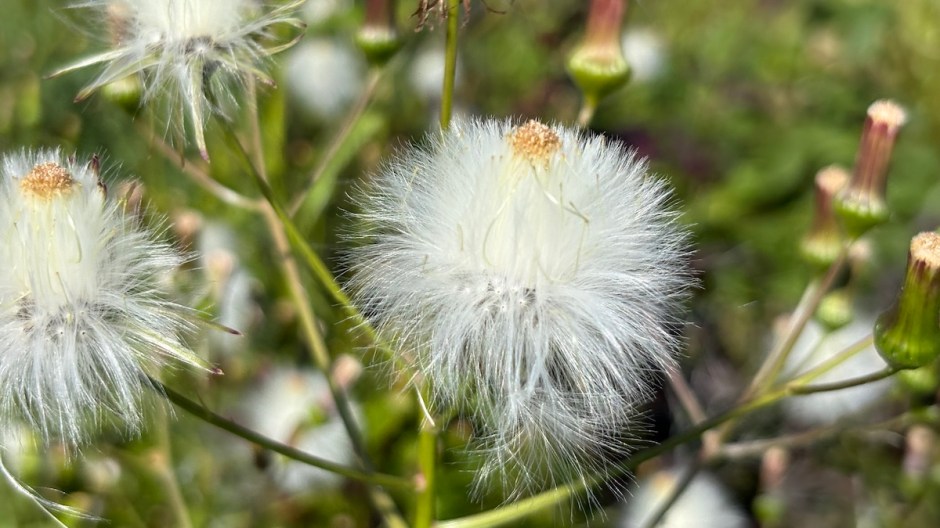
Knowing that I was going to preach this sermon, I attempted this exercise of awareness a few weeks ago at the beautiful Mercy-by-the-Sea in Madison. During a break in the vestry retreat I was leading, I went outside to a wild garden and chose a strikingly lovely plant. I learned later that the plant is a native American Burnweed, but I didn’t need to know its name to apprehend God in it. The burnweed was at the point of seeding and looked something like a very full and fluffy dandelion. I chose a single ball of fluff, and I spent ten solid minutes looking at it. I took in the ingenious way the hundreds upon hundreds of wispy seeds unhook from the flower and then detach as the breeze blows. The whole thing looks like a cottony firework that continues to explode the more wisps get carried off by the wind. As I gazed at this singular fluff ball, my breath matched the breeze, and I found myself praying for God to carry me off like the wispy seeds and drop me where the Holy Spirit most needs me to be. In my prayer, awareness turned to gratitude. I thanked God for the encounter with that particular flower, which is here today and gone tomorrow.
When my kids were babies, I often engaged in a similar practice of awareness and thanksgiving. Rather than giving thanks for them in their entirety, which seemed altogether too much for me to comprehend, I would choose a tiny part of one of them and give thanks for it. I would gaze upon his left earlobe: the slight elven point, the pace where the skin of the lobe meets the skin of the cheek. I would gaze upon the graceful arch between her ring finger and pinky or any one of the hundred shades of blue that painted her eyes, and I would give thanks to God.
We live in a world dominated by the digital, the artificial, the zeroes and ones of the so-called Information Age. We are bombarded with so much information that we have little time for knowledge or experience, let alone wisdom. But the Wisdom of God, who, as Proverbs says, was God’s master craftswoman as God made all things – the Wisdom of God shines forth in the sacred particularity of Creation. And when we apprehend this sacred particularity, we find our place again and again in God’s reality.
This week, I invite you to practice this sacramental exercise of awareness and gratitude. Choose a tiny part of nature – a single leaf, a pinecone, a shell, anything – and take that thing with you into prayer. Like Moses at the burning bush, turn aside and gaze upon the intricate veins of the leaf or the sacred geometry of the shell. Recognize God’s creativity in them. And give thanks. Your awareness of and gratitude for the particularity of that tiny piece of Creation connects you with all of Creation. As Meister Eckhart says, every single creature is a book about God. We can be mystics in our own backyards. All we have to do is start reading.
Banner image: The American Burnweed that I contemplated in Madison, CT.

