A Gospel Medley

Several people who’ve heard me sing this live have asked for a recording, so here it is. And I’m including the lyrics because parts of it (especially the Peter Gabriel section) are a bit difficult to follow. If you want to play it yourself, let me know, and I’ll send you the lead sheet. I hope you enjoy it!

(Oh, btw, I’m working on a second Gospel Medley. If you think of a song I could use for a piece of the Gospel, let me know. Right now, I just have Bryan Adams for the call of the disciples.)

(To download, right-click picture and choose “Save Link As…”)

The Nativity (Journey, “Don’t Stop Believin'”)
Just a virgin girl when the angel said to her,
“You will bear the Son of God.” She said, “Here am I.”
Just a carpenter of David’s line from Bethlehem;
He took her for his wife (the angel told him to).
So Caesar made the census rule
Telling all to go back home
In a stable Mary bears her babe
He’s the Son, the Son, the Son, the Son.

Shepherds grazing up and down the countryside
The wise men searching in the night
Starlight, angels singing ‘bout the Incarnation
Shining on this holy night

Don’t stop believing
Remember it’s with God you’re dealing
Peace to people

– – –

John the Baptizer (John Mellencamp, “Jack and Diane”)
A little ditty about John the Baptist
Whose favorite dinner was honeyed locusts
John, he’s saying, “I’m just the voice crying out:
Prepare the way of the Lord, that’s what I’m talking ‘bout.” (Sayin’)
Oh yeah, it won’t be long:
the kingdom has come near, repent your wrongs
Oh yeah, it won’t be long:
He is coming soon, I can’t tie his sandals’ thong (now walk on)

– – –

The Feeding of the 5000 (The Proclaimers, “I’m Gonna Be (500 Miles)”)
Jesus looks up, and he knows he’s gonna feed,
He’s gonna feed the people coming to see him.
The disciples, they all say they’re gonna need
They’re gonna need denarii to feed them all.

But I see there five loaves of bread
And I see there two tiny fish
I will bless this food to feed five thousand people
So sit down in the grass
Gotta lot now! Gotta lot now!
Gotta lot of scraps of bread leftover now!

– – –

Peter’s Confession and the Transfiguration (John Parr, “Man in Motion (St. Elmo’s Fire)”)
Jesus asks, “Who do you disciples say has come?”
Peter says, “You’re the Son of God, the Chosen One.”
God revealed this to you, not some fleshly search
So I name you Rock, now go build my church.

Then they climb the highest mountain, underneath the starry sky
And they witness Jesus’ changing, whiter and whiter
Gonna build some tabernacles, but then a cloud descends:
“This is my beloved Son, listen to him”

– – –

The Last Supper (John Denver, “Leaving on a Jet Plane”)
All my friends are here in this upper room.
Their feet are clean, now my Passion looms:
Here’s a four long chapter speech to say goodbye.
See this bread I’m breakin’, it’s a special loaf,
The wine you’re drinkin’ is my blood’s merlot.
Let’s share this meal before I’m brought to die.

So take, eat: you’re sharing me.
Drink this to remember me.
Hear my words ‘cause soon I’ll have to go.
I’ll be dying on the cross soon,
But know that I’ll be back again
Oh, friends, I hate to go…

– – –

The Crucifixion (Peter Gabriel, “In Your Eyes”)
On his head’s placed a crown of thorns;
The temple veil will soon be torn.
Without a noise, without his pride, he reaches out to his bride.

They crucify: the blood, the sweat
His mouth is dry from thirstiness.
Eli, Eli, Have you forsaken
Me to die? You’ll be with me in
Paradise. Oh God forgive them.
Then he cries: I commend my Spirit.
I see the blood and the sweat, oh, but it’s not over quite yet.
Just come on down this Sunday, meet you there at sunrise.

– – –

The Resurrection (U2, “Beautiful Day”)
They go to the tomb, on the first day of the week
But there’s no stone, so Mary takes a peak
She’s out of luck, and the reason that she had to care
Was apparently snuck away when they were unawares
But she knows she’s found a friend when the gardener says her name.
And then Jesus sends her saying, “My return proclaim.”

On this Easter Sunday, the grave falls and you know
On this Easter Sunday, death’s sting is wiped away
On this Easter Sunday…

Touch me, put your finger in my side
When I leave, my Holy Spirit will abide

It’ll be Pentecost Day, tongues of fire, you know
On that Pentecost Day, the Church is here to stay
On that Pentecost Day…

Life, in some superlative form

The following post appeared Tuesday, October 13th on Episcopalcafe.com, a website to which I am a monthly contributor. Check it out here or read it below.

* * *

Over the last few months, I have had the opportunity to serve several people who were grieving over the deaths of loved ones. I’ve been a priest for nearly a year and a half, but it was not until this summer that I officiated at a burial office or spent hours with families, stumbling together through the wilderness of loss. These recent months have again and again brought me to the eleventh chapter of the Gospel according to John (which appears more than once in the burial service) and to my own first remembrance of the loss of a love one.

rockport
My grandmother died a few miles inland from this stunningly beautiful seascape.

In the months before she passed on, she began having difficulty remembering which of the people in the room were related to her. One time, she thought my father was her biological son, though he had married one of her four daughters thirty years before. The last time I saw my grandmother, she was confined to her bed in the nursing home, a sterile facility a few miles inland from the rock beaches of the northern Massachusetts coastline. In my memory, she was always a small woman, shrunken by age. But during that final visit, I was shocked by her deterioration: the sheets and blankets seemed to double her body mass. Her white hair, once so carefully curled, hung limply from her head. She spoke in a choked whisper, as if her words were too special to share with the rest of the world. And, in a way, they were.

We got the call one summer evening and immediately made plans to fly to New England. When we arrived, we joined the rest of the extended family and pooled our grief with theirs. Cousins and aunts and sisters shared long embraces and reassuring shoulder squeezes and tears. We conversed in muted tones, offering our favorite memories of Esther: the swing set adjacent to her apartment complex; her inability to cook pot roast; her glowing love for her grandchildren and great grandchildren. As we remembered my grandmother, we started repeating certain phrases. “She lived a long life.” “She’s no longer in pain.” “She was ready to go.” “A part of her died twenty years ago with Jack; I’m so glad they are together again.” These sentiments comforted us as we shared them with each other. An outsider listening in on our conversations might have scoffed at such clichéd remarks, but for our family such well-worn comments gave us words to assuage our grief.

When Jesus arrives in Bethany, Martha leaves her home and goes out to meet him. Their conversation begins with similar phrases that emerge out of grief. I imagine that Martha and Mary had often said, “If Jesus had been here, Lazarus wouldn’t have died,” in the four days since they had buried their brother. And now Martha addresses Jesus with these words: “Lord, if you had been here, my brother would not have died.” Perhaps, this is an accusation; perhaps, it is a statement of faith. More likely (as is so often the case), it is a combination of the two. She continues, “But even now I know that God will give you whatever you ask of him.”

At first, Jesus responds with what sounds like an empty, stock answer to a grieving person: “Your brother will rise again.” Indeed, such a statement had probably reached cliché status at that time, considering a large portion of Jewish society believed in a final resurrection. Judging by her next words, Martha certainly takes Jesus’ words in this clichéd manner. I imagine her hanging her head when she says, “I know that he will rise again in the resurrection on the last day.”

But Martha has not grasped Jesus’ full meaning. Far from offering the usual comforting words to a person in grief, Jesus eliminates the cliché by completely retooling the rules for resurrection. “I am the resurrection and the life,” he says, “Those who believe in me, even though they die, will live, and everyone who lives and believes in me will never die.”

The writer of the Gospel throws the full weight of Jesus’ “I am” statements behind these words. By taking resurrection into his very identity, Jesus proclaims to Martha and to us that his business is always remaining in life-giving relationships. Yes, death will occur, he says; after all, resurrection cannot take place without death. But life, in some superlative form, emerges when resurrection denies the finality of death. The first verses of the Gospel link life and light: “What has come into being in him was life, and the life was the light of all people.” Just as darkness did not overcome light, death fails to conquer life because of the power of the resurrection.

Jesus’ words to Martha appear in our burial services to remind us of that power. But these words carry the weight of Jesus’ divine identity, and thus serve as so much more than a simple reminder. Resurrection is not some impersonal thing that may or may not impact our lives and deaths. Resurrection is not something to bring up just to make a grieving person feel better. Jesus is resurrection. Jesus is life. By revealing resurrection as part of his identity, Jesus further divulges the lengths to which he goes to be in relationship with us. Death cannot stop this relationship, because Jesus is resurrection and life.

Martha understands that resurrection assures this continued relationship with Jesus. When he asks her if she believes his words, she replies in the affirmative, but she answers a different question than the one Jesus asked. “Yes, Lord,” she says, “I believe that you are the Messiah, the Son of God, the one coming into the world.” She answers that she believes in him. Rather than her belief fulfilling a requirement for resurrection, her belief simply affirms her relationship with Jesus. She desires a relationship with him, and Jesus, in his unwillingness to end such a relationship, offers the gift of resurrection. Our belief in Jesus affirms our desire to remain in relationship with him. His gift of resurrection affirms his desire to remain in relationship with us.

When my grandmother died, my family came together to celebrate her life in the midst of our grief. We spoke comforting words to each other, words that had the power of love behind them. And at the service where we laid Esther’s body to rest next to her beloved Jack, we heard Jesus’ words of life proclaiming Jesus’ desire to continue his relationship with us beyond death in the power of the resurrection.

Footnote

* The names of my maternal grandparents have been changed (in order that you’ll have a harder pretending to be me while filling out bank forms).

For once I didn’t disengage

Detachment. Recently, I’ve been giving in to the feelings of this my most famous and well-documented coping mechanism. Friends will tell you that I barely left my room during my second year of seminary except to go to classes and meals. Some days were better than others. I could stomach watching a football game in the common room or going to a birthday dinner at the Mexican restaurant. But on the worst nights — ones in which I had been invited out and had even made a vague commitment to going — I got dressed in going out clothes, laced up my going out shoes, paced the room, argued with myself, grasped the door handle half a dozen times, manufactured some phantom nausea, and put my pajamas back on. I hated myself for those nights. Back then I was coping with the loss of a long-term relationship; I dealt with the decoupling by detaching myself from everyone else, too. I know — not the healthiest of coping mechanisms. Indeed, I needed a coping mechanism for my coping mechanism. But more on that in a moment.

Before you start calling in a crack squad of psychotherapists, this recent bout with detachment is nowhere near as severe. Like Spinal Tap’s amps, the detachment a few years ago went up to eleven. This time, the severity is at about a two or three. But enough of the shadow of that previous time hovers in my memory, making me all too aware of the dangers of detachment. Back then, a loss of relationship made me pull away. Ironically, a similar set of responses is happening as I form new relationships at my new parish. Of course, with the new relationships come the ending or transforming of other relationships. Suffice to say, the constellation of relationships in my night sky is changing, and something in that change is causing me to fall back on my erstwhile coping mechanism.

Enter this week’s lesson from Paul’s letter to the church in Rome. Paul discusses various practices that some find objectionable and others find completely acceptable. Each group thinks they are the ones who are truly honoring God. Paul tells them that both sides are giving thanks to God by different actions, so neither has a right to pass judgment on the other. In this context, Paul writes a verse of surpassing beauty and profundity: “We do not live to ourselves, and we do not die to ourselves. If we live, we live to the Lord, and if we die, we die to the Lord; so then, whether we live or whether we die, we are the Lord’s.”

As I contemplate my recent relapse into old patterns of detachment, I realize that these words have been with me from my first week at my new parish. Since the beginning of August, I have been a part of three memorial services — liturgies during which people come together to mourn and laugh and grieve and celebrate the life of a loved one who has died, and in so doing, celebrate the resurrection of Jesus Christ. At the beginning of each service, the priest intoned these same words from Paul’s letter to the Romans. Each time I heard these words in the last month, I got that spine-tingling feeling that happens when God drops an ice cube down your back to remind you that God’s still there.

These words of Paul speak the beautiful and profound truth that we belong to God, or as the Episcopal burial office puts it: “We are the Lord’s possession.” This reminds me that however much I may feel the need to detach, to disentangle myself from life or friends or responsibilty, God never severs the relationship with me. Hearing Paul’s words during those special memorial services kept me from disengaging in the midst of all the changes and chances my life had been through in recent months.

This is why “church” is so important. In the context of the community of faith, the Lord spoke words of renewed invitation to me. I’m sure you’ve heard the popular epithet that describes someone as “spiritual, but not religious.” I think I understand some of the cultural and sociological forces that have contributed to the emergence of this category. One of these forces, sadly, is a misunderstanding on the societal level of what “religion” means. In the modern era, the terms “religion” and “church” took on the connotation of “edifice” — of imposing structure and immutable establishment.

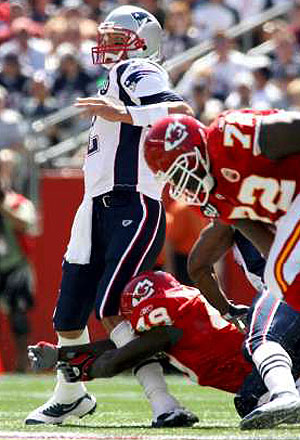
But “church” has very little to do with a building and much to do with a people gathered. While structure and doctrine have their necessity, “religion” does not mean structure and doctrine. When you get right down to it, “religion” means “reconnection.” Re-ligio. Just look at the word and think of all the football players (most recently Tom Brady of my beloved Patriots) who have had surgery for torn ACLs.  An ACL tear is repaired by reconnecting the torn ligaments to the muscle and bones of the knee. Likewise, “religion” is all about reconnecting us to the One who holds us all in possession. And “church” is all about celebrating that reconnection with one another.

The musical Rent offers a stark view of the reality of our society and shows the utter need for these resources of connection and relationship. Near the end of the show, after the characters have dispersed and gone their separate ways, Roger and Mark sing about that special Christmas Eve last year when their group of friends came together to celebrate life and love. They sing: “What was it about that night? Connection in an isolating age. For once the shadows gave way to light. For once I didn’t disengage.” Opening themselves up to that connection with others leads them to joy and pain and life and death and the grittiness of a love that has survived all the assassination attempts by the forces of isolation.

When I begin to let myself detach from those around me, I must remember that God has already repaired the torn ligament and banished the shadows of isolation. I am the Lord’s possession. I am the Lord’s when I die. And I am the Lord’s while I live. I just need to make sure I’m living while I am alive, to make sure that I stay connected to those around me and celebrate the love of the God who knits us all together.