I wrote “A Minstrel’s Christmas Song” back in 2006, and I’ve been blessed to sing it every Christmas morning since at various churches. This recording is from this Christmas morning at St. Stephen’s. If you’d like to download an mp3 of the live recording (mistakes and all!), click here.
Tag: Nativity
A Gospel Medley
Several people who’ve heard me sing this live have asked for a recording, so here it is. And I’m including the lyrics because parts of it (especially the Peter Gabriel section) are a bit difficult to follow. If you want to play it yourself, let me know, and I’ll send you the lead sheet. I hope you enjoy it!
(Oh, btw, I’m working on a second Gospel Medley. If you think of a song I could use for a piece of the Gospel, let me know. Right now, I just have Bryan Adams for the call of the disciples.)
(To download, right-click picture and choose “Save Link As…”)
The Nativity (Journey, “Don’t Stop Believin'”)
Just a virgin girl when the angel said to her,
“You will bear the Son of God.” She said, “Here am I.”
Just a carpenter of David’s line from Bethlehem;
He took her for his wife (the angel told him to).
So Caesar made the census rule
Telling all to go back home
In a stable Mary bears her babe
He’s the Son, the Son, the Son, the Son.
Shepherds grazing up and down the countryside
The wise men searching in the night
Starlight, angels singing ‘bout the Incarnation
Shining on this holy night
Don’t stop believing
Remember it’s with God you’re dealing
Peace to people
– – –
John the Baptizer (John Mellencamp, “Jack and Diane”)
A little ditty about John the Baptist
Whose favorite dinner was honeyed locusts
John, he’s saying, “I’m just the voice crying out:
Prepare the way of the Lord, that’s what I’m talking ‘bout.” (Sayin’)
Oh yeah, it won’t be long:
the kingdom has come near, repent your wrongs
Oh yeah, it won’t be long:
He is coming soon, I can’t tie his sandals’ thong (now walk on)
– – –
The Feeding of the 5000 (The Proclaimers, “I’m Gonna Be (500 Miles)”)
Jesus looks up, and he knows he’s gonna feed,
He’s gonna feed the people coming to see him.
The disciples, they all say they’re gonna need
They’re gonna need denarii to feed them all.
But I see there five loaves of bread
And I see there two tiny fish
I will bless this food to feed five thousand people
So sit down in the grass
Gotta lot now! Gotta lot now!
Gotta lot of scraps of bread leftover now!
– – –
Peter’s Confession and the Transfiguration (John Parr, “Man in Motion (St. Elmo’s Fire)”)
Jesus asks, “Who do you disciples say has come?”
Peter says, “You’re the Son of God, the Chosen One.”
God revealed this to you, not some fleshly search
So I name you Rock, now go build my church.
Then they climb the highest mountain, underneath the starry sky
And they witness Jesus’ changing, whiter and whiter
Gonna build some tabernacles, but then a cloud descends:
“This is my beloved Son, listen to him”
– – –
The Last Supper (John Denver, “Leaving on a Jet Plane”)
All my friends are here in this upper room.
Their feet are clean, now my Passion looms:
Here’s a four long chapter speech to say goodbye.
See this bread I’m breakin’, it’s a special loaf,
The wine you’re drinkin’ is my blood’s merlot.
Let’s share this meal before I’m brought to die.
So take, eat: you’re sharing me.
Drink this to remember me.
Hear my words ‘cause soon I’ll have to go.
I’ll be dying on the cross soon,
But know that I’ll be back again
Oh, friends, I hate to go…
– – –
The Crucifixion (Peter Gabriel, “In Your Eyes”)
On his head’s placed a crown of thorns;
The temple veil will soon be torn.
Without a noise, without his pride, he reaches out to his bride.
They crucify: the blood, the sweat
His mouth is dry from thirstiness.
Eli, Eli, Have you forsaken
Me to die? You’ll be with me in
Paradise. Oh God forgive them.
Then he cries: I commend my Spirit.
I see the blood and the sweat, oh, but it’s not over quite yet.
Just come on down this Sunday, meet you there at sunrise.
– – –
The Resurrection (U2, “Beautiful Day”)
They go to the tomb, on the first day of the week
But there’s no stone, so Mary takes a peak
She’s out of luck, and the reason that she had to care
Was apparently snuck away when they were unawares
But she knows she’s found a friend when the gardener says her name.
And then Jesus sends her saying, “My return proclaim.”
On this Easter Sunday, the grave falls and you know
On this Easter Sunday, death’s sting is wiped away
On this Easter Sunday…
Touch me, put your finger in my side
When I leave, my Holy Spirit will abide
It’ll be Pentecost Day, tongues of fire, you know
On that Pentecost Day, the Church is here to stay
On that Pentecost Day…
The Best Christmas Pageant Never (Bible study #13)
Ever wonder where all that stuff in the Christmas pageant comes from? Haven’t seen a felt board since you were six? Well, then look no further than this third installment of the Moving Picture Bible Study.
The bedtime story
(Sermon for Christmas Eve, 2008 || RCL || Luke 2:1-20)
Imagine with me the day after Jesus’ Ascension. His followers, including his mother Mary and Mary Magdalene, are sharing a meal and remembering all their favorite stories about the one who had died and risen again. The two Marys are sitting in a corner talking when Mary Magdalene asks Jesus’ mother to tell her something about Jesus’ childhood. Mary ponders for a moment and then begins:
As a boy, Jesus had trouble falling asleep. No, he wasn’t afraid of the dark or of monsters under his bed. He just had too much energy. Even a day full of running up hills and building rock forts and fetching water from the well couldn’t tire him out. When he couldn’t sleep, I would sing him a lullaby and run my fingers through his matted hair. Sometimes, after a few notes, he’d say, “Not tonight, Mama. Tell me the story instead.” The story. I was always glad when he asked me to tell him how he was born because, when the story remained silent in my heart, it always threatened to transform into a dream and vanish.
“Before you were born,” I would begin, “I was engaged to your father when an angel…”
Right then, he would interrupt: “You mean Joseph, Mama.” There were no secrets in Nazareth: the town was too small. Everyone knew that Joseph and I didn’t marry until after Jesus was born. Our neighbors knew the truth up to a point — that Joseph wasn’t Jesus’ father, but anything more was speculation. We didn’t want Jesus to hear some maimed version of the events. So, when he was old enough to understand, we told him that Joseph was Jesus’ father because he loved him not because he helped make him. But you know how literal children can be.
“Yes, dear, I mean Joseph. I was engaged to him when an angel from God named Gabriel came right into my room.”
Always a second interruption: “How’d you know he was an angel, Mama?” I’m convinced that he started studying Torah because I could never come up with a satisfactory answer for him. I would say, “Well, he looked like a man, but also like his feet never got dirty or his hair never needed to be combed. More than that, though: it was his voice. When he talked, I didn’t hear his words in my ears. I heard them in my heart. That’s how I knew.” Then Jesus would roll his eyes, the signal for me to continue telling the story.
“Gabriel told me that I was going to become pregnant with you and that I should name you ‘Jesus.’ Do you know what your name means?”
“Yes, Mama. It means ‘God saves.’ ” He would say it matter-of-factly, like there was no disputing such an obvious claim. Then he’d roll his eyes again, and I would continue.
“Even though Gabriel told me what was going to happen, I knew in my heart that it wouldn’t happen if I didn’t want it to. But the moment he said your name — I just knew. I said yes. After Gabriel left, I realized how much trouble I would get into if I got pregnant. I wasn’t married yet, and I thought your father (yes, Joseph) would disown me when he found out. But he was wonderful, and we got married after getting back from Bethlehem.”
Then I would tell Jesus about the journey from Nazareth to Bethlehem, leaving out the part about how uncomfortable it was to travel nearly nine months pregnant. Mary, I wouldn’t mind if that part of the story would transform into a dream and vanish.
Jesus would always sit up and lean in close when I got to the part about Bethlehem. “Because of the census, all the inns were full and we had no place to go. We were passing by a barn when my water broke. Joseph didn’t know what to do. We went into the barn, and he spread his blanket over the hay. I lay down and told him to go find a midwife. He didn’t want to leave me, but I said that the labor would last a long time and that he’d be back well before anything important happened. By some miracle, the wife of the man who owned the farm was a midwife, and she came with hot water, strips of cloth and no thought to turn us out of the barn.”
One time when I was telling the story, Jesus — he was maybe seven or eight — put his hand on my arm and said: “It was a miracle, Mama. She helped you even though she didn’t know you. I wish more people would do that.”
I remember crying after he fell asleep because his words were so true and yet so infrequently accomplished. The song I sang when I was pregnant with him came back to me that night: “God has cast down the mighty from their thrones, and has lifted up the lowly; he has filled the hungry with good things, and the rich he has sent away empty.” Was my son really the one to bring about these things, I thought?
After telling him about the midwife coming, I would get to the part where Joseph laid him in the manger. And I would hug him tight to show him what swaddling clothes felt like.
He was twelve years old the last time he asked me to tell the story. We had just gotten back from Jerusalem, and I had had the scare of my life when he wasn’t in the caravan home. I said, “Then your father… (He had stopped correcting me by that point.) Your father placed you in the manger.” When I reached to give him the swaddling hug, he stopped me. For a moment, I thought he was getting too old to hug his mother, but then he said:
“Mama. I know…I know now why I was born in that barn. It was a miracle. It all makes sense. At the temple I was reading the prophet Isaiah.” He jumped out of bed, still talking. “Right at the beginning of the scroll, Isaiah says, ‘The ox knows its owner and the donkey knows the manger of its lord; but Israel has not known me, and my people have not understood me.’ ”
He was so excited. He pulled me up and grabbed me into his own swaddling hug. “This is what I’m supposed to do. Israel, Mama! Israel will know God because of me. And not just Israel. Everyone everywhere will know God because of me. They will understand what they’re supposed to do. I will tell them to love each other and help each other, and when they do that, they will be loving God. They will be helping me. Everyone everywhere will know God when they see me. Mama!”
We held that embrace for a long time. I remember feeling his tears soaking through my dress. The words of Simeon — that old man in the temple — sprang to my lips and I whispered them into Jesus’ matted hair: “These eyes of mine have seen the Savior, whom you have prepared for all the world to see: a Light to enlighten the nations, and the glory of your people Israel.’ ”
We didn’t finish the story that night. The shepherds coming to see us – always his favorite part as a little boy – didn’t need repeating. When he slept, his countenance was different, older. Then I remembered what Simeon told me next: “A sword will pierce your own soul, also.” I wept that night, too, when I felt a premonition of the sword that wouldn’t pierce me for twenty years yet. But let’s not talk about that now, Mary. We were both there, and I still have no words even though he came back to us, thank God.
Well, I haven’t told the story of his birth to anyone since that night after we lost Jesus in the caravan. (Yes, I can tell you that one next if you like.) But first, my Mary of Magdalene, tell me a story of my son. What was he like when his mother wasn’t around? Has Israel come to know their God? Has everyone everywhere? If you don’t tell the story, it could transform into a dream and vanish. So tell me of my son. Tell me his story. And tell everyone everywhere.
Notes
*Special thanks to Raymond E. Brown, whose study An Adult Christ at Christmas unlocked this sermon for me.
Of sandwiches and second comings
(Sermon for November 30, 2008 || Advent 1, Year B RCL || Mark 13:24-27; 1 Corinthians 1:3-9)
At the end of this sermon, I’m going to explain why the phrase “O come O come Emmanuel” is a funny phrase. But first, I want to talk about my parents’ crèche.
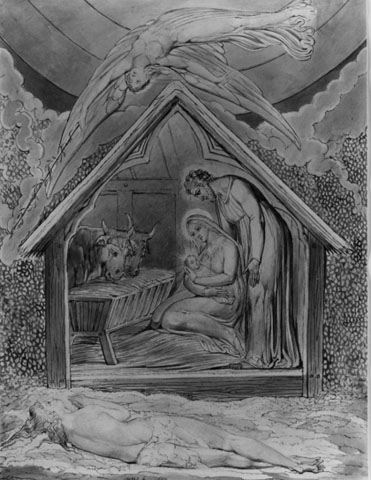
During the season of Advent when I was growing up, my family placed a beautiful Nativity scene on the shelf above the TV. The wooden stable had a bark and moss covered roof, above which we suspended angels on fishing line. Inside the stable, a bearded Joseph leaned heavily on a staff and a kneeling Mary pondered things in her heart, while a donkey and a cow looked on. Outside the stable, a pair of shepherds, a woman balancing a jug of water, and assorted townsfolk queued up like bridesmaids and groomsmen in a wedding photo. Each character was transfixed by something going on at the center of the stable, something that was obviously important if the painted expressions on their faces could be believed. The trouble was that nothing was going on at the center of the stable. An unassuming manger stood in between Mary and Joseph, who stared lovingly down into the empty box.

You see, we waited until Christmas Eve to place the baby Jesus in the manger. (Confidentially, we hid him on the shelf behind the stable until our plastic Mary came to full term.) So, for the entire month of December, our crèche was incomplete. As a child, I might have laughed at the incongruity of the scene if I had known any other Advent tradition. Jesus hadn’t come yet, but the fishing line angels were already fingering their harps, the shepherds were already choosing which lamb to present, and the cattle were already lowing (whatever lowing is).
Without Jesus in the manger, none of these activities made sense. But putting the babe away in that manger a month before Christmas removed the period of expectant waiting that Advent is all about. This is the tension we acknowledge during these next four weeks. By preparing to celebrate Jesus’ Incarnation, we are also preparing for his second coming. To be able to come again, he had to leave. But even as we prepare for his coming again, we remember that Christ abides with us even now in the present.
This incongruity is quite confusing. How can Jesus be coming again and abiding with us at the same time? This makes no sense. If I say I’m going to the kitchen to make a sandwich, I can’t watch football on the couch in the living room at the same time. (I can, of course, pause the football game with the wonderful invention of DVR, but that’s beside the point.)
I can either make a sandwich or watch football. We are used to our world working in this either/or way. We exist in time and space. At this moment in time and at this place in space, I exist in this pulpit talking to you. I can neither make sandwiches nor watch football right here right now. Indeed, many years ago I gave up praying for the ability to teleport and succumbed to the reality of our either/or world.
But we get so caught up in “how things are for us” that we forget God lives outside and above and throughout this reality. We are bound by our either/or perceptions. Our God lives an expansive both/and kind of existence. Both three persons and One God? Yes. Both fully human and fully divine? You bet. Both coming again and abiding with us still? No problem.
The problem comes when we, in all our haste and distraction and busy work, forget that Christ abides with us still. Acknowledging the promise of “coming again” is much easier for us because it takes place in some amorphous future. Now, we humans have developed an awful routine of sloughing the future off on those people who will be alive in the future. This routine has spawned the byproduct of ignoring the consequences of our actions for those unfortunate future people. If we can push those consequences off into an amorphous future, surely we can install Jesus’ second coming there, too.
But when Jesus warns his disciples to “keep alert” and to “keep awake,” he reminds them that the future has a persistent habit of becoming the present. On some day that only the Father knows the Son of Man will come in the clouds with great power and glory. At some hour the master of the house will come, says Jesus. Don’t let the vague obscurity of the future lull you to sleep or you will miss the promise fulfilled in the present.
The Apostle Paul is aware that there are numerous sleepy followers of Christ in Corinth, the city to which Paul addressed this morning’s lesson. He reminds the Corinthians of Jesus’ promise to come again when he mentions “wait[ing] for the revealing of our Lord Jesus” and being “blameless on the day of our Lord Jesus Christ.” In the same breath that he speaks about the future, Paul also focuses on how Jesus Christ abides with the Corinthians and impacts their lives in the present. Christ has given them the “grace of God.” They have been “enriched in him in speech and knowledge of every kind.” They are “not lacking in any spiritual gift.” Christ will “strengthen” them even as they wait for the day of his revealing.
With these words, Paul teaches us that the best way to prepare for the coming of Christ is to realize that Christ continues to grace and enrich and strengthen us even now. Forgetting that Christ is present in our lives feeds the delusion that the future happens only to people yet unborn. On the other hand, setting all our desire on Jesus’ coming again blinds us to the presence of Christ in our midst. Thus, we can’t afford to let our either/or world dictate to which alternative we will subscribe. Only by keeping awake to the presence of Christ in our lives today will we be able to keep alert for the coming of Christ tomorrow.
When we come to the altar in a few minutes, we will share that presence of Christ in our midst. We will be nourished in the breaking of the bread and strengthened to go out and enrich the lives of all we meet. We will be given the opportunity to let our haste and distraction and busy work fall away, and for one shimmering moment, we will remember that the grace of God weaves our lives together. And as the body and blood of Christ fills us, the master of our internal houses will wake us up and set us by the door to watch for his coming again.
Okay, I promised that I would explain why the phrase “O come, O come, Emmanuel” is a funny one. Well, “Emmanuel” means “God with us.” So, when we chant that hauntingly beautiful melody, we are saying: “O come someone who is already here.” No matter how nonsensical our either/or world says this line of reasoning is, we still pray for “God with us” to come to us. By asking us to believe that Christ will come again even as Christ abides here, God invites us to join God in a moment of sweeping both/and reality. During the season of Advent, we cultivate the hope for this expansive existence. At the same time, God jostles our faith to make sure both our presents and our futures are full of the love of God. Keep alert for the coming of Emmanuel. And keep awake for the joy of God with us.