(Sermon for Sunday, December 23, 2012 || Advent 4C || Luke 1:39-55)
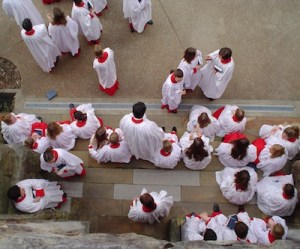 When I was in college, I never had time to watch TV or play sports or go on wild spur-of-the-moment car trips. I was too busy singing. The University Choir rehearsed four times a week and sang every Sunday morning during the church service. When I joined freshman year, I could barely piece two correctly pitched notes together, but the choir director, God bless him, would take anyone who was willing, including me. Four years and hundreds upon hundreds of hours of singing later, my voice managed to match pitch most of the time, and hey, it didn’t sound too bad.
The choir spent more time on one particular song than any other, a song that has found a special place in my heart. We sang the song once a month at the service of Choral Evensong, and every month we sang a different arrangement. But each arrangement had the same words, and those words always began with “My soul doth magnify the Lord, and my spirit hath rejoiced in God my Savior.”
These are the opening lines of Mary’s song, the Magnificat. We always sang them with the Elizabethan translation (with all the doths and haths) because the best musical versions are set to the old text. I must have sang 20 or 25 different settings during my time at Sewanee, and with each one, a single image from this opening line delved into me and settled deep within. I’d like to share that image with you this morning.
“My soul doth magnify the Lord,” sings Mary. What happens when you use a magnifying glass, like a microscope, perhaps? Say we are back in freshman biology lab and the instructor passes around a tray of slides. You and I (you all are my lab partner for this illustration, by the way)…You and I take one of the slides and pass the tray on to the group beside us. Next you take our pipette and squeeze one tiny drop of clear liquid onto the slide. We hold the slide up to the light and squint. We see nothing but a bit of water on glass.
But then I place the small pane of glass underneath the microscope, and you put your eye to the lens. You click into place the scope marked “30x magnification” and fiddle with the focus dial. And what was a moment ago just a drop of clear liquid is now a squirming mass of single-celled organisms, each dancing and stroking its way through the ocean that is the drop of water. How could we miss so much life happening in miniature? How could we ever think the drop of water was simply empty, clear liquid?
When we magnify, we take something difficult to see, and we make it more visible. “My soul doth magnify the Lord,” sings Mary. Mary’s soul is the magnifying lens, and she trains her soul on the God who has blessed her with the Christ in her womb. This brings up two questions. First, if God is so big, then why does God need magnification? Second, what is this “soul” Mary uses as her magnifying glass?
Well, to answer the first question, I’ll admit the whole microscope metaphor breaks down when we bring God into it. But the need for magnification persists because, let’s face it, sometimes God is hard to see. How many of us have ever had a time when we looked for God and found next to no evidence of God’s presence? How many of us have cried out to God and felt like our cries have fallen on deaf ears? This past week, in the wake of the Newtown shooting, how many of us have asked the question, “Where is God in all of this?”
It’s so close, so raw that we have no answer for this question—at least, not right now. We have only glimpses. We can only catch God out of the corner of our eye. We can only nibble around the edges of sense. In a month or two, or in a year or ten, I have hope that we will look back on this week and say, “Oh, that’s where you were, God. You were right there all along.” But right now, we have trouble seeing God. And so we need magnification. “My soul doth magnify the Lord,” sings Mary.
The soul is our magnifying glass, which begs the question: what is the soul? Now, this question is a whole other sermon – or possibly a multi-volume dissertation – so we’ll be brief. Please excuse the poetic language I’m about to employ – poetry is really the only way to speak briefly of such things as the soul.
Our souls are the places within us that are continually in contact with God, whether we are aware of the connection or not. The constancy of this connection happens because the soul is the piece of eternity around which God shapes each one of us. Each piece of eternity resonates with the eternal nature of God. The nature of God is also creative, which is why each piece of eternity comes wrapped in a unique, newly created person. The soul, then, is the deepest part of us, the one that makes us who we are and the one that connects us to God. This soul is the lens for our magnification. “My soul doth magnify the Lord,” sings Mary.
When Mary sings this, she signals both her joy that she is in God’s midst and also her willingness to partner with God to make God more fully known. God could easily be fully and visibly present to each of us all the time, but I wonder if the reason God is not lies in God’s desire to make our souls resonate even more fully with God. This resonance happens when we participate in God’s act of making God known, when we make God visible to other people, when we magnify the Lord.
Because the soul is the piece of each of us where our individuality resides, God has given each of us a unique way to magnify God’s presence. Perhaps yours is your passion for ministry with people who have no homes. Perhaps yours is your devotion to your children’s wellbeing. Perhaps yours is your singing voice or your ability to listen to other people’s fears or your overwhelming capacity to see the goodness in all people. Each of these gifts rises up from the cores of our beings, from our souls, and through them we magnify the Lord.
So in the next couple of days, as we celebrate the Incarnation of God’s greatest gift to us, the birth of our Lord Jesus Christ, I invite you to spend some time in conversation with God and perhaps also with a trusted confidant. Ask how your own particular soul might best serve to magnify the Lord. Ask what special gift God packaged with your own unique piece of eternity. Ask how your life can be a reflection of Christ’s Incarnation.
“My soul doth magnify the Lord,” sings Mary. So do each of ours. Thanks be to God.




 Where the Wind...