Guitar Lessons

(Sermon for Sunday, June 3, 2012 || Trinity Sunday B || John 3:1-17)

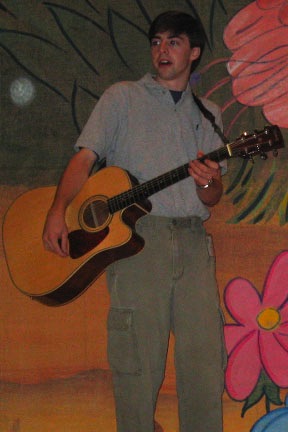
Playing at VBS in 2003 after my sophomore year of college. That was less than three years in to my guitar playing. It would have been seven or eight if I had never quit.

When I was in seventh grade, my parents bought me a three-quarter sized guitar and procured the services of a guitar expert to teach me the basics. At the first lesson, I learned the names of each of the six strings and how to play notes by plucking them. At the second lesson, I learned how to arrange my fingers on the strings so they made special shapes called chords. At the third lesson, I learned that I would have to practice if I wanted to improve my guitar playing. There was no fourth lesson.

You see, I was a bright kid, to whom pretty much everything came quite easily. I was a good athlete, so baseball and soccer were right up my alley. I really didn’t have to work much to make good grades in school. I had next to no challenges in any of my classes. And so when I was confronted with something that I couldn’t immediately master with no effort, I decided not to try. I put the guitar in the case, and the case sat unopened in my closet for years.

Now, as most of you know, I am a guitar player. So what happened? I picked up the instrument again my senior year of high school, and, being a tiny bit wiser than my seventh grade self, started practicing. I’ve been playing for over eleven years now, and I’m not half bad, but a wistful part of me always wonders how much better I would be at the guitar if I had not quit after three lessons back when I was thirteen years old.

My seventh grade self fell victim to a psychological epidemic that affects the vast majority of the population. Exactly one symptom characterizes this epidemic: people have difficulty agreeing to perform tasks that fall outside of their recognized competencies. This is still true for me: you’ve never seen me do ballet or fix the central heating in the church because these are two things that I don’t do very well. I have no training in either of these areas, and so the likelihood that I will agree to pirouette across a stage or put together an HVAC system is next to zero.

I’d be willing to wager that this fact of life is also true for you. I’m sure each of you could come up with a list of things you are unwilling to try because you know that you aren’t going to be good at them. You know that if you tried, failure would be in your future, and who wants to feel like a failure? And so the psychological epidemic keeps us from attempting new things and keeps us safely ensconced within the borders of our comfort zones.

For us this morning, the trouble comes when the list of things we are unwilling to try includes speaking openly about our faith in God. Why should this be any different from playing the guitar or doing anything else, you might ask? The simple answer is this: becoming an expert in guitar playing is possible. Becoming an expert on God is not.

Today’s Gospel reading teaches us this reality, which is an appropriate lesson on a day when we celebrate the mystery of the Holy Trinity. Nicodemus, a Pharisee and member of the Jewish council, fashions himself such a God expert. He comes to Jesus by night, and at the outset of their conversation, tries to display his knowledge of how God operates. “Rabbi,” says Nicodemus, “We know that you are a teacher who has come from God; for no one can do these signs that you do apart from the presence of God.”

Nicodemus’s “we know” sets him up as the so-called expert on God. The irony is that his statement is true. But Jesus isn’t interested in whether or not Nicodemus speaks correctly; Jesus is solely interested in moving this so-called expert into the unfathomable depths of God’s interaction with God’s creation. “No one can see the kingdom of God without being born from above,” says Jesus in response to Nicodemus’s opening remarks. Jesus’ statement is intentionally ambiguous. The words could mean “born from above or born again,” and I think Jesus means both. The very ambiguity of the phrase shows Jesus’ attempt to push Nicodemus out of his comfort zone where “we know” is his default position.

For his part, Nicodemus latches onto the more mundane of the two possibilities: “How can anyone be born after having grown old?” he asks. This response might sound a bit sarcastic, but at least the Pharisee, who has always been the expert answering questions, is now beginning to ask some of his own. The question is the small chink in the armor of Nicodemus’s expertise. Because of Nicodemus’s willingness to ask a question, Jesus sees that there is hope in showing him the expansiveness of all that this so-called expert does not know.

And, boy, does Jesus show him. Jesus opens Nicodemus’s mind and heart to the mystery of how God creates God’s people, and of how God moves in the world like the wind moving through the trees. When Jesus is done, Nicodemus’s opening “we know” now sounds laughably empty in comparison to the mysteries Jesus reveals to him. To begin to walk in and among these mysteries, Nicodemus must change his empty “we know” into an “I don’t know” full of desire and curiosity. And he takes the first tentative steps along this path with the sincerest question in the entire Gospel: “How can these things be?”

In just one conversation, Jesus shows Nicodemus that being an expert on God is not only not possible, but also not the best way to be in relationship with God. Only by acknowledging his lack of understanding can Nicodemus hope to begin to hear the sound of the wind blowing, this wind of the Holy Spirit that breathes life into creation. Nicodemus’s job is no longer to try to explain what makes God tick. Jesus gives him a new job: to bear witness to the mysterious movement of God in his life.

We see Nicodemus twice more over the course of the Gospel. In his next appearance, he puts one tentative foot outside his comfort zone when he reminds the rest of the council about their own rules when they want to put Jesus to death. And in his final appearance, we see that Nicodemus has fully embraced the new life that Jesus revealed to him. In broad daylight on the afternoon of the crucifixion, Nicodemus helps Joseph of Arimethea take Jesus from the cross and bury him in the tomb.

This so-called expert on God had his world turned upside down that night when he went to see Jesus. Jesus showed him that expertise is neither possible nor desired when relationship with God is concerned. There is not a person on this earth who is competent to talk about what makes God tick. While you and I might have difficulty agreeing to perform tasks that fall outside of our recognized competencies, we can take heart in the reality that Jesus released us from needing to be competent in this particular area. We will never be good at talking about God because God is far too glorious, far too mysterious and majestic for our puny words. But that shouldn’t stop us from trying. Releasing us from the need to be competent means that Christ rejoices in even our most halting attempts, in even the simplest expressions of feeling God’s love.

My prayer this morning is that each of us might feel released from the need to be competent when we have the opportunity to speak to someone else about our faith. Don’t be like my seventh grade self who gave up the guitar because he wasn’t an overnight expert. Rather, acknowledge that expertise has no domain where God is concerned. The simple word about how you feel God’s movement, spoken from the heart, is worth more than any treatise on the inner workings of the Holy Trinity. The halting word about not understanding God’s movement is worth more than all the “we knows” like the one Nicodemus speaks when he first encounters Jesus. The good news is that God uses our incompetencies as much, if not more, than our competencies. So I challenge you and I challenge myself: live into our incompetent ability to speak of God’s movement, and perhaps through our witness, someone new might start seeing God’s wind blowing through the trees.

Choosing the Light

 (Sermon for Sunday, March 18, 2012 || Lent 4B || John 3:14-21)

I’d like to go to a Red Sox game and hold up a sign that says, “John 3:17.” Perhaps, a row-mate would ask me why my sign is wrong and I can say that the sign’s not wrong, but a different verse entirely. The verse after the most famous verse of the Bible says, “Indeed, God did not send the Son into the world to condemn the world, but in order that the world might be saved through him.”

Now, before we really get down to the business of this sermon, let’s talk about this “world,” a word John uses three times in this one verse. For John, the world is the creation that rebelled against God – the good works, which God made, but which fell into disrepair because of bad human choices. One of the reasons that John starts his Gospel with, “In the beginning,” is so we readers might make the link back to the story of creation in Genesis, in which God created the heavens and the earth. Three chapters into Genesis, things start to fall apart because of Adam and Eve’s dreadful choices.

Fast-forward to John’s time or even to our own, and the broken state of the world is evident – there’s no need to list all of the broken things in relationships or in society or in the environment (for we know them all too well). Much of the brokenness stems directly from bad choices made over and over again. And because these decisions are made again and again, they become part of the system, the machinery of brokenness, and we feel helpless in the face of a crumbling world. Nevertheless, God so loved this world that God chose to send God’s Son into the brokenness in order that he might show us what is broken. And in showing us, he gave us the gift and duty of helping him restore the broken world to wholeness.

But even though John expands the Son’s salvation to include the whole world (literally the “cosmos” in Greek), the restoration starts taking place in the hearts of God’s children – in us and ever other person who has every walked the earth. The brokenness began in the hearts of Adam and Eve; thus, the healing, the saving of the world takes hold at the origin of the brokenness, in the hearts of all people.

Just like Adam and Eve had the choice to obey or disobey God, each of us has a choice, which Jesus names using the imagery of darkness and light: “The light has come into the world, and people loved darkness rather than light because their deeds were evil,” he says. “For all who do evil hate the light and do not come to the light, so that their deeds may not be exposed. But those who do what is true come to the light, so that it may be clearly seen that their deeds have been done in God.”

We have a choice to stumble in the darkness or to walk in the light, to be part of the problem or part of the solution, to add to the brokenness or to participate in the healing. And we don’t make this choice just once. Rather this choice is part of every single decision we make. Every decision either pulls us back to the darkness or pushes us further into the light. Perhaps you can remember a choice you made that turned out to be the wrong one – failing to stand up to a friend’s bully or taking out your frustration on your spouse or deliberately not noticing the homeless veteran on the street or knowingly purchasing a product that was fabricated under unbearable conditions, or…or…or — the list is endless. I don’t know about you, but when I make a choice the pulls me towards the darkness, I feel just a little bit unmade, like a little bit of me has eroded away. If I continually choose the wrong path, if I continually embrace the darkness, I wonder — will there be anything left of me?

This question points to the condemnation that Jesus talks about. God does not condemn; rather, we condemn ourselves when we choose the darkness over the light. Indeed, each time the verb “condemn” happens in the middle of our passage, the word is passive. God takes no active part in our condemnation, but only patiently and constantly calls us back to the light. And I firmly believe this call is what keeps us from eroding away entirely, what keeps us from total annihilation (which is another way of talking about hell). God’s constant call back to the light gives us a beacon to turn to, a lighthouse, if you will, that can guide us through the darkness and keep us from breaking up on the rocks. God does not force us to choose the light, but rather invites us to steer toward the harbor of God’s radiance.

As we answer God’s call and choose the light over the darkness, we discover that we can be part of the healing of the world. In our own experiences of the darkness, in our own vulnerability, we find the common ground of brokenness that Christ found when he came to earth and when he was lifted up on the cross. When we choose the light, we choose to be partners with Christ in healing the brokenness of the world even as Christ is healing our own brokenness.

So how do we translate the imagery of walking in the light into our everyday lives? What does choosing the light look like on the ground, in our day-to-day lives, at the office or at school or at home? Everything comes back to inviting God into our decisions, about orienting toward the light in each choice so that we do not feel like we are being eroded away to nothingness.

Here’s one practical way to help make decisions. Margot and I have been participating in a Lenten devotional series done by the Society of Saint John the Evangelist in Boston. Each day, a brother of the order talks about a piece of their Rule of Life, and about how each of us can benefit in our walks with God by writing a Rule for ourselves. A personal Rule of Life helps you to figure out how to be the best version of yourself, the version that God created you to be. When faced with a choice, remembering your Rule can help you walk in the light.

Writing out a Rule for yourself could be a simple as praying for clarity about the five things that are most important to you, then writing them on an index card and trying to live with those priorities in mind. Or perhaps, you might feel called to write out a longer, more in-depth set of guidelines for how you relate to yourself, to others, to the world, and to God. I’ve been working on my own Rule, and I’d like to share a few short passages with you so you can see how I am, with God’s help, trying to choose the light.

“I will nurture my relationship with God through praying, listening, serving, and loving.

“I will love my family. I will be loyal, honest, caring, and present to my wife and our (future) children.

“I will live my life with an attitude of thanksgiving, always seeking to choose abundance over scarcity, trust over fear, and relationship over isolation.

“I will live my life with an attitude of invitation, always seeking to choose engagement over apathy, encouragement over criticism, and listening over selling.”

In each of these pieces of my Rule, God has given me guidance for how to choose the light over the darkness. Does this mean I will always choose the light? Of course not, but the Rule will help me see when I have failed and help me turn back to the right paths. I invite you to consider making your own Rule, so that you may more effectively choose light over darkness. Please come see Margot or me if you’d like guidance in doing this incredibly fruitful practice.

Speaking of practice, spring training is going on, which reminds me of my sign from the beginning of this sermon (like that segue?). John 3:17 – “God sent the Son into the world not to condemn the world, but in order that the world might be saved through him.” Christ’s saving of this world began in his life, death, and resurrection, and continues in the hearts of all people. When we choose the light over the darkness, we choose to be part of the healing of this world, we choose to show the world that God is moving in our lives. In this witness, we bring God’s light into the darkness of this world. And do you know what happens when light is introduced into darkness? Darkness flees.

Schooling Nicodemus (or) “Imagine what you’ll know tomorrow”

The following post appeared Sunday, March 14th on Episcopalcafe.com, a website to which I am a monthly contributor. Check it out here or read it below.

* * *

In the film Men in Black, Jay discovers that aliens exist and many of them live on Manhattan Island. When he confronts Kay about this unnerving new detail, of which he (Jay) was previously unaware, Kay deadpans: “A thousand years ago everybody knew, as a fact, that the earth was the center of the universe. Five hundred years ago, everybody knew that the Earth was flat, and fifteen minutes ago, you knew that humans were alone on it. Imagine what you’ll know tomorrow.”

The season of Lent invites us to examine what we know, or, put more precisely, what we think we know. When we tackle this examination, we open ourselves up to encounters with Christ, which tend to augment, rearrange, and expand our knowledge with the addition of deeper faith. The Gospel contains myriad stories of Jesus blasting people with new knowledge,  so we should expect nothing different in our own lives. One such story co-stars the Pharisee Nicodemus (read up on John 3 before you continue).

As a general rule, if someone in the Gospel besides Jesus says “I know” or “we know,” then that person either knows a small fraction of the whole or, more commonly, nothing at all. Strangely enough, knowing nothing at all can even manifest itself when the statement made is quite true and correct. Such is the case with this leader of the Jews, who comes to see Jesus one night.

Nicodemus uses his “knowledge” displayed at the beginning of the conversation as a weapon to corner Jesus into a particular set of expectations. The Pharisee says, “Rabbi, we know that you are a teacher who has come from God, for no one could do these signs that you do apart from the presence of God.” Apparently, so far so good. This statement is true: Jesus has come from God and most definitely stands forever in the presence of God. But there’s irony in the statement, also. Nicodemus calls Jesus “teacher” twice — once in Hebrew (Rabbi) and once in Greek (didaskalos, from which comes the word “didactic”). But at the same time, Nicodemus’s conversational opener allows no room for Jesus to teach. Instead, Nicodemus is the one attempting to teach Jesus, to pigeonhole him into what Nicodemus and his colleagues have labeled him.

But Jesus refuses to be put on the defensive. In usual fashion, he completely ignores Nicodemus’s opening salvo and immediately expands the conversation to a depth and height that Nicodemus is not expecting. Jesus says, “No one can see the kingdom of God without being born from above/again.” There’s a delightful ambiguity here: in Greek, “from above” and “again” are the same word (anothen). They both work in the context, and Jesus probably means both when he says the word. How better to jostle someone loose from his rigidity than with a small helping of ambiguity?

But Nicodemus grasps at the more mundane of the two meanings and responds: “How can anyone be born after having grown old? Can one enter a second time into the mother’s womb and be born?” This may seem like a sarcastic response, but at least this Pharisee, who has always been the one answering questions, is now (albeit haltingly) beginning to ask some of his own. But Jesus doesn’t seem interested in staying on the terrestrial plane, so he ignores Nicodemus questions and pushes him to a new level of understanding. “No one can enter the kingdom of God without being born of water and spirit. What is born of the flesh is flesh and what is born of the Spirit is spirit.” At this point, I imagine Nicodemus’s brain starts hurting.

But Jesus keeps pushing him. Nicodemus’s opening “we know” now sounds empty in comparison to the mysteries Jesus is revealing to him. To begin to absorb these mysteries, Nicodemus must turn this empty “we know” into an “I don’t know” full of desire and curiosity. With his next words, Jesus gives Nicodemus license to let go of what he thinks he knows: “The wind/Spirit blows where it chooses and you hear the sound of it, but you do not know where it comes from or where it goes.” (Here’s another delightful ambiguity—in Greek, “wind” and “spirit” are the same word, pneuma.) Nicodemus must now consent to trusting in things he can never quite figure out. Indeed, he must realize that the truest things that have ever been or ever will be can be believed without being adequately explained. In a word, Jesus asks Nicodemus to have faith that the words he speaks are true, no matter how difficult, preposterous, or confusing they may sound.

And Nicodemus takes a tentative step into the shallows of faith in Jesus. He asks one of the sincerest questions in the Gospel: “How can these things be?” With this question, Nicodemus allows the cognitive dissonance that has been cresting to break on him like a wave. This dissonance is the necessary distress that happens when he realizes he doesn’t know something he thought he knew. But dissonance isn’t a bad thing. In music, dissonance is the interesting part, the part that pushes the piece onward. A pleasing harmony (called “consonance”) can hang in the air indefinitely, but a dissonance begs to move forward to the next consonant chord.

So it is with Nicodemus and anyone who opens up himself or herself to the possibility of the unknown. Allowing the cognitive dissonance to enter our comfortable worldviews pushes us to grow into the next consonant chords in our lives. When Jesus confronts us, like Nicodemus, with the mysteries of the faith, we can either step backward into the comfort of what we think we know or step forward, fully expecting the boundaries of possibility to be far wider than we can perceive. This confrontation goes by another name: revelation.

Every encounter with Jesus, whether in the text or in life, promises an opportunity for revelation, which obeys no boundaries of possibility. Revelation is that thing you know, but don’t know how you know it. Revelation is visceral as well as mental because the brain alone is ill-equipped to handle it. Revelation infuses us with an odd mixture of peace and exhilaration—peace because we know God is there, exhilaration because we know God is calling us to serve. Cognitive dissonance is the birthplace of such revelation. The dissonance reminds us that what we know is far less than the whole. When we can acknowledge that we don’t, in fact, know where the wind comes from or where it goes, we are primed for receiving the revelation of God’s love that Jesus is forever revealing to the world. This is a scary proposition, for if we do, indeed, remain attentive we might actually hear God calling us to serve in a way that doesn’t fit our plans.

But revelation bursts our ability and our desire to control because it blows where it chooses on the wind of the Spirit. When Nicodemus says to Jesus, “We know,” he is seeking to control the conversation that will follow. But he immediately discovers he’s in over his head. When we acknowledge that Jesus has things to reveal to us that we couldn’t possibly imagine, we discover we’re also in over our heads. The trick is to learn to breathe in the wind of the Spirit while underwater (to grow gills and fins) and to find a new natural state submerged in the revelatory love of Christ.

When Nicodemus says to Jesus, “How can these things be,” he allows the possibility for revelation to strike him in his head and in his gut. His cognitive dissonance jettisons his need to control. He is open for Jesus to reveal new and wonderful things to him. And Jesus does — things about the Son of Man ascending to and descending from heaven, things about the Son of Man being lifted up as Moses lifted up the serpent in the wilderness, things about eternal life and self-giving love and believing and salvation.

I imagine Nicodemus left his encounter with Jesus in a daze, his heart and mind on overload attempting to process all he had seen and heard. Is he able fully to put his trust in Jesus, to allow the dissonance to resolve into a new and deeper consonance? Not quite yet. But we are lucky enough to meet Nicodemus twice more in the Gospel (check them out! John 7 & John 19). His journey towards the consonance of a life of faith following Jesus models for us our Lenten journeys of self-examination. If we open ourselves up to encounters with Christ during this season of Lent, then (as Kay says), “Imagine what you’ll know tomorrow.”

Inspiration (Davies Tales #3)

The irony was unbearable. A theology paper about the Holy Spirit due in less than twenty-four hours, and Aidan Davies had less than nothing. No topic. No thesis statement. No inspiration. No inspiration for an essay about the Spirit, the source of in-SPIR-ation. Davies snorted and shook his head. I hate irony. He focused again on the glow emanating from the screen in front of him. He and his laptop had been engaged in a staring contest for the better part of the morning, and the blank document on the screen was winning handily. He reached into the empty bag of pretzels, forgetting about the last half dozen failed attempts to discover untapped sources of pretzel crumbs from the bag’s darker recesses. No thesis statement. No inspiration. And now no pretzels either.

Davies stood up abruptly. Black spots appeared in the corners of his eyes. He swayed and grasped the back of the chair to steady himself. He shut his eyes, willing the oxygen to double time it to his brain. A deep yawn built in his chest, which he exhaled in a frustrated groan. Then he stretched, and his fingertips brushed the ceiling of his dorm room. He looked up and pushed the square tile with his middle finger. He knew that by evening he wouldn’t be tall enough to touch the paneling above him. No oxygen in my brain. No inspiration. And I’ll be getting shorter for the rest of the day.

Davies looked down at the screen. “You win,” he said aloud to the blank document before shutting the laptop with perhaps more force than normal. He stuffed the computer into his messenger bag and cast around for his trainers. He laced up his shoes, slung the bag over his shoulder, and stalked from the room. He didn’t know where he was going. He had only a vague notion that he might walk a bit before lunch. He passed Mark Riley’s room, whose door was ajar as usual. Mark looked up from a comic book (He calls them ‘graphic novels,’ Davies reminded himself) and said, “Where you off to, brother?”

Davies poked his head into the room, “I dunno. It’s just this Holy Spirit paper. I’ve got—” He cupped his hand into a zero. “Zilch.”

“Same here,” Mark said grinning. “That’s why I’m doing some background reading.” He held up the graphic novel and tapped the title: The Spirit. Davies grinned back, appreciating Mark’s ability to justify his procrastination.

Leaving the dormitory, Davies drifted up the twisting sidewalk. He inhaled the perfume of freshly-cut grass and felt the early spring sun warm his hair. He wandered past the library, down the stairs behind the academic building, and across the parking lot. He watched a pair of squirrels zig and zag up a tree trunk before losing them in the budding canopy. He followed his shadow to the sporting field, its rolling expanse dotted with the stragglers of the flocks of migrating geese.

The moment he stepped onto the field, the geese took flight. Davies watched them until he could no longer distinguish their honking from the ambient noise of lunch hour traffic. As his eyes lost the geese to the distant clouds, a sharp breeze reminded Davies that winter hadn’t quite given up yet. He watched the breeze spiral through the trees, the new leaves spinning and dipping with their unseen partner. Words echoed across Davies’s empty mind: “The wind blows where it chooses, and you hear the sound of it, but you do not know where it comes from or where it goes. So it is with everyone who is born of the Spirit.”*

Wind and Spirit, Davies thought, remembering his Greek class from the first semester of seminary. They’re the same word. When Jesus tells Nicodemus about the wind, he could be talking about wind or Spirit or both. Wind and Spirit act the same: you can’t see the wind until it moves the leaves. You can’t see the Spirit until it interacts with us. You notice the Spirit when you see the change, the movement in our lives.

Davies raced back up the hill, his messenger bag bumping his back with each stride. He reached the bench outside the administration building and put his hands on his head. His breath came in ragged gasps as his lungs and heart protested the sprint after a winter of idleness. Several minutes later, he was able to catch his breath. Catch your breath. What a strange phrase. It’s not like a baseball or anything. More words echoed in Davies’s mind: “Jesus breathed on them and said to them, ‘Receive the Holy Spirit.’ ”**

Breath and Spirit, Davies thought, reaching all the way back to high school Latin. Respiration comes from the same root as Spirit. When Jesus breathes on the disciples, they ‘catch’ the Holy Spirit. Every time I take a breath, the Spirit is breathing life into me. The Spirit is always with me, changing me, moving me, giving me life. ‘Giver of life’ – that’s what the Creed says.

Davies sat down on the bench and opened his laptop. No staring matches this time. He looked up at the leaves pirouetting in the wind. He took a deep breath. And he began to write.

Footnotes

* John 3:8

** John 20:22

The Sweet Six Billion

(Sermon for March 22, 2009 || Lent 4, Year B, RCL || John 3:14-21)

Last week, the annual rite of spring commenced. Sixty-four college basketball teams began competing for the NCAA title. My apologies for bringing this up. I wrote this introduction before Dayton upset our own West Virginia Mountaineers. The field has been cut in half, and WVU is, unfortunately, in the wrong half. Soon, the field will be halved again, and there will be sufficiently few teams left for SportsCenter to analyze them as the “Sweet Sixteen”: only one quarter of the teams will have survived. Presumably, this fact makes them “sweet.” After this third round of games, the sportscasters will chatter on about the “Elite Eight.” A mere 12.5 percent of teams will advance to play in this fourth round, making them (sure enough) “elite.” Notice how the sports media doesn’t have a term for the first and second rounds of games; there’s no such thing as the “Snappy Sixty-four” or the “Thrilling Thirty-two.” The field just isn’t small enough to qualify for such exclusive epithets as “sweet” and “elite.”

In our society, we often associate success and value with exclusivity. Only a handful of doctors can perform that neonatal heart procedure. Only a few original 1977 Luke Skywalker action figures exist still in the blister packaging. Only a couple dozen baseball players have accumulated over three thousand hits in their careers. As a culture, we assign value to these exclusive objects and groups. If every baseball player had over three thousand hits, such an achievement would certainly not make one a shoe-in for Cooperstown.

fruitrollupvspuddingcupOf course, our society operates in this way because of Econ 101. From a young age, we are socialized to think in terms of supply and demand. If only one kid in the cafeteria has a strawberry fruit roll-up, the demand for that delicious snack will be high. You might have to trade a week’s worth of pudding cups for that fruit roll-up. The same market forces apply outside of elementary school. If OPEC cuts oil exports, you know what happens to the price.

Sadly, the exclusivity model, on which the doctrine of supply and demand is founded, has infiltrated the Christian religion. Too many Christian groups attempt to define themselves as the exclusive repositories of the faith, as the exclusive holders of the keys to heaven. If you don’t interpret the Bible exactly as they do, then you are excluded. If you disagree about the way worship is conducted, then you are excluded. If you don’t subscribe to the same set of social values, then you are excluded. This exclusion provides for these groups of Christians an illusory feeling of certitude, and, consequently, a “my way or the highway” approach to outsiders.*

Over time, a single severely misinterpreted verse of scripture has developed into the brand for such exclusivist, cliquish Christianity. We heard it this morning in the Gospel. Perhaps, your ears perked up because you recognized the verse from a bumper sticker or the television or the half-forgotten memory of Sunday School. Homemade signs at ballgames give the citation: John 3:16 in big, block letters. “For God so loved the world, that he gave his only Son, so that everyone who believes in him may not perish but may have eternal life.”

Cliquish Christianity has so thoroughly branded John 3:16 that the verse rarely appears outside its exclusivist shrink-wrapping.  Here’s one plausible line of reasoning employed to co-opt John 3:16: Supply and demand teaches that for something to be valuable, it must be limited. Eternal life is valuable. Therefore, eternal life is limited. If eternal life is limited, we must figure out who’s got it and who doesn’t. Let’s see: “everyone who believes in him.” Okay, that’s seems clear enough. If you believe in the only Son of God, you may have eternal life.

But cliquish Christianity ignores two major problems with this logic. First, the major premise of the syllogism** (for something to be valuable, it must be limited) is altogether false. One of the wonderful things about God’s love and grace is their utter repudiation of basic economic theory. The counter-economics of the Gospel are well-documented. All the workers in the vineyard receive the same pay no matter how long they labored. The five loaves of bread feed a thousand times their number with twelve baskets to spare. God’s love abounds when it is freely offered, rather than becoming scarce like the bills in your wallet when you give your cash away. Likewise, eternal life cannot be limited. That’s what makes eternal life eternal.

Second, cliquish Christianity mistakes the minutiae of adhering to particular doctrinal positions for belief in the only Son of God. Disagreements about what constitutes the correct method of making someone wet during a baptism or what instruments are approved to be played in church have driven some Christians to deny eternal life to others. Such disagreements are akin to thinking that ketchup, rather than ground beef, makes something a hamburger.*** History and experience have shown that there are many paths to belief in Jesus Christ. The early leaders of the church recognized the need for four accounts of the Gospel to speak to the widest audience possible. In sixteenth century England, two competing groups struggled for doctrinal dominance, but Queen Elizabeth saw value in each position and accepted both into the Book of Common Prayer. As Christianity spread throughout the world, missionaries fused the message of the Gospel with local custom, creating unique expressions of the Christian religion.

But cliquish Christianity disregards both counter-economics and the substitution of particularity for belief. The misinterpretation of John 3:16 has become inviolable, an idol in blister packaging. And this packaging is necessary for cliquish Christians to use the verse as validation for their exclusivism. You see, the shrink-wrapping protects the sixteenth verse from all the ones surrounding it. But scripture has never been intended to be taken a verse at a time. Indeed, judging by the age of the Bible, verse numbers are downright innovative, having debuted in the 1550s.

So, let’s reattach verse 16 and see what happens: “And just as Moses lifted up the serpent in the wilderness, so must the Son of Man be lifted up, that whoever believes in him may have eternal life. For God so loved the world that he gave his only Son, so that everyone who believes in him may not perish but may have eternal life. Indeed, God did not send the Son into the world to condemn the world, but in order that the world might be saved through him.”

In this context, we notice the object of God’s love: the “world.” God gave his only Son because God loved the world. God sent the Son into the world to save the world. In just these three sentences, the “world” appears four times. God’s loving gift takes on cosmic proportions and comprehends the whole creation.

God doesn’t give the gift of the Son to an exclusive group of people but to the entire world. The Son is not the exclusive property of those who believe in him. He is not trussed up in the backroom, ready to be ransomed in exchange for compliance to doctrinal particularity.  Rather, those who believe in him are the property of the Son, in whose presence eternal life gushes up like a spring.

God loved the world so much that God gave the only Son to be lifted up on the cross and to die and to rise again and, in so doing, to lift us to the light of eternal life. If this sublime story of sacrifice and salvation were meant only for an exclusive few, then there’s no reason to believe it. But the world is the recipient of God’s loving gift, a gift so extravagant and precious that an exclusive few could never hope to unwrap it completely.

In our fallen society, we measure success and value by exclusivity. But in God’s family, we measure success by our ability to include. We measure value by our generosity and hospitality. We invite others to discover God’s loving gift just as we have discovered him. We welcome everyone to celebrate the joy of an abundant life illumined by the light of God’s Son. We do not play the role of the gatekeeper to God’s house, checking credentials and barring entrance. We do not play the role of the bouncer with the clipboard. Our role is simple and humbling. We go out into this world that God loves so much and we meet our brothers and sisters and we say,  “Look at the gift I received from God, this gift full of love and grace. Come and see. God offers the gift to you, too. Come and see. God gave the gift to the whole world. Come and see.”

Footnotes

* In recent years, to the detriment of the work of God in the world, various members of the Anglican Communion, the Episcopal Church included, have exhibited a variation of these exclusivist tendencies.

** My focus group (read: my mother) advised me to remove this word from the spoken version of the sermon, which I did. But, this is technically the correct word for the context, so I figured I could sneak it back into the written version. A syllogism is an argument that has a major premise, a minor premise, and a conclusion. Here’s an example: “People who use the word ‘syllogism’ in sermons are pretentious goobers. Adam used the word ‘syllogism’ in a sermon. Therefore, Adam is a pretentious goober.”

*** Brian McLaren and Tony Campolo have written about this. Check out their Adventures in Missing the Point