Mountaintop removal

The following post appeared Monday, May 3rd on Episcopalcafe.com, a website to which I am a monthly contributor. Check it out here or read it below.

* * *

I recently moved to one of the top ten most beautiful spots in the world. I live a three-minute walk from the Atlantic Ocean. I can see a lighthouse from my living room window. I bought a new car. I started working at a new church, which is as beautiful as the town surrounding it. The people at church are wonderful. The trees and flowers are exploding with spring colors. And to top it all off: it’s Easter, the happiest and most celebratory season in the church year. I know I am blessed, radically blessed.

So, why am I having trouble finding something to write about? Why am I having difficulty elucidating God’s presence in my life, at this, one of my life’s most idyllic moments? You’re probably thinking: “Adam, go back and read your first paragraph and quit complaining.” Fair point. But my difficulty is symptomatic of a deeper spiritual malady, which (strangely enough) a simple recitation of my blessings actually exacerbates. I’m sure this malady affects more Christians than just me, so let’s do a little diagnosing.

Our walks with God are topographically interesting. For the most part, we walk the straight path, which Isaiah and John the Baptizer proclaim is the way of the Lord. But sometimes, we meander through desolate valleys, in which simply finding the tiniest token of God’s presence is drink for our arid souls. Other times, we climb mountains, atop which we touch the very face of God and can never imagine a time when our spiritual energy will need recharging. The valleys and peaks, the lows and highs, are the times we remember.

We remember the smile the stranger gave us in the frozen food aisle when we’d forgotten that God was still around. We remember hearing the choir singing choral evensong and how our hearts soared into the very heart of God during the first chords of the Magnificat. We remember the smell of disinfected despair when we sat overnight in the hospital room. We remember standing on a literal mountaintop and breathing in the wind of the Spirit and seeing the patchwork creation spread out below us.

These valleys and mountains shape our lives as Christians. Some folks have Grand Canyons and Himalayas. Others have dry streambeds and foothills. But the slope of our lows and highs matters little. For this discussion, let’s agree that our walks with God have valleys and peaks. The spiritual malady I mentioned a moment ago severely limits our ability to process the peak category.

By removing the mountaintop receptors, the malady keeps our souls from gathering spiritual nourishment from the peak times in our lives. Our minds know that God must be moving in our lives for life to be so full of blessing. But our souls have trouble metabolizing that blessing into the nutrients that sustain us while we search for God’s presence. Without that sustenance, we cease our active awareness of God until there is a noticeable change from “good” to “bad” times. When the paradigm shifts from “good” to “bad” – that is, from mountain to valley – we enter spiritual survival mode and begin frantically looking for God, only to have the walls of the depression limit our sight.

The disciple Peter is patient zero for this spiritual malady. When Jesus calls him out of the boat, Peter walks on the water as if he’s ambling down a garden path. Walking on the water is a spiritual mountaintop, but the paradigm shifts quickly. Peter notices the waves around him, and he starts to sink. Only when he is floundering in the surf does Peter reach up his hand for Jesus to rescue him. Peter could have taken Jesus’ hand while walking atop the water, but he waits until his valley moment.

Like Peter, I forget to seek God when things are going well. When I’m on a mountaintop, I rarely open my eyes to take in the glorious view. Through an intellectual exercise, I know that I am blessed, but this blessing fails to filter into my soul. Only when the jaggedness of grief or deprivation assaults me do I begin my tardy search for God anew.

I know I’m not alone in dealing with the spiritual malady of mountaintop removal. If you suffer from it, then know that there are steps to address it. Take a few moments to look at your life. Orient yourself on the topographical map of your walk with God. Where are you in relation to your most recent valley? If you know that you are no longer in the valley, force yourself to do more than think about your blessings. Rather than an amorphous abstraction you call “blessing,” separate each small blessing into individual shimmering lights of grace. Write each one down. Then thank God for the blessings individually, and be creative. Thank God with action, not thought. If your blessing is having enough food, go feed someone who is starving. If your blessing is living near the ocean, go stomp around in the shallows. If your blessing is being a member of a loving family, go tell them how much they mean to you. If your blessing is the song in your heart, go sing.

Once you’ve acted out your thanks to God, don’t stop. Actively seek out ways to thank God for God’s blessing in your life. Every morning when you draw your first breath, decide to look for God’s presence that day. Then over time, you may see the ground beneath your feet rise into a mountain. And you will notice just how close is the face of God.
Graceful

At today’s weekly healing service, I forgot something rather important. “Today, we are using Eucharist Prayer B found on page 367,” I said, and then a moment later, “The Lord be with you.”

“And also with you” came the reply from seven chilly parishioners (unlike the abiding presence of God, the heat in our building is both scarce and unreliable). We then exchanged the rest of the sursum corda* and I prayed the proper preface for Epiphany. Together, we said the Sanctus, after which I began the rest of the Eucharistic prayer.

“We give thanks to you, O God…” O God, I thought. I looked down. I looked up. O God. I looked down again. My distorted reflection peered up at me out of an empty chalice. I stopped speaking, pulled my hands out of the orans position, and turned around. “It seems that I forgot to put the wine in the chalice. Um…one moment please.”

I finished setting the table, smiling in a mortified kind of way. Then we continued the Eucharistic prayer, and the rest of the service went as expected. As I was walking back to my office, I thought to myself: I can’t believe I forgot to fill the chalice. That wasn’t very graceful of me.

Then I remembered some of the words I heard at my friend’s ordination, which I attended this weekend in Denver. The bishop looked at my friend standing before him and said, “In all that you do, you are to nourish Christ’s people from the riches of his grace…”

Nourish Christ’s people from the riches of his grace. What a phrase. At my own ordination, these words passed right through my sternum and took up residency in the neighborhood of my left ventricle. They set me on fire and I never thought I’d stop burning. But in the last seven months, I somehow forgot the message of these words. I don’t know — maybe their house in my heart went into foreclosure. Maybe I wasn’t inhaling enough Holy Spirit with each breath to keep the fire going. I never forgot that it was my job to nourish. But I did forget whose meal was providing that nourishment.

You see, as a priest (heck, as a person) it is my job to say, “I have nothing of my own to offer. I have only what you, Lord, have given me.” Too often, I get caught up in succeeding at things that I forget that my success is not really mine at all. Too often, I try to nourish Christ’s people from the paucity of my grace, rather than from the riches of Christ’s. But doing that is like trying to water your lawn with the hose turned off.

When I forgot to put wine in the chalice, I remembered just how graceless I am. There I was with hands outstretched and prayer on autopilot, about to ask God to bless an empty cup. After filling the chalice with wine and a few drops of water, I realized that it was not the only empty cup in the room. I needed to be filled, too. I needed the riches of Christ’s grace to nourish me again because I — through inattentiveness and pride — had let his sustenance leach from my body.

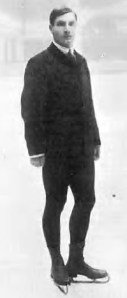
This guy invented the salchow. His name is Ulrich Salchow. What a coincidence!?!

We use the word “graceful” when we describe a dancer pirouetting or a figure skater performing a triple salchow. The word also applies to those people who suck every ounce of nutrition out of Christ’s nourishment and walk about with shimmering cascades of grace spilling over the tops of their heads. I know a few such people. You can tell them apart because they leave little puddles of grace behind them when they leave.

Lord, help me to remember that it is your grace with which you call me to nourish others. I can’t nourish them if I don’t allow you to nourish me. So please, fill this empty cup with the shimmering riches of Christ’s grace.

Footnotes

* Here’s a list of the technical words I used in this post:

Sursum corda: The three calls and responses at the beginning of the Eucharistic prayer, in which the congregation gives the priest the okay to go ahead and celebrate the Eucharist. The responsory nature of this prayer makes explicit that the Eucharist is a corporate event.

Epiphany: The twelfth day after Christmas, on which we celebrate the coming of the wise men to see Jesus. The coming of light into darkness and the call of the disciples are stressed during the season of Epiphany, which extends from January 6 to the day before Ash Wednesday.

Sanctus: “Sanctus” means holy and is the name for the prayer which begins “Holy, holy, holy Lord, God of power and might.” In Hebrew, there’s no way to make a word superlative (good, better, best); so, a three time repetition serves the same purpose.

Chalice: The cup we use at church. Remember that scene at the end of Indiana Jones and the Last Crusade? The room with the old knight is full of chalices. (“He chose…poorly”)

Orans position: “Orans” comes from the Latin word for “prayer” and is used when the priest is saying a prayer on behalf of the congregation. Think of a referee unethusiastically signaling touchdown and you’ve got it.

Ordination: The thing that happens to make someone who’s not a priest into a priest. The word comes from Latin and means something to the effect of “to put into order”; thus, ordination is when someone is set apart from others. There are four “orders” in the church: lay, deacon, priest, bishop — the latter three are “ordained” positions.

Unmuddying the waters (Bible study #9)

I know I’ve said this before, but it bears repeating: the hardest thing to do when studying the Bible is to read the words on the page without the baggage of tradition lending a hand. For the purposes of this Bible study, “tradition” has a lowercase “t.” (While it rhymes wimusicmanth “p,” it does not stand for “pool.”) This tradition is everything from the writings of the church fathers to the texts of songs in our hymnals. Now, I’m not saying that reading with a knowledge of tradition is a bad thing — far from it. Sometimes, however, tradition serves to muddy the scriptural waters to the point that we can no longer see our soggy selves floating around.

The opening of the second chapter of Matthew, one of the choices for this Sunday’s Gospel text, illustrates just how murky the waters can get. This is the bit where the wise men from the East come to see King Herod, and he sends them on a reconnaissance mission to find the newborn “king of the Jews.” Until a dream notifies them, the wise men are unaware of Herod’s malicious plans. They bring the infant Jesus some gifts he has no practical use for (does myrrh clear up diaper rash?) and then go home by another road.

Okay, now let’s bring in tradition. For years and years we have smooshed the beginnings of Matthew and Luke together so much that we have trouble separating them, even when reading them independently of each other. But this independent reading is so important for seeing how each evangelist is setting up his account of the Gospel of Jesus Christ. If you let the “no place in the inn” bit of the story (from Luke) fall away, you’ll notice that it certainly looks like Joseph, Mary, and Jesus live in Bethlehem — they relocate to Nazareth after their jaunt in Egypt. Indeed, the wise men come to Mary’s house, not a stable. So, while Luke uses the census to get the holy family to Bethlehem and back, Matthew uses Herod’s slaughter of the infants to get the holy family out of Bethlehem and eventually to Nazareth. But that’s not how we usually tell the story.

Now, bring in that hymn about the kings and everything gets even murkier. First, the wise men are “magi,” not “kings” — yes, these are entirely different words in Greek. Second, we have no way of knowing how many there were: we surmise three, but that’s because of the gifts. Maybe a couple went halfsies on the frankincense.

I acknowledge that using “We three kings of Orient are…” is a bit of a cheap shot, but it sure gets my point across. While these are small things that end up being mere distractions from what the text says, there are pieces of our tradition that amount to much more. Here’s one: Martin Luther’s “law/grace” dichotomy has colored readings of Paul’s letters for five hundred years. Luther’s viewpoint is so thoroughly embedded in biblical scholarship that it has taken on its own scriptural aura. But his is not the only reading.

Here’s another: one segment of Christian tradition — let’s call it the “rapture dispensationalist” segment (please read the footnote if those words are unfamiliar)* — sees the book of Revelation** as a script for what is going to happen during the “end times” (cue ominous music). This has led people (who would most likely — and ironically — call themselves “biblical literalists”) to speculate that the dragons and locusts symbolize things like atomic weapons and AK-47s. This reading of Revelation as a blueprint for the future has leaked into Christian tradition over the last two hundred years — so much so that the waters of Revelation (already murky by the difficult imagery of the text) are muddied even more by futile searches for modern analogs to biblical images. A more productive reading sees Revelation as an early Christian warning against complacency and the errors of  “the world,” a warning that transcends the time in which it was written.

Tradition helps us float in our biblical waters. But when we study the Bible, we should always take one swim unsupported by inner tubes or those floaties you wear on your upper arms. Perhaps, when we peer into that clear water, we will encounter God in new and fresh ways. Then we can add our encounters to that long story that is our Christian tradition.

Footnotes

* These are people who believe that the world will end in seven years of really gruesome carnage and destruction. Depending on which flavor of rapture dispensationalism you subscribe to, you will be brought bodily to heaven either before, in the middle of, or after these seven years.*** Again, depending on your flavor, Jesus comes back at some point in this time frame as well. As you can probably tell from this explanation, I am not a rapture dispensationalist.

** Please, please, please don’t say “Revelations” when you talk about this biblical text. There is just no “s” anywhere in that word.

*** A footnote inside a footnote! One term for the “middle of” way of thinking is this: “Mid-tribulation rapture dispensationalism.” See how smart you can sound with silly church words!