Books and Bible Studies

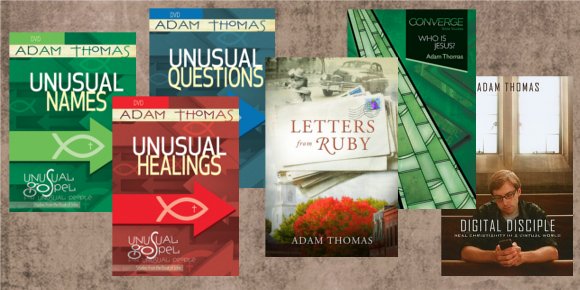
Since November 2009, I have been blessed to work with the good people at Abingdon Press to publish a variety of books and Bible studies. My first book, Digital Disciple, arrived in May 2011, and my most recent publication, Unusual Gospel for Unusual People, came out in April 2014. In between, I wrote the novel Letters from Ruby (August 2013) and contributed to the Converge series of Bible studies with Who is Jesus?

If you enjoy the content on this website and receive words of edification or encouragement from it, then I invite you to check out my published works. Here’s a quick overview of them, beginning with the most recent.

Unusual Gospel for Unusual People

UG4UP3It’s probably time for those of us who follow Jesus to realize we are once again the unusual ones in society. Sure, a majority of Americans profess a belief in God and identify as some sort of Christian, but there’s a big difference between checking “Christianity” on the census form and living your life as a follower of Jesus. People who strive to follow Jesus every day of their lives are fewer and farther between than at any point in history since the early church was still illegal. How many of us feel a bit weird talking about our faith in public? How many of us know the dialogue to old Friends episodes better than we know the stories that feed our faith? How many of us want to dedicate ourselves to Christ, but have trouble finding the time? If you’re like me, and you put yourselves in one or more of these categories, then the story you should read is this unusual Gospel of John.

The peculiar way John proclaims the good news of Jesus Christ speaks beautifully to our modern moment, especially to us unusual people. It probably hasn’t escaped your notice that it’s pretty different from Matthew, Mark, and Luke. It paints the same general picture, yes, but John uses different brushes, different techniques, and different colors than the others. There are no parables in John. Neither are there traditional healing stories nor demonic encounters nor transfiguration. The big moment in the upper room is washing the disciples’ feet, not offering them communion. Flipping over the moneychangers’ tables happens at the beginning, not the end. And Jesus never once keeps his divine identity a secret, as he does in the other three accounts. Let’s face it: John’s account of the Gospel is just plain unusual. Just like us.

Letters from Ruby

LettersfromRuby - Cover 3When the newly ordained Episcopal priest Rev. Calvin Harper arrives in Victory, West Virginia, to be the pastor at an ailing parish, he has no idea how much he still has to learn about being a priest. Thankfully, Ruby Redding takes the young man under her wing and teaches him everything she has learned throughout her long, storied life. Seminary never taught Calvin that the only true way to be a witness to God’s presence in this world is to remain in relationships with people no matter what life throws at them. His studies never taught him that detachment is the bane of ministry. He never learned that deep grief comes only from deep love. But in his first year in Victory, Calvin learns all this and more from Ruby, a woman so full of God’s light that it can’t help but spill onto the people around her.


Converge: Who is Jesus?

convergewhoisjesusHave you ever stopped to think just how much better Jesus Christ knows you than you know him? It’s a pretty staggering thought really. Not only that, Jesus knows you better than you know yourself. And although you’ll never know Jesus as well as he knows you, part of following the Son of God is getting to know him better. But you don’t want to fall into the trap of learning stuff “about” Jesus. Rather, you want to know Jesus himself. This study invites you to get to know four elements of what makes Jesus who he is: his name, his voice, his life, and his peace. In Who Is Jesus? you’ll discover that the more you know Jesus, the more Jesus will teach you who you are.

Digital Disciple
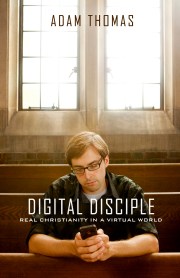
digitaldisciple-CVRThis time in our society is unlike any other. People communicate daily without ever having to speak face to face, news breaks around the world in a matter of seconds, and favorite TV shows can be viewed at our convenience. We are, simultaneously, a people of connection and isolation. As Christians, how do we view our faith and personal ministry in this culture? Adam Thomas invites you to explore this question using his unique, personal, and often humorous insight. Thomas notes, “[The Internet] has added a new dimension to our lives; we are physical, emotional, spiritual, and now virtual people. But I believe that God continues to move through every facet of our existence, and that makes us new kinds of followers. We are digital disciples.”

Titles also available at your local bookstore or online at Amazon or Barnes and Noble. (But go to your local independent bookstore if you have one, because they are awesome.)

 

The Beginning of the Beginning

(Sermon for Sunday, December 4, 2011 || Advent 2B || Mark 1:1-8 )

The Gospel writer Mark wastes no time telling us what the story he is writing is about. The very first words of his account of the Gospel proclaim without hesitation: “The beginning of the good news of Jesus Christ, the Son of God.” Whereas Matthew begins with a genealogy that links Jesus back to Abraham; whereas Luke begins with a short address about his research methodology; whereas John begins with a mysterious poem about creation, Mark just hits the ground running and never looks back. “The beginning of the good news of Jesus Christ, the Son of God.”

Now, until I started thinking about this sermon, I had always taken this verse at face value. The “beginning” that Mark is talking about is simply the launch of the story he is telling. The “good news” is the marvelous effect of the life, death, and resurrection of the main character, whose name and identity Mark helpfully provides at the end of the verse: “Jesus Christ, the Son of God.” The immediate, no frills manner, in which Mark relates the rest of the Gospel, makes this face value interpretation of the opening verse quite attractive. However, just because Mark’s narrative tends to hurtle forward from one encounter to the next, doesn’t mean that the narrative has no depth or intricacy. With that in mind, and because Advent is upon us, let’s slow down for a few minutes and really digest this first verse: “The beginning of the good news of Jesus Christ, the Son of God.”

In today’s parlance, when we hear the term “good news,” the two words are usually embedded in the sentence: “Well, I’ve got some good news and some bad news.” We’ve all used this conversational staple.

“The good news is the Patriots won their game; the bad news is so-and-so outside linebacker broke his leg and is out for the season.”

“The good news is no one was seriously hurt in the accident; the bad news is the car was totaled.”

“The good news is I found the recipe; the bad news is we’re out of eggs.”

In meetings, around kitchen tables, on the bus, we use the words “good news” to talk about the sometimes funny, sometimes bland, sometimes serious details of our lives. These two words are so ordinary, so normal. Because they sound so common, I wonder how we encounter the words “good news” when we hear them right at the beginning of Mark’s account of the Gospel. Perhaps Mark is really excited about the story he is going to tell. Perhaps Mark is employing a specific term that Jesus’ himself or his first followers used to describe his message. Either way, Mark is almost certainly doing something that we 21st century citizens would miss entirely because of our modern connotation of “good news.”

You see, in the first century Roman Empire, of which Israel was an occupied region, the term “good news” had a special connotation. The word was used exclusively for propaganda about the empire and usually about the Roman emperor himself.

“Good News: the Emperor won a victory in Gaul!”

“Good News: the Emperor’s wife has given birth to a strapping infant boy!”

“Good News: the Emperor has had another birthday!”

The Roman propaganda machine churned out these ancient press releases, and the strong arm of the military bade the cowed citizenry of occupied countries to celebrate. This was one small way that the Empire kept control of all that conquered land.

So when Jesus and later Mark proclaim their own “Good News,” they are tacitly setting their story, their message, their view of who’s really in charge squarely in the face of the Roman establishment. The “Good News,” which Jesus and his followers proclaim, is a stark challenge to ruling order of the day. Indeed, Mark shows his faith and his gutsiness in the simple act of writing those two words on the page.

Okay, file the challenge away for just a minute and let’s back up to the first two words in the verse: “The beginning of the good news of Jesus Christ, the Son of God.” The beginning. I’ll confess, until this week, I never thought there was something odd about these two words, which open Mark’s account of the Gospel. But think about them for a second: the beginning. The two words obviously start the story. They’re on page one. They would have been at the top of the scroll in Mark’s day. Why does Mark need to tell us that we are reading the beginning of the story when we are obviously reading the beginning of the story?

Perhaps Mark isn’t just stating the obvious. Perhaps this “beginning” is greater than “the opening verses of Chapter One.” Perhaps the “beginning” that Mark has in mind encompasses the entirety of his sixteen-chapter Gospel. Now we’re on to something.

If the whole, entire Gospel is the “beginning of the good news,” then the natural question becomes, “What is the middle and end of the good news?” And this is where followers of Jesus Christ down through the centuries come in. Jesus lived the beginning of the Good News. Mark, along with Matthew, Luke, and John, wrote down the story of that beginning. And you and I are characters in the middle of that same story begun two thousand years ago. You and I are players in the unfolding drama of the Good News. You and I have taken up the narrative of the Gospel that God continues to tell in our lives.

Alright, go ahead and un-file the challenge we talked about a minute ago. Remember that Mark’s usage of the term “Good News” was a gutsy, implicit challenge to the ruling order of the day. This ruling order touted their empire as the “Pax Romana,” the “peace of Rome.” Of course, this “peace” was accomplished through conquest, coercion, occupation, and fear. But Jesus Christ replaced this so-called “peace” with a peace of his own invention. Jesus’ own Good News, his own triumph was accomplished through welcome, healing, sacrifice, and love.

Of course, when these two versions of “peace” clashed, the broken, imperial establishment utterly crushed Jesus. However, by not fighting back, by sacrificing himself to halt the cycle of violence, Jesus succeeded in his challenge, even though he died. But even then, the story was just beginning. With his resurrection, Jesus demonstrated that his version of the Good News is truly the Good one. As characters who have now appeared later in this same narrative, we have the opportunity to take up the same challenge that Jesus and Mark after him championed. The Pax Romana of our day rules through apathy, self-centeredness, greed, and (as then) fear. But when find ourselves in the middle of the story begun in the Gospel, we find the strength and courage to combat those evils with Jesus’ own arsenal of welcome, healing, sacrifice, and love.

Now, I’ll end this sermon with some good news and some bad news. Which do you want first? The bad news. Sure. The bad news is there is still so much brokenness in this world, so many places where God’s Kingdom seems so far away. The good news is that with God’s help, we can challenge the ruling order of our day and bring the wholeness of the Kingdom to those broken places. The good news is that we are the current characters in the story begun in the Gospel. The good news is that the story isn’t over yet.


A Gospel Medley

Several people who’ve heard me sing this live have asked for a recording, so here it is. And I’m including the lyrics because parts of it (especially the Peter Gabriel section) are a bit difficult to follow. If you want to play it yourself, let me know, and I’ll send you the lead sheet. I hope you enjoy it!

(Oh, btw, I’m working on a second Gospel Medley. If you think of a song I could use for a piece of the Gospel, let me know. Right now, I just have Bryan Adams for the call of the disciples.)

(To download, right-click picture and choose “Save Link As…”)

The Nativity (Journey, “Don’t Stop Believin'”)
Just a virgin girl when the angel said to her,
“You will bear the Son of God.” She said, “Here am I.”
Just a carpenter of David’s line from Bethlehem;
He took her for his wife (the angel told him to).
So Caesar made the census rule
Telling all to go back home
In a stable Mary bears her babe
He’s the Son, the Son, the Son, the Son.

Shepherds grazing up and down the countryside
The wise men searching in the night
Starlight, angels singing ‘bout the Incarnation
Shining on this holy night

Don’t stop believing
Remember it’s with God you’re dealing
Peace to people

– – –

John the Baptizer (John Mellencamp, “Jack and Diane”)
A little ditty about John the Baptist
Whose favorite dinner was honeyed locusts
John, he’s saying, “I’m just the voice crying out:
Prepare the way of the Lord, that’s what I’m talking ‘bout.” (Sayin’)
Oh yeah, it won’t be long:
the kingdom has come near, repent your wrongs
Oh yeah, it won’t be long:
He is coming soon, I can’t tie his sandals’ thong (now walk on)

– – –

The Feeding of the 5000 (The Proclaimers, “I’m Gonna Be (500 Miles)”)
Jesus looks up, and he knows he’s gonna feed,
He’s gonna feed the people coming to see him.
The disciples, they all say they’re gonna need
They’re gonna need denarii to feed them all.

But I see there five loaves of bread
And I see there two tiny fish
I will bless this food to feed five thousand people
So sit down in the grass
Gotta lot now! Gotta lot now!
Gotta lot of scraps of bread leftover now!

– – –

Peter’s Confession and the Transfiguration (John Parr, “Man in Motion (St. Elmo’s Fire)”)
Jesus asks, “Who do you disciples say has come?”
Peter says, “You’re the Son of God, the Chosen One.”
God revealed this to you, not some fleshly search
So I name you Rock, now go build my church.

Then they climb the highest mountain, underneath the starry sky
And they witness Jesus’ changing, whiter and whiter
Gonna build some tabernacles, but then a cloud descends:
“This is my beloved Son, listen to him”

– – –

The Last Supper (John Denver, “Leaving on a Jet Plane”)
All my friends are here in this upper room.
Their feet are clean, now my Passion looms:
Here’s a four long chapter speech to say goodbye.
See this bread I’m breakin’, it’s a special loaf,
The wine you’re drinkin’ is my blood’s merlot.
Let’s share this meal before I’m brought to die.

So take, eat: you’re sharing me.
Drink this to remember me.
Hear my words ‘cause soon I’ll have to go.
I’ll be dying on the cross soon,
But know that I’ll be back again
Oh, friends, I hate to go…

– – –

The Crucifixion (Peter Gabriel, “In Your Eyes”)
On his head’s placed a crown of thorns;
The temple veil will soon be torn.
Without a noise, without his pride, he reaches out to his bride.

They crucify: the blood, the sweat
His mouth is dry from thirstiness.
Eli, Eli, Have you forsaken
Me to die? You’ll be with me in
Paradise. Oh God forgive them.
Then he cries: I commend my Spirit.
I see the blood and the sweat, oh, but it’s not over quite yet.
Just come on down this Sunday, meet you there at sunrise.

– – –

The Resurrection (U2, “Beautiful Day”)
They go to the tomb, on the first day of the week
But there’s no stone, so Mary takes a peak
She’s out of luck, and the reason that she had to care
Was apparently snuck away when they were unawares
But she knows she’s found a friend when the gardener says her name.
And then Jesus sends her saying, “My return proclaim.”

On this Easter Sunday, the grave falls and you know
On this Easter Sunday, death’s sting is wiped away
On this Easter Sunday…

Touch me, put your finger in my side
When I leave, my Holy Spirit will abide

It’ll be Pentecost Day, tongues of fire, you know
On that Pentecost Day, the Church is here to stay
On that Pentecost Day…

Seeing gasoline rainbows

The following post appeared Tuesday, February 2nd on Episcopalcafe.com, a website to which I am a monthly contributor. Check it out here or read it below.

* * *

Sometimes, I am too young to hear Jesus’ words in the Gospel. Or too old. Or too naïve. Or too refined. Often I wonder if God is holding a particular set of words in reserve for a particular time in my life — when I need those words I will finally hear them. Or perhaps I already have, and they have settled into the bedrock of my faith.

The words of Jesus are beautiful and dynamic. They grow in depth of meaning as I grow in depth of experience, emotion, and faith. Many of Jesus’ words mean something new to the disciples after the resurrection because the disciples are different after the resurrection. Likewise, the words of Jesus are the same, the chapters and verses are the same, but I am different every time I read them. In the novel, The Catcher in the Rye, Holden Caulfield says a similar thing about the natural history museum:

The best thing, though, in that museum was that everything always stayed right where it was. Nobody’d move. You could go there a hundred thousand times, and that Eskimo would still be just finishing catching those two fish, the birds would still be on their way south, the deers would still be drinking out of that water hole…Nobody’d be different. The only thing that would be different would be you. Not that you’d be so much older or anything. It wouldn’t be that, exactly. You’d just be different, that’s all. You’d have an overcoat on this time…Or you’d heard your mother and father having a terrific fight in the bathroom. Or you’d just passed by one of those puddles in the street with gasoline rainbows in them. I mean you’d be different in some way – I can’t explain what I mean.

Both small differences in me from day to day and large changes in me from year to year can affect my reading of scripture and my encountering the words of Jesus. The climactic change in the lives of the disciples was the resurrection; for me, the changes tend to be small, the differences subtle. But a new encounter with Christ can erupt from even the smallest change, the subtlest difference. When I open myself up to seeing gasoline rainbows, when I realize I am different than I was before, I discover the power of the words of Christ working within me.

In a recent bout of nostalgia, I read some of my old writings and found that I had discussed the same verses on three occasions. After he washes the disciples’ feet, Jesus says, “I give you a new commandment, that you love one another. Just as I have loved you, you also should love one another. By this everyone will know that you are my disciples, if you have love for one another” (John 13:34-35). The words were the same each time, but I was different. Here’s what I mean.

It’s May 9, 2004, and Easter season blooms on the domain of Sewanee. I’m a junior in college. I’m two or three steps into the exhaustive process towards ordination. Classes are drawing to an end; exams are approaching. With flagging energy, I am writing lectionary-based reflections on xanga.com (before people ever used the word “blog”). And Jesus’ words encounter me:

“Wow. [Jesus] could not have put it more succinctly, or more beautifully. It does not take mighty acts or wondrous miracles to show people that we are followers of Christ. Just love. But I would argue that love is a mighty act, it is a miracle. Loving with the love Christ taught us – the only true love – is more powerful than anything. […] When we love with the love Christ taught us, we bring Christ to others. This love is powerful, transformative, life-changing, irresistible. Paul tells in his letter to the Romans that nothing can separate us from it. And it is our duty, and it should be our joy, to spread this love to others.”

It’s March 7, 2005, and fog rolls into the domain along with Lent. I’m a senior in college. I’m a postulant for Holy Orders, and I’m waiting for my bishop’s decision about sending me to seminary next school year. I’ve broken John’s Gospel into forty passages, one reflection per day for my Lenten discipline. And Jesus’ same words encounter me again:

“This is at the heart of what it means to be a Christian – to love one another as Christ loves us. We are capable of love because God loves us. Indeed, Paul tells us, ‘God is love.’ So how do we love? I think that is an impossible question to answer succinctly. In a past reflection, I called love the ‘conscious or unconscious search for God in other creatures.’ Searching for God means searching for all that is good, right, true, and graceful about another. However, this does not mean looking past all the other stuff. When we love truly, we see the good and the bad and continue to be in relationship. Contact (spiritual, emotional, &c.) is essential for love – only by staying in contact with God and others can we feel the love that purges our iniquities from us.”

It’s March 20, 2008, and Maundy Thursday comes impossibly early this year. I’m a senior in seminary. I’m a new deacon in the church, and I’m preaching at my field education parish. But the flu keelhauls me for five days, the middle of which is Palm Sunday. Being ill is all I can think about, and Jesus’ words encounter me a third time through that illness.

“Life is only worth living when it can be shared with others. This sharing is another word for love. And love shatters the illusion of self-sufficiency. When the flu knocked me out, my friends served me. I had no choice but to let them serve me because I could not serve myself. And I am better for it. They showed their love for me by bringing me medicine and food. In their act of loving service, they washed my feet. I have a share with them, and we all have a share with Jesus Christ. We are his disciples because we have love for one another. There is no such thing as self-sufficiency. An inability to accept the service of others masquerades as self-sufficiency. But this masquerade is a dismal half-life. Christ came that we may have life, and have it in abundance. Washing each other’s feet, serving one another, and loving each other with the love of God brings this full, abundant life in Christ.”

It’s January 26, 2010, and I’m seeing through the eyes of my old selves. On each day when I read those verses from the Gospel according to John, Jesus encountered me with the same words. And each time, Jesus used my gasoline rainbows to transform me into a new vessel for those words. Over the years, the same words have helped me change into the new person I am continually becoming.

I invite you to look for the gasoline rainbows in your life. You are a new person since you last picked up the Bible. How are you different from the last time you read a particular passage of scripture? What is new about you? How have Jesus’ words made you new? What are your gasoline rainbows?

Proclaiming the mystery: John’s first five

The following post appeared Saturday, August 22nd on Episcopalcafe.com, a website to which I am now a monthly contributor. Check it out here or read it below.

* * *

The mystery section was on the back wall of the small independent bookshop at which I worked my last few years of high school. When a customer entered the store, her eyes would glance past the smaller shelving units and fix on the placards proudly bearing the word “MYSTERY.” The shelves containing the mystery section were taller and broader than those holding the other books, and I was the only employee tall enough to dust the top ones without a stepladder. Let’s just say that the manager loved mysteries, so we had a disproportionate number of them. We had humorous mysteries and thrillers, beach reads and stay-up-till-one-in-the-morning nail biters. In those books, a mystery was set forth: say, how did the killer manage to murder someone in a room locked from the inside? The plot revolved around the detective attempting to solve the puzzle. In the end, the detective figured out that the bell rope used to call for the maid was replaced with a poisonous snake, which somehow slithered unnoticed out of the room in the ensuing hubbub of discovering the body. Mystery solved. No more mystery.

The Gospel according to John begins with a mystery, but it is a mystery that is wholly different from the Whodunnits? on the back wall of the bookshop. The mystery that begins the Gospel cannot be solved, cannot be explained away. It can only be unapologetically presented and then unabashedly proclaimed.

rainbowTake a look at the first five verses that John gives us:In the beginning was the Word, and the Word was with God, and the Word was God. He was in the beginning with God. All things came into being through him, and without him, not one thing came into being. What has come into being in him was life, and the life was the light of all people. The light shines in the darkness, and the darkness did not overcome it. (1:1-5; NRSV)

Here John presents the mystery: somehow the Word (who we find out a few verses later becomes enfleshed in Jesus Christ) is in the beginning with God and is also God. Remember in Algebra class when you had to show your work to get full credit? Well, John skips down to the bottom of the page. There is no balancing of equations or solving for “x.” He states the mystery simply: in the beginning, the Word was with God and was God. This is frustrating at first because I’m conditioned to think that mysteries are all supposed to be like the ones on the back wall of the bookshop. I want to know how it’s possible and I won’t be satisfied until I figure it out and if I can’t figure it out then it must not be true.

But I take a deep breath and look at the words again. I read them slowly and speak them aloud. I notice that the rational part of me is sitting in the corner sulking because “with” and “was” should be mutually exclusive. But I find that the creative part of me sees past such mundane things as mutual exclusivity and begins to roll around in the muck of ambiguity. I squelch my toes in the mud, relishing the notion that God lives in a reality where choosing between alternatives is not the only viable option. Of course the Word can be both with God and was God! The limits of my language do not limit God, only my understanding of God. I realize my language skills are not up to the challenge of describing God. And my rational side joins my creative side in the muck of ambiguity because my rationality has been given the license to imagine.

In a few short phrases, John presents the mystery. Then, he deepens the mystery by retelling the story of creation. It’s no coincidence that John uses the same phrase that opens the book of Genesis: “In the beginning.” All things came into being through the Word who was with God and was God. My creative side connects with these verses because they are about creation. Life is created through him, and because I have been given the gift of creativity, I can sense in my gut or in my bones that the Creator is continuing to create me.

This creative force is the light that shines in the darkness. The darkness cannot comprehend or overcome or understand the light because the darkness has never been a part of creation. The darkness is just the absence of any created thing. It tries jealously to unmake created things but fails to triumph since God never stops creating or calling creation to God.*

In these first five verses, John locates us (“life,” “all people”) within the mystery of God and creation, and he presents the adversary of creation, namely darkness. We have the makings of an epic story here.** The seemingly out-of-place verses 6-8 help me realize my role in this story. The mystery has been presented, and now John the Baptizer steps onstage for a brief scene. He is a witness who testifies to the light. (The words “witness” and “testify” are from the same root in Greek; the English word “martyr” comes from it.) His proclamation points to the light, which is the Word made flesh, Jesus Christ. So too, my life, which has come into being through the Word, is meant to be a proclamation of the mystery of God and God’s movement in creation.

When I encounter these first few verses of the Fourth Gospel, I feel the enormity of the mystery of God surrounding me, and I rejoice that this mystery discloses itself in light and life and love. If I could explain the mystery, I would be in danger of explaining it away, of shelving it like the Whodunnits? on the back wall. The mystery transcends explanation. It is elusive, and at the same time intimate; it cannot be grasped, but it can be embraced. The intimacy and the embrace happen when the mystery touches the spark of creativity within me, spurring me to proclaim the Word made flesh, Jesus Christ. Life has come into being through the Word. And my life expands to every pocket and corner of my being when I live to proclaim this good news.

Footnotes

* My apologies for hurling this paragraph at you with no further comment. If it confused you at all, blame Karl Barth.

** I am using the word “story” to convey something that is important enough to be told and retold down through the centuries, something that is about God and about us and is a tale that is never quite finished being woven. Please do not take my use of the word in the sense of “it’s only a story.”

Viral papyri (Bible study #10)

In the middle of the second century, a guy named Marcion took his Bible and tore out most of the Gospel according to Luke and some of Paul’s letters. He stapled these together and chucked the rest in the dumpster. Marcion had decided that the “god” who created the world was evil because the world sure wasn’t doing him any favors. The other god, the real “God,” was Lord of the “spirit world,” totally alien from our world, except for that thing about sending his son here. The trouble was, that’s not what the Bible said. So, Marcion, with a stockpile of misplaced entrepreneurial zeal, made up a new one.

Well…that’s not actually what happened. You see, the “New Testament” as we now have it wasn’t compiled yet. Christians and various derivative groups had been writing letters and gospels and stories and strange things called “apocalypses” for a hundred years. Some circulated widely, like the ancient equivalent of viral YouTube videos. Others stayed put in the community which produced them. Some were attributed to Jesus’ apostles or their associates. Others were written by that guy with the hair and the thing. Some espoused doctrine that both created and helped support the emerging theological position of the “Church.” Others claimed “secret knowledge,” known only to the few who could get into the metaphysical country club.

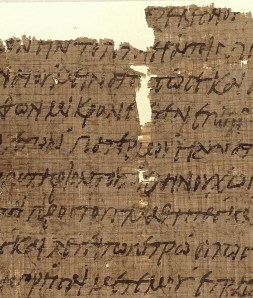
papyrusThe viral papyri attributed to an associate of Jesus and espousing sound theological views eventually became what we now call the “New Testament.” The other stuff — the classified documents, location-specific texts, and the ones written by that guy — predictably faded into obscurity.*

Okay, let’s go back to Marcion. Since there was no list (or “canon”) of authoritative texts, Marcion felt entitled to make one up that suited his own viewpoints. When he threw the Hebrew Scriptures and many of the viral papyri into the rubbish bin, the leaders of the Church said something to the effect of, “Hey, you can’t do that!” And Marcion shot back, “Too bad, suckers.”

At that point, those leaders decided that a list of their own would probably be a good idea. But, things moved slowly in the ancient world, so the top 27 texts were not finalized until the end of the fourth century (and even then, there was still some dispute between the Eastern and Western churches). But, I get ahead of myself. Let’s back up a bit.

With Marcion’s heresy forcing the Church to respond with its own canon of authoritative texts, scholars began compiling lists. Certain texts were shoe-ins. First and foremost, the Hebrew Scriptures (which became known as the “Old” Testament) were never in question because these texts were the Bible for the people who wrote the rest of the Bible. Second, the letters of Paul (the most virulent of all the viral papyri) and the three synoptic gospels, Matthew, Mark, and Luke, along with the Acts of the Apostles (which is sort of the Godfather II of Luke’s Gospel). The Gospel of John was on the bubble at times because some of the heretical groups loved it. But, it made the cut partly because its “high Christology” helped the Church’s position on the divinity of Christ.

Over time, the New Testament canon solidified with 27 texts.** The four accounts of the Gospel came first, as they narrated the reason why the rest of the texts exist. Then the Acts of the Apostles propels the canon into the letters of Paul (strangely enough, appearing in descending order by length). After Paul, Hebrews begins the section of various texts addressed to a wider audience (the “catholic” epistles). Appropriately, the Revelation to John ends the canon.

The compilation of the New Testament from viral papyri to authoritative text speaks to us today of the value of various viewpoints within a larger structure. Unlike Marcion, who depleted the message until it said only what he wanted it to say, the 27 canonical texts present myriad experiences that coalesce into the great message of the love and grace of God. From an early time, the Church valued several different expressions of the Gospel of Jesus Christ because it realized that one text could not contain such overwhelming truth and beauty. What is striking about the compilation of the canon is that the Church exhibited pretty startling ecumenism over a long period of time as the churches from both far-flung places and major cities shared their experience of the God made flesh in Jesus Christ.

I wonder when we Christians decided to stop valuing the experience of our fellows. The viral papyri tell a different story. Would that we could live that story again.

Footnotes

* Well, until a sensationalist media program digs up a “gnostic gospel” and decides that “everything we know about Christianity is about to change.” Honestly, give it a rest. That story lost the lead to the Battle of the Milvian Bridge.

** In the mid-1700s, an Italian named Ludovico Antonio Muratori stumbled upon an ancient fragment stuck in a book in a library in Milan. The “Muratorian fragment,” which could be dated anywhere from the second to the fourth centuries is the oldest extant list of the texts of the New Testament. What’s most interesting about the fragment is the short justifications it gives for why certain texts were either chosen or not.

My Pavlovian response to the word “evangelical”

There’s a good chance I’m about to get incredibly soap-boxy, but I’m going to try my best to fight that tendency.

Do you remember the WABAC (“way-back”) machine on The Rocky and Bullwinkle Show? You know, the segment with the professorial dog and the red-headed kid who asked inane questions. If I could join Peabody and Sherman for a jaunt in their time machine, I would go back to the very hour that the word “evangelical” started being synonymous with “conservative” and attempt to stop the connection. I would fail, of course, like the guy in the movie version of The Time Machine who tries to save his wife’s life because of the temporal paradox. (i.e. If I succeed peabodyand sever the connection between “evangelical” and “conservative” I’d never have to go back in time to make the attempt, thus the words would be connected, thus I’d go back in time and sever them, thus I’d not need to go back in time…you get the point. I’ve said it before — Harry Potter and the Prisoner of Azkaban is the only book I’ve ever read with a truly well-reasoned time travel plot.)

Okay, I apologize for that stunning example of my ability to digress. I could delete it, but then I’d have no reason to use the picture of Sherman and Peabody. Let’s begin again.

You know how some people say “taxi,” some say “cab” and some say “taxi-cab,” but they all mean those yellow cars that you have to pay to ride in? The same thing has happened with the words “evangelical” and “conservative.” The media combine these two words in various permutations when discussing moral, ethical, or religious issues, and they bank on quickly instilling in your mind the vague image of a bellowing reactionary picketing an abortion clinic with a sign that says “Jesus hates gays.” Some media outlets do this so you will know to disagree with such “evangelicals”; others do it so you’ll know to agree. I’m not sure about you, but the image of the sign-wielding picketer has reached Pavlovian proportions in my mind. The fact that the image is a caricatured worst-case scenario is lost on a population conditioned to react strongly (one way or the other) to the word “evangelical.”

The current connotations of the word “evangelical” could not be further from what the word once meant. Peabody and Sherman could jump into the WABAC machine and travel to Mark’s house in about the year 65 and find the word in the fresh ink of the first line of Mark’s account of the Gospel. “The beginning of the euangelion of Jesus Christ.” Euangelion — one etymological hop and a few millennia brings us to “Evangelical.” Do you see the word “angel” in the middle there? That’s the Greek word for news or message. And the “ev-” at the beginning used to be “eu-” as in “eulogy” (good word/speech) or “[e]utopia” (good place/land).  This beautiful word — this word that has been co-opted, dragged through the mud of bigotry, and associated with narrow-mindedness and hate — used to mean “good news.”

The beginning of the good news of Jesus Christ. Not “The beginning of the reactionary bigotry of Jesus Christ.” Not “The beginning of the messy-ideology-of-hate of Jesus Christ.” Good News. Gospel.

I want the word “evangelical” back. I wish I could call myself an “evangelical” without being handed a “Jesus hates gays” sign in someone else’s mind. Of course, I am not saying that everyone who self-identifies as an “evangelical” hates gay people or thinks Harry Potter is the most inherently evil thing since evolution. These are facile characterizations that discount the good that “evangelicals” do in the world. But, as I see it, there is a latent schizophrenia in the “evangelical movement” that leads to simultaneous digging of wells in African villages and campaigning for Prop 8. Mix in the media’s fostering of the image of the sign-wielding picketer and the blustering of certain conservative demagogues, and the rebranding of “evangelical” is complete.

I have no illusion that the word “evangelical” will ever mean what it once did.  Words are collections of sounds and signs by which we signify objects, thoughts, and feelings, and these significations can change over time. Did you know that “happy” used to mean “lucky?” Juliet’s line “O happy dagger” (as in “O lucky weapon that I happened to find lying next to me”) makes more sense that way, right?

But this is a cautionary tale. If “evangelical” can take on such a twisted meaning, what’s next?

Notes

* You may wonder what spurred me to write this today. Well, to be honest, I’m a little bummed that Barack Obama picked Rick Warren to do the invocation at the inauguration. (I know that The Purpose Driven Life has sold millions of copies and helped a lot of people. But I can get on board with very little that Warren preaches or stands for.) Because of this announcement, the word “evangelical” has been on the news about 917 since yesterday.

** I edited out several very snarky pieces of this entry before publishing it. I still think I got too soap-boxy, but what can ya do?

Twenty questions (Bible study #8)

In the last Bible study, I talked about reading the Bible out loud as a way to focus our interpretive endeavor. When we read aloud, we are forced to make interpretive choices that silent reading misses. This is especially true when reading dialogue. In the Gospel, narrators set scenes, but most of the important information is conveyed through characters’ interactions with one another. The evangelists* present these interactions in various ways, but each uses dialogue as the main vehicle of communication.

When you study the Gospel, pay attention to how the writers structure their dialogue. What is said? What is not said? What are the speaker’s preconceived notions? What are his motivations? What is her background?

Here’s one example. Every time someone calls Jesus “teacher” in the Gospel according to Matthew, that someone is not on Jesus’ side. They are scribes and Pharisees and people asking Jesus questions to test him. On the flip side, Jesus’ disciples and those asking for healing always call Jesus “Lord.” In this way, Matthew shows that the former group doesn’t get that there is so much more going on than an eccentric teacher wandering around spouting eccentric ideas. While “teacher” is not necessarily pejorative, Matthew uses it to show Jesus’ opponents attempting to stifle the rumors of his messiah-ship. With this simple comparison of title, Matthew communicates the struggle for influence between the establishment and Jesus’ disciples.

Matthew does all that with two little words: “teacher” and “Lord.” Across the Gospel, there is very little extraneous information, so we rarely get an explicit statement of a character’s mood or bearing. Besides Mark’s use of “immediately,” adverbs are in short supply in the Gospel. The dramatic force of characters’ interactions is driven by the dialogue itself; this dialogue is charged with intent, meaning, and suggestion, so descriptors are distracting at worst and ancillary at best. Read through all four accounts of the Gospel, and I bet you could count the number of times someone’s mood is described on one hand. (Check John 11 for a couple).

The narrators do not need to intrude into conversations because the evangelists are pretty darn good writers. How would it be if the text said: The woman said flirtatiously, “How can you get that living water?” Jesus, feigning ignorance of her advance, responded dispassionately, “You drink of this water…”

I know. Not the best writing ever. Rather than infesting their conversations with adverbs, good writers develop dialogue that suggests what I stated explicitly in the above example. Here’s how John writes the conversation: The woman said to him, “Sir, you have no bucket, and the well is deep. Where do you get that living water? Are you greater than our ancestor Jacob, who gave us the well, and with his sons and his flocks drank from it?” Jesus said to her, “Everyone who drinks of this water will be thirsty again, but those who drink of the water that I will give them will never be thirsty. (John 4:11-14)

Of course, I’m making an interpretive choice when I read flirtation into this conversation, but John’s dialogue leads me there. Pay attention to what the characters in the Gospel say and don’t say, especially the ubiquitous dialogical motif of a speaker failing to answer the question that is asked.

Try this one on for size. At the beginning of the Gospel according to John, some priests and Levites come to question John. They ask him: “Who are you?” Here’s what he doesn’t say: “I’m John from over yonder a bit. My parents are Zechariah and Elizabeth. I’m the crazy guy who eats locusts and wild honey and wears uncomfortable shirts.” Instead, he says, “I am not the Messiah.”** Now, correct me if I’m wrong, but this does not even come close to answering their question. If sobreadboxmeone came up to me and said, “Who are you,” then responding, “Well, I’m not a toaster oven,” doesn’t really narrow it down.

But John and the Levites keep playing twenty questions: “Are you Elijah?” I am not. “Are you the prophet? Nope. Obviously, because of John’s recent activity, both he and the Levites know that this little game is about more than who John is. If it were that simple, my answer about uncomfortable shirts would have been enough. They want to know what his significance is in the history of the salvation of Israel. With this in mind, his leap to downplaying rumors of messianism makes more sense. Rather than asking him if he’s larger than a breadbox, they try a new version of their original question: “What do you have to say about yourself?” And again, John doesn’t answer their question. He speaks not about himself but about the one to whom he points: “I am the voice of one crying out in the wilderness, ‘Make straight the way of the Lord.’ ” Even here, when they ask him a direct question about himself, John points to Jesus.

By structuring a conversation in which John answers different questions than the ones asked, the evangelist offers us insight into both parties. Watch out for this kind of conversation in the Gospel (especially John’s account).

Okay, I’m approaching a thousand words about this topic, so I think I’ll stop soon. When you read the conversations in the Bible, be sensitive to how the writers put the words together. Focus on the dialogue and let it speak to you. And know that Jesus is not just talking to the woman at the well or the crowd beneath the mount. He is speaking to you and to me.

Footnotes

* This is a handy shorthand for Matthew, Mark, Luke, and John, the authorities behind the four canonical accounts of the Gospel.

** Actually, according to the narrator, “He confessed and did not deny it, but confessed…” This is one of those odd places where the narrator does inject description into conversation. But it’s so rare that these few words take up lots of pages in commentaries.