Sermon for Sunday, May 11, 2025 || Easter 4C || Psalm 23
Today, on this beautiful Sunday morning in springtime, when plants are growing and animals are having babies, we’re going to talk about…death. Now, as you can probably tell, I am not dead. So I have no special information to impart to you about what happens after we die. I have only my hope in the resurrection, that the essence of who God created us to be embraces new and abundant life in a way that we cannot even imagine in the midst of our physical existence. I have only this hope in the resurrection and my faith in the promise that Jesus makes to prepare a place for us and bring us to himself, so that where Christ is, we may also be.
During my sabbatical, I’m not writing new sermons, so on Mondays I am choosing one post from every year of WheretheWind.com to highlight. In 2023, my church was in the midst of an unprecedented number of deaths and funerals in the parish. This sermon was a response to that reality and is now one of the most often viewed posts on this website.
Sermon for Sunday, January 29, 2023 || Epiphany 4A
On this day of our Annual Meeting, I’d like to spend this sermon time fulfilling a request from a number of people over the last few months. Today, I am going to share with you some of the elements of the funeral homilies I have preached over the last year. Because funerals are mostly attended by family and close friends, very few of the members of our church have heard me preach at a funeral. And yet we are all grieving in one way or another the deaths of so many of our church family – 23 of whom we have buried in the last year. A funeral homily is my chance to set the life (and new life) of the person who died within the greater context of the resurrection of Jesus Christ. So today, on this day of our annual gathering, we are going to remember those who have died, and I am going to share with you some thoughts on heaven and the eternal love of God.
Sermon for Sunday, September 13, 2020 || Proper 19A || Romans 14:1-12
Today’s sermon is a meditation. In a minute, I’m going to invite you to find a relaxing sitting position, which will be easier on your couch than if you were here sitting on a hard pew. I decided to offer a meditation today because recently I’ve been feeling my jaw clenching more and more. Sleep isn’t restful. I’m on edge all the time. I’d wager you are responding to the abnormally high level of stress in our society in similar ways. A friend of mine has a newborn in the NICU whom he says is there because he has to “remember to breathe.” I think that goes for all of us right now.
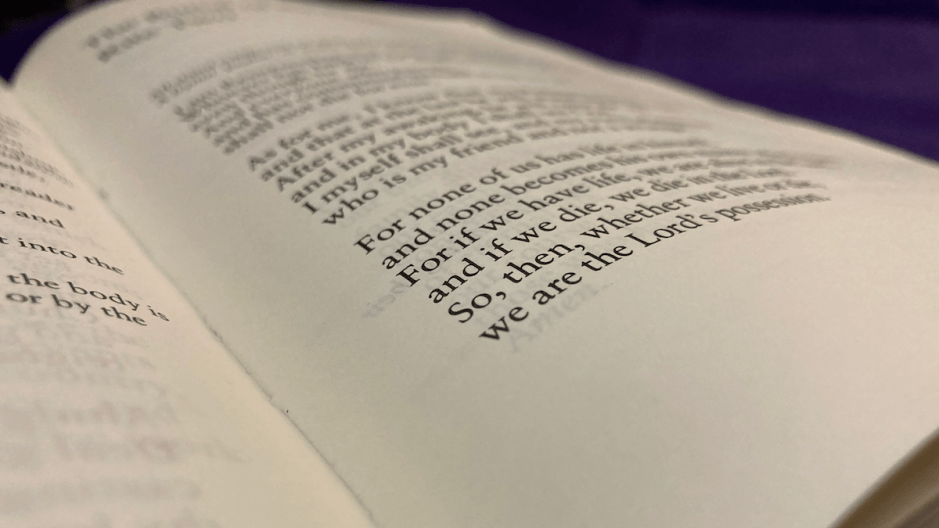
So, in lieu of my regularly scheduled sermon, I’d like to lead us all through a meditation designed to bring our ultimate future into this present moment. This is a meditation about God’s presence and promise when death is an ever-present reality. I’m offering it because today’s reading from Paul’s letter to the Romans includes a paragraph that we read as the third stanza of the opening anthem at the beginning of every Episcopal funeral. All four stanzas are quotations from scripture, and I’d like to meditate on them with you this morning. This might seem like a strange thing to do – focus on words spoken after someone has died. But these words are shared with those who remain, and I believe these scriptural truths actually help to bring us more fully alive.
I offered the following reflection on St. Mark’s All Souls Day services on November 2, 2019.I wrote most of it several years ago and have used pieces of it here and there, but I have not published the entire reflection until now.
During the next few minutes, I would like to share with you four images. I invite you to imagine these images as I describe them. Each one illustrates a facet of the impact of grief on our lives, something that grief does for us, something that grief is. Perhaps you will resonate with one or more of these images. Perhaps, the four that I describe will spur you to discern your own image for grief. I hope you will, because grief is an intensely personal thing, which makes it one of the hardest things to share. By trying to describe grief, we can give ourselves some language with which to talk about it, and thus find, in some small, yet meaningful ways, the ability to share it with others.
One of the great honors of my profession as an ordained pastor is the opportunity to preside at funerals. As a matter of fact, we had one here yesterday for longtime parishioner Bill Everett. Some funerals carry the weight of incredible sorrow; others buzz with palpable celebration. Most hold both sorrow and celebration in tandem, as the two are not enemies but rather both are sincere expressions of love. As I prepare for a funeral, and especially as I write the homily, I find my thoughts drawn to the eternal nature of the love of God, which God made tangible and so very present in the resurrection of Jesus Christ.
Last Sunday, June 23, 2019, my paternal grandmother Dorothy died. She had spent two weeks in the loving and tender care of Hospice following a massive stroke. She was 93-years-old, which was, truth be told, a bit on the young side for her long-lived family. I was in the Holy Land during most of her time in Hospice, and thanks to the wonder of the internet, a FaceTime call put me in the room with her from halfway across the world. My father said that she visibly brightened when she heard my voice, though by that point she could not talk. She could barely squeeze a hand. I lit a candle for her in the “upper room” in the Old City, a peaceful place that beckoned prayer. The tears I shed for her watered the dusty ground of Jerusalem. Continue reading “Sabbatical Notes, Week 10: A Remembrance”→
Sermon for Sunday, April 2, 2017 || Lent 5A || John 11:1-45
“Lord, if you had been here, my brother would not have died.” So say both Martha and her sister Mary when they meet Jesus outside Bethany. They must have been saying this over and over again to each other in the four days since Lazarus’s death: “If the Teacher had been here, things would be different. If Jesus had come when we first wrote to him. If, if, if…”
Two weeks ago, one of our ten Handy Guidelines told us that how a line of dialogue is spoken is a matter of interpretation. So how do the two grieving sisters deliver this line? Is it an accusation? [angrily] “Lord, if you had been here, my brother would not have died.” Is it wistful? [sadly] “Lord, if you had been here, my brother would not have died.” Or is it faithful? [lovingly] “Lord, if you had been here, my brother would not have died.”
Probably a little bit of each one, all rolled together in that roiling mass of anger and sadness and love that we call “grief.” No matter how Martha and Mary speak this statement, my question is this: is it true? Would Lazarus still be alive if Jesus had been there?Continue reading “If You Had Been Here”→
Sermon for Sunday, March 13, 2016 || Lent 5C || John 12:1-11
Imagine with me a letter written by Lazarus, the friend whom Jesus brought back to life after four days in the tomb.
To my dear sisters, Martha and Mary, by the hand of a trusted friend:
I have written and re-written this letter in my mind, and still any words I hope to scratch here will pale in comparison to the anguish I have in my heart for you. I love you both. My spirit wilts to contemplate putting you through grief yet again. You already passed from grief to joy, as I passed from death to life. But I fear we will reverse this cycle again before long.
Indeed, if you are reading this letter, then I have died once again: not from illness this time, but from malice. I am writing this to help you understand what has happened, and I’m sorry if my thoughts seem like fragments. Fragments are all I have right now. After dinner tonight, Jesus confirmed the fear that has been growing in my mind. His words shattered the innocence I wrapped myself in since coming out of the tomb.
He drew me aside after his confrontation with Judas. I could smell the perfume you anointed him with, Mary. I will remember that scent for the rest of my days. I will remember, too, his eyes set on mine, full of love and agitation. “Beloved,” he said, “I’m sorry.”
I didn’t know what to say. What did he have to apologize to me for?
“I’m sorry for what may be coming soon. I’m sorry that you may suffer on my account. I’m sorry I drew you into all this.”
He looked to be on the verge of tears. “Into what, Lord?” I asked.
“I brought you back from death, only to make you a target for death again. There are powers in Jerusalem who seek my life, and now they seek your life as well. These crowds that come to hear me—they also come to see you, to see with their own eyes proof of the words I speak. And now those who seek to kill me have added you to their list.”
I had sensed this—in the roving eyes of some in the crowd, in the growing sense of foreboding in my gut—but hearing it from Jesus’ own mouth made it real. I hadn’t named the fear I was feeling. I had feigned innocence, hoping that ignoring reality would change it. But Jesus’ words set reality in front of my eyes, and I could not turn away.
Will I die tomorrow? Will I be stoned in a public square or dispatched by an assassin’s blade? Will there be blood? Will it hurt? My sisters, I know you are reading this after I’m gone, so these thoughts must seem wild and misplaced in such a letter. But I beg you: keep reading, for I have not said all.
He kept his eyes on me as I took in his words. I didn’t know whether to run away or to weep on his shoulder. I felt faint. I looked around for something solid to lean on. The walls and chairs looked flimsy somehow. So I reached out and steadied myself on his arm. Finally, words came. “Why did you restore my life if I’m just going to be murdered weeks later?”
“Lazarus,” he said, “I wish I could spare you the prying eyes that have hounded you since that day. I wish I could spare you the pain that may be ahead of you. I cannot. But I can tell you this…”
Dear sisters, coming from any other person, what he said next would have rung pitifully hollow, but the light in Jesus’ eyes held the promise that his words are truth. “I came that you may have life,” he said, “and have it in abundance. This life that I give, beloved, is more than just your ability to move or think or breathe. This life includes those things, just as it includes pain and grief. But ever so much more, this life includes those wonderful gifts from God that reach into eternity: love and joy and grace and justice and peace. You are mine, and I have taught you how to love others as I love you. You are mine, and I make your joy complete. You are mine, and I offer the grace to strive for justice and peace everyday, no matter how many days are left to you.”
I was captivated. I looked him in the eye, and again that light of truth danced behind brimming tears that now began to trace silent streams down his face. “I shed tears now,” he said, “knowing that you may suffer for my sake. But I shed them also for the joy of knowing that such suffering cannot diminish the life I give you. Yes, you will die again. Do not let that keep you from living. And yes, you will live again after you die. Do not let that keep you from living now, either.”
His words washed over me, like clear water from a living spring. I drank them in, and they filled me. The life that he gives is more than life. The life that he gives is more than death. It does not begin when I die, nor did it begin when he brought me from the tomb. His life endures, for I am his whether I live or whether I die.
Dear sisters, while I pray to be spared from pain and suffering, I am not afraid of death. I am afraid that I do not have the strength to live as one who has this abundant life that reaches into eternity. I am afraid that I will live as though I were dead again.
But Jesus chose his words well the day he brought me back to life. Yes, he knew my fears even before I did. Do you remember what he said that day? I do, and those words are imprinted on me like the smell of tonight’s perfume. “Lazarus, come out.” He never spoke a word of resuscitation, never said, “I raise you from the dead.” He just commanded me to leave the tomb. And the gift of life came back to me in order to obey this command.
So until the day I pass through the gate of death again – and I sense it will be soon – Jesus’ command to stay out of the tomb still rules my life. This life he has given me – given each of us – reaches into eternity, so whatever ways we show forth his love now are burnished with the sheen of heaven. Whatever ways we show forth his love now will last long after we are gone, will ripple out to touch more lives than we can possibly imagine.
Mary, Martha: if you are reading this, I have died again. But know that my death will not stop the abundant life that Jesus revealed to me when I was still with you. Do not wait for death to begin your abundant, eternal life. It is yours now. Laugh and dance and sing and serve and love. And rejoice that Jesus continues to give you—and me—the gift of himself, the gift of abundant life that reaches into eternity.
(Sermon for Sunday, October 2, 2011 || Proper 22A || Philippians 3:4b-14)
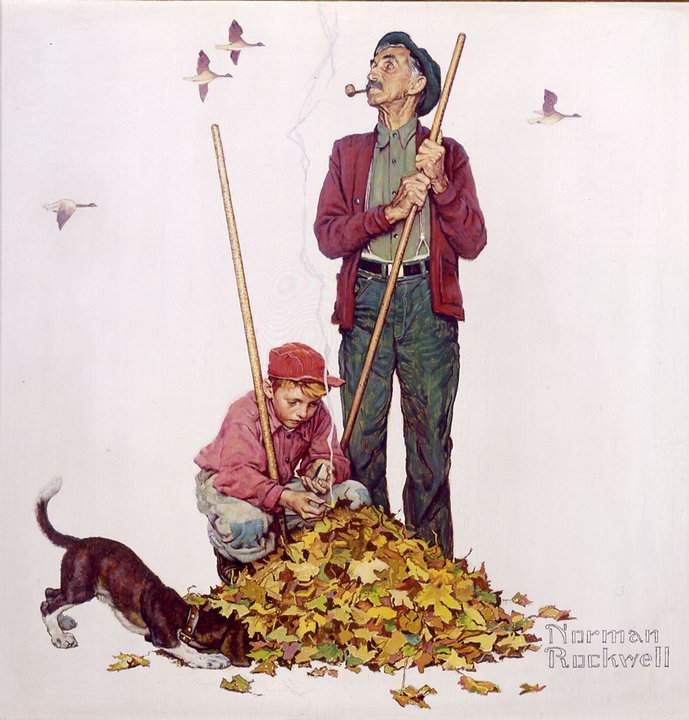
My grandfather, Roy Thomas, went into hospice twelve days ago, after several difficult weeks in the hospital. Less than twenty-four hours later, he passed away due to complications from being alive for more than nine decades. I awoke to the phone ringing at quarter to six in the morning, and I knew before answering what the news would be. Now, my grandfather and I were never close. There are no pictures of him teaching me how to fly fish or taking me to the ballgame or riding a tractor with me perched on his lap. There was never a Norman Rockwell moment in our relationship. He sent me a card each birthday, and I saw him every other year, give or take.
So, when I broke down weeping in my office a few hours after I received the call from my father, I was taken completely by surprise. Where were those tears coming from? How could the loss of someone, with whom I had but a passing relationship, hit me so hard in my gut? These were the questions I was asking myself as I wiped the tears away. I felt a bit silly, crying so uncontrollably when I was sure I was just fine, thank you very much. But perhaps, more fitting questions ask exactly the opposite. How could I be surprised that I felt such tear-stained grief over the loss of my own grandfather, no matter the state of our connection? How could I possibly think that the loss of a member of my own family wouldn’t hit me so hard in my gut?
The concept of “loss” is tricky thing. The overriding fact of earthly life is that one day – perhaps not today or tomorrow, but one day – we will lose our earthly lives. Everyone dies. There are no exceptions. We have thousands upon thousands of years of data backing up this reality. And yet, we train ourselves to ignore this overriding fact. We assume that death is something that happens to other people – fuzzy, nebulous people on the news and in the obituaries. Not the people we love. Not the people close to us.
But then a relative develops an aggressive cancer. Or a friend flips his SUV. Or a grandparent goes into hospice. And the illusion that loss only happens to other people shatters. The overriding fact that earthly life always ends sneaks up and surprises us, even though this fact is enmeshed in the very fabric of existence.
And death isn’t the only kind of loss we encounter. We confront loss on a daily basis, and still we have tremendous difficulty dealing. There is the loss of autonomy when others make decisions for us. There is the loss of relationships when we part ways with those who have made impacts on our lives. There is the loss of material possessions, the loss of health, the loss of trust, the loss of baseball games (sorry, fellow Sox fans). There is even the loss of loss, which is the grief that happens in response to you realizing that you are no longer grieving.
With loss surrounding us all the time, you’d think we’d have developed ways to deal that didn’t include various forms of denial and willful ignorance. But more often than not, we ignore the potential for loss until the loss is right in front of us hitting us in the gut.
And this willful ignorance is what made me read today’s lesson from Paul’s letter to the Philippians over and over again. Paul writes: “Yet whatever gains I had, these I have come to regard as loss because of Christ. More than that, I regard everything as loss because of the surpassing value of knowing Christ Jesus my Lord. For [Christ’s] sake I have suffered the loss of all things.”
Somehow, Paul’s relationship with Jesus Christ has allowed Paul to confront the reality of loss head on, well before any sort of loss has a chance to sneak up and surprise him. How does Paul do this? Let’s take a look. Can we do the same? Yes, I think we can.
According to Philippians, Paul values knowing Christ Jesus above all else. Nothing even comes close. The value of being in relationship with Jesus surpasses everything. And because knowing Jesus is so incalculably valuable, everything else in Paul’s life seems utterly insignificant. The gulf between what was important before meeting Christ and what is important now that he has met Christ is so wide that Paul can barely see the stuff of his old life shrinking in the distance.
And, therefore, he regards everything as loss. Based on Paul’s own words and my interpretation of them a moment ago, we might come away with the impression that nothing besides being in relationship with Christ should matter, that we should ignore everything that isn’t Jesus. This is the interpretation favored by hermits and ascetics that got away from everything to focus on God. However, I’m not convinced that that’s what Paul had in mind. We must keep going, because so far we’ve only gotten through the first half of Paul’s discussion.
Because Paul values his relationship with Christ above all else, he no longer attempts to cling to the rest of his life. He lets go of everything – his relationships, his possessions, his fears, his illusions. But all of this that Paul regards as loss is not lost. Paul does not cast everything into the void. Rather, he gives everything away to Christ. He gives everything to Jesus, and in doing so, Paul finds that everything he has regarded as loss was always God’s in the first place. Even Paul himself.
Paul relates this comforting reality to the Philippians: “Not that I have already obtained [the resurrection] or have already reached the goal; but I press on to make it my own, because Christ Jesus has made me his own.” Christ Jesus has made me his own. These words are the crux of Paul’s ability to deal with loss. The surpassing value of knowing Christ compels Paul to give everything up to Jesus and thus find himself at a loss. But in the act of giving away everything to Jesus, Paul discovers that Jesus has taken even more. Jesus has taken Paul. Jesus has made Paul his own, along with all that stuff that Paul gave him.
And Christ has made us his own, as well. When we enter into relationship with Christ, the surpassing value of that relationship makes everything else seem entirely insignificant. This seeming insignificance allows us to release our stranglehold on everything that we have been putting in place of a relationship with Christ. And when we release our grip and give away everything to Christ, we will find that Christ has already obtained us in the bargain.
Because Christ Jesus has made us his own, he has empowered us to give to him everything and everyone that we possibly could lose before the loss sneaks up and surprises us. Does this make grieving un-Christian? Of course not. Rather, our grief is one of the things that Christ invites us to give over, so that God might enfold us in our hour of need.
When my grandfather passed away eleven days ago, I was not prepared for the sense of loss that would hit me. Perhaps, this profound loss of someone I didn’t even realize I was clinging to has opened my eyes to truth that I still have plenty to give away to Christ. I would hazard to bet that we all continue to cling to things that have never really been ours to cling to. The good news is this: Any loss, any gain, any grief, any joy, any challenge, any victory is ours to share with Jesus Christ because Christ has made us his own.






 Where the Wind...