
Homily for Maundy Thursday || April 17, 2014 || John 13
 Imagine with me the Apostle Peter at night in his prison cell in Rome near the end of his life.
It all happened so long ago. Thirty years or more now. And yet sometimes – like tonight – I wake up in the cold wee hours of the morning gasping for air because my dreams drag me back to that week. One moment, I’m being suffocated by the crowds pressing in on me, buffeting me, shouting for blood. The next I awake in my prison cell, take in great swallows of stale air.
My cellmate – another follower rounded up here in Rome like I was – he says, “You were shouting in your sleep again.”
“What was I shouting?” I ask, though I already know the answer.
“Something like, ‘I don’t know who you’re talking about,’ ” he says.
Yes, of course. The same old dream. I always wake up when the rooster crows.
Why can’t I dream of the happier times? Lugging the huge catch of fish onto the beach. Talking with Jesus around the campfire. Sharing a meal with him in our hideout in Jerusalem.
“Perhaps you still feel guilty,” my cellmate says. “We’ve all heard the story: how you denied you knew Jesus when he needed you most.”
“But Jesus forgave me,” I say. “I told him I loved him. He gave me a mission to feed his sheep. He knew I couldn’t live with myself, so he told me to live for him instead…And I have…”
My voice trails off. I used to give this defense with more fire.
“He might have forgiven you.” My cellmate again. “But have you truly accepted his forgiveness? Have you ever forgiven yourself?”
I want to say, “yes.” I want this fellow in my cell to know that I am one of Jesus’ most fervent followers, that I remember everything he ever taught, that I apply it constantly to my life. But it’s all a lie. A front I put on so others will be encouraged. If they knew the doubts that assail my hearts, they’d be less eager to follow, I tell myself. I do follow, but…fervently?
His question lingers in the stale air: “Have you ever forgiven yourself?” I want to say, “yes,” but something about the dank prison cell drags the truth out of me instead. Must be the hardness of the floor, the right angles of the walls, the smoothness of the stones. In Rome, even the prison cells are plumb. “No,” I say. The word rebounds off the wall. The echo indicts me.
Silence replaces the echo, and we listen to each other breathing in the dark. “I’d always heard you were stubborn, Peter,” says my cellmate. “But that forgiveness. That love of his. It was a free gift. You didn’t need to earn it. Your denial didn’t make you unworthy of it. Do you not see that?”
A recent convert, this one. I can always tell by their zeal. This one is mouthier than most.
He presses on. “It’s the footwashing all over again.”
“The what?”
“The night before Jesus went to his death on the cross. We’ve all heard that story, too. Jesus knew he was going to God and so he wanted to show you all the importance of service. Of love. The fact that service and love are really the same thing. So he took off his robe, got down on his knees, and washed the feet of his friends.”
“I remember. I was there.”
“But…but when he got to your feet, you didn’t want them washed. You didn’t feel worthy of that either.”
This I have to answer. “He just looked so small,” I say. “Crawling on his knees, pushing the wash basin before him. It felt so wrong for him to humble himself like that for my sake. His humility made me feel even more unworthy.”
More silence. Again, the truth tumbles out.
“It still does.”
And what does my cellmate do? He starts to sing:
“Being found in human form,
he humbled himself
and became obedient to the point of death–
even death on a cross.
“I heard that the day I was arrested,” he says. “We sang it at a gathering.”
“So?”
“It says Jesus humbled himself and became obedient. Don’t you see, Peter? How can I, who is so new to the Way, be the one to teach you this, you who have the keys to the kingdom? Humility and obedience go together.”
I shift on my cot. I don’t want to hear this, but his voice has taken on a new tone, one I remember Jesus using: excitement and insight mixing together to form revelation. I sit up and feel the hairs raise on the back of my neck.
“When he washed your feet he demonstrated humble service. And what did he do next?”
“He told us to love each other.”
“No. He commanded you to love each other. It wasn’t a request. Jesus gave you a direct order, a new commandment. To obey you had to love. To show love you had to serve humbly. To serve humbly you had to obey – to listen deeply for his call and act on it. I found my church – my new family – because I watched them loving each other, serving each other, and I knew I wanted to be part of that. I wanted to follow Jesus’ commandment.”
“And yet here you are, in prison with me.”
“I believe I’m exactly where I’m supposed to be, doing exactly what I’m supposed to do.”
“And what exactly is that?”
He takes a deep breath. “Helping Peter find a new dream.”
I grunt my derision, but the memory of the rooster crowing still hovers behind my eyes. I’m listening, in spite of myself.
“Look,” he presses. “You can dismiss everything I say as the ravings of convert’s zeal. But just because I’m new doesn’t mean I’m wrong. Those words you said in fear that night still haunt you. Let them go. Tell me now. Say it aloud. Say you know him.”
His words awaken the same ones in me. I open my mouth. My voice catches in my throat. But I force them out. “I do know the man.”
“Say it again.”
“I do know him.”
“Where is he?”
“He’s here in this cell. I hear him speaking through you.”
“What is he commanding?”
“He wants me to let go, to let his forgiveness wash me clean, to release my stubbornness and pride, to hear and obey.”
“ To hear and obey. To love and serve in humility?”
“That is his command. Loving and serving. The command and the gift, both at the same time.”
He reaches across the divide between our cots and grasps my hand. I can feel his blood pulsing. And for the first time in God knows how long, I feel the fire blaze in me again. He squeezes my hand and holds it fast. “Peter, my friend, there’s your new dream.”
 If you’ve spent any length of time in the Episcopal Church, you know the sermon comes after the Gospel reading. But because of the nature of our Gospel reading today, I hope you will allow me to flip that convention around. The Passion Gospel we will read in a few moments has the lyric substance of an epic poem; the depth of one of the works of a Russian master – Dostoyevsky, say; and the emotional weight of the entire book of Psalms: all in the space of an average magazine article. So rather than preaching after we listen to the performance of this momentous work of faith and story-telling, I thought I’d talk with you now, before we listen. I plan, in the next few minutes, to give you something of a listening guide: a few keys to listening faithfully, and a few things to listen for.
 The prayers have all been prayed. The farewells to the deceased have all been said. The dirt has been cast on the shining, glossy coffin. The low murmur of voices mingles with the whisper of the wind through the long, cemetery grass. The new widow rises from the velvet-covered folding chair, the triangle of the blue field and white stars of the American flag peeking out from under her arm. A line of black-clad people forms, and they begin to file past her. You watch her receive with grace each well-meant, but well-worn sentiment. You join the line, and soon it’s your turn. You grasp her hand in both of yours and wait for the words to come.
 “Let me see some I.D.”
 Last week I talked about the fact that we crave certainty, but in this life we will never achieve it. Jesus knows this, and so he offers us something even better than certainty. He offers us the gift of himself. Today, I’d like to talk about that gift. I’d like to talk especially about what we think we need in order to accept such a gift. Specifically, I’d like to talk about four things we think we need and the one thing we actually need. We’ll use Jesus’ wonderful conversation with the Samaritan woman to explore these things we think we need to accept the gift of Jesus.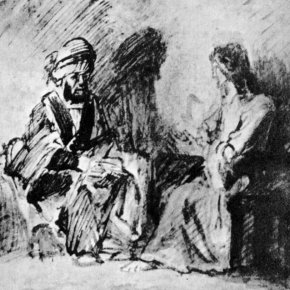
 Full disclosure: the chapter of the Gospel I just read to you easily makes my Top 5 list of favorite passages of scripture. Nicodemus is my favorite recurring character in the entire Bible. Even the name of my website – wherethewind.com – has its roots in this chapter. I love John 3; I’ve read these words many hundreds of times over the years. I barely needed to look at the Gospel book while reading just now, because these words have carved out a space within me. I know them by heart. I knew what they said before I even sat down to work on this sermon. I was certain of their content; just as certain of their content as Nicodemus is of his knowledge at the outset of his conversation with Jesus.
 We consume about a quarter of the world’s energy, and yet we make up only one twentieth of the world’s population. Several of our most popular ways to die involve over-consumption of food or drink or drugs. I mean, have you seen how they deliver French fries at the restaurant Five Guys? They fill a cup with a fairly generous, but not outrageous, serving and then dump three or four more scoops into your bag! Who could possibly eat all those fries?
 “At last Aragorn stirred. ‘Gandalf!’ he said. ‘Beyond all hope you return to us in our need! What veil was over my sight?”
 “Be perfect, therefore, as your heavenly Father is perfect.” Sounds like a tall order, doesn’t it? Sounds like naïve idealism at worst and hopeless hyperbole at best. Sounds like one more command of Jesus that we could never live up to. I mean, it’s hard enough turning the other cheek and walking the extra mile and loving our enemies, but now he wants us to be perfect on top of all of that? Doesn’t he understand that to be perfect there could never have been a time when one wasn’t already perfect? Doesn’t he understand that one cannot become perfect? Either you are or you’re not…and we’re…not.
 When I was a little kid, I wanted to grow up to be a fireman. Well, a fireman and a garbage man. Well, a fireman, a garbage man, and a baseball player. Well, a fireman, a garbage man, a baseball player, and a paleontologist. I wanted to be a baseball playing, dinosaur-fossil finding, fire fighting trash collector. And you know what? That didn’t happen. Something even better happened. I got to be someone whose job it is to walk with people during the most important moments of their lives and point out God’s movement in those moments. I got to be a priest. And I got to be your priest.
 Where the Wind...