
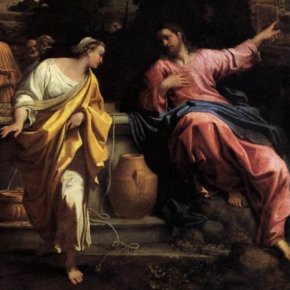
Sermon for Sunday, March 23, 2014 || Lent 3A || John 4:5-42
 Last week I talked about the fact that we crave certainty, but in this life we will never achieve it. Jesus knows this, and so he offers us something even better than certainty. He offers us the gift of himself. Today, I’d like to talk about that gift. I’d like to talk especially about what we think we need in order to accept such a gift. Specifically, I’d like to talk about four things we think we need and the one thing we actually need. We’ll use Jesus’ wonderful conversation with the Samaritan woman to explore these things we think we need to accept the gift of Jesus.
“If you knew the gift of God,” Jesus says to the woman, “and who it is who is saying to you, ‘Give me a drink,’ you would have asked him, and he would have given you living water.” This gift is Jesus himself, the Son God gave to the world – and not just the world, but all of creation – because of God’s great love. In our story today, the gift of Jesus manifests in his offer of this mysterious living water, water that gushes up to eternal life. This same gift of Jesus manifests in our lives in myriad ways, some mysterious, some plain, all powerful and life-changing.
But too often we do not accept the gift because we don’t think the gift is for us. We don’t have the right social status. Or we lack the understanding. Or we don’t worship in the right ways. Or, most often, we just don’t feel worthy of the gift. In our story today, the Samaritan woman exhibits each of these four reasons not to accept the gift God freely gives us out of love. She exhibits each one, but another force trumps all. Simply put, she is willing to accept Jesus’ gift. “Give me this water,” she says. In effect: “Help me accept the gift of God in my life.”
Let’s look at each of these four and see how they keep us from accepting the gifts Jesus showers upon us like springs of living water. First we have social status. “Jesus, tired out by his journey, was sitting by the well,” John tells us. “It was about noon.” Noon, you say? With the hot sun beating down? Why not come to draw water in the cool of the morning or evening? That’s when most of the women would be out. But not ours. She comes to the well at noonday. Presumably, the other women have cast her out of their circle. She comes to the well alone during the heat of the day. And there she finds the Savior of the World.
How often have we let social status blind us to the gifts of God? Maybe we thought ourselves too lowly or we didn’t feel put together. We didn’t have the right clothes for church. Or we didn’t have anything to put in the offering plate. More often than not, however, it’s not our own social status, but our dismissal of the status of others that blinds us to God’s gifts. We look down our noses. We judge on first impression. We turn away. And we fail to notice the gift of God wrapped in that other person.
And yet Jesus approaches the Samaritan woman – a social outcast, not to mention a person from another culture – and he offers her the gift of himself. And she is willing. All she needs is willingness. “Give me this water,” she says. “Help me accept the gift of God in my life.”
The conversation continues. Jesus leads her down the path from the mundane into the metaphorical and past the metaphorical into the mystical. And yet her mind stays on the level of actual, physical, wet water. When Jesus offers her his living water, she expects never to have to come back to the well for honest-to-goodness H2O. She doesn’t understand the mysteries he’s sharing. But she knows she wants to share in those mysteries. She wants to share in his life, despite her lack of understanding.
How often have we let our need to understand blind us to the gifts of God? We thought we needed to have everything figured out. We confused understanding with belief, though the two are not the same thing. We didn’t take the plunge into the life of faith because God was just so unfathomable.
And yet Jesus ushers the Samaritan woman, who sure doesn’t get everything he’s talking about, and he offers her the gift of himself. And she is willing. All she needs is willingness. “Give me this water,” she says. “Help me accept the gift of God in my life.”
Next comes the hot button issue of Jesus’ day. Is the right place to worship on Mount Gerezim in Samaria or in Jerusalem? We might call this a question of “orthodoxy.” How often have we let our fervent desire to worship in the right ways blind us to the gifts of God? Don’t get me wrong: worshiping God is a wonderful thing, something that God calls forth from us. But when we get so caught up in the practice and rules of what right worshiping looks like, we can lose sight of the subject of that worship. In effect, we begin worshiping the act of worship.
The Samaritan woman brings up this topic, and Jesus gently pushes it aside. In its place he gives her the gift of himself when he tells her, “I am” the messiah. And when he offers this gift she is willing. All she needs is willingness. “Give me this water,” she says. “Help me accept the gift of God in my life.”
Finally, the elephant in the room: our own self-worth. Does the Samaritan woman shade the truth when Jesus asks about her husband because she’s embarrassed – or worse, ashamed – of her marital past? Does she think Jesus will run away from her if he knew the man she’s now living with is not her husband? What about coming to the well at noon? How much of a hit does her sense of worthiness take if she’s been made an outcast in her own town?
And what of our own self-worth? The biggest mistake we make when we refuse to accept God’s gifts is thinking we need to be worthy of them. Of course we aren’t worthy of them! They come from God, the creator of all that is, the Lord of heaven and earth. We will never be worthy of our gifts. But that’s not the point. The point is that God showers gifts upon us anyway.
Jesus offers the gift of himself to the Samaritan woman – his own living water, gushing up to eternal life. Her sense of worthiness. Her confusion about worship. Her lack of understanding. Her outcast social status. These are traps that could hold her back from accepting such a gift. But – thanks be to God – they do not hold her back. Despite everything arrayed against her, she is willing to accept the gift Jesus offers her, the gift of himself.
All she needs is willingness. All we need is willingness: the momentary, yet momentous, courage to say “yes” to God. I invite you now in this moment or this day or this week or this year or even sometime during this lifetime or the next to allow God to free you from everything that keeps you from saying, “Yes.” And when that moment comes, dip your hands into the bucket, feel the fresh moisture cool your fingertips, and say to Jesus: “Give me this water. Help me accept the gift of God in my life.”
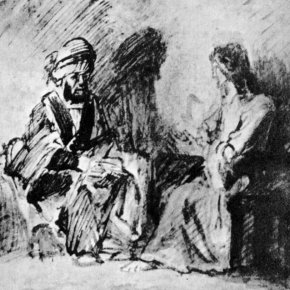
 Full disclosure: the chapter of the Gospel I just read to you easily makes my Top 5 list of favorite passages of scripture. Nicodemus is my favorite recurring character in the entire Bible. Even the name of my website – wherethewind.com – has its roots in this chapter. I love John 3; I’ve read these words many hundreds of times over the years. I barely needed to look at the Gospel book while reading just now, because these words have carved out a space within me. I know them by heart. I knew what they said before I even sat down to work on this sermon. I was certain of their content; just as certain of their content as Nicodemus is of his knowledge at the outset of his conversation with Jesus.
 We consume about a quarter of the world’s energy, and yet we make up only one twentieth of the world’s population. Several of our most popular ways to die involve over-consumption of food or drink or drugs. I mean, have you seen how they deliver French fries at the restaurant Five Guys? They fill a cup with a fairly generous, but not outrageous, serving and then dump three or four more scoops into your bag! Who could possibly eat all those fries?
 “At last Aragorn stirred. ‘Gandalf!’ he said. ‘Beyond all hope you return to us in our need! What veil was over my sight?”
 “Be perfect, therefore, as your heavenly Father is perfect.” Sounds like a tall order, doesn’t it? Sounds like naïve idealism at worst and hopeless hyperbole at best. Sounds like one more command of Jesus that we could never live up to. I mean, it’s hard enough turning the other cheek and walking the extra mile and loving our enemies, but now he wants us to be perfect on top of all of that? Doesn’t he understand that to be perfect there could never have been a time when one wasn’t already perfect? Doesn’t he understand that one cannot become perfect? Either you are or you’re not…and we’re…not.
 When I was a little kid, I wanted to grow up to be a fireman. Well, a fireman and a garbage man. Well, a fireman, a garbage man, and a baseball player. Well, a fireman, a garbage man, a baseball player, and a paleontologist. I wanted to be a baseball playing, dinosaur-fossil finding, fire fighting trash collector. And you know what? That didn’t happen. Something even better happened. I got to be someone whose job it is to walk with people during the most important moments of their lives and point out God’s movement in those moments. I got to be a priest. And I got to be your priest.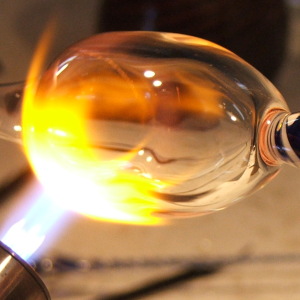
 So – did you know you are made of glass? It’s true! Now, of course, I don’t mean that you’re made of glass in the idiomatic way; it’s not that you’re easily offended or that your baseball career was cut short because you have a “glass arm.” Nor do I mean made from actual glass that once was sand.
 This past Thursday morning, Leah and I awakened early to watch the sun rise over the water. We sat on our bed in the house on Groton Long Point looking east, away over the tip of Fishers Island as the velvet dark blue of night softened, as the dawn fire kindled on the horizon, as the stars faded from view – all except one stubborn star up and to the right. With each passing minute the glorious scene displayed before us took on more and more depth and color and vibrancy. The skeletal trees stood out in silhouette, their branches arcing in all directions. The waterfront houses transformed from indistinct rectangles to homes with windows, shutters, and weathered shingles. And the water – the water caught the nascent light, which gilded the crest of each small wave, turning the water from blue to gold and shimmering brighter every minute.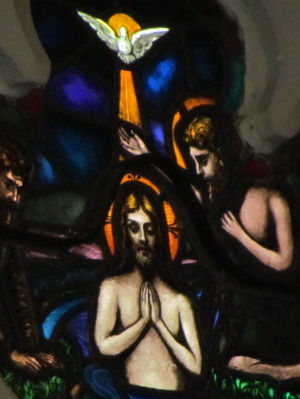
 Since this is my last sermon, it seems only fitting that today I’ll be talking about a beginning. In a few minutes, we will reorient our worship to the south side of the church. We will stand around that behemoth stone basin over there. (As an aside, I have no idea how our font didn’t sink the ship that carried if here from England all those centuries ago.) Anyway, we will stand around the stone basin, say prayers over the water, and baptize little Kaylee. But before we do, let’s have a quick session of Christianity 101: An Introduction to Baptism. It seems only fitting to do this on a day when we will witness a baptism and when we’ve just read about Jesus’ own baptism by John in the River Jordan.
 At the end of the season of the church year that we begin today, we find ourselves standing on the mountain with Peter, James, and John. Countless stars shine in the deep blue sky above, and we find ourselves staring up at those stars in wonder and awe. But then a new light – one that outshines the stars themselves – grows in front of us. It’s so bright that we can barely look at it, yet it commands our vision. Jesus is at the center of the light. It’s not shining on him, but forth from him. He is the light. As we gaze at him, a thought stirs in our guts: this is what Jesus looks like all the time. But in this moment, we are given the gift of seeing him as God sees him: as a luminous being that outshines the sun. We are given the gift of revelation, a sudden and surprising knowledge that we can attribute only to God. We are given the gift of epiphany.
 Where the Wind...