A Still More Excellent Way

Sermon for Sunday, January 31, 2016 || Epiphany 4C || 1 Corinthians 13:1-13
AStillMoreExcellentWayWe’ve all heard those words from the Apostle Paul a hundred times. “Love is patient. Love is kind.” I read them at my sister’s wedding. Perhaps you had them read at your own. Statistically speaking, if you go to a wedding there’s a better than average chance you’ll hear First Corinthians 13. Now, it is true beautiful chapter can stand apart as an ancient ode to love. But when we sequester these verses to the marital service alone, we miss how Paul uses them in the greater context of his letter. We miss how love is the corrective for the issues facing the church in Corinth. We miss what love is for. So let’s put these famous words back in context, and with a little help from Harry Potter, we’ll remember a thing or two about love.

First, I’m glad we get to read these words outside the wedding. Of course, with the snow last week, not many of us got to hear Paul’s words leading up to this chapter. So here’s a quick recap: the Corinthians are having a problem welcoming all people into their community. Apparently they have been sorting people out into greater and lesser classes depending on their material wealth, social circumstance, and (this is the one that gets Paul really worked up) their spiritual giftedness. “We need all types of people and all sorts of gifts to make the Body of Christ function,” he argues. “We are all part of the one Body and don’t you ever dare say someone else doesn’t belong because that person doesn’t share your particular set of gifts or your elevated social status.”

Paul punctuates his point by asking a series of rhetorical questions at the end of Chapter 12. “Are all apostles? Are all prophets? Are all teachers? Do all work miracles? Do all possess gifts of healing? Do all speak in tongues? Do all interpret? But strive for the greater gifts.”

And next we have the verse that links the two chapters beautifully, which the framers of our reading schedule left out. “But strive for the greater gifts. And I will show you a still more excellent way. If I speak in the tongues of mortals and of angels, but do not have love, I am a noisy gong or a clanging cymbal.” The still more excellent way is the way of love. Love is the antidote for the Corinthian disease, the symptoms of which include “welcoming only those who are like me” and “judging others solely by how they might be of use.” The first symptom limits our welcome to the least diverse group possible and siloes us off from any point of view that might expand our own. The second symptom discounts the value of persons who contribute to the community in ways that are not readily apparent. As the medicine for this Corinthian disease, Paul prescribes love.

But Paul isn’t sure the Corinthians have any idea what love is, so he instructs them. The still more excellent way begins with a recognition that love is the motivator of all God’s gifts. If I have all the spiritual gifts listed in the surrounding chapters – speaking in tongues, prophesying, understanding mysteries, possessing mountain-moving faith – but do not act in love, then it’s all worthless. Without love, I do everything for myself alone. I seek pleasure at the expense of others. I self-aggrandize. Eventually, I die deserted and embittered. But with love motivating action, our gifts do not enrich ourselves alone. With love, our gifts enrich everyone we encounter. Love is the powerful weaving force that stitches our actions into the tapestry of God’s story. Acting without love, we unravel the tapestry; we pull ourselves out until our individual threads are just wafting in the wind. A single piece of thread doesn’t tell a story until it’s woven together with other threads. The desire to be woven together is better known as love.

With this desire expressed, Paul moves on to what love does. Our translation messes this up. It should not read, “Love is patient; love is kind.” The original language involves much more action: “Love shows patience; love shows kindness.” The old song goes, “They will know we are Christians by our love, by our love. Yes, they will know we are Christians by our love.” But how will this nameless “they” know our love? There is only one way, and it springs from the only piece of advice an aspiring writer ever really needs: Three little words: “Show, don’t tell.”

If we have to tell people, “No, seriously, we are a loving community,” you can bet dollars to donuts that we aren’t. But if love is the desire to woven together, then we show love when we start weaving: you learn someone’s name and remember it. You ask, “Want to have coffee on Tuesday?” You look past the red doors of this place and notice the threads of God’s movement running in all directions, towards all people. And you begin to realize that this church is not bounded by these walls and doors; this church is unbounded because the Body of Christ goes forth from this place to show love in every place. You bear witness to the love of Jesus in your homes, in your businesses, the ball field, the gym, the grocery store, the street corner, the Internet. (Especially the Internet! Please show the love of Jesus online. The digital world is in dire need of the healing power of love. Just look at YouTube comment sections.)

I know it may sound tired or quaint to be preaching about love. Indeed, when Albus Dumbledore tells Harry Potter that Harry’s greatest gift is love, Harry just rolls his eyes. He would much rather be gifted with more talent or better intellect or greater weapons to contend with the dark wizard Voldemort. But no. In the end, Harry is stripped of all the trappings of talent and privilege and pride. He has only the love for and of his friends and family – both living and dead – to give him the courage to face his foe. To die. And then to live. (Sounds like another story I’ve heard somewhere.)

For Harry (and for Jesus) love is the true motivator. Not pride or glory. Not fame or fortune. Love: the desire to be woven together. For an orphan like Harry, this desire first manifests in finding a loving home with the Weasleys. And it last appears when he sacrifices himself to save everyone he loves. To quote Jesus, “No one has greater love than this, to lay down one’s life for one’s friends” (John 15:13). Jesus and Harry and, say, the heroic soldier who dives on a grenade literally laid down their lives. Perhaps we might be called to this someday, but it will only happen once. In the meantime, we can show great love by laying down our threads on the loom of God’s tapestry, side by side with each other and everyone else whom God loves.

The still more excellent way is the way of love, this weaving power that heals and reconciles creation. True love will never be tired. True love will never be quaint. True love will never end. Because God’s tapestry has no borders, only edges for more thread to be woven in.

Art: Screenshot from the Harry Potter and the Deathly Hallows (Part 2), when Harry meets Dumbledore at Kings Cross Station after being killed by Voldemort.

Mothers and Sons

Sermon for Sunday, January 17, 2016 || Epiphany 2C || John 2:1-11

mothersandsonsI love my mother with all my heart. For thirty-three years and five days, she has never wavered in her steadfast love for me, support of me, and delight in me. She delivered me in the middle of a Maine snowstorm; she endured through my advanced childhood self-centeredness; and she never let her own demons keep her from being my nurturer, advocate, mentor, and friend. I get my love of reading from her. I get my precociousness from her. And I get my ability to be quiet and listen from her. When I had my first ever bona fide moment with God, it was my mother who held me and rocked me – her seventeen-year-old baby boy – while I bawled my eyes out, overwhelmed by the immensity and clarity of it all.
As I said, I love my mother with all my heart. I’m saying this aloud today for two reasons. The first is to say “thank you” to my mother, who will be reading this tomorrow, I have no doubt. If she were here right now, I’d give her a big hug, and my chin would rest snugly on top of her head. The second reason is to locate myself on the continuum of relationships between mothers and sons. I am an unabashed “momma’s boy,” and proud of it. I would never think to call my mother by her first name, Edna. It just wouldn’t feel right. And while I now tend to call her “Amma” (her chosen grandmother name), I will always cherish the way my heart feels when I address her as “Mom.”

So when I read the story of the wedding in Cana of Galilee, I tend to focus on the relationship between Jesus and his mother. If you were paying attention, you might have noticed that the Gospel writer does not name her. She is not called “Mary” in this story. She is simply known as “the mother of Jesus.” In her only other appearance in the Gospel of John – at the foot of the cross – she is also only identified as Jesus’ mother. No name, just a relationship. This isn’t a fluke, as another recurring character in the Gospel of John is given the same treatment, someone mysteriously known as “the disciple whom Jesus loved.” Tradition tells us this disciple is “John,” but the story never names him. The relationship to Jesus is what matters.

Identifying people by their relationships to us is commonplace. Who’s that? “Oh, that’s my boss. Oh, that’s my best friend from high school. Oh, that’s my first cousin once removed.” (By the way, if you ever want to confuse my mom, try to explain the difference between first cousins once removed and second cousins. It’s really funny.)

When you were a kid, you more than likely fell victim to this tendency to identify via relationship. You were behaving badly and one of your parents identified you as the child of the other parent, right? “Tell your daughter to pick up her shoes.” “Tell your son to eat his zucchini.” (It’s possible that second example is personal – I do eat zucchini now, as long as it’s in soup.) In our language we stress our relationships. If a stranger asked me who is the vertically challenged woman with the beautiful smile and the heart of gold, I wouldn’t just say, “Edna.” I would surely add, “My mother.”

Yes, in our language we stress our relationships. We use possessive grammatical constructions quite a lot. My mother. Jesus’ mother. “There was a wedding in Cana of Galilee, and the mother of Jesus was there. Jesus and his disciples had also been invited to the wedding. When the wine gave out, the mother of Jesus said to him, ‘They have no wine.’” Now, he sasses her here, calling her, “Woman.” I’ve read that in Jesus’ day such an appellation was not considered rude, but I’m not sure I buy that. Jesus seems a mite petulant here; perhaps a bit of childhood regression for the Son of God. I know that I would never get away with it if I called my mother “Woman,” so I’ve never tried.

By calling her “Woman” instead of “Mom,” Jesus plays down the relationship. He doesn’t really want to be bothered. He just wants to keep a low profile and enjoy himself. But his mother is having none of that. She pushes him to help the wedding planners retain their hospitality. She pushes him to be his best, to reveal his glory. Just like a mother, right? – wanting her kid to shine. And, of course, Jesus gets over his momentary petulance and does what she says. So their mother-son relationship remains intact: she coaxes him to be brilliant, to be extraordinary. And he is.

By never calling her by name, the Gospel writer tacitly tells us to focus on this relationship. She is the mother of Jesus. Focusing on this relationship begs the question: Who are we? Yes, we have our names, which later on in the Gospel the Good Shepherd will speak as he leads us out of the sheepfold. Yes, we have our names, but who are we?

Well, to answer that question, we must quote the famous Christian axiom, “It’s not who you are that matters. It’s whose you are.” So whose are we? Last week, we spent the whole sermon answering this question. We are God’s beloved children. If we believe that, we have the starting point for every relationship that matters in our lives.

Who are you? I’m a child of God. Each of us is “child of God.” That’s the beginning. That’s the spark. That’s the soul. Every other meaningful relationship springs from this one. That’s why the marriage vows begin, “In the name of God.” That’s why the solemn, scrunched up faces of our infant children make us fall to our knees in gratitude to the Giver of all life. That’s why every difficult or inconvenient encounter can be transformed by remembering the other person is a child of God, too.

Indeed, the good news of Jesus Christ resounds with the beauty of relationships based in God’s own connective tissue. Today’s story happens at a wedding, after all! Over and over again in the Gospel, Jesus invites people into deep and abiding relationships with him. “I am the vine,” he says, “and you are the branches.” And just to make sure we get the point of all this, when Jesus’ mother appears for the second time, at the foot of the cross, in the moments before Jesus’ death, do you know what he does? With his last few ragged breaths, he stitches together a new family. He gives the two people who have no names into the other’s care: his mother and the disciple whom he loved. “Here is your son. Here is your mother.”

That’s what God’s story is all about: stitching us and all people and all creation more deeply into the fabric of God’s love. So the next time you see someone with whom you have a deep and abiding relationship – perhaps your own mother or your spouse or your child or your friend – give thanks to God for that relationship. And notice how the love of God strengthens that relationship. And notice how that relationship strengthens your love for God.

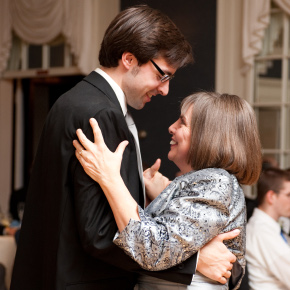
Image: Groom and Mother of the Groom dancing at mine and Leah’s wedding. A lovely memory, dancing with my mom.

God’s Dazzling Truth

Sermon for Sunday, January 10, 2016 || Epiphany 1C || Luke 3:15-17, 21-22

Godsdazzlingtruth“You are my Son, the Beloved; with you I am well pleased.” Whenever I read this beautiful verse of Scripture, my lungs expand with more air than normal. I take a deep, cleansing breath, and I remember the truth of these words, and I lament how easy it is to forget them.
“You are my daughter, the Beloved; with you I am well pleased.” God’s truth embedded in this verse expands out from Jesus and touches each precious life. Jesus did not hoard God’s love and pleasure; no, he gave himself freely so that we might share God’s love and pleasure.

“You are my child, the Beloved; with you I am well pleased.” Can you feel power and the promise in these words? Drink them in now. Close your eyes and whisper them to yourselves. Feel the weight of their truth. Feel the freedom they bring. You are my child. I love you. You are my joy, my delight. In all my acts of creating, over billions of years, across countless galaxies, I had never created you until now, and I am well pleased.

As you let these words sink in, I guarantee you will start to feel a conflict forming inside yourself. The conflict pits God’s dazzling truth against our natural wariness to believe anything that seems to have no strings attached, that seems too good to be true. Our suspicion arms itself with several arguments, so let’s take them in turn.

The first argument coming to the plate is swinging the bat of literalism: “God was talking to Jesus. Of course, God would say all that about the person who is literally God’s own Son. Let’s not get delusions of grandeur now. We’re taking too great a leap to include ourselves in the conversation.”

Well, we are taking a great leap: a leap of faith. We have faith that Paul’s words written to the church in Rome are true: “For all who are led by the Spirit of God are children of God. For you did not receive a spirit of slavery to fall back into fear, but you have received a spirit of adoption. When we cry, ‘Abba! Father!’ it is that very Spirit bearing witness with our spirit that we are children of God, and if children, then heirs, heirs of God and joint heirs with Christ” (8:14-17). We are children of God. Thus, God’s words, spoken from heaven as the dove descends, are for us, too.

“But wait,” says our suspicion, which now comes to bat with a little more nuance: “Maybe the first bit is for everyone because you are God’s children, but the second half has got to be for Jesus alone. Of course God would be well pleased in him. He’s Jesus. Look at everything he did!”

Well, that is true. And if this beautiful verse were spoken at the end of the Gospel rather than at the beginning, I might be swayed by that argument. But within Luke’s narrative, Jesus hasn’t done anything yet. He hasn’t said anything yet. He has completed no healings, spoken no parables, gathered no disciples, performed no miracles. All he has done is take a swim with his cousin John in the River Jordan. Therefore, God’s love and pleasure are not predicated on what Jesus does, but on who he is. And he is God’s child, just like us.

But now the heavy hitters are coming to the plate, the guys who swing for the fences. “What’s so beautiful about these words about being God’s children? Your own parents never lived up to your expectations. What makes you think God will?”

Yes, this is the sticking point. How could we believe God’s promise of love and pleasure when promises around us are routinely broken? (And not usually with malicious intent, but because things just fall apart sometimes.) There’s a whole other sermon waiting right here, so I’ll try not to get too diverted. Basically, one of the biggest challenges in our life of faith is resisting the urge to remake God in our own image. We are made in the image and likeness of God, not the other way around. The moment we start comparing God to our own parents or our own meager ability to be parents, we are no longer talking about God. God is the One who keeps promises, who tells the truth, whose steadfast love lasts forever. If our natural urge to compare God to ourselves or our parents ever waters down these fundamental stanchions of God’s own self, then we are no longer contemplated God for who God truly is.

The trouble is, it’s really hard to contemplate perfection using our own imperfect hardware. But the closer we get to believing that God really is who God claims to be, then the beauty of God’s words to Jesus at the River Jordan gain even more dazzling vibrancy. “You are my child, the Beloved; in you I am well pleased.”

But now the cleanup hitter comes up to bat, and our suspicion hits the ball right into our guts: “What have you ever done to deserve such love?”

You might think we covered this one when I mentioned that fact that Jesus’ ministry hadn’t even started yet. But no, our pernicious feelings of inadequacy and unworthiness will not let us off the hook that easily. Perhaps you lived in fear of your parents finding out you made a “C” on your report card. Perhaps you grew up with an alcoholic father and everything had to be just so, or else. Perhaps you have convinced yourself that you’d be more popular or more successful if you just had…something…more.

Whatever the case, it’s all a lie, a smokescreen. We have never, ever done anything to deserve such love. And we never will. The love of God is a pure gift. No strings attached. It’s too be good to be true, and yet it is true.

And so the conflict rages within us, our natural wariness pitted against God’s dazzling truth. Our arguments scream and howl and stamp and claw, but God only whispers again and again the same words, because the truth needs no bluster. Close your eyes again and listen for God whispering these words in the depths of your being. You are my child. I love you. You are my joy, my delight. In all my acts of creating, over billions of years, across countless galaxies, I had never created you until now, and I am well pleased.

Now open your eyes again and look around. God speaks this same truth not just to you alone, not just to us sitting here this morning, not just to people who look like us or think like us or believe like us, not just to people in the same type of family unit or the same income bracket. Everyone you meet and everyone you avoid meeting has this same truth stitched on their hearts. Treat them as beloved children of God, with no arguments or reservations. Treat all people as beloved children of God, and we will change the world.

Tapestry

Sermon for Sunday, January 3, 2016 || Christmas 2 || Luke 2:41-52

tapestryWell, here we are in 2016. Another year has come and gone, and oh so quickly. Years are short and not necessarily memorable unless we take the time to remember them, to stitch them into our living tapestries. I love that today’s Gospel mentions that Mary “treasures all these things in her heart.” Mary treasures both the painful memories, like losing Jesus in the caravan, and the happy memories, like finding him again in the temple. Mary treasures her memories, and they become the warp and weft of her life. They become the story of her walk with God.
At the last Confirmation class, we discussed how hard it can be to notice God’s movement in our lives because of how constant God’s presence is. We are hard-wired to notice change, not constancy. So to improve our awareness of God’s movement – and thus improve our chances of responding to that movement – I have a homework assignment for you. I want you to treasure things in your hearts.

Specifically, as we begin another new year, I invite each of you to look back over the past decade. For each year since January 2006, choose one event or theme that crystallizes for you what that year meant for your life. The event or theme doesn’t have to deal overtly with God’s movement, but I suspect that as you stitch these ten important moments together, you might start to see the wind of the Holy Spirit blowing in your life in unexpected ways. For the rest of this sermon, I’d like to present for you a personal example of this homework assignment. So, starting ten years ago:

It’s spring 2006, and my first year of seminary is coming to a close. I refuse to notice that love has already eroded into convenience and is well on its way to indifference. In mid-May, my girlfriend of two years initiates the end of our relationship. I push away the abyss threatening to engulf me because I need to focus on my chaplaincy at the children’s hospital. Back at seminary, I fall into despair. I isolate myself, presumptuously assuming that none of my friends has ever felt this way. I escape into the fantasy world of an online video game. I don’t surface again for many months.

It’s December 2007, and I ask my spiritual director to hear my confession in preparation for my first ordination. We enter the sanctuary. I kneel at the altar rail. I have written some notes on yellow legal sheets. The tears begin to flow as I confess the big things like my arrogant reliance on myself above everything else. I also confess the little things like cheating on that math quiz in fifth grade (sorry Mrs. Goldberg!). I am utterly exhausted when I finish. I feel empty, but in a good way, like there is more space in me for God to fill.

It’s June 2008 and blisteringly hot outside. There’s no A/C at the church, so I’m glad to be wearing seersucker. I kneel before my bishop and his hands are gripping my head firmly. The rest of the priests touch me lightly. I can feel my father’s hand on my shoulder. At the end of the service, people come to me for the customary blessing from the new priest. I don’t know what to say, but the words come just the same.

It’s late 2009, and some situations are just so brutal or hit so close to home that reliance on God is a requirement and not the fallback position. I get a call that a parishioner’s daughter has died suddenly in the night. God finds me cowering on the front stoop. I take a deep breath and enter the house. Every day for a week and a half, I spend time with the grieving parents, and I know without a shadow of a doubt that my normal strength is unequal to the task. I officiate at her funeral, my first for someone my own age. And God is there.

It’s the beginning of 2010, and I’m looking for a new position. I email my former spiritual director about a job on the day after she mentions off-handedly to her husband that she’d like an “Adam Thomas clone” to be her assistant rector. We don’t believe in coincidences, but in the weaving power of God’s movement. I start my new job in Massachusetts six weeks later. Four weeks after that, I meet Leah.

It’s February 2011, and I’m standing at the top of the steps in my church with my father by my side. Leah walks towards me wearing a beautiful white dress. We vow in the name of God to have and to hold each other until we are parted by death. She is my future, and you couldn’t stuff any more gratitude to God in my heart if you tried.

It’s July 2012, and I rush Leah to the hospital. She’s at a ten on the pain scale, and it takes the ER doctors all day to figure out why. The reason is connected to the fact that every month we hope and hope and hope for a positive pregnancy test, and every month our hopes are dashed. We cry a lot. We wonder what’s wrong with us that we can’t seem to do what our bodies are designed to do. The future we planned together dims.

It’s November 2013, and I get off the phone with Chris Barnes, who has just invited me to be your rector. I have to wait patiently for him to stop talking so I could say, “YES!” I feel the same sense of glowing rightness in my chest that I had felt about going to Massachusetts and marrying Leah. The next day, Leah and I have a special medical procedure, and two weeks later we see two tiny heartbeats on the ultrasound monitor.

It’s July 2014, and I watch as first a tiny baby girl and then a slightly less tiny baby boy enter the world. I look in awe at their solemn little faces and their fingers and their miniscule fingernails. I have no idea what I’m doing, but I hold them and whisper to them and change their diapers, and those seem to be the right things to do. I am overwhelmed, and my gratitude comes in kisses, not in words.

It’s the end of 2015, and I’m writing this sermon. I only cry twice (maybe three times) while writing it. It takes me a long time to figure out what to say about this last year. It has been a year of ups and downs, of complete joy and utter exhaustion. It has also been a year of first words and first steps and lots of food dropped purposefully on the kitchen floor. But as I look back, the one word that captures this past year for me is “home.” In all my life, I’ve never felt at home until now – until my children started crawling up the stairs and knowing which room is theirs, until I started walking in the back door and knowing that a pair of sticky hugs was in my immediate future. I am home.

This is what I treasure in my heart today. These are the events from the last decade that have woven themselves into the tapestry of my life. These are the moments – both happy and painful – that have helped sink the moorings of my faith deeper and deeper. As we begin 2016, I invite you to take some time to treasure the last decade in your heart. View your own living tapestry and see how the golden thread of God’s movement weaves through it. If you’d like to write yours down like I did, I would love to read it. Above all, in this new year, I pray that you may find treasure to hold in your hearts, and I pray that you may be the treasure, which others hold in theirs.

Made His Home

Sermon for Christmas Eve 2015; John 1:1-14

madehishomeRight now, you might be thinking, “Wait a second…where are the baby and the manger and the shepherds and the angels? I know it’s late, but I don’t think I nodded off during the Gospel reading.” Now, I don’t know whether or not you nodded off, but I can assure you that I didn’t say anything about the baby or the manger or the shepherds or the angels. Tonight, I read a different version of the story of Jesus’ Nativity. Allow me to explain in brief, and then we’ll get to what I really want to talk about on this most Holy Night, which is God making a home here.
But first: yes, we are used to the Christmas Pageant version of the story of the Nativity. Most of that story is found in the Gospel according to Luke. I say “most” because a few bits come from the Gospel of Matthew and a few others bits are made up entirely. Tonight we read another take on that same story, a take so vastly dissimilar that it seems to be a different story entirely. But it’s not. The story is just condensed. The story of the Nativity is distilled down to a single, yet powerful verse of scripture: “And the Word became flesh and lived among us, and we have seen his glory, the glory as of a father’s only son, full of grace and truth.”

That’s it. That’s the Gospel of John’s Nativity story. That one verse; half a verse really. “And the Word became flesh and lived among us.” Pretty concise, right? But even in their brevity, these words pack in a whole lot of meaning. They are pregnant words, so to speak.

The Word that becomes flesh is the main character of this prologue to John’s account of the Gospel. In just eighteen verses, John explores some pretty weighty theological ideas, and he does so using poetry. Indeed, these verses are best understood as a poem: John uses special words and rhythm and imagery in an attempt to get to the very heart of God’s making of and presence in Creation. The weightiest of these special images is the word “Word.”

This is the Greek word logos. We get the English suffix “-ology” from it; you know, biology, zoology, paleontology. We also get the word “logic” from it. When something is “logical,” it is orderly, organized, it makes good sense. So when John claims that Creation “came into being through [the Word],” he’s stating that God was organized about the act of creating, that God had a plan for the universe and wasn’t just creating all willy-nilly. You can see how John’s poem goes all the way back to before anything existed, all the way back to when there was only God. John needs this cosmic perspective in order to demonstrate the extraordinary specialness of what happens next.

This organizing principle, this logic behind Creation, this giver of all life, this Word became flesh. This Word took on the very meat and bones and skin and breath and soul that had evolved over untold millennia within the Word’s own orderly Creation. This Word became flesh in the person of Jesus of Nazareth, a man of seemingly humble origin who had a knack for helping people live better, fuller, and more authentic lives, serving one another in love. This Word became flesh, which means he got dirty and tired; he grieved and wept and sought comfort; he ate and drank and laughed with his friends. He was homeless at times; he was also a refugee. He was welcomed and excluded; he was loved and hated. He touched and healed so many people, but sometimes he needed to go off by himself to recharge. He took a first, newborn breath. He took a last dying breath. All this to say: he was one of us.

In fact, he was the best one of us. He was the best one of us because he was so much more than simply one of us. He was the Word. He was life as life is meant to be lived, as God dreams for life to be. As so many theologians have said, this Word became like us, so that we could become more like him.

And this thought brings us to the last important word in John’s brief Nativity story: “And the Word became flesh and lived among us.” Lived among us. I don’t like this translation. It’s about as weak a translation of the original language as you can get. I prefer this: “And the Word became flesh and made his home among us.” Made his home among us. This gets much closer to the intent of John’s original poetry. The Word didn’t just live here for a time. The Word settled here. The Word made a home here.

I think this second translation impacts me so much because I have lived quite a nomadic existence. In my nearly thirty-three years on this planet, I’ve lived in ten different states. The longest I lived anywhere was six years in Tuscaloosa, Alabama. The second longest was four years at college. I’ve lived a lot of places. But I never, ever felt like I was making my home anywhere. Until now. I live in a real house with my wife and two children. We brought the twins home to that house. In their short lives, they have never lived anywhere else. That is their home. We have made a home.

The Word became flesh and made his home among us. God made a home here. The Nativity we celebrate this night marks not a brief dalliance with Creation, not simply a passing through, but a commitment to be present, to be active, to be here. And through the power of the Holy Spirit, this commitment continues long ages past the Word’s earthly walk. The home God made is no longer just in Bethlehem or Nazareth or Jerusalem. The home God makes is here, in each beating heart. And the home God makes is also out there, within the whole of Creation. As the Godly Play stories so aptly put it: “All of God is in everyplace.” That’s God’s home. We are God’s home. And God is our home, now and into eternity.

So this night, we celebrate not only the first, newborn breath of the babe in the manger. We celebrate the deep reality that God made a home here in order that we might have a home in God.

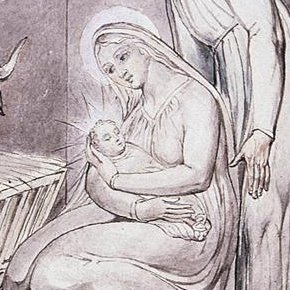
Art: Detail from “On the Morning of Christ’s Nativity” by William Blake, 1809.

The Whispered Power of God

Sermon for Sunday, December 13, 2015 || Advent 3C || Luke 3:7-18

whisperedpowerofgodI think the Gospel lesson I just read sounds harsher than it really is. Notice the last line: “So, with many other exhortations, [John] proclaimed the good news to the people.” Either this means that the “good news” came in these other exhortations spoken off camera, or everything that John says is to be considered “good news.” I think it’s the latter. Of course, good news doesn’t usually begin by calling people a “brood of vipers.” John the Baptist is not exactly a people person; after all, he’s spent a lot of time by himself in the wilderness. He’s definitely a loner, unlike his cousin Jesus who comes on stage in a few verses and who surrounds himself pretty quickly with a group of friends. But even though John’s social skills may have suffered from his solitude, he’s astute enough to know the crowds expect a spectacle. And he gives them one right off the bat by calling them a “brood of vipers.”
In Matthew’s account of this story the name “brood of vipers” specifically targets the Jewish leadership, but here in Luke’s account, John broadens this designation to include everyone in the crowds (which includes us, by the way). My favorite modern translation of the Bible renders this verse with a little less fervor and a little more silliness: instead of “You brood of vipers” it’s “You children of snakes!” Not quite as punchy.

But I don’t think John is naming the crowds “children of snakes” simply to give them the spectacle they desire. Rather, he’s pre-empting an argument they might make after he instructs them to “bear fruit worthy of repentance.” This pre-empting continues when he says, “Do not even begin to say to yourselves, ‘We have Abraham as our ancestor.’ ” In other words, your heritage does not make you bear good fruit nor give you a free pass. The crowds may be “children of Abraham,” but they are also children of snakes. And be assured that everyone in the crowd would hear a hissing of the memory of Adam and Eve’s temptation in the garden when John names them a snake’s descendants and talks about the fruit of the tree.

Thus, in just these opening lines of John’s exhortations, he sets up the duality inherent in all of us. We are none of us entirely good or entirely bad. We are children of Abraham (that is, children of God’s promise) and we are children of snakes (that is, children schooled by separation, temptation, and distrust). I bet each of you has had, at one time or another, these two natures war within you. In real life this war is much less comical than the angels and devils sitting on the shoulders of old Looney Toons characters.

Most often, the war plays out between what is right and what is easy. You can have a reasonable discussion in the wake of a disagreement or you can punch below the belt with slurs and hurtful epithets. You can stand up for those in need or you can ignore their plight. You can tell the truth or you can lie. Everyday, we face choices like these. And everyday, the whispered power of God contends with the hiss of the snake. Every time we listen to the snake, we end up just a bit more alone and isolated than we were before, which makes us so much easier to pick off. Every time we listen to God, we resonate with the song of love and faith and freedom – we sing and dance and exult and fall down weeping in gratitude for God’s gift of grace.

But if that’s the case, if the whispered power of God is so attractive, then why do we give into temptation as often as we do? The simple answer is this. Giving into temptation involves doing absolutely nothing because doing absolutely nothing leads to complacency, and complacency is the root of so much of the world’s despair. That’s why John warns the crowds not to get too comfortable in their heritage as Abraham’s descendants. And that’s why he gives them something to do: “Whoever has two coats must share with anyone who has none; and whoever has food must do likewise.” Food and clothing: if these were dispersed fairly throughout the world, a lot of problems would be solved. It was true in John’s day. It remains true in ours. The world has enough, but this “enough” is divided poorly. And we don’t work to change this reality because the one thing the world has too much of is complacency.

If you’ve ever wondered why we confess “things done and things left undone,” now you know. Things left undone make us slip into complacency and from complacency into despair. The whispered power of God invites us to get up like the paralyzed man at the pool, take our mats, and walk; to say with Mary, “Here I am, the servant of the Lord”; to leave our nets like the fishermen and follow Jesus. But too often the hiss of the snake lulls us back to sleep. Every time we hit the snooze button on life, the duality of nature skews further toward the snake, towards complacency.

So why does John call people a “brood of vipers?” Why does he dunk them under the cold water of the River Jordan? To shake them out of their complacency. To remind them that God is and always will be moving in their lives, urging them to serve and love with active passion and fervor. It’s no wonder then that we prayed what we did in today’s collect. Did you notice the power you invoked a few minutes ago? “Stir up your power, O Lord, and with great might come among us.”

Are you ready for this? I’m not sure I am. There’s still way too much child of snake in me to desire the wind of the Holy Spirit to stir me up and push me to God knows where. But it’s too late now. The prayer has been prayed. And now it’s up to us to partner with God to see how God’s power will be revealed. Perhaps, you will find this power in new courage to face a difficult circumstance or in new patience amidst uncertainty. Perhaps you will find this power in advocating sensible gun control on this third anniversary of the shooting in Newtown. Or in welcoming a stranger to our community, maybe a refugee family fleeing terror.

However the whispered power of God manifests in your life, know that it is and always will be stronger than the hiss of the snake. The inertial force of complacency is powerful too, but it is no match for the Creator-of-All-that-Is. Remember, it might seem like we’re just sitting still, but in reality we’re spinning at about 800 miles per hour around the earth’s axis. And if that’s not fast enough for you, we’re also moving at about 67,000 miles per hour around the sun. And that’s not even thinking about what our galaxy is doing in space. Talk about being stirred up.

The power we invoked during our collect this morning keeps this universe moving. And it keeps us moving, always ready to harness our birthright as children of the promise and to participate in God’s mission here on earth. During Advent, we don’t wait for the Lord in complacency. No. During Advent, we don’t wait. We prepare.

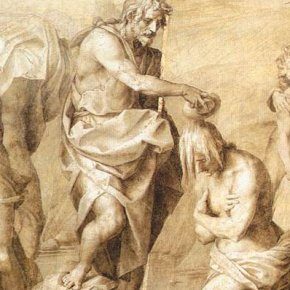
Art: Detail from “Baptism of the People” by Andrea Del Sarto (1515)

Advent in Haiti

Sermon for Sunday, December 6, 2015 || Advent 2C

AdventinHaitiAs many of you know, Tim Evers and I spent much of last week in Haiti visiting our mission partner, St. Luc School. As you will see later in this sermon, I’m so thankful that a coincidence of calendar had us travel there during Advent. My first glimpse of the country came from 10,000 feet in the air. The Haitian landscape rises rugged and mountainous to the east where it abuts the Dominican Republic and flattens to the west where a peninsula bathes in the Caribbean Sea. Our destination was in the countryside west of the capital.

We arrived at the hospital of St. Croix in Leogane after the wildest vehicular ride of my life. Negotiating intersections paired survival of the fittest with a massive game of chicken. There were next to no traffic lights, and the painted traffic lanes seemed merely suggestive. Even which side of the road to drive on was in doubt. But we made it, thanks to our driver’s aggressive skill and liberal use of the horn.

As we drove, both from the airport and on the way to St. Luc, I tried to take in as much of my surroundings as possible. Here are a few impressions in no particular order:

Wherever there is an open patch of ground, there are kids playing soccer on it. Grass is optional. And having a ball is optional.

Most people are dressed the way you or I might when we’re doing yard work. The big exception are kids – particularly girls – wearing immaculate school uniforms. And I mean immaculate. Their blouses are the only thing I saw that I would classify as the color white. Everything else that could be white was painted tan by all the dust.

There are stray dogs all over the place, many with mammary glands obviously swollen with milk. I realized how odd this sight was to me because nearly every dog in the U.S. is spayed or neutered.

The two main forms of transportation are walking and riding small motorcycles — dirt bikes, really. I didn’t know you could fit five people on a dirt bike, but you can.

There are lots of scrawny little goats milling around.

Many of the ramshackle dwellings are fenced in with tarps emblazoned with “USAID” – the United States Agency for International Development. The tarps say, “From the American People” on them. It’s a sad commentary that the emergency tarps provided five years ago after the earthquake have become a permanent fixture in people’s dwellings.

In the distance, the landscape is truly stunning, but focusing on the landscape close by tells what happens when there is no functioning sanitation department. Discarded bottles and Styrofoam food containers collect in piles like raked leaves, along with other unidentified refuse.

All this I saw from the seat of a dented Mazda dualcab truck. All this I saw without actually interacting with anyone. Thankfully, we did interact with people, and so my appreciation for both the blessings and challenges of life in Mercery, Haiti deepened. Our main contact was Fr. Sonley Joseph, the priest in charge of St. Croix and its eight — eight! — satellite parishes, including St. Luc. Sonley and I have a lot in common: we’re both writers and we both lived in the same dormitory at Virginia Theological Seminary (he a couple years after I). I liked him immediately, and not just because of our kinship, but because of his soft-spoken, yet ardent and inviting vision of the mission of God. In Haiti, the Church’s participation in God’s mission has always been linked with education, and most churches have schools attached. Sounds like St. Mark’s, if you ask me.

Fr. Sonley was our guide and interpreter when we went to St. Luc on Wednesday morning to say hello to the students and teachers. We received 270 bon jours in return across the eight classrooms, from 6th grade on down to pre-K. The school has no electricity, but there is enough tropical sunlight to illuminate all the rooms, save one whose windows are shaded by plants. The classrooms are quite noisy because there’s nothing but cinderblocks to keep sounds from one room invading another. And most teaching is done using the blackboard, as there aren’t enough books to go around.

But even with these challenges, the teachers’ love for their profession and their students is evident from the moment you step into the room. Tim and I met with the teachers later in the day, and they all agreed that St. Luc is the best school in Mercery. Their pride for and dedication to their school was wonderful to feel. Access to education is a fundamental human right. And these teachers are realizing this fundamental human right for those 270 beautiful children, in a country were such access is far from assured.

To be involved in the process of educating these children, even in the small way we at St. Mark’s are, is a gift. Our partnership with St. Luc School is a gift from God, a participation in God’s mission as Fr. Sonley described it. Of course, there is so much more we could do. We have a list, prioritized from simple to incredibly ambitious. But that’s only for these 270 kids. What about the other children of Haiti or in other poverty-stricken places (even here in the States) or the other needs and disparities that need to be addressed or the issues of injustice that keep people from having access to fundamental human rights? There is so much more that we could do! There is always so much more we can do — So, so, so, so, so much more that we can easily be overwhelmed; the need can steal our breath, then our balance, then our will to persevere.

And this is where the season of Advent infiltrates our hearts and minds and gives us a little breathing room to stand back and take it all in. Yes, the needs of this world are great. Yes, the harvest is plentiful and the laborers are few. But Advent teaches us two things that will sharpen our focus and our will.

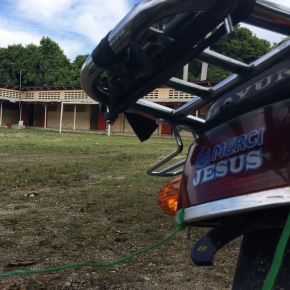
First, as Stacey so aptly put it last week, Advent reminds that the One we long for is already here. There is a tension at play between God’s kingdom already here and God’s kingdom still to come. God’s kingdom is alive and well in Haiti. Indeed, despite the general poverty of resources and circumstances, the faith of the people of Haiti is deep and abiding. I saw dozens of signs that said “Merci Jesus” on them. Thank you, Jesus! For what, you might ask? For life. For love. For family. For the same things you and I thank Jesus for. That’s the “already” of the kingdom. The “not yet” is still breaking in: it’s in the teachers sweltering at blackboards with 50 students clamoring for attention; it’s in the mother painstakingly washing the uniform each night so it is immaculate again in the morning; it’s in the hungry yet smiling faces of those children who are Haiti’s future, whom we are helping to educate.

Second, Advent teaches us to focus on a particular spot at a particular time on a particular person. The particularity of Jesus’ Incarnation is what we are getting ready for. God came to us in all the particularity of a precious human life, born in a place that could easily have been fenced with a tarp from USAID. Because of this Incarnation, Jesus had a chance to meet people in a way God couldn’t — eye to eye, touching, embracing, walking with, eating with…dying for. When you start to get overwhelmed by the needs of the world, return to Advent. Walk with Mary and Joseph to that starlit stable in Bethlehem and witness the birth of grace and love. See Christ embodied in his own peculiar humanness. Then go back to the needs of this world. Don’t be overwhelmed by the sheer quantity. Instead, do what God did in the Incarnation: pick a place; pick a person. Be present there. Form a partnership there. Form relationships there in that singular place. Find Christ in that person. And be an incarnation of Christ to that person.

That’s what we’re doing in the partnership between St. Mark’s Church and St. Luc School. It’s an Advent partnership: already begun but never quite finished. It’s also a Christmas partnership, because in that little school off a dirt road in the boondocks of the poorest country in the western hemisphere, we incarnate Christ for each other. Thanks be to God.

Listen for Truth

Sermon for Sunday, November 22, 2015 || Christ the King Year B || John 18:33-37

listenfortruthI find it ironic that the framers of our lectionary chose the Gospel lesson I just read as the one for today. Today is the feast we call “Christ the King” or “Reign of Christ.” And yet, for the entire length of his conversation with Pontius Pilate, Jesus specifically dodges Pilate’s questions about his kingship. “Are you the king of the Jews?” Do you ask this on your own, or did others tell you about me? “So you are a king?” You say I am a king. But if Jesus is king of anything, if Jesus claims to reign over anything in this passage, his kingdom would not include land or crops or livestock or resources. His reign would be over “the truth.” For this I was born, and for this I came into the world, to testify to the truth.
A truth kingdom. I like the sound of that. Would that we lived in one of those. But for anyone who’s ever heard a joke about politicians, you know the punch line always involves untruthfulness of some sort. We might give them the benefit of the doubt and say they don’t out and out lie most of the time, but they are masters of prevarication, obfuscation, and equivocation, that’s for sure. We’re used to this behavior from our political leaders; so used to it, in fact, that when a politician stumbles into a genuine moment, we’re amazed and we start asking if it were staged.

In our Gospel passage today, Jesus seems to be engaging in just such an impressive display of political obfuscation. Perhaps he’s trying to meet Pilate where Pilate is. Perhaps Jesus is using Pilate’s own tactics to get through to him. Or perhaps Jesus is simply telling the truth, but we’re so used to prevarication that even the truth sounds false. If that’s the case, I’d like to try something this morning. I’d like to try to rehabilitate the truth simply by speaking Jesus’ truth to you. Truth has a special ring to it, and I hope you hear its crystal clarity this morning. There will be no prevarication or obfuscation. But there will be mystery; after all, the truth is too big for us to understand completely. Jesus says, “Everyone who belongs to the truth listens to my voice.” So close your eyes now and listen for Jesus’ invitation to you to enter his kingdom. Listen for Jesus’ truth.

Are you hungry for more? Not for more stuff, more possessions, more things to clutter your house. Not for prosperity at the sake of others’ poverty. Not for more empty calories, the white starch of idolatry and self-deceit. There are so many idols out there scheming to fill you up, but you’ll only be left craving. There’s so much fear to gorge on, but fear will just leave you hollow. Are you hungry for more? For more meaning? For deeper connection? For sustenance that truly sustains? Then listen to Jesus: “I am the bread of life. Whoever comes to me will never be hungry, and whoever believes in me will never be thirsty” (John 6:35).

But I still have dry times, Lord. I believe, but I still feel empty more often than I’d like. How can I trust your words when I feel like this?

I know how you feel, says Jesus. I felt desolate in the garden of Gethsemane. I felt abandoned on the cross. I know it can be so hard to hear my invitation when you feel lost in the desert. But I’ve been lost there, too. I’m lost there with you right now, so that you may be found. Listen again to my invitation: “Come to me, all you that are weary and are carrying heavy burdens, and I will give you rest” (Matthew 11:28).

The desert I can handle, Lord. At least it’s bright there. But sometimes I look out at the world and all I see is darkness. There’s so much darkness, and I’m afraid there’s a shadow growing over my soul, too.

One time, says Jesus, I was looking out over the city of Jerusalem, and the tears just started flowing. Another time, my beloved friend died, and all I could do was weep. I know what it means to be a light shining in the darkness: a flickering flame that might snuff out at any moment. But have you ever seen a ray of darkness? There’s no such thing. Have you ever seen the darkness of a hallway flood into a bright room when the door opens? No. The light wins every time. The light will always win. As for the shadow growing over your soul, make sure it listens to my words: “I am the light of the world. Whoever follows me will never walk in darkness but will have the light of life” (John 8:12).

The light of life, Lord? How could I ever be worthy of such a prize? I spend too much time in darkness to deserve the light of life.

Nonsense, says Jesus. Do you think anyone has ever been worthy of the gifts God gives them? Do you remember that story I told about the son who takes his inheritance and squanders it? He came home penniless and ashamed, and what did his father do? His father ran out to him! His father could not wait another second to rekindle their relationship even though the son didn’t deserve it. Don’t be paralyzed by unworthiness. My love makes you worthy of my love. So listen to my truth, “Remember, I am with you always, to the end of the age” (Matthew 28:20).

But it can’t be all about me, Lord, can it? You helped so many people in your life, but up to now I’ve just been concerned with myself? There’s got to be more.

Oh, there is more, says Jesus. So much more. When you realize I am with you, you’ll also realize I’m with everyone else. And with that realization will come the desire to serve others as you serve me, especially those who are poor and lost, those who are my special project. You’ll find joy in feeding the hungry and giving drink to the thirsty. You’ll find joy in welcoming the stranger. You’ll find joy in clothing the naked and visiting the sick and imprisoned. Do you want to know the truth? Listen to this: “Just as you [served] one of the least of these who are members of my family, you [served] me” (Matthew 25:40).

Okay, Lord, so I live my life serving others, being a light in the darkness, and finding refreshment in your arms. But I’m still going to die someday. And I’m afraid.

I understand, says Jesus. I was, too. I even prayed to be spared, to let the cup pass from me. I can’t promise you a life free of pain. I can’t promise you a death free of pain, either. But I can promise to be with you in the pain of life and death. If you love others as I love you, then pain is inevitable. But so is joy. In the end, there is nothing but love and joy. Or should I say the new beginning? Listen to my truth: “I am the resurrection and the life. Those who believe in me, even though they die, will live, and everyone who lives and believes in me will never die. Do you believe this?” (John 11:25-26)

Yes, Lord, I believe. Please help my unbelief.

A truer prayer has never been uttered, says Jesus. “Everyone who belongs to the truth listens to my voice.” So listen for my word in your life. Listen for my truth. Live my truth: For “if you continue in my word, you are truly my disciples; and you will know the truth, and the truth will set you free” (John 8:31-32).

Hold Fast to Hope

Sermon for Sunday, November 15, 2015 || Proper 28B || Hebrews 10:11-25

holdfasttohopeNote: For the sermon at St. Mark’s on 11/15, I was planning to read the Bishop’s address to the Diocesan Annual Convention, which took place the same weekend. Then when the terrorist attack in Parish happened, I knew I needed to say something different. Arriving home from convention in the evening of Saturday, I had little time to put a sermon together, so I went back in my vault to see if I had anything appropriate. I found a sermon from six years ago and started with that as my base. But with the Paris attacks on my mind, the old sermon morphed into something completely different, with nearly two-thirds of the words being new.

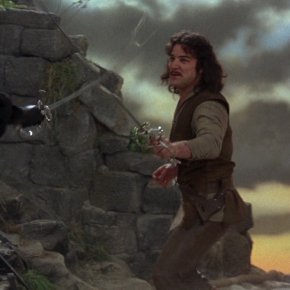
I know I already used my yearly allotment of Princess Bride references in sermons, but I was a little time-crunched this week after my homiletic plan changed, so I went back to the deep well that is one of my favorite movies. So imagine this scene: Inigo Montoya, the Spanish hired sword who helped kidnap Princess Buttercup, is losing his duel with the Man in Black. The fight has ranged all over the rocky terrain at the precipice of the Cliffs of Insanity. The two swordsmen had both begun left-handed, but have switched to their dominant hands when they recognized the masterful fencing of the other. Thrust. Parry. Riposte. The Man in Black acrobatically flips off the ruins. Inigo stares at him, clearly amazed: “Who are you?” he asks.

“No one of consequence,” replies the Man in Black.

“I must know,” pleads the Spaniard.

“Get used to disappointment.”

The fight continues, only to end a minute later with an increasingly flustered Inigo receiving a knock to the back of the head. And I’m sure the Man in Black’s words rang in his mind.

Get used to disappointment. Sounds like quite sensible advice. Sounds like the Man in Black has been around the block a few times. Sounds like he knows something about the ways of the world. However, this worldly wisdom is often counterproductive to a life of faith. The Letter to the Hebrews urges us this morning to “hold fast to the confession of our hope without wavering, for Christ who has promised is faithful.” In a world that teaches us to “get used to disappointment,” holding fast to our hope can be so very difficult.

Our inoculation begins at an early age. Children enter life with bright, wide eyes and unbounded, unfettered imaginations. Every couch cushion is a stone in a castle under siege by the invading hordes who desire nothing more than to pillage the kingdom. Every bath is a deep-sea expedition to find the lost city of Atlantis. Every day is another chance to see a unicorn. But before long, we start getting used to disappointment. We are told that couch cushions are for sitting, baths are for bathing, and there’s no such thing as unicorns.

I remember my mother shouting: “Young man, there are no dinosaur bones in the backyard. Stop digging up my flowerbeds.” But what she didn’t know was that my imagination was equipped with ground-penetrating sonar and that there was an intact velociraptor skeleton just beneath the gardenias. It was the find of the century. Any moment, Richard Attenborough was going to land in a helicopter and whisk me off to Jurassic Park.

But in the grand scheme of things, from the moment we are born, our imaginations do nothing but shrink as our understanding of so-called reality grows. The trouble is that hope exists in the imagination’s ability to frustrate the enclosing nature of the “real” world. We are made in the image of God; therefore, our imagination connects us to the creative spark of our Creator within each of us. And hope resides in this spark. As mounting disappointment attempts to snuff out our imaginations, we encounter great difficulty in accessing the hope, which our Creator installed in us.

This disappointment comes in both the mundane and the catastrophic. First the mundane: another chance for promotion and you’re passed over. A promising new relationships ends abruptly – and you thought it had been going so well. The new water heater has inferior parts and you have to jury-rig what should be a simply installation. Each of us has such mundane disappointments, setbacks, and frustrations all the time. They sap our vitality. And they obscure our hope.

Then there are those catastrophes that make hope seem silly and microscopic in comparison. A parent dies; or a child. A missed payment turns into two and three and the landslide has started and before you know it you’re out on the street with nowhere to live. A war rips through your town and the next day you’re a refugee fleeing the violence. A terrorist attacks ignites the Parisian sky with explosions and gunfire and litters the ground with the slain bodies of the innocent.

How can hope possibly compete with this twin barrage of mundane disappointment and heartbreaking catastrophe? Shouldn’t we, as the Man in Black suggests, get used to such things? They seem to be the natural order, after all. Shouldn’t we just get used to disappointment?

No.

No – because we have been to the foot of the cross. No – because we have seen the ultimate disappointment that was the Savior of the World gasping for his final breath: betrayed, abandoned, mocked, hanging limp.

But that’s not the end of the story. The last vestige of hope was buried with Christ in the tomb. His hopeless friends then entombed themselves in their own hideout. But as Andy Dufresne reminds Red in another of my favorite moves, The Shawshank Redemption: “Hope is a good thing, maybe the best of things, and no good thing ever dies.” Such was proven true three days after the ultimate failure when the ultimate triumph changed everything. Hope rose from the tomb with Christ. Hope does not die. Hope might hide. Hope might be obscured or hard to find. But hope does not die.

The next day dawns. The catastrophe has still happened. The Parisian streets are still awash with innocent blood. But the next day still dawns. And the day after that. And the only thing that keeps those of us who remain alive and eating our breakfast and hugging our children – is hope. Hope does not die. Hope will never die.

And do you know why?

Because Christ who has promised is faithful. That’s the reason the Letter to the Hebrews gives. The writer states emphatically: “Let us hold fast to the confession of our hope without wavering, for [Christ] who has promised is faithful.” We hold fast to hope not through the strength of our own faith, but through the surpassing faith of Christ, the same Christ who early on that Sunday morning simply would not break a promise to be with us always.

We do not manufacture our faith. Faith is not self-centered. Faith is God-centered. The confession of our hope proclaims that the reality of resurrection life exists, and that we will encounter its utter joy when we finally and fully enter God’s eternal presence.

We believe that this happens in the power of the resurrection when we pass from life through death to new life. But the confession of our hope does not merely cast our thoughts to the life beyond death. Remember, hope exists in the imagination’s ability to frustrate the enclosing nature of the so-called “real” world. This real world is full of disappointments, frustrations, and, yes, catastrophes.

But God has blessed us with hope-fueled imaginations. God has blessed us with the mission, as Hebrews says, “to provoke one another to love and good deeds.” God has blessed us with the resources to feed and clothe everyone in this world. God has blessed us with the patience and love to stand together against terror and senseless violence. We must only provide the will. We must set our disappointments in the context of the hope that God’s own faith makes real in our lives.

When we were children, the magical words “Once upon a time” lost their luster when we heard their counterparts: “Sweetheart, it’s only make-believe.” But I say to you that we have the opportunity, we have the imagination, we have the will to change this world for the better. Because God keeps God’s promises, we are able to keep our promises. We are able to make a difference in people’s lives. Get used to disappointment? Not a chance – because hope is a good thing, and no good thing ever dies.

The Long Prayer

Sermon for Sunday, November 8, 2015 || Proper 27B || Mark 12:38-44

thelongprayerI’ve been preparing recently for Confirmation class, which begins later today. We have four tenth and eleventh graders and their sponsors ready to begin a five-month journey through their faith: learning, discussing, sharing stories. The next time the bishop visits, these four will have the opportunity to make a mature profession of faith if they so desire, and I am really excited to get to walk with them these next several months. Because I’ve had Confirmation on my mind, I’ve been thinking and rethinking some of the “nuts and bolts” of the way we express our faith as Episcopalians. Every once in a while, I like to preach on these “nuts and bolts” because in my job I get asked the same dozen or so questions about our practice all the time, and exploring such questions can help us all deepen our engagement in worship and in mission.

One of these questions has to do with the second half of our Sunday service – Holy Communion in particular. “What is Holy Communion,” I am often asked, “and why do you say such a long prayer right before it?” The second half of this question hit me again this week when I read today’s Gospel lesson, in which Jesus takes the scribes to task for all sorts of things – a few of which struck a little close to home.

“Beware of the scribes,” says Jesus, “who like to walk around in long robes” (looks down at self wearing an alb and chasuble) “and to be greeted with respect in the market-places” (not many people have the definite article at the beginning of their title, but priests do – ‘the Reverend Adam Thomas’) “and to have the best seats in the synagogues” (I guarantee you my chair is more comfortable than yours – look at that cushion!) “and places of honor at banquets” (Okay, okay, finally something that’s not true – as long as I have a lefty seat at the corner of the table, I’m good). “They devour widows’ houses” (All right, moving further away, this is good) “and for the sake of appearance say long prayers” (gulps).

For the sake of appearance say long prayers. We say a lot of long prayers on Sunday morning, and one in particular is longer than all the others put together: the Eucharistic prayer. We haven’t gotten to it yet this morning, since it happens later in the service. You’ll know when we arrive at the Eucharistic prayer because I will be standing behind the altar when we start it. So Jesus indicts the scribes on six different issues, and by my count I’m guilty of three, innocent of two, and the final one is pending. For the sake of appearance, they say long prayers. I can’t dispute that the Eucharistic prayer is long – most graces before a meal don’t last five minutes. So to break even on these six charges, I have to prove that I don’t pray this prayer for “the sake of appearance.”

Before I start my defense, you need to know I’m not the only one implicated in this. You all are co-conspirators. At the beginning of the prayer you and I share a short dialogue, right? (The Lord be with you. And also with you. And so on…). In this dialogue, I ask your permission to pray on your behalf, and you grant it when you say, “It is right to give God thanks and praise.” So that’s the first thing to remember: even though I’m the one talking, we’re all praying this Eucharistic prayer together.

Now that you have joined the defendant’s side of this indictment with me, let’s explore this question: If not for appearance, why then do we pray such a long and involved prayer before receiving Communion? My answer is this: we are part of God’s story. We nurture our faith when we take time each week to locate ourselves in this great story. And when we locate ourselves in the story, we realize that, by the power of the Holy Spirit, the story is still being told. And when we have this realization, we give thanks to God for our participation in God’s story through the Body and Blood of Jesus Christ.

Now I know that was a pretty dense answer, so let’s unpack it a little bit. First, we locate ourselves in the story by praying, “Holy and gracious Father: In your infinite love you made us for yourself.” We fell away from you, but you gave us another chance by sending your Son. We and Us. Not They and Them. This story is about us. We don’t deserve mercy, but God doesn’t care one lick whether or not we deserve it. And that’s called grace.

With this grace emboldening us, we then fulfill Jesus’ request made at his last supper with his friends when he took bread and broke it. But notice that when I narrate the breaking of the bread, I don’t actually break it. Not yet. I break the bread later for the utilitarian purpose of sharing it. The reason I don’t break the bread when Jesus does is because I am not standing in for Jesus. And we are not reenacting the Last Supper. This is important, so listen up. We are not reenacting the Last Supper; we are participating in it. There has only been one Last Supper, and we were there. We are there each time we partake of Christ’s Body and Blood. We are there with everyone who has ever received the sacrament. We are there with the great cloud of witnesses that we invoke later in the prayer. We are there as the Body of Christ to receive the Body of Christ. Thus, the broken bread makes us whole: one body in Christ made up of many members, each supporting the others in worship, love, and service.

That’s why we invite the Holy Spirit to fill the bread and wine with the presence of Christ: not simply to remember what Christ did, but to participate in what Christ is doing. The story is not over yet. The Bible might be finished, but the story continues – God’s story of making, redeeming, and sustaining this little Creation of God’s. When you come to the altar rail and put out your hands, you signal your fervent desire to participate in this great story. In the Eucharistic prayer, we tell the story together, and in the telling and in the sharing we take on our role as the characters in the current chapter. We are the people to whom Christ offers his Body and Blood in order that we might both feel closer to him and feel strengthened to serve. We are the people enlivened by this precious nourishment. We are the people with a story to tell.

And that’s why we give thanks. The Eucharistic prayer is a prayer of Great Thanksgiving: thanksgiving for God’s mercy and grace; thanksgiving for Christ’s sacrifice and sustenance; thanksgiving for the Holy Spirit’s presence and empowerment. We give thanks that we are a part of the story. And it is quite a story. I don’t know about you, but a five-minute praying of the story seems downright short when you realize all that it entails. But of course, we don’t tell the story just once a week for five minutes on a Sunday. We tell the story each day of our lives.

We don’t pray this long prayer just for the sake of appearance. We pray this long prayer to give thanks for our part in God’s great story. And then we receive Holy Communion to strengthen and nourish us to continue telling that story together.