Make Your Face Shine

(Sermon for Sunday, November 27, 2011 || Advent 1B || Mark 13:24-37; Psalm 80 )

Imagine with me the Apostle Peter, who is imprisoned in Rome near the end of his life, talking to his cellmate about the day when Jesus spoke about his coming again.
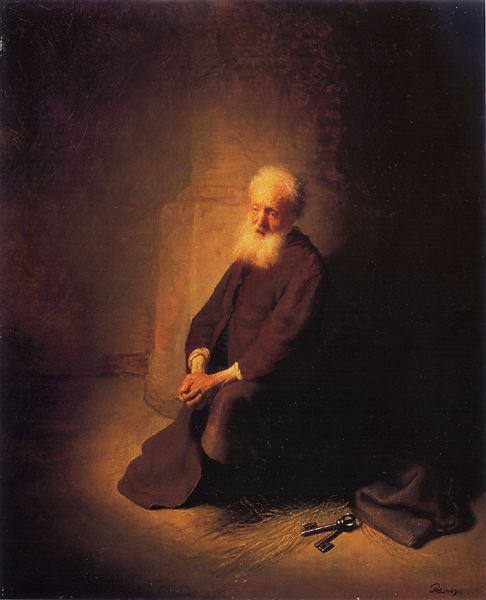
We were used to hearing Jesus say strange things. He would get this faraway look in his eyes, like he was seeing another place and time, or perhaps every other place and time. When we noticed him go distant like that, the twelve of us would gather around close because we knew he would have something to say when he came back to us a moment later. More often than not, the faraway look meant something strange and sometimes unsettling was about to come from his lips. But, as I said, we were used to Jesus saying strange things, having traveled with him for months or years. In fact, I suspect that a few of us – Bartholomew especially – followed Jesus precisely because of those strange things he said.

But this one time was different. I think Bartholomew was just trying to bait Jesus into saying something memorable when he pointed out the architecture around us and said: “Teacher, look! What awesome stones and buildings!”

I don’t think Jesus was in a mood to banter with Bartholomew because his response was short and clipped: “Do you see these enormous buildings? Not even one stone will be left upon another. All will be demolished.”

I remember seeing the smile drain off of Bartholomew’s face. The conversation ended as quickly as it had begun. But Jesus’ words had unsettled me. I knew that the temple had been demolished in the past by invaders, but if the Romans had wanted to destroy such a grand building, wouldn’t they have done so already?

Later that day, we were sitting on the Mount of Olives, and James, John, Andrew, and I went to Jesus privately to ask about what he had said. The temple rose out of the city across from us, and Jesus gazed at those old stones for several minutes. But he had that faraway look in his eyes, so we knew he was seeing something other than Jerusalem’s skyline.

We waited patiently, and finally he came back to us. He spoke in low tones for a time, as if the sky and the trees around us weren’t prepared for what he had to say. He spoke of wars and earthquakes and famines. He spoke of deceivers and false prophets. He spoke of stars falling from the sky and the sun going dark. I had hoped for something comforting after his clipped response to Bartholomew, but what Jesus had to say troubled me even more.

Seeing the distressed look on my face, Jesus squeezed my shoulder and said, “But after this they will see the Son of Man coming in clouds with great power and glory.”

He meant the words to be reassuring, but my mind was still filled with images of famine and falling stars. All I could think to say was, “When will this happen, Lord?”

Jesus shook his head and shrugged. “I don’t know,” he said. “No one does but the Father. That’s why you need to keep alert. Think what happens at a house when the master goes off leaving the slaves in charge. They don’t know when the master will return – in the evening or at midnight or when the rooster crows or at dawn – so they stay awake.” Jesus fixed his eyes on each of us in turn and said: “The same goes for you: keep awake.”

A week later I failed to do what he said. It was the most important week of Jesus’ life, of my life, and I failed to keep awake to the great power and glory of God being revealed in the world. Even during his trial and crucifixion, even during that pivotal moment, I could not keep awake and alert. Did Jesus know? When his eyes went faraway on the Mount of Olives, did he see me falling asleep in the garden at midnight? Did he hear the rooster crow when I abandoned him? Did he see me sobbing when I realized my betrayal?

After such total failure, I vowed from then on always to keep alert for the Lord’s coming. And over the years, I discovered three things. Very quickly, I discovered just how easily the distractions of this world can lull me to sleep. There is always something other than God clamoring for my attention, something immediate and important. And yet this something doesn’t necessarily lead me astray from following God. Rather, the things that clamor for my attention simply make me walk with my head down so I don’t see God’s glory all around me. The distractions win out much of the time because God doesn’t clamor. God whispers. God nudges. God invites. I don’t know about you, but keeping awake and alert is the only way I ever notice God’s subtle movement.

I also discovered that Christ still comes to me even now – again and again – but like God’s movement, subtly. Now, I know what you’re going to ask. Before you do, the answer is yes. I do believe Jesus when he said the Son of Man will come again in great power and glory. But I also know that I saw him in the face of the woman who brought us fresh clothes, and I see him in you. I know this sounds like a paradox – how can Jesus be present with us here in this rotten prison and still be coming again? I wish I could explain, but I’m no theologian. But Jesus taught me how the truth tastes, and this seeming contradiction tastes true.

Thirdly, I discovered that the best way to keep awake was to keep a light burning. Yes, I know they don’t allow us candles in this stinking cell, but that’s not what I mean. Many years ago, I wandered into a synagogue somewhere in Galilee and found the scroll of the book of psalms open on a table. I glanced down and read the first few lines of the eightieth psalm. And one of them has been with me ever since, rising unbidden from my consciousness whenever I begin to fall asleep. The verse reads: “Restore us, God! Make your face shine so that we can be saved!”

“Make your face shine!” God is the light that shines to keep me awake. Now, my friend, I don’t think you know the history of my people. Well, the psalm was written when Israel was in exile. That’s why they prayed, “Restore us, God!” But what they discovered in exile was that God was there with them even though they assumed God had stayed in Jerusalem. So they prayed: “Make your face shine” so they could see God more clearly when they were far from home. And I have taken up their prayer.

I am far from home. I have been distracted by many things clamoring for my attention. I don’t always notice Christ’s subtle presence in the people I meet. But when this prayer to God springs to my lips – “Make your face shine” – I become more alert. I notice Christ’s face shining in the faces of those I meet. I look up from all the immediate and important things and notice God’s glory shining all around me. I may be far from home. And the Son of Man may not come in great power in glory for years, even centuries. But I have tasted the truth that Christ’s face shines in the darkness of my life. I failed to keep awake during Jesus’ own dark days. But because his face is shining light on my path, I will not fall asleep again.

Breathing on Statues

(Sermon for Sunday, May 1, 2011 || Easter 2A || John 20:19-31)

Imagine with me the Apostle Peter, who is in Rome near the end of his life, talking to a friend about the day when Jesus rose from the dead and appeared to the disciples in the locked house.

"Aslan Breathes" by Melissa Carter. Click the picture to see more of her paintings.

I wish I could tell you that seeing the empty tomb was enough. I went inside the tomb and saw the linen cloths lying there and the cloth that had covered Jesus’ face folded up in a corner. Thinking back now, surely grave robbers would not have folded his ceremonial burial garments while stealing his body! But in the semi-darkness of that early morning, I wasn’t thinking rationally. I wasn’t thinking at all. I was numb on the outside, immune to the sliver of hope that the empty tomb brought.

I was numb on the outside, but on the inside, I was at war. I always thought of myself as his most faithful disciple, but at the time of his greatest need, I abandoned him, I lied about knowing him to save my own skin. In the garden, I had been ready to fight to the death for Jesus. But the moment he took away my sword, I crumbled. I wasn’t strong enough to remain by his side without a weapon in my hand. I wasn’t strong enough to trust him, to trust that his plan included death without fighting. I was at war within myself, and I could not access a single crumb of the peace that Jesus had always radiated.

I saw the empty tomb, but the conflict within kept me blind to what the emptiness might mean. The war inside of me – with fresh reinforcements of guilt – was still raging when I returned to the house we had used a few nights before, on the night when I didn’t want Jesus to wash me feet. Nine of the others were there; they had been locked in the room since the mob had formed three days before. As I was shutting the door, Mary Magdalene rushed up and squeezed her way into the room. “I have seen the Lord,” she shouted.

She was breathing hard. I had left her standing outside the tomb, so she must have raced all the way to the house to catch up with me. I looked at Mary: her face glistened with sweat, her eyes were bright. If the conflict within had not been blinding me, I might have identified the brightness in her eyes as “joy,” but how could there ever be joy again after what had happened? The other disciples barely looked up when she burst in shouting. She looked around the room, then back at me. “He has risen from the dead,” she said, defiantly.

I took a step toward her. “Just because the tomb was empty,” I began, but my voice trailed off. She backed away, and now her voice was very small, small and wounded. “But I did see him,” she said. And I shut the door with Mary on the other side.

Sliding the bolt home, I slumped against the door and slid to the ground. Oblivious to Mary’s pounding on the door, I looked around the room. Judas was gone, of course, but everyone else was there, I was sure. We had escaped the mob and the authorities. Would they be content with the death of our leader or would they be coming after us, too? I counted the others. Nine, and I made ten. Someone else was missing. “Where’s Thomas,” I called out.

Philip looked up for a moment and managed a one-word response. “Gone,” he said, and he put his head back into his hands. I sat with my back to the locked door. Eventually Mary gave up her pounding. I could hear her sobbing, her breath coming in great heaves. She was, no doubt, sitting against the other side of the door. Three inches of wood separated us: three inches of wood and my disbelief and the war raging within me.

Inside the room, we might have been statues. I couldn’t even hear the others breathing. Hours passed and no one noticed. No one spoke. No one ate or drank. We were entombed in the locked house, alive but acting like dead men. And all the while the war raged on while numbness froze my body against the bolted door.

The ten of us were still frozen in place when evening fell. I had been staring at nothing in particular when I began unconsciously counting the others again. “Eight. Nine. Ten.” I counted aloud, and then I put my finger to my own chest. “Eleven.” I counted again. Eleven again. I leapt up and stared at the man in the center of the room. He was slowly spinning in a circle, studying each statue in turn. I looked where he was looking: at the hollow eyes, at the sunken cheeks, at the dried up streams of tears that had washed clean lines on dirty faces.

As far as I could tell, I was the only one who had noticed his presence. Since my rational mind was still turned off, I didn’t even wonder how someone else had entered the room while I was sitting against the locked door. I just stared at him, uncomprehending, but the sliver of hope that lay dormant in me since the tomb was beginning to glow. Then he said, “Peace be with you.”

They were the first words spoken since Philip’s one-word response to my question hours earlier. The words rang out, and the others began to stir. They raised their heads. Some stood up. The man walked over to me, gripped my arm in a firm grasp, and I noticed fresh wounds that cut through both of his wrists. He went around the room clasping the others’ shoulders and lifting their chins with his fingers. “He can’t be,” I said, as the war of guilt and pain and loss continued to rage within me, stronger now that the faint glow of hope was illuminating the battlefield.

The man heard me and turned to face my direction. “Peace be with you,” he said again. We were all standing now. The room, so empty a moment before, seemed full now, but not full enough for him. He gestured to me. I turned, unbolted the lock, and opened the door. Mary, still slumped against the other side, fell into the room. I helped her to her feet. “Is he?” I whispered to her. She looked from the man to me, and she beamed at me through brimming eyes.

“As the Father sent me, so I am sending you,” he continued. With these words, we, who had been as still as statues mere minutes before, all leaned in, like trees bending toward the sunlight. And he exhaled a deep, cleansing breath, then another and another. As he breathed out, I breathed in. I breathed in his breath, the wind of his life. I breathed in the words he had spoken twice since his arrival, the very peace that he proclaimed, that he radiated. This was Jesus, and he was alive, and he was breathing life back into us, into the ones who had entombed ourselves in that locked house.

As we leaned closer, Jesus said, “Receive the Holy Spirit.” And his breath washed over me, into me, through me. His Spirit brought peace to the war raging within. His breath blew across the faint glow of hope, turning the glow into a spark, and the spark into a flame, and the flame into a fire. And the fire set my heart alight with all the fervor of rekindled belief in this Jesus, this risen Lord, this one who would not abandon me to the grave even after I had abandoned him to die.

I tell you, friend, that in the years since that day, my daydreams have often brought me back to that moment when Jesus breathed his Spirit into me. When I am in distress, when I am in grief, when I forget that I believe that I am with God, I can take a breath. And I will remember that I am breathing in the peace that our Lord has given to each of us, the peace that passes all my ability to understand and lodges where I need that peace the most – in the secret places within where the war still rages from time to time. You see, every time I take a breath, and, for that matter, every time you take a breath, we are not only filling up our lungs with air. We are filling up our souls with the Holy Spirit of God, who continues to breathe into us the new life of the Risen Christ.

Wake Up, Jerusalem

An interview with Peter, James, and John about the Transfiguration, performed March 6, 2011 as the homily.

The morning news show in Jerusalem is interviewing the disciples Peter, James, and John about Jesus’ Transfiguration. Since the news show didn’t pay much attention to Jesus until his trial and death (they never reported his Resurrection, considering it hearsay from biased sources), this interview is happening after Jesus rose from the dead. The disciples could not have talked about it beforehand without breaking Jesus’ command, after all. The interviewer is Benjamin Bar-Reuben of Bethlehem.

Benjamin: (talking to the camera) Welcome back to Wake Up, Jerusalem. I’m your host Benjamin Bar-Reuben of Bethlehem. It’s three weeks after a very eventful Passover here in Jerusalem, and today I’m joined by three special guests who you’ve met before on the show, (gestures to the others) Simon Peter and James and John, the sons of Zebedee. These three fishermen from Galilee were all followers of the late Jesus of Nazareth. (turning to the trio, and voice full of concern) Before I go any further, let me express my condolences for the loss of your teacher. He was by all accounts a great man.

James: Thank you for your kind words, Benjamin. But while we grieved his loss for a few days, something miraculous happened…(Benjamin cuts in)

Benjamin: Now, now…let’s not get into that again. The last time you were on the show, we had to cut the interview short because you three started talking about impossible things. People can’t come back from the dead. Everyone knows that.

James: Don’t be so sure.

Benjamin: I want to talk about something else today. I’ve brought you back on the show to clear up some confusing reports of something that happened several weeks ago before the story got buried by the events of Passover. There were some strange localized weather distortions on the top of the mountain – thunder and strange lights, like lightning – but there was no storm that night. Our viewers want to know what happened on that mountain, and you three seem to be the only ones alive that know the real story.

Peter: If we tell you the real story, you’re likely to cut this interview short as well, Benjamin.

John: That’s true.

Benjamin: Just stick with the facts and we should be all right. (grimaces towards the camera) Okay, so why were you on the mountain in the first place?

James: Jesus asked us to accompany him when he went off to pray. He often did that, but usually he would go off a little ways by himself and we would wait for him.

John: But not on that mountaintop!

Peter: It all happened less than a week from the time I told him that I thought he was the Messiah, the Son of the Living God.

Benjamin: But surely that can’t be true now. The Messiah doesn’t die on a cross. He drives out the Romans with great armies at his back.

Peter: That’s what I thought, too, when Jesus told us he was going to die. I know better now.

John: We all know better now.

Benjamin: Leaving that for the time being, tell me what made the mountaintop different. Why the changes in weather? Our viewers want to know!

James: It may have seemed like strange weather from below. But I assure you, what we saw was stranger still. When I close my eyes, I still see the brightness of the light that your viewers thought was lightning.

Benjamin: What was it then?

Peter: It was Jesus. (Benjamin tries to cut in, but Peter continues) You wanted to know and we’re telling you. This is the truth, no matter how strange it sounds. Jesus looked like I had never seen him before. He was dazzling. He was as bright as a signal fire used to keep ships from running aground.

John: It was like the sun had fallen out of the sky and lodged inside him.

Benjamin: Wait a minute. How can that be? How can a man be filled with light?

James: If Jesus taught me one thing, Benjamin, it’s that we’re all filled with light. We just hide it most of the time.

John: That night, we saw Jesus shining with all the light that God blesses each of us with. He didn’t hide any of it. Never has anyone been able to shine like that. But Jesus did!

Peter: That’s why he’s the Messiah, the Son of God, because he shines with God’s light – unbounded, undiminished, like the lights of a city on a hill. He has no thought to cover up the light.

John: And for years, he’s been teaching us to uncover ours.

Benjamin: You mean, I might have this light inside of me, too?

John: Of course you do. Everyone does. From the smallest child in the street to the Emperor of Rome!

Peter: People have always had God’s light in. Some have let it shine brighter than others. We saw two of them with Jesus when his light was shining!

James: Moses and Elijah were there, standing with him.

Benjamin: You could see Moses and Elijah?

Peter: I know it sounds out of this world, but they were there. You know what? I think they have always been there, near us, surrounding us…

John: …But it has always been too dark to see them…

James: …Until Jesus was shining on the mountain.

Peter: Moses and Elijah – and everyone who God loves – their lights never went out. The light just changed. It spread out, filling the space between things, filling the world!

Benjamin: Fascinating! But tell me, what about the thunder!?

John: That wasn’t thunder. We heard – well, it was so loud that we didn’t really hear it – we felt it in our bones. It was the voice of God.

James: God confirmed that Jesus is God’s son.

Peter: And God told us to listen to Jesus.

Benjamin: This all sounds so strange…strange and amazing…amazing and true…I don’t know why, but I believe you.

John: Maybe you are seeing us shine with some of Jesus’ light.

James: When we listen to what Jesus teaches us, we can begin to uncover the light that we spent so much time hiding.

Peter: And we can shine it all over the world.

Benjamin: How can I find the light in me?

Peter: Start be being quiet…

James: …being still…

John: …and listening.

The Sweepings of the Wheat

(Sermon for Sunday, September 19, 2010 || Proper 20, Year C, RCL || Amos 8:4-7)

Imagine with me a fellow of no particular consequence, an Israelite who lives in the capital city of Samaria. The year is 752 BCE, thirty years before the Assyrians conquer Israel. Through the words of prophets such as Amos, however, we know that the people of Israel lost themselves long before the Assyrians came. Our fellow of no particular consequence knows first hand the truth behind Amos’s words. His name is Dallim. This is his story.

He said I was free. He said I had paid my debt. He said I no longer had to work for him. The steward said these things as he walked me to the front of the estate. He opened a postern door in the baked clay walls and gestured to me. I shuffled through the small doorway, and without another word, the steward began walking back to the main house. I was about to call out to him when the guard shut the door in my face. I slumped against the warm, looming wall. He said I was free. But as I crouch here…now…on another forsaken threshing floor, searching for scraps of wheat to lessen my hunger, I know one thing for certain. I may no longer be indebted to his master, but I am unquestionably not free.

It all started six years ago. I wasn’t rich by any stretch of the imagination. But I wasn’t poor either – not like the beggars in the street. I got by. We got by – my wife and I. I ran a small stall in the marketplace selling whatever I could get my hands on. I called my stall a “specialty” store; everyone else called it “Dallim’s Junk Shoppe.” But I did a fair bit of business. I was the guy who could find things – a scrounger.

The day my wife told me she was pregnant was the happiest day of my life. I started trading for all of the things I imagined new parents would need – swaddling clothes and wooden toys and a woven bassinet. Then one day, something went wrong. She shouldn’t have gone into labor for three more months. She delivered our little girl on the floor of our hut. The baby never opened her eyes. My wife took to bed and a week later closed her eyes for the last time. For months, I didn’t leave the hut.

When I finally came back to myself, I had next to nothing. My family was gone. My landlord kicked me out of the hut. I went to the stall in the marketplace and found that my “specialty” store had truly become the junk shop. The thieves left a few baubles and trinkets, the things not worth stealing. They took everything else, including my scales, a gift from my wife’s father. That made me miss her all over again. Those scales were priceless, and not just for the memory. They were weighted perfectly – my father-in-law was no cheat. I used the scales so much that I nearly stopped needing them: I could weigh a shekel in my hand.

As the shock of the theft of my merchandise subsided, I realized how badly I needed food. I had been subsisting on dust and grief for too long. I put the worthless trinkets in a sack and slung it over my shoulder. I walked through the marketplace until I found a grain merchant. I tried to trade him the trinkets for some grain, but he would have none of that. “I’ll tell you what,” he said, “I’ll give you an ephah of grain and you can pay me next week, eh?” I was amazed. How generous he was. He handed me a sack of grain and asked for my sandals as surety that I would come back. You can’t eat sandals, so I readily agreed. I was so relieved that I didn’t notice how small this merchant’s ephah really was.

The week went by, and I still had no money to pay him. “No problem,” he said. “You can pay next week.” I went away with another sack of grain. This happened several more times – I’m not quite sure how many. I planned to sell my stall to repay him, but I just couldn’t find a buyer. The last time I went to see the merchant for grain, I told him my plight. His smile faded from his face. “You have no money. Then I will take your stall.” Again I was relieved. “But your stall,” he continued, “is not nearly enough. No. No. I will take you, as well.”

The genial merchant was gone. He was a hard, grim man from that moment on. I was indebted to him, and I worked and I worked. But I rarely saw him, and he didn’t even know my name. The steward gave me my orders. I filled the grain sacks and noticed them shrink year after year. The moment the sun set every Sabbath day, I hitched the horses to the grain carts so my master could immediately go back to market – no doubt to seduce more helpless people like me. What’s a few sacks of grain to half a dozen years of free labor?

In those years, I often thought of the life I could have had – with a wife and children and a small, successful business. That was my dream, and I woke to my nightmare. I was a nameless drone, a slave to a corrupt man, whose corruption seemed to be rewarded at every turn.

I lost count of the days working in that estate. They ran into each other and made weeks. The weeks made months and the months years. So I was surprised the day the steward walked me to the postern door. The guard shut the door in my face, and I slumped against the warm, looming wall. I thanked God for giving me my life back. I was Dallim again, not the grain merchant’s debt-slave. I was free.

At least, I thought I was free. But I had nothing. The beggars had more than I – they had begging bowls. But I promised myself I would not fall into debt again. I used to be good at finding things. I used to be a scrounger. I could do that again. But oh, I felt the darkness creeping in, the same heaviness that gripped me after the deaths of my wife and baby girl. I started sleeping in doorways and alleys. I could not make myself get up. My world shrank to the space within reach of my prone position. I wasted away.

When I finally came back to myself, I was beyond hunger. In my reflection I could see where each of my ribs met my breastbone. I went to a windswept hill near my old master’s holdings to find a threshing floor. The floor was bare. I went to another. It, too, was bare. And here I am now – crouching on a third bare floor, swept clean of the scraps of wheat that are supposed to belong to the poor. And driving away I see the distinctive cart to which I hitched the horses for so many years. My old master: stealing the poor by loaning them the very grain that is rightfully theirs. Ours. Mine.

I’m trying to muster some righteous anger or indignant surprise. But I simply feel…ragged. I will never be free while the threshing floors stay bare, while I’m stuck in this soul-rending poverty. How can I exist in a world where corrupt men like my old master trample on the needy? How can I live when they bring to ruin the poor of the land? How can I find a morsel of food when they sell the sweepings of the wheat? They move through life making collateral damage out of everyone that can’t afford to get out of their way. They see only what they want to see and the poor fade into the scenery. They consume and consume with no regard for the welfare of those that they have taught themselves to ignore.

But God: you know I’m not collateral damage, don’t you? In your eyes, the merchant and I are the same, right? You won’t ignore me like they do. God: you still know my name. My name is Dallim. And I matter.

I matter.

I matter.

Do You See this Woman?

(Sermon for Sunday, June 13, 2010 || Proper 6, Year C, RCL || Luke 7:36—8:3)

Every once in a while in my preaching, I’m going to ask you to imagine that I am a character in the story we’ve just heard. I will speak in the voice of that character and invite you to bring your own imagination to the story. This is an old technique for exploring the scripture going back to the sixteenth century’s St. Ignatius of Loyola and before him to the ancient Jewish Rabbis. So, imagine with me a letter written by Simon the Pharisee the day after his dinner party.

Simon, a servant of the Lord God and Pharisee faithful under the law, to Judith, my dearest sister and confidant: Peace to you and to your house.

I thank God for you every time I write to you since you are one of those rare people whom I know I can trust with my most private affairs. I smile as I write this because you yourself pointed out in your last letter that I only seem to write when I am vexed. And yes, this observation holds true today. I am vexed. I have so many questions, which I’m sure have answers, but I don’t know if I want to hear those answers.

By this point, I’m sure you’ve heard of the teacher from Nazareth who has been making the circuit throughout the region. I invited this Jesus to my house for the evening meal, as is my custom with all the rabbis visiting town. You know I have a soft spot for these provincial teachers who venture out of their backwater villages into the wider world. I enjoy their dusty, local wisdom, and their eyes always grow wide when they see the spread of my table. Never has one spoken words I could not predict. Never has one challenged me. Never has one planted festering questions in my heart.

Until he spoke up last night. I had heard stories about Jesus, but they were the same ludicrously incredible stories I always hear when the gullible discover hope. He forecast a huge catch of fish. He made a leper’s skin clean. He raised a widow’s son from the dead. I tell you, sister, the masses are never satisfied unless they have something sensational to chatter about. You know that I’ve always been good at reading people – but I confess, I misread Jesus from the very beginning. He may be from a provincial backwater, but he spoke with an authority I’ve never heard before. And he said such unnerving things. His voice continues to echo in my mind. But I get ahead of myself.

Here’s what happened. Dinner was progressing nicely. My guests were appropriately appreciative, and I was appropriately modest. But as the steward came around to refill our cups, he very nearly tripped over the prone body of a woman. She lay at Jesus’ feet, a quivering heap of streaming tears and unbound hair. A full minute passed before my shock subsided, and I realized that this trespasser, disguised by her reddened face and tangled curls, was in fact someone I had met several times. She is notorious in the district. Independently wealthy after a string of ancient husbands, she adds to her fortune by lending money at exorbitant rates of interest. Desperate people will take any avenue open to them, God knows – even the road to a predatory usurer.

Such was the kind of woman who walked uninvited into my home, disrupted my gathering, and disgraced everyone in the room with her outrageous display. Everyone that is, except Jesus. He allowed the behavior to continue. He even allowed the usurer to pour expensive ointment on his feet (bought no doubt by means of her immoral practices). “Some prophet,” I said to myself. “If he were who people claim he is, he’d know that the woman touching him is a sinner.”

Just then, as if he had heard my thoughts, Jesus confronted me. “A creditor had two debtors,” he said. Maybe he does know this woman’s sin after all, I thought. “One owed a lot of money and one owed a little,” he continued. “When neither could pay, the creditor canceled both debts. Which do you think will love him more?” The answer was obvious – the one who owed more money. But I couldn’t comprehend why he told the story. Then Jesus gestured to the sinner at his feet. “Do you see this woman?” he asked me.

Did I see her? Of course, I saw her. She was ruining my dinner. She was staining my house with her very presence. But sister, oh, his question does continue to fester. “Do you see this woman?” No. I did not see her. I saw “it.” I saw the spectacle: the weeping, the kissing, the impropriety of it all. I did not see her. I saw her sin – her usury, her taking advantage of the poor and desperate. I saw only her sin wrapped up around her like a costume.

But that is not how Jesus saw this notorious woman. He knew she had many sins, and he forgave them. He touched her face with his hand, looked her right in the eye, and said, “Your sins are forgiven.” An uproar went up around the table at these words, but I had no stomach to generate the appropriate outrage. Jesus’ words continued to echo in my mind, disarming me. And today, as I write you this letter, I find that those words have begun to sink down into my heart and into my gut.

Rather than seeing the woman, I saw only her sin wrapped around her. But Jesus saw her. He saw the person underneath the heavy layers of transgression and immorality. He saw the good creature that God created – before her sin distorted her. And in that act of forgiveness, I think Jesus removed those burdensome layers. Don’t ask me how, but he untwisted the distortion, and the costume fell away. Is it possible that Jesus never even saw the costume? Is it possible that he immediately saw the woman as she was going to be once he forgave her? And in his seeing beyond the distortion, did the costume simply disappear?

Oh sister, these thoughts are too much for my mind to comprehend. This provincial teacher understands forgiveness much better than I. Perhaps…perhaps Jesus has shown me a glimpse of how God sees us. Could it be that God sees beyond our sin from a place of total forgiveness? And because God sees from this place of total forgiveness, does not God grant us this same gift of vision? Could forgiveness allow us to see beyond the masquerade of sin that distorts our reality? If so, then forgiveness allows us to see others as they truly are, not as accumulations of sin, but as broken people in need of love.

Dearest sister, that is my sin: I see the transgression so I don’t have to see the person. I see the costume because I want an excuse to keep the person underneath at a distance. Jesus saw that in me right away. He called me out for my inhospitality. I didn’t wash his feet or welcome him with a kiss or anoint his head with oil. I brought him into my own home simply to stoke my own ego, not to form any kind of relationship.

But do you think he could forgive me like he forgave the woman? Or has he already done so? Yes, I think he has: in his act of forgiveness, I am able to see my own costume now. I see my sin. He must have forgiven me so that I might find the eyes to see myself as God sees me – without the distortion, without the costume. If I can see myself with these eyes, how could I ever again look at those around me and see only their sin?

Dearest sister, I pray for these new eyes. I pray for the capacity to see beyond the costume. I pray that, if Jesus ever again asks me, “Do you see this woman,” I can say without hesitation or equivocation: “Yes, I see her.”

Clean feet becoming dirtier

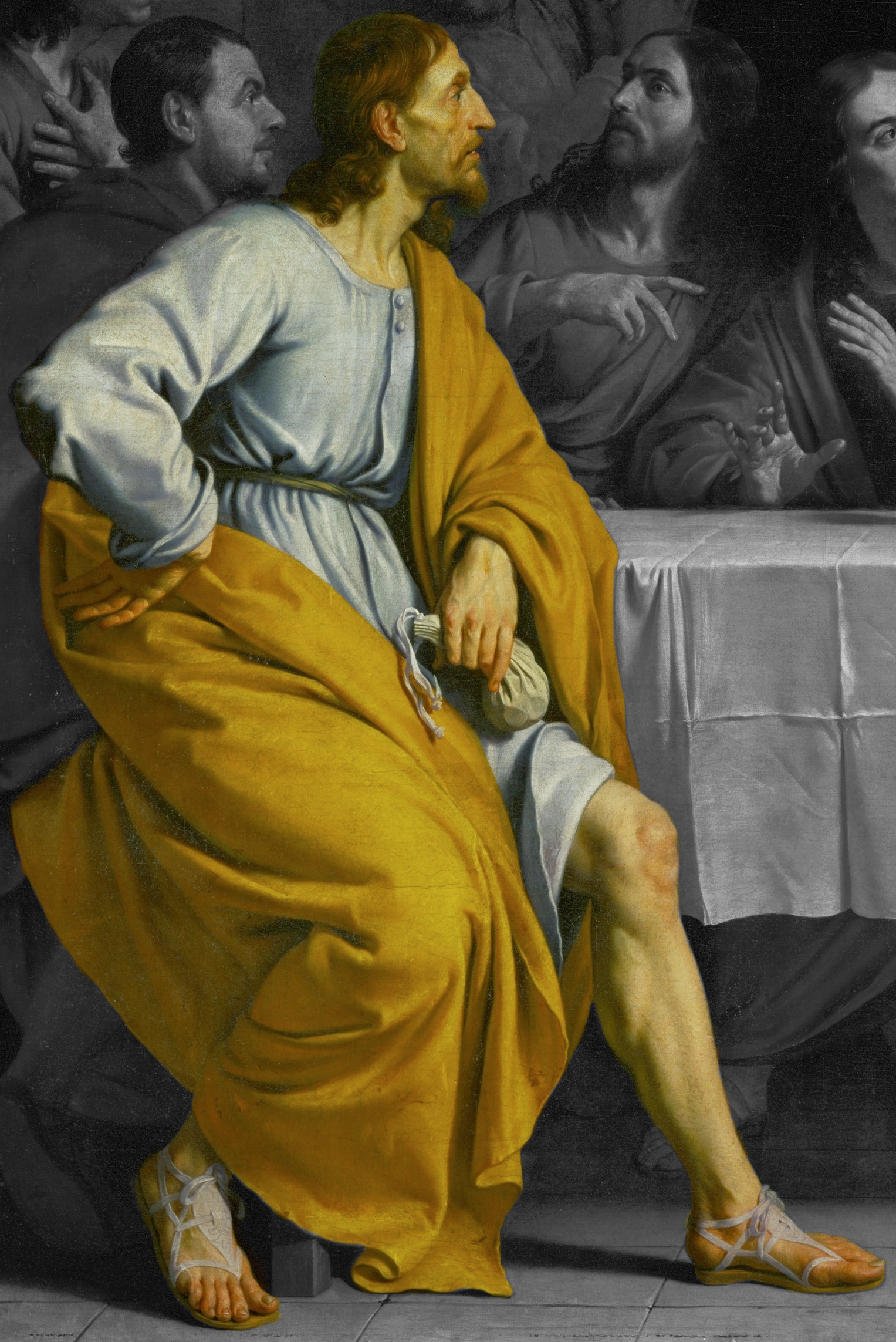
Imagine with me the thoughts of the disciple Judas Iscariot, after he has left the Last Supper while he is on the way to the police. You may wish to click here and read John 13:1-30 before reading the following.

Detail from "The Last Supper" by Philippe de Champaigne, 1648

I let him wash my feet. I knew what I was going to do, and I still let him wash my feet. I could feel the gentle pressure of his hands through the coarse towel as he dried them. God. Gentle pressure: it’s always gentle pressure with him. He touched the dirtiest part of me, and there was no recoil, no disgust. And all the while, I had this strange sense in my gut that he knew what I was getting ready to do. Even though I had decided to go to the police and let them know where they could find him, I still let him wash my feet. I let him serve me, but there was no earthly reason why he should, for I am on my way to betray him.

Betray him. It sounds so ugly when I say it like that. I’m not betraying him: I’m saving myself, saving all of those lazy hangers-on who don’t realize how much trouble he’s getting us into. Peter, who can’t keep his big mouth shut. Thomas, who says he’s ready to die with him, which I doubt. Andrew, Philip, Nathanael, the rest. They have no idea what’s really going on. I’m the only one that sees clearly. I’m giving them the opportunity to escape with their lives. Once he’s out of the picture, the police and authorities will forget all about the rest of us. I’ll be off the government’s most wanted list. I’ll be able to slip back into obscurity. No one will remember my name, and that’s just fine with me.

Will people remember his name after all this is through? He’s just another in a long line of disposable saviors. God. How did I let myself get caught up in all of this? I’m the smart one. I’m the planner. I see into the way of things. And still, he called my name and I followed. I feel so foolish. Foolish and angry. I’ve been angry for so long that I can hardly remember the last time I was at peace. Last week in Bethany, I yelled at Mary for being wasteful with her money, but I would’ve yelled at anyone who gave me an excuse. Why do I feel like this?

I’ve always sensed that I’m different somehow from the rest of them, that I’m on the outside of the group. Last year, he said one of us was a devil, and I’m sure he was talking about me. He didn’t say it outright, but I remember him looking at everyone but me. He always seems to hold me at arms length. I never feel close to him. Until tonight. Until he washed my feet tonight. Until he handed me that piece of bread tonight.

I had to get out of there. I felt this sudden surge of anger in my chest, a feeling of such malevolence, stronger and more foreign than I had ever felt before. He handed me that piece of bread. He handed me himself. God. At that moment, we had our closest connection ever and I understood most perfectly my place in all of this.

I’ve been so angry for so long because his words mean something different for me than for everyone else. I’m the exception. I’m the one who doesn’t count in the total. And he chose me! He chose me for this assignment. He knew all along. I’m not betraying him, no matter what people will say. I’m doing exactly what he wants me to do. I’m his most faithful follower. So why am I shut out? Why am I alone in the darkness?

He chose well. He knew I have the foresight and the stomach to see this through. I could go back. I could forsake the path I’m on. But that – that would be a betrayal. He handed me himself. He is in my hands. And I have to make those hands bloody. Now my anger is my ally. It steels me for the task ahead. As long as I keep seething with this foreign hatred I’ll be able to accomplish what he sent me to do. He told me to do it quickly. Perhaps he thought that I would change my mind if I dwelt on this task too long. But I will not. I will not. I will not. I will keep walking away from him, walking toward his end, walking with clean feet becoming dirtier with each step.

Letting down the nets

(Sermon for February 7, 2010 || Epiphany 5, Year C, RCL || Luke 5:1-11)

I wrote this sermon before a blizzard dumped three feet of snow of my town, so I never got to preach it. Accordingly, here’s a recording of the sermon as it would have sounded. Use the audio player below or download it here.

Imagine with me the Apostle Peter, who is in Rome near the end of his life, thinking back on that day when he met Jesus by the lake of Gennesaret.

“He sounds like my kind of fellow,” I remember saying to the traveler at my stall, just days before I met Jesus in the flesh. The traveler was gossiping with the rest of my customers about the goings-on in his hometown of Nazareth. According to him, an angry mob nearly threw Jesus off a cliff for something he said in the synagogue. That was the first thing I heard about him. Like I said, my kind of fellow.

At the end of the next Sabbath day, I was getting my gear ready to go out on the water, when my brother Andrew burst through the door. He stumbled into the room and panted, “He’s coming here.”

I stared at him, both eyebrows arched. He kept talking: “Jesus of Nazareth. Jesus is coming here.” Then he grabbed me by both shoulders. “I need to tell you, I just saw the most incredible thing: there was a man in the synagogue with a demon that was screaming at Jesus, but he told it to be silent and go, and it did, and the man’s not even hurt.”

He said it all in one breath. I don’t think I’d ever seen Andrew so excited. “He’s coming here?” I said it as a question, and then realization dawned. “He’s coming here.” I looked around the house. I hadn’t realized how dirty my home had become since my wife started taking care of her mother. “Why?” I asked.

His reply came all in one breath again: “Your mother-in-law: I told him about her fever, and how she was getting sicker and sicker, and he wants to help, and I ran ahead, so he should be here any time now.” Right on cue, I heard a knock on the door. I barely remember what happened next. Jesus shook my hand, and ten minutes later, my wife’s mother was cooking dinner like she had never even been sick.

A month later, I met Jesus again, and I remember that second meeting like it were yesterday. We’d just finished arguably our worst night ever. Not a single fish. And we weren’t out there with bait and tackle. We were using trawling nets, and we still didn’t catch anything. To make matters worse, a crowd of people was surging onto the docks, which creaked and groaned under the weight. I looked up from my net and saw Jesus at the front of the crowd, backing slowly toward the end of the dock. I thought about the cliff in Nazareth. Was this crowd trying to drown him? I couldn’t reach him from where I was, so I dived into the water and swam a diagonal to the other side of the pier. He and I reached the end of the dock at the same time. “Simon,” he called, and laughing, he hoisted me from the water.

I could tell by the way he said my name that he wasn’t in immediate danger of being tossed from the pier. “You remember me?” I said.

“Yes, and I also remember you have a boat. It doesn’t happen to be one of these, does it? My friends want to hear me speak, but I’m afraid they might knock me into the water by accident.” He gestured to a pair of boats moored to either side of the jetty and then out to the crowd still pressing onto the docks. “Here,” I said, untying the lines to my boat. We embarked, and I pushed a few yards into the bay.

Then Jesus sat on the gunwale, his legs dangling over the side of the boat, and he began to speak. His tone was casual, like he was speaking just to me, though I expect everyone thought the same thing. I can’t quite remember what he said that morning, but I can remember the feeling. His words got inside me somehow. They got inside me and found a hole that I didn’t even know was there. And they filled the hole. I wish I could explain it better than that, but I’m not an educated man. I just know that those little gnawing fears and disappointments that I always have and my frustration with the night’s fishing mattered less while he was speaking.

When he was finished, he swung his legs back into the boat. “Put out in the deep water and let down your nets for a catch,” he said.

I stared at him. I’m sure my mouth hung open. I was tired and sore and hungry and I just wanted to go home and flop onto my bed and sleep. Or at least I should have been tired and sore and hungry. I was always tired and sore and hungry after a night’s fishing. But that morning, I wasn’t. His words had invigorated me and soothed me and fed me. Of course, nothing Jesus ever said purged me of my natural cynicism, so my response came out with a hint of sarcasm: “We’ve worked all night long but haven’t caught anything. Yet if you say so, I’ll let down the nets.”

I steered the boat to where Andrew sat scrubbing the nets, and he dragged them aboard. We tacked for the middle of the lake and let down the nets. Within minutes, the boat began to list to starboard, groaning under the weight of so many fish. Through my bare feet on the deck, I could feel the small tremors of lines breaking underwater. Frantically, I signaled to James and John in the other boat. Andrew and I began hauling in the nets, and Jesus lent a hand, all the while shaking with unrestrained glee.

My boat started taking on water because of the added weight of so great a catch. I splashed to my knees in front of Jesus. “Go away from me, Lord, for I am a sinful man,” I said. Again, Jesus hoisted me up, saying, “That’s precisely why I’m staying with you.” Then he looked at all of us. We stood there, on sinking boats with torn nets in our hands, looking back at him. “Do not be afraid,” he said, “From now on you will be catching people.”

That day was longer ago than I care to remember, and still I feel ashamed for not understanding those final words until years later: “From now on you will be catching people.” Jesus had cast out the demon from the man in the synagogue and healed my mother-in-law. He had spoken to everyone while making me feel like he was talking to me alone. He was so personal. He healed and loved and encouraged and admonished each individual person he encountered. For years, I thought his personal approach meant he was being selective, like an angler casting for one kind of fish. But I was mistaken.

He told us to catch people – not to fish for them. No selectivity. No specificity. No discrimination. He told us to catch people like we caught fish: throw the nets in the water and trawl for everyone.

Years later, I finally understood this call. I was living at Joppa when I had a vision: I saw a sheet descending from heaven loaded with all kinds of food that I’d never eaten before. The food was unclean according to the law, but a voice called to me: “What God has made clean, you must not call profane.” That same day, a group came and took me to Ceasarea to meet Cornelius the centurion. Cornelius told me about his own vision of a man in dazzling clothes who told him he was remembered before God. At that moment, I remembered Jesus’ words: “From now on you will be catching people.” I looked at Cornelius and all his friends, and I said, “I truly understand that God shows no partiality.”

That day on the lake of Gennesaret, I met Jesus for the second time. He taught a crowd with his legs dangling over the side of my boat. I heard his words, and he filled a hole I didn’t even knew I had. All those years later, his words continued to teach me. God shows no partiality. Jesus told us to throw our nets into the deep water and catch everyone: not just a select few, but everyone.

Like I said, my kind of fellow.

Notes

Special thanks to my friend Steve for unlocking the ideas in this sermon. He writes the blog draughting theology.

Something stronger

(Sermon for June 28, 2009 || Proper 8, Year B, RCL || Mark 5:21-43)

Imagine with me the thoughts of Jairus, the leader of the synagogue, in the aftermath of his encounter with Jesus.

I have been afraid my whole life. When I was little, a scorpion stung my friend, and he died drooling and thrashing in his crib. And so I feared scorpions. When I was old enough to understand the meaning of the scowling soldiers wearing shiny, metal armor, I realized what happened to people who looked at them the wrong way. And so I feared that my father might one day fail to return home. When I met my wife, I feared I wouldn’t be able to provide for her. When I became leader of the synagogue, I feared that I would have no wisdom to share. And when my little girl was born, I feared for her safety every minute of every day. I have been afraid my whole life.

And so when my daughter showed me the tiny, insignificant puncture on her forearm, and she bit her bottom lip to keep from crying out in pain, my world ended. I found the assassin and stomped its hardened, scaly body into the dirt, and then I collapsed – shivering – to the ground. My wife came `round the corner and saw me weeping, the dead scorpion in pieces next to me. She dropped the washing, raced over, and began checking me for signs of a sting. I could barely talk through my heaving: “Not me. Not me. Not me.” She understood and launched herself into the house to find our daughter. I couldn’t go back inside. I rocked back and forth: “Not me. Why not me? Why not me instead?”

Twelve years old, my little girl. On the verge of womanhood. My wife cataloging potential suitors. Me practicing my menacing glare for those same suitors. Twelve years old, and not so little anymore, if I’m honest with myself. She and I used to climb the hill at night, lie down in the scrub grass so that the tops of our heads touched, and name the stars. She always named them after the heroes of the great stories: David and Gideon and Deborah and Esther. “And that one’s you, Daddy.” She always named the brightest one after me. But at the indefinable moment when she began her adolescence, she stopped wanting to climb the hill. I asked her why one day. “That’s kid stuff, Daddy,” she said.

The night the scorpion stung her, I climbed the hill alone and screamed names at the sky – not the names of heroes, but blasphemous names I never thought I could utter. The darkness swallowed my anger, and I don’t know if my obscenities reached their intended target. He created the scorpion: for that, I could not forgive him.

I stalked back home and tapped on my daughter’s bedroom door. My wife opened it, and our eyes met – one empty stare gazing past another. The candle threw swaying shadows on the wall as I entered the room. All my fears were confirmed when I looked at my little girl. She was drenched in sweat, her neck twitched, and her eyes darted from corner to corner. I wrapped my arms around her and put my head on her chest. I could barely distinguish one heartbeat from the next. My wife wrapped her arms around me. Thus I spent the remainder of the night – embraced by the one I love but feeling only the heavy grasp of fear.

I awoke suddenly and cursed myself for having fallen asleep. Dawn was piercing through the gaps in the window’s shutters. I bent my ear to my daughter’s mouth, but the sounds of a commotion outside drowned out the low rasping of her breath. “Vultures,” I growled and my wife woke up. I stabbed a finger at the window: “Here, no doubt, to console us with their wailing performance.”

I looked down at my little girl. I couldn’t just sit there and watch her die. I had to do something. I resolved first to run the vultures off. I had enough grief of my own. I didn’t need to pay someone else to manufacture it. I squeezed my wife’s hand and kissed my daughter on the forehead. So clammy. I banged open the front door ready to unload on the would-be grievers. But the commotion was something else entirely. People were running up the street in the direction of the shore. They were laughing and calling to one another: “Jesus of Nazareth is sighted off the beach. He’s coming here.”

Without thinking, I joined the throng. People recognized me as the leader of the synagogue and let me through. I reached the shore in time to see a fishing boat bump into the shallows. The crowd swelled around the vessel. Jesus’ disciples muscled a hole in the multitude and the man himself stepped off the boat. “Jesus, Jesus,” I cried. But mine was only one voice in a thousand. I feared there was no way he heard me.

Then he turned and gestured to me. His disciples opened a path for him. I fell at his feet. “My little daughter, my little one is at the point of death.” I swung my arm back in the direction of my house. “Come and lay your hands on her, so that she may be made well, and live.”

I didn’t know where the words came from. My fear was grasping at the words in my chest, but something stronger ripped them out of me. The fear fought back, reminding me of last night’s blasphemy. A new fear gripped me – that God had, indeed, heard my anger and would do nothing for me now.

We walked back to my house, but the great crowd slowed our progress. I wanted to run, to sprint home with Jesus keeping up beside me. But then, he stopped. “Who touched my clothes?” he said. I looked at him in disbelief. I wanted to scream: “There’s a thousand people trying to touch you right now. Who cares? My daughter is about to die.”

A woman fell down at his feet and started speaking. She probably spoke for less than a minute, but it was a lifetime to me. As Jesus responded to her, my eyes found my brother and his sons pushing their way through the crowd. “No. No. No.” I started to fall, but my brother caught me and held me tight. “Your daughter is dead,” he whispered. I sagged in his arms. Again, he picked me up. “Come,” he said. “Why trouble the teacher any further?”

I turned back to the woman who delayed me, who kept the teacher from coming to my house on time, and curses curled on the edge of my lips. But Jesus stepped in between us and grabbed my shirt in both hands. “Do not fear,” he said. “Do not fear, only believe.” The stronger something that had earlier ripped words from my chest reflected in his eyes. “Trust me,” he said, and he pulled me along the path to my house. The curses died on my tongue, and I let myself be dragged home to face my own death in the still body of my little girl.

The vultures had come while I was out, but I had no ears for their wailing. And I had no eyes but for my little daughter. Jesus looked around at everyone. “Why do you make a commotion and weep,” he said, “The child is not dead but sleeping.” A laugh erupted from my chest, and it felt utterly foreign in this house, which now had Death for a tenant. But then I laughed again, and I noticed that the laugh didn’t come from my fear. The stronger something caused the laugh. The laugh was my body’s involuntary response to the truth of Jesus’ words.

Jesus took my daughter by the hand, brushed a stray lock of hair behind her ear, and said, “Little girl, get up.” And she did. She walked up to my wife and me and we picked her up and the three of us held each other and turned in circles, laughing and crying at the same time. I looked at Jesus and realized what had ripped the words from me at the beach. Trust. Something about this man radiated trust. No. Not something about him. He, himself, radiated trust. He stared back into my eyes and suddenly I knew that hurling blasphemies at God under the cover of darkness meant that somewhere deep down I still believed. I knew that trust is something entirely stronger than fear. I knew that trust and belief are the antidotes for fear.

Jesus’ own laugh pulled me out of my thoughts. He smiled at the three of us twirling around and said, “She’s had a rough day. Give her something to eat.” My wife rushed off to the kitchen to prepare something, tears streaming behind her as she went. And then my daughter looked up at me, trust shimmering in her eyes. Twelve years old and still my little girl. “Daddy,” she said, “Can we go up the hill tonight and name the stars?”

“Of course,” I said, and I gathered her into my arms.

I had been afraid my whole life. But not anymore.

The new version of me

(A Meditation for Good Friday; April 10, 2009 || John 19:31-42)

Imagine with me the thoughts of the Pharisee Nicodemus on his way home from helping Joseph of Arimathea bury the body of Jesus.

Two years ago, I knocked on a door. I waited until nighttime and wrapped myself in a traveling cloak with a deep hood so no one would recognize me. Was I afraid to be seen with Jesus, who my colleagues branded as a dangerous radical? Yes, but fear was not the main reason for my caution. I was ashamed. I was ashamed to admit that I didn’t have all the answers, ashamed that someone else’s words could make me feel so infantile, like a newborn baby. So I hid myself in darkness, not to protect against prying eyes, but to conceal me from myself. I hid from myself. I hid from the version of me that Jesus was beckoning to emerge from some long forgotten exile.

I used to relish my position on the council, my authority as an arbiter. I took pleasure in the blank looks of acceptance on the faces of my litigants. They invested me with the power to judge, and I failed to notice when that power mutated into self-assured complacency. Predictability became my idol. There was never a new problem to be solved, never something I couldn’t explain or interpret or analyze. Over the years, I forgot how to ask questions because I was always the person with the answers.

Until that night. Until my vestigial curiosity awoke that night. When I first opened my mouth, my council voice came out, and I made a grand statement about knowing who comes from God. I could tell immediately that Jesus was not one to be cowed by my position or impressed by my stature. “I tell you the truth,” he said, “no one can see the kingdom of God without being born from above.”

I didn’t know what to say. I remember opening and closing my mouth several times. I remember Jesus smiling at me – patient, eager. Then my breath forced an “H” sound from my throat, and I was surprised when the word “how” came from my lips. I was asking a question. “How can anyone be born after having grown old?” The floodgates opened, and for the rest of the conversation, all I did was ask questions: “Can one enter into the mother’s womb a second time and be born? How can these things be?”

Ever since that night, I have heard his words carried on the wind. Since the wind blows where it chooses, my idolatrous reliance on predictability has vanished. Since I don’t know where the wind comes from or where it goes, my fantasy that I have all the answers has disappeared, as well. On my way to see Jesus, I was hiding from a new version of me. But everyday, I felt Jesus’ words drawing that new version out of me.

Last year, I reminded my colleagues to obey their own rules. No one on the council had discovered my secret meeting with Jesus, so my position was safe. The two versions of me occupied the same body, and, at that time, the familiar one dominated still. But I had begun to question and look past the veneer of institutional banality.

Jesus had shown up at the festival of booths and caused quite a stir. The chief priests had sent the temple police to arrest him, but they came back empty handed saying: “Never has anyone spoken like this!” I suppressed a smile. He escaped again. The rest of the Pharisees were outraged. One of them shouted: “Surely you have not been deceived, too, have you? Has any one of the authorities or of the Pharisees believed in him?”

A small voice inside me murmured: “I do.” Then a louder voice: “Careful. Careful.” When I spoke, I tried to defend Jesus without giving myself away. “Our law does not judge people without first giving them a hearing to find out what they are doing, does it?” But they were implacable. That’s when I noticed something I would never have seen had Jesus not awakened my curiosity. These colleagues of mine, the keepers of tradition, the self-proclaimed protectors of the Law, were breaking their own rules. I could no longer be party to such bankrupt ideals and blind action. That day, the small voice grew louder, the voice attached to the new version of me.

Today, I buried my Lord. Two years ago, I went to see him at night to cloak my own shame. But today, the sun shines down, unaware that its brightness mocks the darkness in my soul. The sun shines down, and I walk out under its beams so the world can see where my allegiance lies. When first we met, Jesus said to me, “Those who do what is true come to the light, so that it may be clearly seen that their deeds have been done in God.” It took two years, but here I am. Here I am in the light.

See, all you who pass by: I am one of his. I am not the person you knew. I am a new version of me, the version Jesus called out of me. See, all you who pass by: I am not ashamed any more. I feel the wind on my face, and I know his words are true. See, all you who pass by: is there any sorrow like my sorrow. My Lord is dead. It took his death for my old version to die. But will my new version survive with him gone? Will I have another chance to walk in the light? Has the darkness won? Will the light return?

Aaron’s story

Sermon for April 5, 2009 || Palm Sunday, Year B, RCL || Mark 11:1-11

Imagine with me the thoughts of a boy named Aaron whose family owns the donkey, which Jesus’ disciples borrow for his triumphant entry into Jerusalem.

They came up to our farm this morning — two of them — while I was doing my chores. I don’t like mucking out the stable, but Father says it builds character, whatever that means. Mother says when I turn twelve next year, I don’t have to do it anymore. Then mucking will be Benjamin’s job. He’s only eight. We live in Bethany, which is really close to Jerusalem, and Father does a lot of trading there and sometimes he takes me with him.

Anyways, these two strangers just walked right up to Stony – that’s what I call him because he’s gray and hard to move when he has a mind to stay put. They walked right up to him and started untying him. Well, I came out of the stable with my rake and started shaking it at them. And they backed off because they didn’t want to get splattered. I held the rake like a spear and said: “What are you doing with Stony?”

“The Lord needs Stony for a little while, son, but we’ll bring him back soon,” says the first one, and I say right back: “I’m not your son, and you can’t have Stony. He’s mine.”

Then I felt a hand on my shoulder and looked up and Father was standing there. “Actually, he’s mine,” he says. I gave the strangers my best smirk, but then Father says: “And you may borrow the colt for as long as you need.” I threw the rake on the ground: “But, but Father…”

“No buts, Aaron.” And I knew he meant it because he said it in his deep voice. I watched the two men lead Stony away. When they were gone, Father looked down at me: “And don’t ever let me catch you mouthing off to strangers again. You know the story of Abraham and the three men.”

“Yes, Father.” Then he walked back to our house and when he was out of sight I hopped the fence and started following the two strangers. I decided it would be a good idea to keep an eye on Stony, just in case.

They led Stony a little ways toward Jerusalem and met up with a group of people. Then they threw their shirts onto Stony’s back like a saddle and one of the other men got on him. I’ve tried to jump on Stony a lot, but he never let’s me stay on. He jumps and bucks and shakes until I fall off. It’s not fair, ’cause Stony let this total stranger ride him.

I followed the group while they walked to the city. I made it into a game, running from rock to rock and trying to keep out of sight. I ran ahead and beat them to Jerusalem. There was a big crowd lining the road leading up to one of the gates. The people spread more clothes and even some tree branches on the road. They were all shouting and cheering and waving, like at a parade. I didn’t know what was so special about this stranger…except that he could ride Stony without falling off.

I tried to push my way through the crowd to get to the front so I could see better, but there were too many people. I walked all the way down the crowd looking for an opening, and when I got close to the gate, I saw another group of people. They weren’t shouting or cheering or waving. They were in a tight little group talking to each other. They sounded really mad. I heard one of them say, “Who does he think he is, a king?” Then they all laughed, but it didn’t sound like they thought it was very funny.

Then I remembered something I heard from my Rabbi last week. He said something about a king riding a colt like Stony. I crawled under the legs of the crowd and pushed my way through the gate into the city. I ran all the way to my Rabbi’s house, and when he let me in, I asked to see the scroll we were using last week — the prophet Zechariah. He still had it open on the table, but first he made me wash my hands and feet because I was mucking out the stable earlier. Then he helped me find the right place, and I read the lines over and over until I had them by heart: “Rejoice greatly, O daughter Zion! Shout aloud, O daughter Jerusalem! Lo, your king comes to you; triumphant and victorious is he, humble and riding on a donkey, on a colt, the foal of a donkey. He will cut off the chariot from Ephraim and the war-horse from Jerusalem; and the battle bow shall be cut off, and he shall command peace to the nations…”

If that’s right, then Stony is in good hands, I thought. I left my Rabbi’s, and when I got back to the gate, all the people were gone. The parade was over, and I was really hungry, so I walked home. When I got to the farm, Stony was tied back in his place. I tried to jump on him, but he shook me off. I guess only kings can ride Stony.

But what is that stranger king of? Why would a victorious king ride on a smelly donkey and not a chariot or a big warhorse? I guess it might be because the king is supposed to cut off the chariot from Ephraim and the warhorse from Jerusalem. He wouldn’t ride one if he got rid of them all. The chariots and warhorses the Roman soldiers ride scare me. I’m short, and they wouldn’t even see me if I was in front of them.

But if he is king, then doesn’t he need chariots and soldiers to fight all the people who don’t want him to be king – like the Romans and those other people at the parade? Doesn’t he need the battle bow? How can he become king without fighting? How can he command peace to the nations? The Romans always say they bring us peace, but Father says it’s not really peace. Father says we are like prisoners…only without a jail. If the stranger who rode on Stony isn’t going to fight the Romans, how will he bring us peace?

Maybe he’ll bring peace by not fighting.