Eternity happens

The following post appeared Saturday, September 19th on Episcopalcafe.com, a website to which I am now a monthly contributor. Check it out here or read it below.

* * *

‘Jesus said to them, “Very truly I tell you, before Abraham was, I am.” ’ (John 8:58)

You can always tell when Jesus says something truly sensational and scandalous because people respond by searching for rocks to fling at his head. The eighth chapter of the Gospel According to John contains four instances of Jesus saying, “I am,” which is one way Jesus imparts his divine identity to his listeners. Out of the four, only the final one elicits such a stony reaction, while the first three build to the climactic iteration. The escalation begins slowly when Jesus says, “I am the light of the world” (8:12). Next, Jesus says, “You will die in your sins unless you believe that I am” (8:24). Then, a few verses later, he says, “When you have lifted up the Son of Man, then you will realize that I am” (8:28). Each of these statements of his divine identity flies right over the heads of his opponents. But then the conversation intensifies. Jesus says they are from their father the devil. They think he may have a demon. He says no one will see death if they keep his word. They are sure he has a demon. He says Abraham rejoiced to see his day. Now they know that he’s crazy—he’s not even fifty! How can he have seen Abraham?

YHWHThen Jesus knocks their socks off with his most dangerous statement in the whole Gospel: “Before Abraham was, I AM.” This time, no one mistakes his meaning. No one asks him to clarify his words. They understand the full significance of saying, “I AM.” They know God said the same thing to Moses when Moses was brash enough to ask God for God’s name (Exodus 3). But underneath the shocking nature of Jesus’ statement is a subtler point (ultimately missed in the search for stones) about how our eternal God interacts with a finite creation.

Jesus’ “I am” statements in the Gospel According to John are revelations of God’s very being. Because of the simplicity of the sentence (just a subject and a verb), “I am” is as close as language can get to universality and eternity. Since we live in a temporal world, eternity is an impossible concept for us to wrap our heads around. Eternity is not “endless” time; nor is it the framework in which time finds a snug fit. In eternity, before and after are undefined and the only when is now. (The previous sentence makes no sense, of course.)

When Jesus says, “Before Abraham was, I am,” he uses our language to express the eternal nature of God. He does not say, “I was before Abraham was,” which is the grammatically correct way to articulate the thought. Instead, his  “I am” (while functioning in our world as a present tense construction) is really a representation of the eternal tense. In eternity, I AM is the only sentence that makes any sense at all. In other words, eternity happens. It didn’t start and it won’t stop because the notions of beginning and ending are thoroughly temporal. And eternity happens because God is.

We run into trouble when we expect God to exist in the same way we do. Our minutes tick by one after another. For every one of our actions there is an equal and opposite reaction. Objects fall at a rate of 9.8 m/s2. But those are our minutes, our reactions, our gravity, and they all rely on linear experience. When Jesus says, “I AM,” he reminds us that God created linear experience, and thus is not beholden to it.

When we stumble into God’s presence, we encounter eternity making utter nonsense of time. Time ceases to matter because eternity overrides the rules of linear experience. That’s why it’s so hard to say how long we feel the presence of God. We feel that presence in moments, not minutes. When Jesus says, “Before Abraham was, I am,” he pushes us to relinquish our need to order events when God is concerned. God exists in eternity, which just happens.

Footnote

* If you read my last contribution to EpiscopalCafé in conjunction with this one, you might deduce two things: (1) I like to use Holy Scripture to discuss spirituality and (2) I seem partial to the Gospel According to John. These deductions are both entirely correct. As a member of the Millennial generation, I am attracted to the Fourth Gospel’s combination of mystery and revelation. If you have a group of Millennials in your church (right now, that would be your middle schoolers through your college students, give or take) who huff and sigh and roll their eyes every time you pull out the Bible, try some passages from the Gospel According to John. You might encounter fewer glazed looks and drool-flecked chins.

Proclaiming the mystery: John’s first five

The following post appeared Saturday, August 22nd on Episcopalcafe.com, a website to which I am now a monthly contributor. Check it out here or read it below.

* * *

The mystery section was on the back wall of the small independent bookshop at which I worked my last few years of high school. When a customer entered the store, her eyes would glance past the smaller shelving units and fix on the placards proudly bearing the word “MYSTERY.” The shelves containing the mystery section were taller and broader than those holding the other books, and I was the only employee tall enough to dust the top ones without a stepladder. Let’s just say that the manager loved mysteries, so we had a disproportionate number of them. We had humorous mysteries and thrillers, beach reads and stay-up-till-one-in-the-morning nail biters. In those books, a mystery was set forth: say, how did the killer manage to murder someone in a room locked from the inside? The plot revolved around the detective attempting to solve the puzzle. In the end, the detective figured out that the bell rope used to call for the maid was replaced with a poisonous snake, which somehow slithered unnoticed out of the room in the ensuing hubbub of discovering the body. Mystery solved. No more mystery.

The Gospel according to John begins with a mystery, but it is a mystery that is wholly different from the Whodunnits? on the back wall of the bookshop. The mystery that begins the Gospel cannot be solved, cannot be explained away. It can only be unapologetically presented and then unabashedly proclaimed.

rainbowTake a look at the first five verses that John gives us:In the beginning was the Word, and the Word was with God, and the Word was God. He was in the beginning with God. All things came into being through him, and without him, not one thing came into being. What has come into being in him was life, and the life was the light of all people. The light shines in the darkness, and the darkness did not overcome it. (1:1-5; NRSV)

Here John presents the mystery: somehow the Word (who we find out a few verses later becomes enfleshed in Jesus Christ) is in the beginning with God and is also God. Remember in Algebra class when you had to show your work to get full credit? Well, John skips down to the bottom of the page. There is no balancing of equations or solving for “x.” He states the mystery simply: in the beginning, the Word was with God and was God. This is frustrating at first because I’m conditioned to think that mysteries are all supposed to be like the ones on the back wall of the bookshop. I want to know how it’s possible and I won’t be satisfied until I figure it out and if I can’t figure it out then it must not be true.

But I take a deep breath and look at the words again. I read them slowly and speak them aloud. I notice that the rational part of me is sitting in the corner sulking because “with” and “was” should be mutually exclusive. But I find that the creative part of me sees past such mundane things as mutual exclusivity and begins to roll around in the muck of ambiguity. I squelch my toes in the mud, relishing the notion that God lives in a reality where choosing between alternatives is not the only viable option. Of course the Word can be both with God and was God! The limits of my language do not limit God, only my understanding of God. I realize my language skills are not up to the challenge of describing God. And my rational side joins my creative side in the muck of ambiguity because my rationality has been given the license to imagine.

In a few short phrases, John presents the mystery. Then, he deepens the mystery by retelling the story of creation. It’s no coincidence that John uses the same phrase that opens the book of Genesis: “In the beginning.” All things came into being through the Word who was with God and was God. My creative side connects with these verses because they are about creation. Life is created through him, and because I have been given the gift of creativity, I can sense in my gut or in my bones that the Creator is continuing to create me.

This creative force is the light that shines in the darkness. The darkness cannot comprehend or overcome or understand the light because the darkness has never been a part of creation. The darkness is just the absence of any created thing. It tries jealously to unmake created things but fails to triumph since God never stops creating or calling creation to God.*

In these first five verses, John locates us (“life,” “all people”) within the mystery of God and creation, and he presents the adversary of creation, namely darkness. We have the makings of an epic story here.** The seemingly out-of-place verses 6-8 help me realize my role in this story. The mystery has been presented, and now John the Baptizer steps onstage for a brief scene. He is a witness who testifies to the light. (The words “witness” and “testify” are from the same root in Greek; the English word “martyr” comes from it.) His proclamation points to the light, which is the Word made flesh, Jesus Christ. So too, my life, which has come into being through the Word, is meant to be a proclamation of the mystery of God and God’s movement in creation.

When I encounter these first few verses of the Fourth Gospel, I feel the enormity of the mystery of God surrounding me, and I rejoice that this mystery discloses itself in light and life and love. If I could explain the mystery, I would be in danger of explaining it away, of shelving it like the Whodunnits? on the back wall. The mystery transcends explanation. It is elusive, and at the same time intimate; it cannot be grasped, but it can be embraced. The intimacy and the embrace happen when the mystery touches the spark of creativity within me, spurring me to proclaim the Word made flesh, Jesus Christ. Life has come into being through the Word. And my life expands to every pocket and corner of my being when I live to proclaim this good news.

Footnotes

* My apologies for hurling this paragraph at you with no further comment. If it confused you at all, blame Karl Barth.

** I am using the word “story” to convey something that is important enough to be told and retold down through the centuries, something that is about God and about us and is a tale that is never quite finished being woven. Please do not take my use of the word in the sense of “it’s only a story.”

Snapping turtles

The following post appeared Friday, July 31st on Episcopalcafe.com, a website I am very excited now to be a part of. Read the post here or below.

* * *

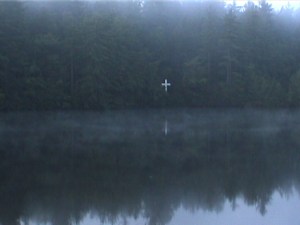
Snapping turtles live in the muddy water underneath a dock that extends into Lake Kanuga. I know this because I have been slowly fattening them up with Wonderbread since I was eleven. I’m 26 now, and (while I’ve doubled my body mass in the intervening years) the turtles remain – stubbornly – about the size of my hand. Misty crossAll but one. There is the “Big One” that rises Kraken-like from the depths and that you only ever see out of the corner of your eye.

For years during the last glorious week of July, my friends and I have gone down to the water’s edge to feed the turtles. We used to sprint to the dock. Now we amble. Once there, we untwist our ordnance and pass out the sliced, carbohydrate projectiles. Some employ the patented tear-and-toss approach, which maximizes the number of pieces for the turtles to eat. Others drop whole slices of bread into the water and count the number of bites necessary to consume each piece.

Within seconds of the bread hitting the water, the turtles surface. Plop. Snap. The first breadcrumb disappears, and ripples are the only evidence the turtle was ever there. Plop. Snap. The second piece vanishes. Plop. Snap. We keep a weather eye out for the Kraken. Plop. Snap. There he is, the Big One, the Leviathan that God has made for the sport of it. Plop. Snap. No, it was just the way the light hit the water. Plop. Whoosh. Snap. Missed him again. Maybe next year. Plop. Snap. Plop. Snap. Plop. Snap.

The turtles propel themselves out of the depths, eyes on the dark spots on the surface. They trap the bread in their little, beaky mouths, and they dive again. They stay on the surface just long enough to snap up their sustenance before retreating to the darkness of the brackish shallows underneath the dock. After years of dropping bread to the turtles, I’ve realized that we do the same. We never stay topside in the sun for too long. We prefer the anonymity of the murk. We prefer to focus only on that bit of bread, a floating shadow above us. We prefer to surface only at feeding time, lest the daylight expose us to all the pesky problems of the world.

Now, I’m pretty sure that the above metaphor is thinly veiled enough that my impending addition of the Holy Eucharist to this discussion will seem both appropriate and timely. Here goes. All too often, we approach our worship with a Plop. Snap. mentality. For an hour and fifteen minutes on Sunday morning, we notice the Wonderbread falling from the sky, and we surface to snap up our fill. Then we dive until next week. Same time. Same place.

The trouble is twofold. First, the Wonderbread, heavenly manna, God’s grace – call it what you will – does not descend on us at predetermined times once a week. However, we condition ourselves to notice it only during those times we’ve set aside for God. We kneel at the altar rail. Plop. We lick the bread off our palms. Snap. In seven days time, we’ll commune again. In the six days in between, we are more than a little oblivious to the fact that God wants to commune with us every day. Indeed, we may say “daily,” but too often we mean, “Give us this day our weekly bread.”

Second, the surface is where the action is. The psalmist prays, “Out of the depths have I called to you, O Lord; Lord, hear my voice.” God’s grace pulls us out of these depths, out of the brackish water underneath the dock. We surface in the brightness of day. As our eyes adjust, we notice all the injustice and desperation and fear that the murk makes easy to ignore. And as we share the bread and cup, we remember that the Body we ingest connects us to the greater body of Christ in the world. Jesus says to his disciples, “ If you walk in the darkness, you do not know where you are going. While you have the light, believe in the light, so that you may become children of light.” Being children of light means remaining on the surface, knowing we share our lives in a larger community, and addressing those inequities that the light throws into sharp relief. We can accomplish none of these if we dive back to the depths – back to anonymity and ignorance – immediately after receiving our nourishment.

When we begin to notice the abundance of God’s grace around us, which pulls us to the light of the surface, we can break out of the cycle of the Plop. Snap. mentality. Silent ripples should not be the only signs that mark our ascent to the surface. Just as God blesses Abraham, God blesses us so we can be blessings in the world. God nourishes us with the bread of heaven so we can nourish others.

At the end of July this year, I will once again amble to the dock to feed the turtles. I will toss the bread into the water. Plop. Ever vigilant for signs of the Big One, I will watch the little, beaky mouths spear the soggy pieces. Snap. And I will pray to God that we can all remain on the surface, paddle there in the light of the sun, and serve our Lord.