
Sermon for Sunday, June 14 2026 || Proper 6A | Romans 5:1-8
It has been about nine months since I preached a sermon about hope, so I think we’re due for one today. Hope is one of those slippery theological concepts because true, enduring hope differs from the more common Pollyanna-ish, reality-defying hope. But since we more often encounter the Pollyanna-ish hope, such a watered down version of hope tends to creep to the forefront of our minds. St. Paul, however, describes a much more hard-won hope, one that begins in suffering. And that’s the hope we’re going to talk about today. Also, a little bit of Calvin and Hobbes, but we’ll get to that in a minute or two.
In today’s reading from Paul’s letter to the church in Rome, Paul says, “…We boast in our hope of sharing the glory of God. And not only that, but we also boast in our sufferings, knowing that suffering produces endurance, and endurance produces character, and character produces hope, and hope does not disappoint us…”
Paul begins this thought with hope. “We boast in our hope of sharing the glory of God.” The King James Version translates “boast” as “rejoice,” which I like better: “We rejoice in hope of the glory of God.” Paul begins here, and then he backtracks. In order to keep his flock from seeing hope in God’s glory through rose-colored glasses, Paul offers a swift corrective. He traces how we must pass through other, more uncomfortable stages on our way to enduring, powerful hope.
Paul starts with suffering, with trials, affliction, and distress. On the one hand, this seems to be a strange sales pitch to this new group of followers in Rome. Who wants to join a group and immediately be told you’re going to suffer because you joined? But again, Paul’s not interested in reality-defying hope; he only wants to talk about hope based in the reality of God. Hard as it is to face, the reality of God does not make suffering disappear. A brand new faith in God does not make cancer go away, it does not stop natural disasters nor thwart oppressors. The very center of our faithful witness is the ultimate suffering of Jesus Christ on the cross. This witness leads to two deeper truths: that in his suffering, Jesus stands with all those who are suffering for all time in every place; and (2) the suffering on the cross is not the end of the story for we have the hope of the empty tomb.
And that leads us to Paul’s second stage: suffering produces endurance. Anyone who has trained to run a long distance will tell you that it begins with suffering: aching muscles, creaking knees, blistered feet. That first run nearly killed you and you didn’t even make it a mile. But after a few more runs you notice the suffering diminishing in direct proportion with endurance increasing. Endurance is always linked to unpleasant things. No one says, “Ugh, I had to endure petting all those cute puppies.” But your friend might say, “Why didn’t we just go for drinks? I had to endure his self-important chatter all through dinner!” Endurance allows us to persevere through difficult circumstances. As children, if our parents shielded us from everything that might cause us to suffer at all, we would never have built up a capacity for endurance.
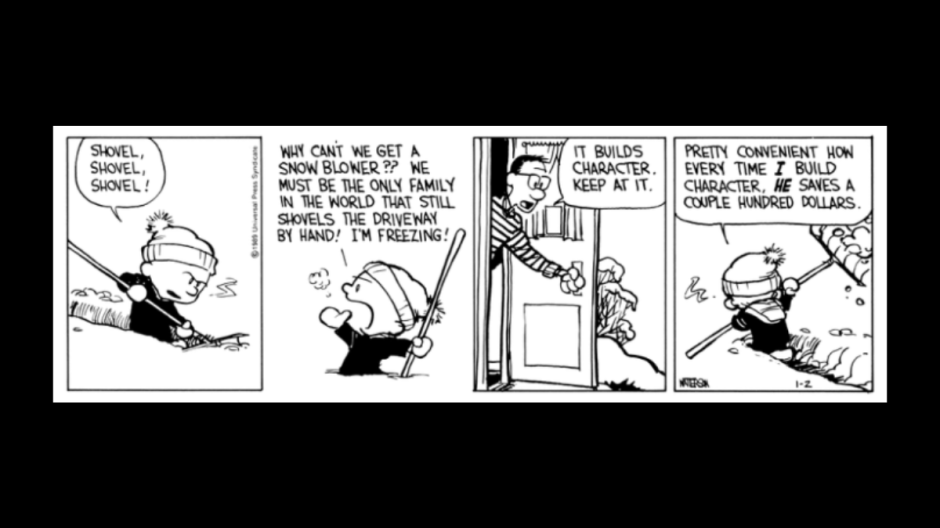
Which brings us to Paul’s third stage: endurance produces character. And this brings us to Calvin and Hobbes. One of the constant punchlines of that brilliant comic strip came from Calvin’s dad, who told Calvin that anything Calvin had to do but didn’t want to do built character. In one strip, Calvin is all bundled up in his winter clothes. He says, “Why can’t we get a snowblower?? We must be the only family in the world that still shovels the driveway by hand! I’m freezing!” His dad pokes his head out the door and says, predictably, “It builds character. Keep at it.” What makes the Calvin and Hobbes gag so funny is that the things Calvin complains about are never that bad: shoveling snow, eating strange foods, trying out for a sports team, going camping. But even in these intensely relatable childhood examples, Calvin’s dad understood that suffering produces endurance and endurance produces character.
Until we face something that tests our abilities, we will never know how far we can go. Sometimes, we go further than we should have to go. When this happens, suffering can overwhelm us. We might call character in these situations by another name: resilience. Resilience is the learned skill of bouncing back from overwhelming suffering. Resilience helps us remember that we are more than the worst thing we have ever endured. And so resilience is the capacity to see a larger picture of ourselves than the narrow frame created by suffering.
This larger picture is called hope. Hope is the God-given expectation that the boundaries of possibility are far wider than they seem. Our eyes see only a tiny slice of the spectrum of light (we call it the visible spectrum), but the spectrum extends both ways to encompass all sorts of other waves: radio waves, microwaves, infrared, ultraviolet, x-rays, gamma rays, cosmic rays. Humans didn’t know about any of these until the 1800s, but they were always there. In the same way, God-given hope expands our perception of reality beyond our limited points of view.
This expansion is the key, and it explains the last part of Paul’s thinking. Paul says, “…Suffering produces endurance, and endurance produces character, and character produces hope, and hope does not disappoint us, because God’s love has been poured into our hearts through the Holy Spirit that has been given to us.”
The word “poured” here has a connotation of gushing, of being filled to overflowing. God’s love overflows the banks of our hearts, flooding us with hope, which allows us to build resilient character, which allows us to gain endurance, which allows us to endure suffering. So, when we say God is with us in our suffering, this is the map St. Paul, with a little help from Calvin’s dad, draws for us.
Only the Pollyanna-ish concept of hope can disappoint us because it is not based in reality. But true, enduring hard-won hope is based in the intense reality of suffering, of loss, of pain. Because only in the depths of those places do we ever have the opportunity to see that, even in the pit, God is there.

