
Sermon for Sunday, June 7, 2026 || Proper 5A
Today is our Youth Sunday at St. Mark’s, and to celebrate we invited the Godly Play kids to ask me any questions they desired. We collected a list of twelve questions, ten of which are autobiographical in nature. We’ll run through those quickly. The last two are absolute theological doozies, so we’ll spend the bulk of this sermon tackling those two. Here we go with the first ten.
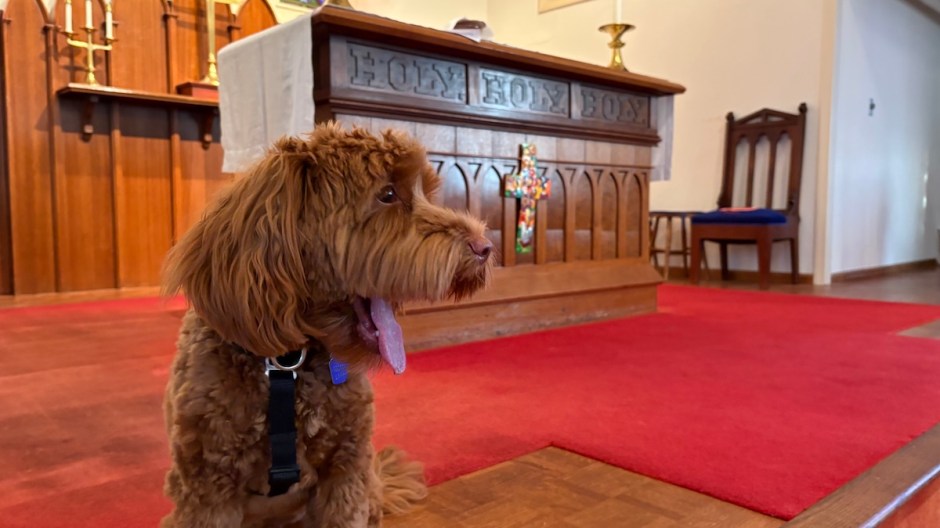
The kids asked what is my middle name. That one’s easy: “Parsons.” What type of dog is Wicket? Wicket is an Australian Labradoodle, which is a breed created in the 1980s in Australia specifically for people with allergies who needed a service dog. How old am I? I am 43 years old, also known as the age when the lenses in your eyes start to harden and you have trouble finding your focal length. How old is Wicket? Wicket will be two years old in October. How long have I been a priest? Next Sunday is the 18th anniversary of my ordination to the priesthood.
How long have I known Stacey? Stacey and I have been friends for ten years, ever since she and Zach showed up at St. Mark’s when she was working at Mystic Seaport. Stacey will be with you all on the Sundays of my vacation next month. Can I speak Spanish or any other language? I can speak English pretty well. I have studied Latin, Greek, and Japanese, but I can’t speak them much. Do I speak my own imaginary language? I love this question. The answer is yes. I created an Elvish language for Dungeons & Dragons. Alre sta yo. “I love you.” Fyarana. “Deep peace.”
Do I know geography? Not as much as I did when I was the geography specialist on my high school’s quiz bowl team. How many times have I read the Bible? I’m not exactly sure on this one. I think it’s four times, and I’m working my way through Number Five while recording The Bible in 10.
Okay. Those were the kids’ easy questions. Are you ready for the two theological doozies? Here they are: Why didn’t Jesus save himself from the cross? And how old is God? I told you that kids ask great questions. We’ll dig into both of them for a few minutes each.
Why didn’t Jesus save himself from the cross? Based on his own words, he certainly could have. During his arrest, he tells his friends to put away their swords and not to fight back. Then Jesus says, “Do you think that I’m not able to ask my Father and he will send to me more than twelve battle groups of angels right away?” He continues, “But if I did that, how would the scriptures be fulfilled that say this must happen?”
So, at first glance, Jesus doesn’t save himself from the cross because he believes he is fulfilling something the old prophets wrote about. A piece of the writing of the Prophet Isaiah is most often looked to as the scripture Jesus is fulfilling. One of the verses says, “He was pierced because of our rebellions and crushed because of our crimes. He bore the punishment that made us whole; by his wounds we are healed” (Isaiah 53:5). Using verses like this one, we might describe Jesus as pulling all the sins of the world – that is, all the things that separate us from God and each other – Jesus pulls all that sin to himself like a magnet and nails it to the cross with him. Then all that sin gets buried with him, and when he rises again, the sin stays buried in the tomb because nothing in all of creation can separate us from the love of God. When we think about the cross like this, we see that Jesus didn’t save himself because he was more concerned with bringing all of Creation back into a right relationship with God.
Another way to think about why Jesus didn’t save himself has to do with the other two people who are hanging on crosses next to Jesus. These two guys were bandits who were upsetting the Roman rule by robbing caravans up and down the countryside. One of them hurls a desperate insult at Jesus, saying, “Aren’t you the Christ? Save yourself and us!” But the other recognizes Jesus’ innocence and pleads, “Jesus, remember me when you come into your kingdom.” And Jesus responds, “I assure you that today you will be with me in paradise.”
“You will be with me” are the important words in Jesus’ statement. Jesus has willingly fallen to the lowest status possible – a criminal being crucified – in order to be with everyone, especially those whom an unjust society has punished or oppressed or forgotten about. Jesus won’t save himself from the cross because he is there to be with the criminals who are crucified next to him. This is the action that his nickname “Emmanuel” means: “God with us.” There is a special English word for this action. It is “solidarity,” which means to stand with other people, even if you yourself are not directly harmed by what is harming them.
So when we look at why Jesus didn’t save himself, we can see he was working both to save all of Creation AND to save that one guy hanging there next to him. And that’s just how God always acts: in big universal ways and in small personal ways.
Which brings us to our second theological doozy. How old is God? This is a tricky one due to a word we use to describe God: “eternal.” This word doesn’t mean really, really, really old. It means something closer to “timeless,” meaning “without time.” We can’t use time words to talk about eternal things, words like “old” or “ancient.” This doesn’t stop us from trying though. For example, one of God’s nicknames in the Bible is “Ancient of Days” (exclusively in the Book of Daniel).
We think of God as old, and artists have often depicted God as an old man with a long white beard. But these pictures of God just show the limits of our imaginations and our ability to understand eternity. God is timeless, not old. And God’s not a man; God is God. So, my response to the question “How old is God” is complicated because God doesn’t have an age. God has been acting in Creation for 13.8 billion years, which is the current scientific consensus of how old the universe is. But this doesn’t account for possible universes before ours or other universes running at the same time in alternate dimensions.
In the end, this is where my mind takes me when I think about how old God is. For God, everything that we experience as time – the past and the future – is always happening in God’s present. Therefore, God is always Now. God is present to all of Creation all at once, every time and every space. And that means God is Now years old.

