
Sermon for Sunday, March 23, 2025 || Lent 3C || Exodus 3:1-14
I need to apologize in advance for this sermon because it is going to be both theologically and grammatically dense. Today we’re going to talk about God’s response to Moses when Moses asks God what God’s name is. God has just given Moses his mission to bring the Israelites out of Egypt and lead them to the Promised Land. Moses is aware of his severe lack of credentials, so he says, “If I come to the Israelites and say to them, ‘The God of your ancestors has sent me to you,’ and they ask me, ‘What is his name?’ what shall I say to them?”

“WheretheWind.com Sermon” on your podcast app of choice.
God answers Moses with a cryptic phrase that we translate into English as “I Am Who I Am.” God then says, “Thus you shall say to the Israelites, ‘I Am has sent me to you.’” For the next few minutes, I’m going to break down this cryptic response and then talk about how it impacts our walks of faith. But first, because this is a grammatical sermon, I want to talk about the word “God.”
Over the years, you might have noticed that I do not use pronouns for God in my sermons. You have to go back to the very earliest days of my priesthood to find an instance of my calling God “him” in a sermon. The closest you’re going to get is when I’m quoting someone else, but even then I usually massage the quote away from the pronoun. There are two reasons I do not use pronouns when I’m talking about God.
First, God is bigger than we can imagine and applying human notions of gender to God artificially diminishes God’s infinitude. While we are made in the image and likeness of God, that does not mean God has a humanoid form through which to express a gender identity. The “image” of God is our ability to imagine and create; the “likeness” of God is our souls’ eternal nature. Neither of these has to do with gender. Also, the ancient languages the Old Testament was written in handle pronouns differently than English, so when you see a “default male pronoun” for God in an English translation, the original language is not necessarily a masculine word. Jesus’ use of the word “Father” in the Gospel is more about relationship than gender identity. The Greek word in the Gospel has a gender but the Aramaic word Jesus used in his actual speech would have been more layered and complicated. Throughout Christian history, God has received a male pronoun because of patriarchal norms, not because of any deep truth of who God is.
Second, I do not use pronouns for God because I consider the word “God” a pronoun itself. A pronoun is a word that stands in for a noun that was referenced earlier. So, the way I look at, the word “God” stands in for the “Being of Oneness, Love, and Light that is the Foundation of All Creation and Who Continues to Speak Creation Into Being and Call Creation Back Into Right Relationship and Fulfillment.” But if I abbreviated that as the BOOLALITFOACAWCTSCIBACCBIRRAF, that’s still a mouthful. So I say “God,” knowing that my use of the word “God” is standing in for something beyond my ability to comprehend that sustains me being.
So that’s why I call God “God” and don’t use English pronouns. Let’s get back to Moses. God says God’s name is “I Am Who I Am.” This name is really a construction of the basic verb “to be.” And in Hebrew it has the added benefit of sounding like an exhale when you say it out loud. So God’s name is intimately tied to our breath and our being. The word “being” is interesting because it is the verb “to be” with the continuous tense suffix “–ing” added to it. So a “be-ing” is something whose living essence continues. As the Foundation-of-All-Being, God is the genesis of all there is and the Ultimate Source of our Being. So when God says, “I Am Who I Am,” we could also translate the name as “I Create What I Create.” God’s name, then, communicates that God is the Creator and Sustainer of all that is.
In addition, the name “I Am” is the absolute shortest a complete sentence can be in our language. Subject: I. Verb: Am. This is the fundamental sentence upon which the rest of our language system rests. Likewise, God is the Fundamental Being from which all subsidiary being springs. When you feel fully awake and alive, you are connecting more deeply with this Fundamental Being which is the Source of Aliveness.
In the Gospel According to John, Jesus demonstrates his own connection with God by quoting God’s name over and over. “I am the bread of life. I am the light of the world. I am the Good shepherd. I Am. I Am. I Am.” The writers of the Gospel consciously link Jesus’ divine identity back to the identity God shares with Moses at the burning bush. Jesus is the divine “I Am” and the human “i am” at the same time, 100% of both, with neither subsuming nor diminishing the other.
I told you this sermon was going to be full of theology and grammar. Again, I’m sorry. As we turn towards the end of the sermon we reach the “So What?” question. What does all this have to do with us as followers of Jesus? Recognizing that our being (our essence or spark or soul) springs from the Foundation of All Being that we call God – recognizing this truth comes with some responsibilities. For one, we embrace the revelation that all of Creation (and not just us humans) derives its existence and its sustenance from the God who said, “Let there be light!” And so the revelation of God’s name is also the call to our mission to protect and nurture the integrity of our precious environment.
Second, recognizing our own “be-ing” is contingent on recognizing the “be-ing” of other humans. God is the Foundation of All Being, which includes you and me. So when I claim my own being, I must also accept your being. This is the awakening of dignity, the fundamental recognition of personhood or what we might call “belovedness.”
Third, the fact that God’s name is essentially a verb reminds us that our faith in God is active and kinetic. Faith is not something we have. Faith is something we do. Rather than being a prerequisite for a proverbial “faith journey,” Faith happens when we walk the Way with God. As one of my favorite spiritual writers Brian McLaren says, “We make the road by walking.”
Okay, that’s enough theology and grammar for one day. In the end, remember that God is the Foundation of All Being, the soil from which our trees’ roots grow. We have our be-ing because God continues to speak our existence into reality. And the good news is this. From the first moment when God spoke Light into being, God has never stopped speaking.
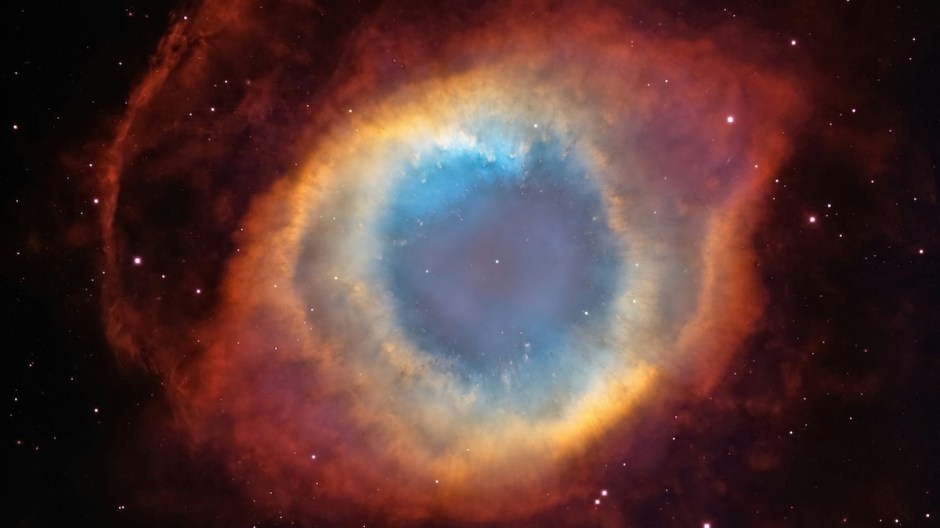
Photo by NASA Hubble Space Telescope on Unsplash. (The Helix Nebula)
 Where the Wind...
marvelous! 87The Capacity to Act