The ministry intern at St. Mark’s preached yesterday, so I have no sermon to offer to the Internet this morning. Instead, I held on to the following for just such an occasion, and I am glad to share it today. In August, I attended a training event called Living in the Green up in Hartford. It was a lovely training, which paired personal storytelling and deep sharing of convictions, values, hopes, and dreams with some nuts-and-bolts activities designed to move abstract conviction into concrete action. We had some time to journal following a session on the second day, during which I had been caught by the phrase “to pay attention.” That phrase was the genesis of the following poem which I wrote over the course of the hour or so following the session. I shared it with my colleagues at the training and now am happy to share it with you.
The Box Garden (August 20, 2015)
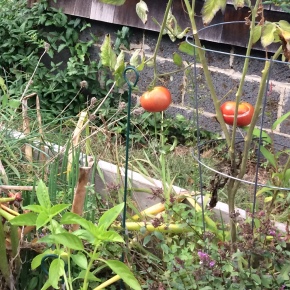
The tomato plants in the box garden
are fruiting right now.
When I walk up the back steps,
I see, peeking among the shoots,
a slippery red – here and there –
and my heart rejoices.
And before I pick the ripe ones,
before I even walk to the box,
I can taste the acidic sweetness
and feel the pulp roll around my tongue.
Each day, I anticipate seeing new ripeness,
and some days I am rewarded.
But not every day.
Some days the tomatoes are there,
but they are still green,
still growing, still emerging.
And from the back steps I can’t see them.
The next day a shock of red arrives,
and I know the tomato was there yesterday, too,
but it wasn’t ready yet.
The tomato was there, but camouflaged,
hidden until its taste blossoms
to meet the bite in my imagination.
Other days I have my head down,
and I trudge up the back steps
with the weight of too many lives
leadening my feet.
On those days, I don’t lift my eyes
to survey the box garden.
The dash of red dances on the periphery
of my vision, but I don’t acknowledge it.
Instead, I go inside and slump down.
And the next day,
the red remains, but its luster is gone.
It has rotted on the vine
like stored up manna.
And all because I was too caught up
to pay attention.
“Pay attention.”
It’s a curious phrase.
There is a transaction at stake,
A cost to be paid.
That cost is my “attention”;
my willingness to engage
Perceive
Embrace
Dwell
Awaken.
If I have paid this cost,
I wonder what I get in return.
A life lived in God, certainly.
But there is no quid pro quo here.
The presence of God abides always –
Awakens in me, awakens me.
And so the goods I receive
and the cost I paid
are one in the same.
My capacity to remain awake to God
is the first gift,
which allows the tasting of all others:
The acidic sweetness, yes,
And also the saltiness of tears,
the meaty savoriness of ragged love,
the bitterness of brokenness,
The broken bread, the cup poured out.
I pay attention when I lift these gifts to God,
or at least I try to.
I smell the flour
stuck to the round loaf
to keep it from sticking to the pan.
I smell the wine, too,
redolent of celebration.
I pay attention to each pair of hands
that receives the bread of heaven,
and I know that as I place it in those hands,
it is the Body of Christ.
But today is not Sunday,
And so I try to pay attention to other things:
The seagulls cartwheeling overhead,
the tangled man asleep
on a stone bench in the town square,
the box garden as I climb the back steps.
And for today, I know the reward
for my paying attention.
Today, it is one ripe tomato.
Sermon for Sunday, September 20, 2015 || Proper 20B || Mark 9:30-37
Every day of my fourth grade year, my class lined up at the end of recess to go back inside. The bell rang, and we raced to our spots in the line. But the race was in vain because no matter who arrived at the door first, we always lined up alphabetically by last name. By last name. What I wouldn’t have given to line up by first name. Then (Oh happy day!) I would have been at the very front of the line. No Aarons or Abigails in my class. No. Adam would have been the first name on the list. But those days were cruel. Every morning, I stood on tiptoes to see over the twenty-three heads in front of me, and only one boy – Shane Yellin – was worse off than I.
Then, on the day when all the mothers began insisting their fourth graders wear winter coats to school, something happened. Mrs. Ida Hughes, my math teacher, challenged us to line up in reverse alphabetical order. And for one cold, drizzly, glorious day, I stood at the front of the line and only one head obstructed my view of the playground doors.
Standing at the front of the line feels good and the benefits are numerous. Being in front means the concert tickets aren’t sold out. The first baseman hasn’t tired of signing autographs. The bucket of fried chicken at the church potluck retains its full complement of chicken legs. Certainly, perks abound for those in front. Go to any shopping center in the wee hours of the morning on the day after Thanksgiving and witness the millions of Americans attempting be first in line simply to purchase new TVs for “doorbuster” prices.
Of course, these benefits are all about me. I get the tickets and the autograph and the preferred piece of chicken. I get the deal on the television. I get all these things because I got in line before you. You are behind me and someone else is behind you and countless faceless others line up behind that someone else. So we stand in our line and stare at the backs of the heads in front of us. In this linear configuration, no one can converse. No one can relate. No one can do anything more than slowly shuffle forward, both surrounded and isolated at the same time.
This isolation is the danger Jesus envisions when he places a little child among his disciples. They’ve been arguing about which one of them is the greatest (in other words, which one of them should be first in line). The prevailing linear culture has thoroughly molded the disciples. They only understand relationships in terms of hierarchy based on class, gender, and age. But they’ve been hanging around Jesus long enough to know that Jesus is thoroughly countercultural. He talks with women. He eats with outcasts. He touches the unclean. And so the disciples lapse into embarrassed silence when Jesus asks them about the content of their argument. They know they’ve provided Jesus with what would now be called a “teachable moment.”
The disciples expect something countercultural and that’s exactly what Jesus gives them: “Whoever wants to be first must be last of all and servant of all.” To illustrate the revolutionary nature of this statement, Jesus brings a small child and places the child among the disciples – not before them or after them, but among them. In Jesus’ day, this child was the last of the last. The hierarchy of the society placed children just below farm animals because you could get a lot more out of a goat than a toddler, and the goat would probably live longer. Children had no rights or protections. They weren’t even considered people until they were old enough to work.
But Jesus ignores this cruel stratification when he says: “Whoever welcomes one such child in my name welcomes me.” Jesus commands his disciples and us to welcome those whom society deems lowest of all. With this welcome comes the opportunity to see the faces and learn the stories of those who until now were at the end of the line, too far removed from us to register on our radar. And as we hear the stories of the lowest and the last, we seek ways to serve them and serve with them.
But one of the greatest mistakes of our time has been the Western presumption that we know what’s best for the people we serve: “You might not have said you need a well in your village, but we’re going to come and build one anyway.” This imperialistic attitude only perpetuates the linear model, which our service should be attempting to supplant. However, with his command to welcome, Jesus doesn’t allow us to develop a “serve first and ask questions later” mentality. Welcoming provides the framework through which service leads to the building up of relationships.
With his emphasis on relationships, Jesus changes the existing linear model into a circular one. In the line, you can’t welcome anyone because all you see are the backs of heads. You can’t serve anyone because the implied hierarchy of the line makes isolation the norm. You can only count the number of people ahead of you and nurse your own indignation over your rotten place in line. But in the circle, there is no first and no last. We can grasp hands in welcome precisely because we will be unable to quantify our position in the continuous round. And relationships have a chance to flourish because we look not at backs but at each other’s faces.
This circular model of welcome and service stands in laughable contrast to the current situation in this country. Too many incidents to count show that the tired old scourge of racism is alive and well. The drive to produce leads to longer hours, more work, and more money, but assuredly less happiness, less camaraderie. The gap between the rich and the poor grows ever wider. Each of these examples depends on the linear model continuing to thrive. And it is. So here we sit with our Lord challenging us to do something, which the loudest voices on the other side of those doors claim is utter nonsense.
To be first you must be last of all and servant of all, he says. Let go of linear relationships based on power and ambition and embrace circular relationships based on welcome and service. If you are standing near the front of the line now, start walking to the back. Grab the hand of the last person in line and form the circle. Welcome the least among us. Listen to their needs, their desires, their dreams. Form new relationships. Partner with them in service because we are only as strong as our weakest members. Jesus invites us over and over again to accomplish these things. And Jesus never issues an invitation without simultaneously offering the gifts needed to embrace it.
So to every fourth grader lining up after recess and to every businessperson lining up at Starbucks and to everyone whose ambition blinds him or her to those standing on tiptoes in the back: Give up your place in line.
Sermon for Sunday, September 13, 2015 || Proper 19B || Mark 8:27-38
This week has been a particularly tough one for our twins, Charlie and Amelia. At thirteen and a half months, we think they are cutting their molars, so their extreme fussiness is understandable. On Tuesday, I walked in the door of the kitchen, and before I had taken three steps, Charlie was toddling up to me as fast as his little legs and precarious balance would allow. He ran into me and buried his head between my knees, which is his way of saying, “Pick me up, Daddy.” I hefted him into my arms. He put his arms around my neck and his head on my shoulder. And for the next twenty minutes, I just walked around, holding him and speaking softly into his ear. It was a special moment, a physical heart to heart.
The next morning, I was preparing to write this sermon and reading Jesus’ question over and over again: “Who do you say that I am?” And this question about identity got me thinking about Charlie, about how he would answer the question if it were asked about me. Who does Charlie say that I am? I think Charlie’s answer and Peter’s answer share a lot in common.
You see, Charlie’s first word was “Dada.” Early on he used it for everything, so it wasn’t really my name, it was just what he said. Then, as the months progressed, Charlie’s collection of sounds increased, “Dada” became “Daddy,” and, for the most part, focused in on my personage. He says “Daddy” in the sweetest, high-pitched singsong that melts my heart like butter. And yet, I wonder what his toddler’s mind imagines when he identifies me.
Judging by the way he wanted to be held on Tuesday, the way he clung to me so fiercely, the way he calmed down immediately when he was safe in my arms, I think I have a lot to live up to. In his eyes, my identity must be larger-than-life. I am, quite literally, the largest person he sees regularly. And I’m not around as much as Mommy, so there’s an air of mystery to my presence, a rock star quality. I’m a super hero. I just don’t have any super powers. I can remember the exact, illusion-bursting moment in my own adolescence when I realized my parents were not the infallible super heroes I always took them for. And I wonder when Charlie and Amelia will figure that out about me.
Identity is a tricky, slippery thing. Our identities are multi-faceted. They are synthesized and refined and redefined throughout our lifetimes as we gain new skills and interests, as we adapt to new circumstances and relationships, as we deal with success and failure. For example, for nineteen years (about 60 percent of my life) “student” was the most important facet of my identity, but no longer is. The importance of one facet of identity might rise or fall in direct proportion to another. My identity as “sports fan” has fallen significantly with the rise of my identity as “father.” Identity is also a negotiation between what we think about ourselves and others’ expectations of us. If someone asks me, “Are you a golfer,” I always respond the same way. “I own golf clubs.” I don’t want that person to generate an undue expectation of me, as someone with a handicap less than the maximum.
The reality (or unreality) of expectation is where Charlie’s and Peter’s answer to the question converge. Who do you say that I am? You are the Daddy: bottle giver, tantrum calmer, crib rescuer, super hero! You are the Messiah. And while Peter doesn’t expand on this identity, his reaction to Jesus’ explanation of it shows us what Peter’s expectation is. You are the Messiah: Israel’s deliverer, Rome’s exterminator, mighty warrior, sure victor. It’s no wonder Peter takes Jesus aside to clarify things. Jesus is obviously mistaken. Had he heard Peter right? Peter had said “messiah,” not “sacrificial lamb,” not “victim.”
Bur Jesus had heard Peter. Jesus could sense the underlying expectation of such a baggage-laden identity as “messiah.” That’s why he starts speaking openly for the first time in the entire Gospel. He needs to clarify things. He needs to make sure his disciples know just what he thinks the identity of “messiah” means. If he had wanted to live into the militaristic expectation of “messiah,” he probably wouldn’t have recruited fisherman. “Look around,” he seems to say to his disciples. “I don’t have an army. I have you guys. I haven’t been fighting. I’ve been healing.”
We follow Jesus precisely because his expectation of “messiah” runs counter to Peter’s. We follow Jesus because he chose not to fight. We follow Jesus because he gloried not in destruction, but in resurrection, in new life, in deep relationship that lasts beyond death. That’s Jesus identity as “messiah.” He suffered not because suffering is good, but because suffering was the natural outgrowth of his taking on the isolating, dominating, death-dealing machinery of this world. We follow Jesus because we believe he won that fight by not fighting back, by not fighting fire with fire, but by clogging the machine with the love, grace, and peace of God.
And that brings us to our own identity as followers. “If any want to become my followers,” says Jesus, “let them deny themselves and take up their cross and follow me.” It’s quite possible this isn’t what we signed up for. It’s quite possible we expected more comforting words. Perhaps we expected Jesus to say, “Come to me, all you that are weary and are carrying heavy burdens, and I will give you rest.” Perhaps we expected Jesus to say, “Remember, I am with you always, to the end of the age.” Perhaps we expected Jesus to say, “I came that [you] may have life, and have it abundantly.”
Well, the good news is this: Jesus does say all those things. It is these promises of rest and relationship and abundant life that make us able to accept his strident expectation of identifying as his followers. Denying ourselves means letting go of our stranglehold on our own lives – our self-determination, our bootstraps mentality – in order to allow Christ to live in us. And when Christ lives in us, we find we can resist the machinery of this world. We take up the cross because from the cross Jesus beckoned everything that’s wrong with this world to come die with him. When we come to the cross, we come face to face with all the manifestations of evil, snarling in its death throes. It’s a scary place, teeming with poverty, racism, disease, violence. But this is the place our followers’ footsteps lead us because this is the place we partner with Christ to bring resurrection and new life.
Someday, Charlie is going to realize I’m not the super hero he thought I was. That expectation will crack, and our relationship will change. Some days, we follow Christ more closely than other days. Some days, the identity of follower takes us to dark places, despite our expectations. But that identity takes us there because part of being a follower is being a light-bearer to such darkness. The light we bear is the light of Christ, our healer-messiah. And our identity as followers is safe in his hands because no amount of evil or darkness will ever extinguish his light.
Sermon for Sunday, September 6, 2015 || Proper 18B || Mark 7:24-37
You might be wondering if I accidentally read two weeks worth of Gospel lessons just now. The story of Jesus and the Syrophoenician woman ended satisfactorily, and at that point I could have said, “The Gospel of the Lord.” But the appointed lesson for today barrels forward into the next story, as well, and we read about Jesus healing a man who cannot hear and can hardly speak. We could focus on either half of this Gospel reading: there surely is enough in each to fill out a sermon. But today, I’m going to break a rule of preaching and bite off more verses than I normally do because I think the Gospel writer Mark places these two stories side-by-side for a reason. And this reason centers on the strangest word in the passage, a word that itself needs to be translated because Mark chose to preserve Jesus’ original language when he wrote it down. That word is “Ephphatha”: Be opened. Openness is the key to these two encounters. And openness is one of the keys to our lives as followers of Jesus Christ.
But before we get to openness proper, we need to address the historic challenge of the first encounter in our passage. For hundreds and hundreds of years, faithful readers of scripture have had more trouble with the story of Jesus and the Syrophoenician woman than almost any other story in the Gospel. The main issue boils down to this: Jesus seems to change his mind after the woman’s response to his rather rude statement about dogs eating the children’s food. If Jesus is who he says he is, the argument goes, then how could he possibly be induced to change his mind? Wouldn’t that be tantamount to saying he’s wrong about something?
You can see why people of all stripes – scholars, clergy, laypersons – have trouble with this story. It has always made me a little spiritually itchy, as well, to be honest. And because of this trouble, people throughout history have used some (shall we say) flexible interpretive gymnastics to bend the encounter until it fits into their conception of who Jesus is. “Jesus was going heal the little girl all along,” says the most common acrobatic interpretation. “He was just testing her mother.” Another goes: “Jesus is simply moved by her plight. That’s why he gives in to her request.”
While these might be fine interpretations of the passage, they miss the simplest explanation entirely because they are not open to the possibility that Jesus might just be wrong in this case. But let’s for a moment step out of this history of interpretive gymnastics and imagine such a possibility. Let’s see if there is some good news in a story about Jesus being wrong and changing his mind.
The first thing to notice is the status of the other person in the encounter. Right away, Mark gives us three reasons why this woman would normally be dismissed in Jesus’ day and age (and perhaps ours, as well). She’s a woman. She’s a foreigner. And she has a child with some challenges. That’s three strikes, three excuses others would use to marginalize her. And this is the person who teaches Jesus something.
She comes to Jesus and implores him to cast the demon out of her daughter. He responds with what sounds like a stock retort of the day, complete with ethnic slur (and let me assure you, “dog” is the mildest translation of the word). But the woman takes the slur and turns it around, in effect saying: “Listen to me. Take me seriously. I might not have a seat at the table but I deserve to be fed.”
And then something astounding happens. I imagine Jesus standing there, dazed for a minute, then his features softening as he realizes how closed off he is being, how stuck in a cultural norm, how unlike his usual self who is always pushing boundaries and rubbing shoulders with outsiders. The woman’s response jars him out this unusual narrowness. “Good answer,” he says – not just because it gets her what she wants but because it also helps Jesus reassert his normal posture of openness.
The beauty of living a life of openness is illustrated in the next encounter. People bring to Jesus a man who cannot hear and can hardly talk. Jesus looks him over, touches him, and says, “Ephphatha”: Be opened. Immediately, the man is able to hear and speak. Jesus could have said any number of things to heal this man. Or he didn’t have to say anything at all. And yet the word he chooses is a word of openness. That’s what’s on Jesus’ mind when he heals the man – not just the mechanical action of opening his ears and releasing his tongue, but the greater reality that open ears convey, the deeper meaning of Ephphatha.
Be open. Do not let your preconceptions deafen you to new ideas. In our world today, we can pick and choose the voices who influence us, and human nature pushes us towards voices we already agree with. The arguments we expose ourselves to in such a partisan climate often pit the best of one side against the worst of the other, or else have no basis in reality in the first place. The loudest voices in the media are always the most extreme. And yet underneath that layer of bluster, there are other, quieter, smarter men and women who disagree with each other and take the time to appreciate and understand one another’s views. They may not change their minds like Jesus does in the story, but the openness exists, nonetheless.
Be open. Do not let innate tribalism keep you from getting to know people unlike yourself. We all fall into this trap. We like people who remind us of ourselves. This isn’t a bad thing at all. But it’s also not the only thing. Rubbing shoulders with people unlike us – in whatever way the differences present – has a way of broadening us, giving us greater awareness, growing in us more empathy, more solidarity. It’s no wonder that the person who reminds Jesus of his usual openness is so unlike him.
Be open. Pray for the trust that leads to openness. Open your hands to receive. Then open your hands again to give. Walk with your arms outstretched, open to embrace the call God places in your heart. Ask God to open your heart to welcome whoever walks across your threshold, to listen to experience that differ from your own, to learn what others have to teach.
I truly believe Jesus learned something that day from the Syrophoenician woman, or perhaps remembered something he had forgotten. She teaches him to embrace his openness and then returns home to a demon-free daughter. Jesus returns home, too, and meets a man who is physically closed off. Be opened are his words of healing to that man, who then cannot contain his raucous proclamation. And just as Jesus lived a life of openness to God and to those people whom most never bothered to see, Jesus gives us the same invitation today. Ephphatha. Be open.

 The ministry intern at St. Mark’s preached yesterday, so I have no sermon to offer to the Internet this morning. Instead, I held on to the following for just such an occasion, and I am glad to share it today. In August, I attended a training event called Living in the Green up in Hartford. It was a lovely training, which paired personal storytelling and deep sharing of convictions, values, hopes, and dreams with some nuts-and-bolts activities designed to move abstract conviction into concrete action. We had some time to journal following a session on the second day, during which I had been caught by the phrase “to pay attention.” That phrase was the genesis of the following poem which I wrote over the course of the hour or so following the session. I shared it with my colleagues at the training and now am happy to share it with you.
 Every day of my fourth grade year, my class lined up at the end of recess to go back inside. The bell rang, and we raced to our spots in the line. But the race was in vain because no matter who arrived at the door first, we always lined up alphabetically by last name. By last name. What I wouldn’t have given to line up by first name. Then (Oh happy day!) I would have been at the very front of the line. No Aarons or Abigails in my class. No. Adam would have been the first name on the list. But those days were cruel. Every morning, I stood on tiptoes to see over the twenty-three heads in front of me, and only one boy – Shane Yellin – was worse off than I.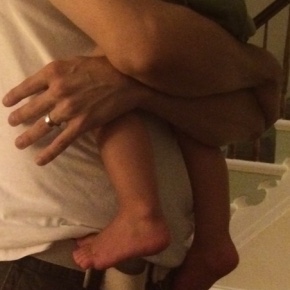
 This week has been a particularly tough one for our twins, Charlie and Amelia. At thirteen and a half months, we think they are cutting their molars, so their extreme fussiness is understandable. On Tuesday, I walked in the door of the kitchen, and before I had taken three steps, Charlie was toddling up to me as fast as his little legs and precarious balance would allow. He ran into me and buried his head between my knees, which is his way of saying, “Pick me up, Daddy.” I hefted him into my arms. He put his arms around my neck and his head on my shoulder. And for the next twenty minutes, I just walked around, holding him and speaking softly into his ear. It was a special moment, a physical heart to heart.
 You might be wondering if I accidentally read two weeks worth of Gospel lessons just now. The story of Jesus and the Syrophoenician woman ended satisfactorily, and at that point I could have said, “The Gospel of the Lord.” But the appointed lesson for today barrels forward into the next story, as well, and we read about Jesus healing a man who cannot hear and can hardly speak. We could focus on either half of this Gospel reading: there surely is enough in each to fill out a sermon. But today, I’m going to break a rule of preaching and bite off more verses than I normally do because I think the Gospel writer Mark places these two stories side-by-side for a reason. And this reason centers on the strangest word in the passage, a word that itself needs to be translated because Mark chose to preserve Jesus’ original language when he wrote it down. That word is “Ephphatha”: Be opened. Openness is the key to these two encounters. And openness is one of the keys to our lives as followers of Jesus Christ.
 Where the Wind...