Facing Fear

(Sermon for August 8, 2010 || Proper 14, Year C, RCL || Luke 12:32-40)
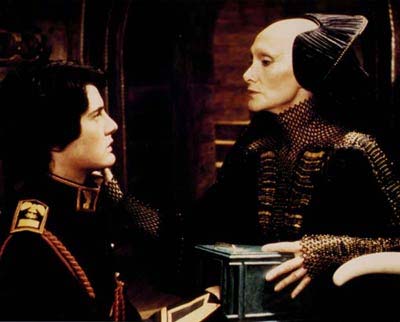
The Bene Gesserit test Paul Atreides at the beginning of Dune. (1984)

Many years ago in a dusty volume, I read an old Bene Gesserit litany against fear, and this prayer has stuck with me every since. “I must not fear,” says the litany. “Fear is the mind-killer. Fear is the little-death that brings total obliteration. I will face my fear. I will permit it to pass over me and through me. And when it has gone past I will turn the inner eye to see its path. Where the fear has gone there will be nothing. Only I will remain.”

Now that dusty volume was Frank Herbert’s Dune, the best selling science-fiction novel of all time, but the words of the litany ring true nonetheless. “I must not fear… Fear is the little-death… I will face my fear.”

From the time we are young children, our parents echo these words and tell us to face our fears. Perhaps you were afraid of the dark. So you mother let you sleep with the lights on for a while. Then she turned the lights off and left the bedside lamp on. A few days later, she turned off the bedside lamp and plugged a nightlight into the wall near the door. Pretty soon, you didn’t even need the nightlight. Your mother helped you face your fear of the dark, and you overcame it.

Or perhaps you were afraid of the monsters under your bed. There they were: always lurking, rumbling, slurping, ready to pounce – until you summoned up enough courage to dangle your head over the side of the bed and chase the monsters away. You faced your fear, and you overcame it.

We look back on these childhood fears and chuckle at how intangible worries grew into monstrous fears. The shadow of your own feet under the covers cast a winged creature on the wall, and the creature moved the more you shook. Under your bed, a pair of shoes and a couple of tennis balls made the ears and eyes of a monster peering up through the floorboards. The fears were nothing really. Our imaginations ran away with us, that’s all.

At least, this is how we adults dismiss those childhood fears. We dismiss them as fanciful or as attention-seeking or as the fruits of overactive imaginations. But hidden within this easy dismissal is also a tacit dismissal of our parents’ advice. “Face your fear,” they said, and we did, and everything got better.

But those were our intangible, childhood fears. That advice couldn’t possibly work on our concrete, grown-up fears. Our fears are too immediate, too relentless, too real. Of course, we forget that this is exactly how our childhood fears felt, as well. Perhaps our parents’ advice, the same advice that I learned reading science fiction, really might work in our lives today. In this morning’s Gospel, Jesus asks his disciples to take our parents’ advice. He asks them to face their fears.

But before we get to that, we first need to address where fear comes from. The root of fear is deprivation. We fear when something has the potential to become scarce. We fear when we perceive that there is not enough of a certain something. Supply and demand economic theory is based squarely on this reality. The root of fear is deprivation. You can trace all fears to this specific cause, even though specific fears may appear quite differently. Fears manifest themselves one way or another depending on the nature of the deprivation. If you are afraid of the dark, you fear a scarcity of light. If you are afraid of contracting a terminal illness, you fear being deprived of a long, healthy life. If you are afraid of how you will live when you retire, you fear that you will not have enough income to sustain your manner of living.

You can trace all fears to specific deprivations, and by confronting the sources of scarcity, you can face your fears. Jesus identifies the disciples’ source of fear when he says to them, “Do not be afraid, little flock, for it is your Father’s good pleasure to give you the kingdom. Sell your possessions, and give alms.” Jesus assures them that their fears are baseless because their accumulation of stuff will not help them enter the kingdom of God. This assurance runs counter to the fashionable reasoning of the day, which stated that the more stuff you owned, the more blessed you were. “God obviously favors that person,” ran this line of thinking. “Just look at all the stuff he has.” Not too much different from today, I’m sad to say.

But Jesus changed the rules. Remember last week’s Gospel? Jesus told us the parable of the rich fool. His land produced more than his barns could hold, so he decided to tear down those barns and build larger ones. The more stuff the rich man had, the more secure and comfortable he would feel, he told himself. Surely, this man would have been considered blessed in his society. But he died the very night he planned to erect larger storehouses, and he surely couldn’t take his barn-loads of stuff with him. The rich man’s folly shows the misguided lengths to which people will go to ward off deprivation, the root cause of fear.

But Jesus shows his disciples another way to face their fear. Rather than accumulating stuff, give it away, he says. Face deprivation by depriving yourself of the things you think you can’t live without. And you’ll discover pretty quickly that you can, in fact, live without those things.

I’m sure that you’ve heard this interpretation before, perhaps so many times that you tune it out now. And if you’re like me, you really aren’t any closer to facing the root of fear than you were the last time you heard someone talk about this. I know for myself that I used to be able to fit all my possessions in a 1992 Mazda Protégé. When I moved to Massachusetts, I needed every square inch of a 14-foot U-Haul. With more stuff comes more fear of loss, more fear of that stuff not being enough.

And the more fear that we have, the more we deprive ourselves of fear’s antidote. That antidote is trust. When we were children, we faced our fears because we trusted our parents’ advice. We believed that they would not lead us astray, and they didn’t. The darkness did not frighten us to death. The monsters did not pounce.

So how come we have so much trouble trusting in God? How come fear tends to trump trust more often than not? I think the answer is this. Trust takes energy. While fear creeps along, keeping us from action, trust derives from the kind of sustained relationship, which establishes and nourishes fidelity. God always keeps God’s promises. God is always trustworthy. The trouble is we have to trust that God is trustworthy. We have to practice the faith that God has given us in order to maintain our ability to trust in God.

And fear constantly diverts this ability. But when we practice trust, when we believe that God’s keeps God’s promises, we can face our fears, we can keep at bay the gnawing dread of deprivation. Our grown-up fears may be concrete and relentless. But I am convinced that they are no match for the power of trusting in God.

This week, I ask you to take some time to be silent and to turn your thoughts inward. What do you fear? What kind of deprivation is at the root of that fear? And how will practicing trusting God help you face that fear? In your reflection, remember this good news. When Jesus says, “Do not be afraid,” he is not just giving a command. He is giving a promise that when we face our fears, we will not be alone. When we face our fears, they will pass through us, and when they are gone, only God, holding us in the palm of God’s hand, will remain.

Something stronger

(Sermon for June 28, 2009 || Proper 8, Year B, RCL || Mark 5:21-43)

Imagine with me the thoughts of Jairus, the leader of the synagogue, in the aftermath of his encounter with Jesus.

I have been afraid my whole life. When I was little, a scorpion stung my friend, and he died drooling and thrashing in his crib. And so I feared scorpions. When I was old enough to understand the meaning of the scowling soldiers wearing shiny, metal armor, I realized what happened to people who looked at them the wrong way. And so I feared that my father might one day fail to return home. When I met my wife, I feared I wouldn’t be able to provide for her. When I became leader of the synagogue, I feared that I would have no wisdom to share. And when my little girl was born, I feared for her safety every minute of every day. I have been afraid my whole life.

And so when my daughter showed me the tiny, insignificant puncture on her forearm, and she bit her bottom lip to keep from crying out in pain, my world ended. I found the assassin and stomped its hardened, scaly body into the dirt, and then I collapsed – shivering – to the ground. My wife came `round the corner and saw me weeping, the dead scorpion in pieces next to me. She dropped the washing, raced over, and began checking me for signs of a sting. I could barely talk through my heaving: “Not me. Not me. Not me.” She understood and launched herself into the house to find our daughter. I couldn’t go back inside. I rocked back and forth: “Not me. Why not me? Why not me instead?”

Twelve years old, my little girl. On the verge of womanhood. My wife cataloging potential suitors. Me practicing my menacing glare for those same suitors. Twelve years old, and not so little anymore, if I’m honest with myself. She and I used to climb the hill at night, lie down in the scrub grass so that the tops of our heads touched, and name the stars. She always named them after the heroes of the great stories: David and Gideon and Deborah and Esther. “And that one’s you, Daddy.” She always named the brightest one after me. But at the indefinable moment when she began her adolescence, she stopped wanting to climb the hill. I asked her why one day. “That’s kid stuff, Daddy,” she said.

The night the scorpion stung her, I climbed the hill alone and screamed names at the sky – not the names of heroes, but blasphemous names I never thought I could utter. The darkness swallowed my anger, and I don’t know if my obscenities reached their intended target. He created the scorpion: for that, I could not forgive him.

I stalked back home and tapped on my daughter’s bedroom door. My wife opened it, and our eyes met – one empty stare gazing past another. The candle threw swaying shadows on the wall as I entered the room. All my fears were confirmed when I looked at my little girl. She was drenched in sweat, her neck twitched, and her eyes darted from corner to corner. I wrapped my arms around her and put my head on her chest. I could barely distinguish one heartbeat from the next. My wife wrapped her arms around me. Thus I spent the remainder of the night – embraced by the one I love but feeling only the heavy grasp of fear.

I awoke suddenly and cursed myself for having fallen asleep. Dawn was piercing through the gaps in the window’s shutters. I bent my ear to my daughter’s mouth, but the sounds of a commotion outside drowned out the low rasping of her breath. “Vultures,” I growled and my wife woke up. I stabbed a finger at the window: “Here, no doubt, to console us with their wailing performance.”

I looked down at my little girl. I couldn’t just sit there and watch her die. I had to do something. I resolved first to run the vultures off. I had enough grief of my own. I didn’t need to pay someone else to manufacture it. I squeezed my wife’s hand and kissed my daughter on the forehead. So clammy. I banged open the front door ready to unload on the would-be grievers. But the commotion was something else entirely. People were running up the street in the direction of the shore. They were laughing and calling to one another: “Jesus of Nazareth is sighted off the beach. He’s coming here.”

Without thinking, I joined the throng. People recognized me as the leader of the synagogue and let me through. I reached the shore in time to see a fishing boat bump into the shallows. The crowd swelled around the vessel. Jesus’ disciples muscled a hole in the multitude and the man himself stepped off the boat. “Jesus, Jesus,” I cried. But mine was only one voice in a thousand. I feared there was no way he heard me.

Then he turned and gestured to me. His disciples opened a path for him. I fell at his feet. “My little daughter, my little one is at the point of death.” I swung my arm back in the direction of my house. “Come and lay your hands on her, so that she may be made well, and live.”

I didn’t know where the words came from. My fear was grasping at the words in my chest, but something stronger ripped them out of me. The fear fought back, reminding me of last night’s blasphemy. A new fear gripped me – that God had, indeed, heard my anger and would do nothing for me now.

We walked back to my house, but the great crowd slowed our progress. I wanted to run, to sprint home with Jesus keeping up beside me. But then, he stopped. “Who touched my clothes?” he said. I looked at him in disbelief. I wanted to scream: “There’s a thousand people trying to touch you right now. Who cares? My daughter is about to die.”

A woman fell down at his feet and started speaking. She probably spoke for less than a minute, but it was a lifetime to me. As Jesus responded to her, my eyes found my brother and his sons pushing their way through the crowd. “No. No. No.” I started to fall, but my brother caught me and held me tight. “Your daughter is dead,” he whispered. I sagged in his arms. Again, he picked me up. “Come,” he said. “Why trouble the teacher any further?”

I turned back to the woman who delayed me, who kept the teacher from coming to my house on time, and curses curled on the edge of my lips. But Jesus stepped in between us and grabbed my shirt in both hands. “Do not fear,” he said. “Do not fear, only believe.” The stronger something that had earlier ripped words from my chest reflected in his eyes. “Trust me,” he said, and he pulled me along the path to my house. The curses died on my tongue, and I let myself be dragged home to face my own death in the still body of my little girl.

The vultures had come while I was out, but I had no ears for their wailing. And I had no eyes but for my little daughter. Jesus looked around at everyone. “Why do you make a commotion and weep,” he said, “The child is not dead but sleeping.” A laugh erupted from my chest, and it felt utterly foreign in this house, which now had Death for a tenant. But then I laughed again, and I noticed that the laugh didn’t come from my fear. The stronger something caused the laugh. The laugh was my body’s involuntary response to the truth of Jesus’ words.

Jesus took my daughter by the hand, brushed a stray lock of hair behind her ear, and said, “Little girl, get up.” And she did. She walked up to my wife and me and we picked her up and the three of us held each other and turned in circles, laughing and crying at the same time. I looked at Jesus and realized what had ripped the words from me at the beach. Trust. Something about this man radiated trust. No. Not something about him. He, himself, radiated trust. He stared back into my eyes and suddenly I knew that hurling blasphemies at God under the cover of darkness meant that somewhere deep down I still believed. I knew that trust is something entirely stronger than fear. I knew that trust and belief are the antidotes for fear.

Jesus’ own laugh pulled me out of my thoughts. He smiled at the three of us twirling around and said, “She’s had a rough day. Give her something to eat.” My wife rushed off to the kitchen to prepare something, tears streaming behind her as she went. And then my daughter looked up at me, trust shimmering in her eyes. Twelve years old and still my little girl. “Daddy,” she said, “Can we go up the hill tonight and name the stars?”

“Of course,” I said, and I gathered her into my arms.

I had been afraid my whole life. But not anymore.