The Seeds of the Kingdom

(Sermon for Sunday, June 17, 2012 || Proper 6B || Mark 4:26-34)

When I was nine or ten years old, I walked into the church across the street from our house really early on a particular morning. Ash Wednesday had always been one of my favorite days. I’m not sure why, but I think I liked going to school with the ashes scraped across my forehead – hence me being in church really early. As many of you know, my father is also a priest, and he met me in the church wearing all of his vestments. But no one else came for the service early that morning. However, as Jesus says, “When two or three are gathered in my name, I am there among them.” So we went ahead with the service, just my dad and me.

When the time came for the ashes, he put his thumb in the gritty, black stuff and scraped first a vertical and then a horizontal line across my forehead, making the sign of the cross. “Remember that you are dust and to dust you shall return,” he said. Then he knelt down and offered the little bowl with the ashes to me. I was surprised, but I put my own thumb in the gritty, black stuff and scraped the sign of the cross on his forehead. “Remember that you are dust and to dust you shall return,” I echoed with all the solemnity that my fourth-grade voice could muster.

Then we finished the service, he took me to school, and we went about our days, and we went about our lives. And about a decade later, my father and I realized that on that Ash Wednesday morning, God planted a seed in me, one so small that neither of us noticed the seed until the stalk started poking through the topsoil of my life.

This seed was the mustard seed of God’s kingdom, the one that Jesus talks about in today’s parable from Mark’s account of the Gospel. Before we go any further, however, I want to dispel any notion that you may have that such a seed would only be planted in someone destined to be ordained as a priest. While some of the seeds of the kingdom that God planted in my life have germinated into my call to the priesthood, others have grown into my call to be Leah’s husband and to spread God’s love through our marriage. I hope other seeds that are still hidden in the soil will sprout into a call to parenthood. God sows within each of us, not just we few who wear the collar, the seeds that grow into a panoply of kingdom callings. Together, as our seeds stretch upwards into beautiful flowers and trees, we help God transform this planet once again into a garden of God’s kingdom.

I firmly believe that God has sown seeds so wildly, so expansively, that every person on this planet has the seeds of the kingdom nestled in the soil of their souls. The parable before the ones we heard this morning speaks to this belief. The sower doesn’t seem to mind that his seed lands, not just on the good soil, but on the road and on the rocky ground and among the thorns, as well. The sower doesn’t just plant in nice furrows in the prepared field, but across every surface, no matter how ready the ground is to receive the seed.

Because of God’s unrestrained scattering of seed, each of us surely has the seeds of the kingdom within us. But, as Jesus says, the seeds start out so small that we can barely see them. In fact, until the seeds have grown into visible plants, we won’t have much luck seeing them at all. But this is how the life of faith works – oftentimes, the moments when the seeds of the kingdom drop into our soil are as small as the seeds themselves. We miss these moments all too easily because they tend to be subtle and quiet. Or they tend to happen in the midst of really difficult and challenging circumstances. Or they tend to happen when we least expect them, when our soil is least ready for the seeds.

With God’s help, we can train ourselves to notice the seeds of the kingdom earlier and earlier in their development. Perhaps, you have a mustard seed that has grown into the full-fledged plant or perhaps you have a stalk peaking up from the ground. Move into a space of prayerful reflection and trace that plant back to the subtle, quiet moment when God scattered the seed in you.

Consider this example. God has given you the gift of teaching. Even though some of the students can be pains in the neck, you love going into the classroom everyday to teach. You feel that teaching is certainly a way that you respond to God’s call. Now, work your way back past your first year struggles, past your student teaching, past your high school days, and find yourself back in fifth grade when your favorite teacher in the whole wide world instilled in you a love of learning and a desire to teach. There’s the seed. God used the dedication and love of your fifth-grade teacher to plant the seed of the kingdom in you.

Here’s another example. God has given you the gift of cooking. Recently, you began helping at your church to prepare hundreds of meals every week for a local homeless shelter. You can feel in each stir of the pasta and each pour of the sauce that you are doing something in which God takes great joy. Now, work your way back past your joining the church, past all those experiments in the kitchen trying to perfect your pie dough, past that semester at culinary school, and find yourself in the kitchen with your mother on the day she finally let you spice her world famous chili for the first time. There’s the seed. God used your relationship with your mother, who passed on her culinary secrets to you, to plant the seed of the kingdom in you.

No matter how old or young we are now, God has planted seeds in us. Some have grown into the greatest of shrubs and the birds nest in their branches. These are the places where we can see God’s kingdom blooming into beautiful gardens around and within us. Other seeds are still nascent, still tucked in the soil waiting for the right moments to start their journey toward the sun. By tracing the plants we can see back to when they were invisible seeds, we can train ourselves to recognize the currently hidden seeds even sooner in their development. And when we do, we can join God in more active participation of their cultivation.

Every week in the Lord’s Prayer, we pray, “Thy kingdom come, thy will be done, on earth as it is in heaven.” The kingdom begins as tiny mustard seeds, which God scatters wildly into our very souls. As we live out our lives as followers of Jesus Christ, we become gardens of the kingdom, spreading the beauty of God wherever we go. The seeds are in each of us. The seeds are sprouting and growing and blooming each day. All we need do is notice.

Guitar Lessons

(Sermon for Sunday, June 3, 2012 || Trinity Sunday B || John 3:1-17)

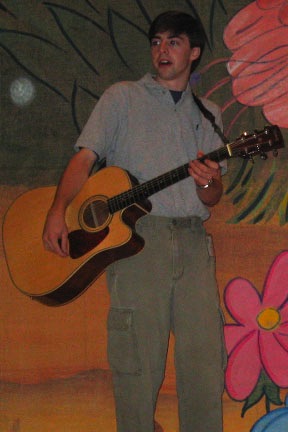
Playing at VBS in 2003 after my sophomore year of college. That was less than three years in to my guitar playing. It would have been seven or eight if I had never quit.

When I was in seventh grade, my parents bought me a three-quarter sized guitar and procured the services of a guitar expert to teach me the basics. At the first lesson, I learned the names of each of the six strings and how to play notes by plucking them. At the second lesson, I learned how to arrange my fingers on the strings so they made special shapes called chords. At the third lesson, I learned that I would have to practice if I wanted to improve my guitar playing. There was no fourth lesson.

You see, I was a bright kid, to whom pretty much everything came quite easily. I was a good athlete, so baseball and soccer were right up my alley. I really didn’t have to work much to make good grades in school. I had next to no challenges in any of my classes. And so when I was confronted with something that I couldn’t immediately master with no effort, I decided not to try. I put the guitar in the case, and the case sat unopened in my closet for years.

Now, as most of you know, I am a guitar player. So what happened? I picked up the instrument again my senior year of high school, and, being a tiny bit wiser than my seventh grade self, started practicing. I’ve been playing for over eleven years now, and I’m not half bad, but a wistful part of me always wonders how much better I would be at the guitar if I had not quit after three lessons back when I was thirteen years old.

My seventh grade self fell victim to a psychological epidemic that affects the vast majority of the population. Exactly one symptom characterizes this epidemic: people have difficulty agreeing to perform tasks that fall outside of their recognized competencies. This is still true for me: you’ve never seen me do ballet or fix the central heating in the church because these are two things that I don’t do very well. I have no training in either of these areas, and so the likelihood that I will agree to pirouette across a stage or put together an HVAC system is next to zero.

I’d be willing to wager that this fact of life is also true for you. I’m sure each of you could come up with a list of things you are unwilling to try because you know that you aren’t going to be good at them. You know that if you tried, failure would be in your future, and who wants to feel like a failure? And so the psychological epidemic keeps us from attempting new things and keeps us safely ensconced within the borders of our comfort zones.

For us this morning, the trouble comes when the list of things we are unwilling to try includes speaking openly about our faith in God. Why should this be any different from playing the guitar or doing anything else, you might ask? The simple answer is this: becoming an expert in guitar playing is possible. Becoming an expert on God is not.

Today’s Gospel reading teaches us this reality, which is an appropriate lesson on a day when we celebrate the mystery of the Holy Trinity. Nicodemus, a Pharisee and member of the Jewish council, fashions himself such a God expert. He comes to Jesus by night, and at the outset of their conversation, tries to display his knowledge of how God operates. “Rabbi,” says Nicodemus, “We know that you are a teacher who has come from God; for no one can do these signs that you do apart from the presence of God.”

Nicodemus’s “we know” sets him up as the so-called expert on God. The irony is that his statement is true. But Jesus isn’t interested in whether or not Nicodemus speaks correctly; Jesus is solely interested in moving this so-called expert into the unfathomable depths of God’s interaction with God’s creation. “No one can see the kingdom of God without being born from above,” says Jesus in response to Nicodemus’s opening remarks. Jesus’ statement is intentionally ambiguous. The words could mean “born from above or born again,” and I think Jesus means both. The very ambiguity of the phrase shows Jesus’ attempt to push Nicodemus out of his comfort zone where “we know” is his default position.

For his part, Nicodemus latches onto the more mundane of the two possibilities: “How can anyone be born after having grown old?” he asks. This response might sound a bit sarcastic, but at least the Pharisee, who has always been the expert answering questions, is now beginning to ask some of his own. The question is the small chink in the armor of Nicodemus’s expertise. Because of Nicodemus’s willingness to ask a question, Jesus sees that there is hope in showing him the expansiveness of all that this so-called expert does not know.

And, boy, does Jesus show him. Jesus opens Nicodemus’s mind and heart to the mystery of how God creates God’s people, and of how God moves in the world like the wind moving through the trees. When Jesus is done, Nicodemus’s opening “we know” now sounds laughably empty in comparison to the mysteries Jesus reveals to him. To begin to walk in and among these mysteries, Nicodemus must change his empty “we know” into an “I don’t know” full of desire and curiosity. And he takes the first tentative steps along this path with the sincerest question in the entire Gospel: “How can these things be?”

In just one conversation, Jesus shows Nicodemus that being an expert on God is not only not possible, but also not the best way to be in relationship with God. Only by acknowledging his lack of understanding can Nicodemus hope to begin to hear the sound of the wind blowing, this wind of the Holy Spirit that breathes life into creation. Nicodemus’s job is no longer to try to explain what makes God tick. Jesus gives him a new job: to bear witness to the mysterious movement of God in his life.

We see Nicodemus twice more over the course of the Gospel. In his next appearance, he puts one tentative foot outside his comfort zone when he reminds the rest of the council about their own rules when they want to put Jesus to death. And in his final appearance, we see that Nicodemus has fully embraced the new life that Jesus revealed to him. In broad daylight on the afternoon of the crucifixion, Nicodemus helps Joseph of Arimethea take Jesus from the cross and bury him in the tomb.

This so-called expert on God had his world turned upside down that night when he went to see Jesus. Jesus showed him that expertise is neither possible nor desired when relationship with God is concerned. There is not a person on this earth who is competent to talk about what makes God tick. While you and I might have difficulty agreeing to perform tasks that fall outside of our recognized competencies, we can take heart in the reality that Jesus released us from needing to be competent in this particular area. We will never be good at talking about God because God is far too glorious, far too mysterious and majestic for our puny words. But that shouldn’t stop us from trying. Releasing us from the need to be competent means that Christ rejoices in even our most halting attempts, in even the simplest expressions of feeling God’s love.

My prayer this morning is that each of us might feel released from the need to be competent when we have the opportunity to speak to someone else about our faith. Don’t be like my seventh grade self who gave up the guitar because he wasn’t an overnight expert. Rather, acknowledge that expertise has no domain where God is concerned. The simple word about how you feel God’s movement, spoken from the heart, is worth more than any treatise on the inner workings of the Holy Trinity. The halting word about not understanding God’s movement is worth more than all the “we knows” like the one Nicodemus speaks when he first encounters Jesus. The good news is that God uses our incompetencies as much, if not more, than our competencies. So I challenge you and I challenge myself: live into our incompetent ability to speak of God’s movement, and perhaps through our witness, someone new might start seeing God’s wind blowing through the trees.

Four Layers of Peace

(Sermon for Sunday, April 15, 2012 || Easter 2B || John 20:19-31)

Last Tuesday, I received two rather large packages in the mail from my parents. Turns out they have been cleaning out closets in their house, and they decided for me that I would like to be in possession of all of the Star Wars memorabilia I collected when I was a kid. This includes about three-dozen action figures, none of which is old enough to really be worth anything and all of which are now taking up space in my closet, rather than my parents’. Many of them are still in their boxes (yeah, I was that kid), and I spent a while on Tuesday looking at them, trying to dredge up all the intricate details I used to know about the Star Wars universe. And I noticed on the back of every box an advertisement to purchase more action figure, which states: “The Force is with you in all the Star Wars figures and vehicles.”

Even if you don’t know much about Star Wars, I’m sure you’ve heard the most famous line of dialogue from the films. And if you’re an Episcopalian, I’m also sure that you have a kneejerk reaction to this line. Let’s try: “May the Force be with you.” (And also with you.) I like to think that George Lucas borrowed and tweaked that bit of dialogue from the Book of Common Prayer. We say something similar three times during an average Sunday service – at the beginning before the Collect (“The Lord be with you”), in the middle during the Peace (“The peace of the Lord be always with you”), and a few minutes later at the beginning of the Eucharistic Prayer (“The Lord be with you” again”).

Let’s focus on the middle one: “The peace of the Lord be always with you.” (And also with you.) George Lucas might have borrowed his dialogue from us, but we borrowed ours from Jesus. Three times in this morning’s Gospel reading, the Risen Christ says to his disciples: “Peace be with you.” (They aren’t Episcopalians, so they aren’t trained to say, “And also with you,” back to him.) On one level, Jesus saying, “Peace be with you,” is just a greeting to the disciples. And he has to repeat this greeting after showing them his maimed hands and side because they don’t recognize him the first time around. But as the words of the Gospel according to John so often do, even something as simple as a greeting is loaded with layers of meaning.

So what is this “peace” that Jesus offers to the disciples when he appears to them on the evening of the first day of the week, the day he rose from the dead? The surface level is the greeting still heard today in Hebrew and Arabic speaking countries. “Shalom” and “Salaam” – one wonders how there can be so much conflict between and among peoples in these countries – countries like Syria, Israel, Iran – when their special words for greeting one another means “peace.”

On the level below the surface, Jesus’ word of peace to the disciples acknowledges their current situation. There they are, huddled together in the house: shutters drawn, candles doused, door locked for fear of the people who colluded to put Jesus to death. Would the disciples be next? Would the chief priests and the council be satisfied with the blood of the leader or would they pursue the followers too? How had the disciples gotten everything so wrong? How could they have followed someone so disposable, so utterly breakable as Jesus turned out to be?

And into their fear, their confusion, their uncertainty the Risen Christ comes and says, “Peace be with you.” He comes to them even though the door is barricaded. He comes to them even though three days earlier he had died an excruciating death on the cross. He comes to them even though they aren’t expecting him, even though they haven’t understood what he told them about who he is. And when Jesus gives them peace, their fear turns into joy.

But let’s not stop there: let’s go a level deeper. When the Risen Christ offers the disciples peace, he is offering them more than a greeting and an antidote for fear. He is offering them “the abiding presence of God.” This is how a member of our Wednesday Bible Study group described what “peace” means to her, and I adore this definition. Peace is not simply the absence of conflict. Peace is “the abiding presence of God.” Peace happens when we tune ourselves to God’s abiding presence. Peace happens when we resonate with God’s movement in our lives. Peace happens when we discover the inner serenity that God provides in the midst of the maelstrom of activity that marks our lives today.

We might naturally conclude that the peace, which the Risen Christ offers to the disciples and to us, would excuse us from the pain and suffering that life sometimes brings. But Jesus never promised us a reprieve from tragedy. Rather, he promised something so much greater. He promised to be with us always to the end of the ages. He promised to suffer with us, to cry with us, to break his heart open when our hearts break and pour his heart’s love on our wounds. There is no door we can pass through, which the abiding presence of God has not already entered. There is no depth or height that we can attain and not be where God already is. As the psalmist says in one of the most beautiful passages in the book of Psalms:

Where can I go then from your Spirit?
where can I flee from your presence?
If I climb up to heaven, you are there;
if I make the grave my bed, you are there also.
If I take the wings of the morning
and dwell in the uttermost parts of the sea,
Even there your hand will lead me
and your right hand hold me fast.

But all too often we forget that God’s presence abides, and we fail to look for God in situations where we conclude that God couldn’t possibly be. And yet how many of us have said at one time or another, “I just need a moment’s peace.” By our definition, when we say that, what we are really saying is, “I just need a moment to remind myself that I am in God’s abiding presence, a moment to drink in God’s love, a moment to be folded into the arms of grace. This is what “peace” is.

And yet there is another level deeper still. When the Risen Christ offers peace to the disciples, the peace comes with a mission: “Peace be with you,” says Jesus. “As the Father has sent me, so I send you.” And then he breathes on them, saying, “Receive the Holy Spirit.” Thus, Jesus not only gives them the word of peace; he also breathes God’s abiding presence into them through the power of the Holy Spirit. The Father has sent Jesus to bring peace, and now Jesus commissions the disciples and us to do the same. The peace, which Jesus offers, is not for us alone, but for us to share with this damaged, broken world.

In about five minutes, we’ll have a chance to practice bringing this peace. I will say, “The peace of the Lord be always with you.” And you’ll respond: “And also with you.” Then we will greet one another with God’s peace. Just think how powerful an act this is. In these simple words – “Peace be with you” – we bring with us greetings from our Lord. We bring with us the joy that quells fear and uncertainty. And we bring with us the abiding presence of God and of the Risen Christ. Now just imagine: if we took this greeting we practice in church and carried the peace of the Lord into every handshake, every wave, every high five, every tilt of the head, every smile of recognition, every embrace, then we would change the world.

Four Names

DevotiONEighty will be taking a break during the week following Easter. It will return next Monday, April 16th. In the meantime, here is my sermon for the Easter Vigil from Saturday evening. –Adam

(Sermon for Saturday, April 7, 2012 || The Easter Vigil || John 20:1-18 )

If you’ve ever been to a Bible study that I’ve led, then you know that I have a lot of favorite scenes in the Gospel according to John. But the one we just read is easily in the top three. What always strikes me about the scene is the movement from Mary’s desolation when she weeps at the empty tomb to her utter elation when she recognizes the resurrected Christ. John paints the scene with a special tenderness he reserves for only the most intimate of moments between Jesus and his followers. John focuses our attention on this intimate moment, the first reaction to Jesus’ resurrection, because the moment of the resurrection itself is far too mysterious and far too momentous for John to attempt to narrate. That moment belongs to God alone. And so John gives us a sliver of Mary Magdalene’s story – her move from desolation to elation when she realizes that Jesus is still with her as he promised he always would be. And the pivotal moment of this story is Jesus calling her by name.

Names are rare in the Gospel according to John. I went back and counted, and in the entire 21 chapters of the Gospel, Jesus calls exactly four people by name. There’s Simon Peter, first among the disciples. There’s Lazarus, whom Jesus brought back to life. There’s Philip, who had been with Jesus from the beginning. And then there’s Mary, who heads to the tomb before dawn on the first day of the week. In each of the special moments when Jesus calls these four people by name, he is somehow affirming or strengthening his relationships with them.

The first thing Jesus does when he meets Simon is give him the nickname “Peter,” which means “Rock,” which is a pretty cool nickname. We invest all kinds of theological motivation to this name because of Peter being the “rock” on which the church is built. But if they were any two people besides Jesus and Peter, we would see the nicknaming as a sign that their relationship is moving into the territory of good friendship. At the end of the Gospel, Jesus says Peter’s name three times, and this naming reasserts the relationship that Peter had denied three times during Jesus’ trial. In the end, their relationship is repaired because Jesus calls Peter by name.

The Gospel describes Lazarus as “one whom Jesus loves.” When Lazarus dies, Jesus is days away, and Lazarus’s sisters make the faithful accusation that if Jesus had been there, Lazarus wouldn’t have died at all. So Jesus goes to the tomb and shouts out, “Lazarus, come out.” Notice that Jesus doesn’t say, “Lazarus, I raise you from the dead.” Rather, he says, “Come out.” Jesus calls Lazarus by name, but does not give Lazarus the option of remaining in the tomb. The naming is joined to Jesus’ command to return to his family and his friendship with Jesus.

Jesus calls Philip by name after Philip says to him, “Lord, show us the Father; that will be enough for us.” Jesus replies, “Don’t you know me, Philip, even after I have been with you all this time? Whoever has seen me has seen the Father.” Jesus calls Philip by name in the midst of wondering how Philip could possibly not know him yet after being with him from the beginning. With this, Jesus calls Philip into deeper, more committed relationship with him.

And then there’s Mary Magdalene, who is weeping at the empty tomb. She is desolate, thinking that her Lord’s body had been stolen and possibly desecrated by the people who put him to death. With tears and the fog of despair clouding her vision, she sees the gardener, who asks her, “Woman, why are you weeping? Whom are you looking for?” Could this gardener be in collusion with the body-snatchers, she wonders? And she accuses him of being in on the plot. But then he says the all-important word: “Mary.” And she turns and the desolation vanishes in an instant of delight. And new elation, new hope, new life surges in to fill the void. “Teacher!” she shouts, and I imagine her jumping into his arms. Then Jesus gives her a task – to be the first to proclaim his resurrection.

So why does Jesus saying her name change the story? Why is this the pivotal word? As with Peter, Lazarus, and Philip, saying Mary’s name proves Jesus’ relationship with Mary. Her name is the outward sign of her inward identity. In this way, names are quite sacramental. Know a name and you know something of the person. Who among us didn’t feel elation when we found out our high school crush did, in fact, know our names? On the flip side, take away a name and you begin to take away the humanity of the person. How many Jews had their names erased and exchanged for numbers in the concentration camps?

Saying Mary’s name is Jesus’ shorthand for saying that he has returned just as he promised and that life would never be the same again because their relationship would never end. Earlier in the Gospel, Jesus foreshadowed this when he said, “[The shepherd] calls his own sheep by name and leads them out. Whenever he has gathered all of his sheep, he goes before them and they follow him, because they know his voice.” Later in the same passage, Jesus talks about the command from his Father that he “give up” his life in order to “take it up again.” Thus, Jesus links the power of the resurrection with the power of naming, which is really shorthand for the power of relationship.

This is the good news of the resurrection: Christ rose from the dead to show us that nothing, not even death, has the power to keep him from remaining in relationship with us. Christ knows each of our names. They are written in the book of life. They are written on his heart, just as his name is written on ours. As Jesus called Peter, Lazarus, Philip, and Mary to deeper relationship by saying their names, he calls to each of us. He calls to each of us, speaking our names, and thus ourselves, into being.

These names of ours are special things – they carry within them the promise of eternal relationship with God in Christ through the power of the resurrection. So the next time you find yourself in a moment of silence, a moment of peace at the center of the maelstrom of busyness that marks our lives today, just be still. Be still and listen. Be still and listen for the resurrected Christ calling you by name.

The Unfair Fight

(Sermon for Sunday, April 1, 2012 || Palm Sunday Year B || Mark 11:1-11; Philippians 2:5-11 (NOTE: At my church, we read the Passion Gospel at the end of the service, so this sermon moves from Palms to Passion.))

I’ve always been struck by the incongruity of the scene. A crowd lines the dusty road leading up to the gate of Jerusalem. They are there to see a parade, but the spectacle is just a fellow riding a baby donkey. People spread their cloaks on the ground as a sign of respect. But Jesus isn’t stepping on the cloaks: the donkey is.

The crowd shouts aloud, “Hosanna! Blessed is the coming kingdom of our ancestor David!” Now when David entered Jerusalem, he did so at the front of a grand procession – “all the house of Israel,” II Samuel tells us. They were carrying the Ark of the Covenant. There were shouts and the sound of the trumpet and the sacrifice of an ox and a fatling. And “David danced before the Lord with all his might.” David had just defeated the Philistines and his dynasty was assured. His triumphant march into the city was a victory march.

But when Jesus rides to Jerusalem, he rides alone. No army. No conquering legions. The people in the crowd shout for the return of the kingdom of David, but all they see is a lone man atop a baby donkey. As I said, I’ve always been struck by the incongruity of this scene.

Sensing something to be incongruous – to be out-of-place – means that there are expectations that are not being met. If you go to a job interview at State Street in a t-shirt and jeans, there’s a better than average chance that the interviewer will take one look at you and send you home. The interviewer has the expectation that you will enter the room in your best suit, and the incongruity of your casual clothes will trigger discomfort and then disapproval in the interviewer. But say that you wear your t-shirt and jeans to the park to throw a Frisbee with the guys. No incongruity there. The expectations match the scenario.

When Jesus rides into Jerusalem on the back of the baby donkey, he is actively challenging the expectations of the crowd that is shouting “Hosannas.” They praise him while he rides in humility. They celebrate his arrival in the capital city while he knows the outcome of his arrival will be bloody. They show him the respect due to royalty. And all the while Jesus is boldly defying the people who have no respect for him, the chief priests and their lackeys, who have until now hoped he would keep a lower profile.

And in the greatest incongruity of all, the crowd shouts for the return of David’s kingdom; that is, a kingdom marked by a sovereign Israel, an Israel with no Roman occupiers. But Jesus frustrates this expectation, as well. In this case, the crowd is thinking too small. They have only their own country on their minds. But Jesus isn’t concerned with the Romans. They’re small potatoes. When Jesus rides into Jerusalem on the back of that baby donkey, he sets in motion events that will drive out, not the Romans, but the power of death, the grip of evil, all the forces of darkness. No wonder no one was expecting that.

Jesus hovers above the crowd, sitting atop the donkey as the beast shambles ahead. He remains above the crowd not for the glory of the exalted position, but in order that the powers of death, evil, and darkness might get a clear view of their target. And in seeing this small, humble human being, those powers underestimate their foe.

The powers of darkness do not realize that this Jesus riding on the donkey is someone they’ve met before, albeit in a more glorious form. In his letter to the Philippians, Paul tells us why the powers don’t recognize Jesus. Paul says, “Though [Christ] was in the form of God, [he] did not regard equality with God as something to be exploited, but emptied himself, taking the form of a slave, being born in human likeness. And being found in human form, he humbled himself and became obedient to the point of death–even death on a cross.”

The powers of darkness have their expectations too. The incongruity of Christ’s humanity throws them. They have no idea who they’re dealing with because Jesus acts in ways they never expect. While the powers of darkness would always seek to exploit, Christ empties. While they would always seek self-aggrandizement, Christ humbles. While they would always seek to get their own way, Christ becomes obedient to the point of death.

How could the powers of darkness possibly think they could win if they completely underestimate their opponent? And all the while, Christ is here on earth, learning all about the darkness, participating in the brokenness of people’s lives, bringing wholeness, bringing hope, bringing light.

And yet, the darkness sees the little man on the back of the baby donkey and wishes for a more impressive opponent, if only so the fight would be more interesting. But what the darkness fails to realize is that this is the most unfair fight of all time.

The powers of darkness bring all of their standard weapons to the ring: fear, mistrust, the desire to dominate. They expect Jesus to bring the same. But Jesus brings no weapons at all. Instead, he brings the willingness to sacrifice. He brings the love that gives him the courage to lay down his life. He brings the peace that passes all understanding.

They are David and Goliath, and David left his sling at home. Normal expectations would ask how Jesus could possibly win this fight. But we know the incongruity of God’s love. We know that God loves us even though we don’t deserve such an amazing gift. We know that God loves this broken, messed-up world so much that God sent God’s only Son to save the world. We know that God rejoices in letting us in on the secret that our expectations are always too small. God let slip this secret when the women went to the tomb on Easter morning.

But we’ll get there with them next week. First, the powers of darkness marshal. First, Jesus rides humbly into the teeth of the storm. First, the battle.

Choosing the Light

 (Sermon for Sunday, March 18, 2012 || Lent 4B || John 3:14-21)

I’d like to go to a Red Sox game and hold up a sign that says, “John 3:17.” Perhaps, a row-mate would ask me why my sign is wrong and I can say that the sign’s not wrong, but a different verse entirely. The verse after the most famous verse of the Bible says, “Indeed, God did not send the Son into the world to condemn the world, but in order that the world might be saved through him.”

Now, before we really get down to the business of this sermon, let’s talk about this “world,” a word John uses three times in this one verse. For John, the world is the creation that rebelled against God – the good works, which God made, but which fell into disrepair because of bad human choices. One of the reasons that John starts his Gospel with, “In the beginning,” is so we readers might make the link back to the story of creation in Genesis, in which God created the heavens and the earth. Three chapters into Genesis, things start to fall apart because of Adam and Eve’s dreadful choices.

Fast-forward to John’s time or even to our own, and the broken state of the world is evident – there’s no need to list all of the broken things in relationships or in society or in the environment (for we know them all too well). Much of the brokenness stems directly from bad choices made over and over again. And because these decisions are made again and again, they become part of the system, the machinery of brokenness, and we feel helpless in the face of a crumbling world. Nevertheless, God so loved this world that God chose to send God’s Son into the brokenness in order that he might show us what is broken. And in showing us, he gave us the gift and duty of helping him restore the broken world to wholeness.

But even though John expands the Son’s salvation to include the whole world (literally the “cosmos” in Greek), the restoration starts taking place in the hearts of God’s children – in us and ever other person who has every walked the earth. The brokenness began in the hearts of Adam and Eve; thus, the healing, the saving of the world takes hold at the origin of the brokenness, in the hearts of all people.

Just like Adam and Eve had the choice to obey or disobey God, each of us has a choice, which Jesus names using the imagery of darkness and light: “The light has come into the world, and people loved darkness rather than light because their deeds were evil,” he says. “For all who do evil hate the light and do not come to the light, so that their deeds may not be exposed. But those who do what is true come to the light, so that it may be clearly seen that their deeds have been done in God.”

We have a choice to stumble in the darkness or to walk in the light, to be part of the problem or part of the solution, to add to the brokenness or to participate in the healing. And we don’t make this choice just once. Rather this choice is part of every single decision we make. Every decision either pulls us back to the darkness or pushes us further into the light. Perhaps you can remember a choice you made that turned out to be the wrong one – failing to stand up to a friend’s bully or taking out your frustration on your spouse or deliberately not noticing the homeless veteran on the street or knowingly purchasing a product that was fabricated under unbearable conditions, or…or…or — the list is endless. I don’t know about you, but when I make a choice the pulls me towards the darkness, I feel just a little bit unmade, like a little bit of me has eroded away. If I continually choose the wrong path, if I continually embrace the darkness, I wonder — will there be anything left of me?

This question points to the condemnation that Jesus talks about. God does not condemn; rather, we condemn ourselves when we choose the darkness over the light. Indeed, each time the verb “condemn” happens in the middle of our passage, the word is passive. God takes no active part in our condemnation, but only patiently and constantly calls us back to the light. And I firmly believe this call is what keeps us from eroding away entirely, what keeps us from total annihilation (which is another way of talking about hell). God’s constant call back to the light gives us a beacon to turn to, a lighthouse, if you will, that can guide us through the darkness and keep us from breaking up on the rocks. God does not force us to choose the light, but rather invites us to steer toward the harbor of God’s radiance.

As we answer God’s call and choose the light over the darkness, we discover that we can be part of the healing of the world. In our own experiences of the darkness, in our own vulnerability, we find the common ground of brokenness that Christ found when he came to earth and when he was lifted up on the cross. When we choose the light, we choose to be partners with Christ in healing the brokenness of the world even as Christ is healing our own brokenness.

So how do we translate the imagery of walking in the light into our everyday lives? What does choosing the light look like on the ground, in our day-to-day lives, at the office or at school or at home? Everything comes back to inviting God into our decisions, about orienting toward the light in each choice so that we do not feel like we are being eroded away to nothingness.

Here’s one practical way to help make decisions. Margot and I have been participating in a Lenten devotional series done by the Society of Saint John the Evangelist in Boston. Each day, a brother of the order talks about a piece of their Rule of Life, and about how each of us can benefit in our walks with God by writing a Rule for ourselves. A personal Rule of Life helps you to figure out how to be the best version of yourself, the version that God created you to be. When faced with a choice, remembering your Rule can help you walk in the light.

Writing out a Rule for yourself could be a simple as praying for clarity about the five things that are most important to you, then writing them on an index card and trying to live with those priorities in mind. Or perhaps, you might feel called to write out a longer, more in-depth set of guidelines for how you relate to yourself, to others, to the world, and to God. I’ve been working on my own Rule, and I’d like to share a few short passages with you so you can see how I am, with God’s help, trying to choose the light.

“I will nurture my relationship with God through praying, listening, serving, and loving.

“I will love my family. I will be loyal, honest, caring, and present to my wife and our (future) children.

“I will live my life with an attitude of thanksgiving, always seeking to choose abundance over scarcity, trust over fear, and relationship over isolation.

“I will live my life with an attitude of invitation, always seeking to choose engagement over apathy, encouragement over criticism, and listening over selling.”

In each of these pieces of my Rule, God has given me guidance for how to choose the light over the darkness. Does this mean I will always choose the light? Of course not, but the Rule will help me see when I have failed and help me turn back to the right paths. I invite you to consider making your own Rule, so that you may more effectively choose light over darkness. Please come see Margot or me if you’d like guidance in doing this incredibly fruitful practice.

Speaking of practice, spring training is going on, which reminds me of my sign from the beginning of this sermon (like that segue?). John 3:17 – “God sent the Son into the world not to condemn the world, but in order that the world might be saved through him.” Christ’s saving of this world began in his life, death, and resurrection, and continues in the hearts of all people. When we choose the light over the darkness, we choose to be part of the healing of this world, we choose to show the world that God is moving in our lives. In this witness, we bring God’s light into the darkness of this world. And do you know what happens when light is introduced into darkness? Darkness flees.

High Noon

(Sermon for Sunday, March 4, 2012 || Lent 2B || Mark 8:31-38 )

I’m sure we’ve all watched this scene unfold in a film, a Western, perhaps starring John Wayne or Gary Cooper. The sheriff checks the rounds in his six-shooter, puts on his Stetson and shiny, star-shaped badge, and walks bowlegged out of his tin-roofed station. His spurs clink as he walks, and his shoes kick up the dust of the main street running through town. At the same time, the batwing doors of the saloon swing outward, and the gun-slinging outlaw swaggers down the steps into the street. The outlaw wears a black bandana and black chaps and keeps his Colt .45 slung low in his hip, the better to draw quickly. They face each other at high noon out on the street. They are alone, though the whole town is watching from windows and roofs. A tumbleweed skitters across the road between them. There are no shadows. And the sheriff says, “This town ain’t big enough for the both of us.”

With these words, the sheriff gives the outlaw the chance to turn himself in or to leave town before the inevitable shootout. But the shootout is inevitable for two reasons: first, the movie-going public would be disappointed in a Western without a shootout; and second, the outlaw’s very nature and personality won’t let him go quietly. If today’s Gospel reading were staged as a Western, you and I would be cast as the outlaw. And a Stetson-wearing Jesus would be the sheriff, who says to us, “This town ain’t big enough for the both of us.”

But Jesus wouldn’t be talking about a town. He would be talking about us, about our souls, about our lives. “This life ain’t big enough for the both of us” is the Western film version of what Jesus actually says: “If any want to become my followers, let them deny themselves and take up their cross and follow me. For those who want to save their life will lose it, and those who lose their life for my sake, and for the sake of the Gospel, will save it.”

With these words, Jesus gives us the same choice that the sheriff gives the outlaw. We can surrender ourselves to Christ or we can fight in an attempt to keep control of our lives. We cannot, however, do both.

At first glance, the second option seems quite appealing. Who wouldn’t want to remain in control of his or her own life? Is that not the American dream – self-determination, self-preservation, pulling oneself up by one’s own bootstraps? Do we Americans not prize the entrepreneur, the independent thinker, the individual who defies the odds to become someone? Of course we do. In and of themselves, these things are not bad. But they can lead us down some wrong paths.

Let’s take self-preservation, for example. As infants, this is the only thought in our little brains. We cry whenever we perceive that something is being withheld that will help us thrive. We are incapable of taking care of ourselves on our own, so we induce through love and tears others to take care of us. At this stage of our life, self-preservation is not a choice. Keeping ourselves going is a hardwired imperative of our biology. As we grow up and become more self-sustaining, the affinity for self-preservation that we displayed as infants stays with us. The biological imperative keeps us seeking things that will help us survive.

Again, this is not a bad thing at all. The problems begin when the “self” we are trying to preserve starts wandering away from those life-giving things that helped us thrive as infants. Some of those life-giving things – such as family and love – can remain throughout our lives, but other, life-taking things can crowd them out. In middle school, we define ourselves based on the insecure input of our peers and the warped input of the consumer culture. In young adult life, we define ourselves based on our (never quite good enough) physical attractiveness to prospective mates. In adult life, we define ourselves based on our work and our need to be comfortable.

When these definitions lead us down life-taking paths, we humans have a tendency to follow such paths to the extreme. We become addicted to alcohol or drugs or gambling or video games. We pursue what marketing experts define as success. We take on the lone wolf persona, ignoring the welfare of others because we perceive that we are not faring well enough ourselves. Pretty soon, the selves that we have become look so very little like the selves that God created us to be.

The farther down the life-taking paths we go, the deeper the need to preserve these false selves becomes. We know no other way to live. We have no idea what another path would like, and the unknown is the scariest reality of all. So we cling hard. We preserve these so-called lives. And we become outlaws in our own bodies, betrayers of the abundant life that God desires for each of us.

To these outlaws, Jesus says, “This life ain’t big enough for the both of us.” But instead of drawing his six-shooter like the sheriff, Jesus unbuckles his holster and lets the belt drop into the dust. He spreads his arms wide and starts walking toward us. We keep our hands on the hilts of our guns, too bewildered by his behavior to draw and start firing. When he reaches us, he takes the gun from our belts, empties the bullets, and pulls the bandana away from our faces. Then, with his arms once again outstretched as on a cross, he beckons us to him. He calls to us to take one step toward him, one step down a new life-giving path, one step that will find us close enough for his arms to embrace us.

And in that embrace, our need to preserve those false selves starts fighting. But our gun is in the dust. Our arms are pinned to our sides. The only thing left to us is to surrender those false selves into Christ’s care and to begin to let Christ’s life replace the half-lives we were leading. In the embrace, Jesus leans close and whispers, “If you want to become my follower, deny yourself and follow me.”

And so we deny the false selves that we have become, the small, scared people who stubbornly walked down the wrong paths. We lose the half-life we had because we stopped trying to save this old life. And instead, we take on Christ’s life. We step into the life of Christ as Paul says to the Galatians: “I have been crucified with Christ; and it is no longer I who live, but it is Christ who lives in me. And the life I now live in the flesh I live by faith in the Son of God, who loved me and gave himself for me.”

As Christ lives in us, there is no room for the old life to hold sway. This life just ain’t big enough for the both of them. But Christ’s life is big enough to encompass and redeem the old life. The new paths we tread don’t start out new, but as the old, life-taking paths we followed. We just travel them in the opposite direction. And as we journey back up the life-taking path, Christ gives us the opportunity to repair and reconcile with those we’ve hurt and to reject and abandon the system that defines self with stuff. As Christ’s life takes hold in us, we find that this new life is worth preserving, and not only preserving, but rejoicing in and sharing with others.

Surrendering our outlaw lives and living Christ’s life is not easy. That’s why Jesus uses the imagery of the cross – not just because of his own impending execution, but because the cross is a symbol for suffering. Living Christ’s life means sharing in the suffering of the world, and also working to change the world to alleviate some of the suffering. But the good news is this. When we no longer live to preserve our false selves, but allow Christ to live in us, then we are never alone. We never have to face the joys and sorrows of this life alone. We never have to encounter suffering alone. The shootout ended without a shot fired. Our false selves are dead. And Christ is alive in us.

Three Panels of the Story

(Sermon for Sunday, February 26, 2012 || Lent 1B || Mark 1:9-15)

Every year on the First Sunday of Lent, we hear the story from the Gospel that tells about Jesus’ time in the wilderness. We hear this story on this particular Sunday because Jesus’ forty days off by himself, fasting in the arid austerity of the desert, are a model for our own forty-day Lenten journey. Last year, we heard Matthew’s telling of this tale – an eleven-verse treatment, complete with the devil’s three-pronged attack on a famished Jesus. The year before that, we heard Luke’s version, a full thirteen verses that recount the same story as Matthew does. Now, if Matthew and Luke spend on average a dozen verses on this story, then you might be wondering whether you nodded off during the Gospel reading from Mark a few moments ago and missed something. Where was the dialogue between the seductive devil and the stalwart Jesus? Where were the temptations: the bread from the rock, the leap from the temple, the view from the mountain? The answer is that I didn’t read them because they aren’t there. And I can assure you that you didn’t have time to nod off, no matter how sleepy you are.

Never one to spend his words frivolously, Mark gives us a grand total of two verses on Jesus’ time in the wilderness. “And the Spirit immediately drove him into the wilderness. He was in the wilderness forty days, tempted by Satan; and he was with the wild beasts; and the angels waited on him.” That’s all Mark has to say on the subject. So, to keep you all from feeling gypped by a two-verse Gospel reading, the framers of our lectionary tacked on a few verses before and a few verses after Jesus’ time in the wilderness. And I’m so glad they did.

I’m glad because Mark’s rapid style progresses from scene to scene with such haste that the individual scenes cannot be isolated from one another. Indeed, I don’t think Mark intended for them ever to stand alone. Rather, taken together like the three panels of a comic strip, the three short scenes we read a few minutes ago tell the concise story of our life of faith.

Here’s the first panel: Mark draws Jesus emerging from the waters of the River Jordan. A dove alights on his outstretched arm. A text bubble points out the top of the frame and reads: “You are my Son, the Beloved; with you I am well pleased.” This first panel in the story of our life of faith is “relationship.” Jesus hears God’s voice calling him “Son.” And not just son, but a son whom God loves. And not just a son God loves, but a son God loves, in whom God finds delight and joy. This relationship that God has with Jesus is the same relationship that God initiates with each one of us. Each of us is a son or daughter whom God loves and in whom God delights.

I know this can be hard to accept because most of the time we feel way too messy and unkempt for God to want to know us, let alone to delight in us. Our socks have holes in them. We haven’t vacuumed in a while. We ate that pretzel we found between the couch cushions. And that’s just the surface stuff. Why would God want to have anything to do with such untidy people?

But the wonderful thing about this first panel of our story is that Jesus hasn’t done anything yet. We’re less than a dozen verses into Mark’s account of the Gospel. Jesus hasn’t spoken a word or accomplished anything more remarkable than traveling from Nazareth to the Jordan and coming up for air after John dunked him under the water. Before Jesus has time to win or lose God’s favor, God has already staked out a place in their relationship. Likewise, God tossed God’s lot in with us long before we let God see our untidiness. And God’s not going to cut and run just because of our state of disrepair. God’s knowledge of us, love for us, and delight in us do not depend on our worthiness. In fact, they create our worthiness. Because God is in relationship with us, we are worthy to be in relationship with God. This is the first panel of our story.

In the second panel, Mark draws Jesus walking in the desert. At first glance, he seems to be alone. But then you notice the faint outline of an angelic hand holding one of Jesus’ hands as the other fends off Satan. This second panel in the story of our life of faith is “adversity.” Immediately after God affirms God’s relationship with Jesus, Jesus finds himself in the wilderness with the wild beasts and the temptations of Satan. I always assumed that Jesus had to travel quite far to get to the wilderness, but as I thought about this sermon, I changed my mind. I doubt he went very far at all. The wilderness is all around us. We live in the wilderness. Sometimes through our actions and inactions, we contribute to expanding the wilderness. The wilderness exists anywhere that we feel isolated or afraid or tempted or lost. And let’s be honest – we are feeling at least one of those most of the time.

But the adversity, which brings on these feelings, does not make the wilderness a trial or a proving ground. God does not drop us in the desert just to test our endurance. We simply wander into the wilderness, and we get caught there because the wilderness is vast and tangled. But remember the first panel of our story. The relationship God entered into on our behalf does not end at the desert’s edge. When the people of Israel wandered in the desert for forty years after fleeing Egypt, they made a remarkable discovery. Their God was in the desert, too. The adversity of the wilderness is the second panel of our story, but the relationship of the first panel carries through.

When we discover God’s constant presence even in the midst of the wilderness, we are ready to move to the third panel. Mark draws Jesus striding through Galilee proclaiming a message to everyone who will listen and to some who won’t. A text bubble points to Jesus, saying, “The time is fulfilled, and the kingdom of God has come near; repent, and believe in the good news.” This third panel in the story of our life of faith is “proclamation.” After God has claimed a delight-filled relationship with the beloved Son, and after the Son has wandered in the wilderness, Jesus returns to Galilee with the words of the good news of God on his lips.

Our proclamation of this same good news happens whenever we act on the faith that comes from God’s delighted, loving relationship with us. Our proclamation happens when we come to know, love, and delight in all the messy and unkempt people around us. Our proclamation happens when, even in the midst of the tangled wilderness, we rely on God to show us the path to freedom.

Our life of faith moves from relationship through adversity to proclamation. But this life of faith is not linear; rather, this life is a spiral. As we grow in our faith, we delve more deeply into our side of our relationships with God. As we come ever closer to the God who is always close to us, we can endure greater adversity. And we can proclaim more continuously and more courageously the love and delight God has for all people.

As we enter this holy season of Lent, I invite you to take stock of where you are in this life of faith. Are you nurturing your relationship with God? Or are you wandering through the tangled wilderness of adversity? Or are you reveling in all the ways that you show forth God’s love? Or perhaps, you are living out a little of all three. Wherever you are in this story of the life of faith, trust that God began a relationship with you before you were worthy of one, that God is hacking away at the tangle of wilderness right alongside you, and that God is constantly speaking the words of the good news through your words and deeds into the hearts of those you meet along the way. Thanks be to God.

Be Silent, and Come out of Him

 (Sermon for Sunday, January 29, 2012 || Epiphany 4B || Mark 1:21-28 )

I don’t know about you, but if I were the unclean spirit in today’s Gospel reading, I probably would have kept a lower profile. I would have lain low, kept my mouth shut, perhaps donned a pair of those Groucho Marx glasses with the big eyebrows and moustache. Then, after Jesus left the synagogue, I would have slunk home, incessantly cackling and cajoling, coercing and enticing, whispering, persuading, coaxing, craving, swaying, squeezing, luring. I would have slunk home, still embedded within my “patient,” as C.S. Lewis’s Screwtape calls you delicious people. I mean, us delicious people. I mean, us people.

*shakes head vigorously*

What I’m trying to say is this unclean spirit doesn’t seem to have much of a sense of self-preservation. If the unclean spirit knew that Jesus was “the Holy One of God,” and therefore had plenty of authority to command said spirit, then why did the spirit make a peep? And not just a peep, but a scene? And not just a scene, but a scene in the synagogue, which would be like the event taking place right now during this service. As I said before, I probably would have kept a lower profile.

However, maybe I’m not giving the unclean spirit enough credit for trying. Perhaps, this thing afflicting the guy in the synagogue did attempt to keep his lips zipped. Perhaps, the unclean spirit knew that Jesus would make the spirit’s existence rather uncomfortable if Jesus caught wind of the afflicting presence. And perhaps, the spirit just couldn’t help but cry out when Jesus was nearby.

The unclean spirit is caught in Jesus’ gravitational field. Like a satellite in a degraded orbit falling to earth, the spirit succumbs to Jesus’ gravity and reveals itself. The gravity – the authority – of Jesus’ presence compels the unclean spirit to cry out. And by this same authority, Jesus pulls the spirit from the man with the words: “Be silent, and come out of him!”

Now, I know that dismissing this kind of Biblical story is easy in our day and age. We look to psychology for a comfortable, modern lens with which to interpret unclean spirits. Demonic possession belongs to horror films and to currently popular fantasy worlds populated with vampires, zombies and werewolves. But for all the science and science fiction that we can use to explain away stories like today’s Gospel, the fact of the matter remains that Jesus took this man, who was afflicted by spiritual uncleanness, and made him well. The thought of unclean spirits may make you uncomfortable – sure makes me uncomfortable. But the reality of Jesus standing near and cleansing the filth within replaces my discomfort with wonder and awe and thanksgiving.

“Be silent, and come out of him!” says Jesus. He says this to the unclean spirit within the man at the synagogue, and he says this to the unclean spirits within us at St. Stephen’s church. Our afflictions may not look like the ones depicted in Renaissance frescos or horror film special effects, but that doesn’t make our unclean spirits any less real or damaging to our walks with God and one another. The question is: do we want to stand close enough to Jesus for his gravity to act on our uncleanness?

Whenever I ask myself this question, an overwhelming sense of lethargy strikes me out of nowhere. The status quo may not be perfect or even ideal, but I’ve gotten along well enough so far, I tell myself. May as well stay the course. “If it’s only somewhat broke, don’t fix it!” But honestly, this lethargy doesn’t strike out of nowhere. The lethargy comes from the unclean parts of me that want to be left well enough alone. I hear a voice within that sounds like mine, but I know deep down this voice is not the one I should listen to. The voice coaxes me back: back to bed, back to sleep, back away from the Holy One of God, whose gravity is always seeking to pull me to a closer orbit.

To this voice, Jesus says, “Be silent, and come out of him.” For me this voice belongs to pride and self-sufficiency and self-importance. Jesus calls the owner of this voice to leave me so that I can follow Jesus more closely. That’s mine. I wonder what your unclean voice is coaxing and coercing from you?

Perhaps, yours tells you that if you do just enough to get by, everything will work out. Your life might not be great, but your life will be easy, and that’s good, right? You don’t study for the test because you know you can scrape a C-minus, and that’s good enough. You don’t practice the piano piece because you can hit most of the notes most of the time, and that’s good enough. “Good enough, good enough” says the voice, which belongs to the indolent drifter within you, the slacker who’d rather just play video games all day. To this unclean spirit, Jesus says, “I never promised life would be easy, but I did promise life would be abundant, not just good enough. Be silent, and come out of him.”

Perhaps, your unclean voice tells you that working all those extra hours shows your dedication, and you never think to ask, “Dedication to what?” You stay late at the office most nights and the tonnage of missed dinners and little league games and ballet recitals piles up around you. You burned out a year ago, but you’re still plugging away because you’re no quitter. “You’re giving your family a better life, no matter if you’re not around,” says the voice, which belongs to the petrified consumer within you. To this unclean spirit, Jesus says, “Your relationships are more important than your money. Be silent, and come out of him.”

Perhaps, your unclean voice tells you that you are unattractive, unlovable, and doomed to a lonely existence; or that you should just shut yourself in your house so others won’t see that the years are taking their toll on your faculties; or that your challenges are too insignificant to ask others for help; or that others will laugh at whatever you say; or that whatever you do, nothing will be enough for God or anyone else to love you. To each and every one of these unclean spirits, Jesus says, “Be silent, and come out of him.”

These unclean spirits are familiar to us. They are comfortable, even though they demean and debase and shackle us. The overwhelming feeling of lethargy happens when they sense that we are moving nearer to Jesus Christ, when we are circling at a closer orbit. The unclean spirits feel the pull of his gravity, and they try to escape, to keep us for themselves. But they can never escape, because we were made not for them, but for God. And the Holy One of God has the authority, the mercy, and the grace to cleanse us.

When you give in to the unclean spirit within you, the enticing voice that speaks of lethargy or apathy or anger or fear, listen also for a second voice, the voice of Jesus Christ speaking from the depths of your soul. His is the voice of freedom from the filth that keeps us from living into the fullness that God desires for each of us. His is the voice filled with the gravity and authority of the Holy One of God. His is the voice that cries out: “Be silent, and come out of him.”

The Heart’s Square Footage

(Sermon for Sunday, January 1, 2012 || Feast of the Holy Name || Luke 2:15-21; Philippians 2:5-11)

At the end of this sermon, I’m going to invite you to make a New Year’s resolution, but don’t worry because you only have to fulfill the resolution for a week, which I think is the standard longevity of such things anyway.

But first I have a couple of wondering questions that this morning’s Gospel calls to mind. We read that the shepherds “made known what had been told them about this child.” I’m wondering to whom did they make this known? I’m really curious. Did they run through Bethlehem Paul Revere style (“The messiah is coming! The messiah is coming!”)? Did they go to the local census bureau and tell them to add another Israelite to the rolls? Did they go to the religious leaders and tell them that their hopes had been fulfilled?

In fine Godly Play style, I’m just going to let that first question hang in the air while I pose a second one. I’m wondering what kind of reaction the shepherds received. Luke tells us “all who heard [the shepherds’ testimony] were amazed at what the shepherds told them.” But “amazed” is neither a positive nor a negative word. As far as the shepherds are concerned, I suspect that they received quite a few responses that went along the lines of: “That’s amazing; ridiculous, but amazing.” Others probably said, “Get off my front stoop, you mangy shepherds.”

In the end, the narrative gives us single answers to both these wondering questions. While the shepherds surely told a wide array of people and received a wide array of amazed responses, we are privy to only one, and that is Mary’s. The shepherds burst in on the exhausted new parents with their witness to the angel’s words about the infant. The angel had said, “I am bringing you good news of great joy for all the people: to you is born this day in the city of David a Savior, who is the Messiah, the Lord.” The shepherds proclaim this good news to Mary and Joseph. And “Mary treasure[s] all these words and ponder[s] them in her heart.”

Notice what is happening here with Mary’s response to the shepherds’ news. For nine months, since the angel appeared to her on that fateful day, Mary has carried within her the Incarnate Word. She has nurtured in her womb the physical embodiment of God’s good news to the world. She has felt the Son of God kick. Then, on the night we celebrated last week, she delivers him. Jesus is born to the rest of the world, and Mary’s womb is empty once again.

And yet, even though her womb is now empty, is her body void of the Word of God? Thanks to the shepherds: No. They bring the first message of the Gospel back to Mary, and she fills herself with the good news. She treasures their words in her heart as she had so recently treasured the Word in her womb.

Each of us bears the Gospel inside of us. The good news of Jesus Christ is treasure hidden in our hearts waiting to be shared. But our hearts are also home to all of the boxes and baggage and bulk that accumulate over lifetimes of focusing our attention away from the things that really matter, away from God and loving relationships. Our hearts are storage units for all of our misplaced priorities, inflated egos, broken promises, habituated distrust, forgotten loyalty, and shackling fears. These things clutter our hearts and leave less room for the good news of Jesus Christ to dwell.

Mary’s brave agreement to carry the Christ child makes a space within her, and God fills her emptiness with the embodiment of this good news. In today’s passage from the Letter to the Philippians, Paul tells us of another emptying, one that the Word made flesh accomplished in order to inhabit Mary’s womb. Paul says of Jesus: “Though he was in the form of God, [he] did not regard equality with God as something to be exploited, but emptied himself, taking the form of a slave, being born in human likeness.”

The Greek word translated “something to be exploited” might be better translated as “something to be grasped” or even “something to be hoarded.” Even though he was in the form of God, Jesus let go of his station. Even though he was part of all the might and majesty and magnificence of God, he did not hoard them. Even though he shared the most precious thing in the universe — equality with God — he shared himself with us by emptying himself; by taking on the form of a slave; by filling Mary’s empty womb and being born in human likeness.

All this happened because Jesus was willing to let go of his grasp on his divine form. All this happened because Jesus refused to hoard the incomprehensible harmony of light and love and grace that is our God. All this happened because Jesus emptied himself. And Jesus emptied himself to fill Mary’s emptiness, to fill our emptiness.

So the question is: how empty are we? How much space within our hearts is left for the good news of Jesus Christ to fill?

If you’re anything like me, then the boxes and baggage and bulk take up a majority of your heart’s square footage. But we can begin to clear away this accumulation by resonating with Jesus’ own self-emptying and echoing Mary’s assent to be filled with God. The resulting emptiness is unlike any other instance of emptiness out there. This is not the emptiness of a bare pantry or a sock drawer on laundry day. This is purposeful emptiness, holy emptiness. This holy emptiness makes room for the grace of God to expand within us. Our internal storage units, once the depositories for those misplaced priorities and shackling fears, transform into the sanctuaries they were always meant to be. The emptier we become, the greater is our opportunity to discover true fullness.

This wonderful paradox is at the heart of our life of faith. As we begin the slow process of self-emptying, we realize that God has been at work in us all along: breaking down the boxes, removing the baggage, and shaving off the bulk. When we, like Mary and Jesus, empty ourselves, we find ourselves ready to respond to God. We are eager to serve others. We are prepared to give of ourselves because we know the fullness of God expanding within us has no bounds.

I invite you to join me in a New Year’s resolution this week. Each night before you go to sleep, focus your mind and heart in prayer. Identify something in your life that is taking up too much square footage within you, that is cluttering your heart. Perhaps this something is trouble at work or doubt about your financial future or concern for a loved one. Give this something to God in prayer. Ask God to inhabit the space vacated by this offering. Do this every night. Each time give something else to God. Practicing this holy emptiness will allow more space for the good news of Jesus Christ to breathe and move and dance within you. Soon you will empty yourself of enough clutter to notice that God has been at work in you from the beginning, and you will be able to dance along.