
Sermon for Sunday, August 17, 2014 || Proper 15A || Matthew 10:21-28
 Good morning! It’s good to be back after three weeks away. I know I’ve only been next door, but it seems like another world when newborns are filling all your waking (and the few sleeping) moments. I seriously thought about skipping this sermon entirely and just showing you baby pictures for the next ten minutes, but then I realized lemonade on the lawn might be a better venue for that. So, let’s get down to the sermon.
Having newborns in the house has a way of making you get back to basics. It’s not easy to care for them, but it is simple. Feed. Change. Soothe. Try to catch a few zz’s. Repeat. Likewise, today I’d like to get back to one of the basics of following Jesus Christ. I’m going to talk about faith – specifically about how faith works in our lives. Hopefully, at the end of this sermon we will all rejoice that, while faith seems like an abstract, ephemeral concept, faith is in truth the fuel that fires our lives.
To start this little discussion about faith, we need to clear up one minor issue. In the English language the word “faith” is a noun. This grammatical construction makes it normal for us to ask a question like “Do you have faith?” Faith here is the object of your possession: “Yes, I have faith.” This sounds like completely correct and acceptable English, right? The trouble is, while faith is a noun, it should be a verb. I should be able to say “I’m going faith-ing today” or “We faith-ed yesterday and we’re going to faith again tomorrow.” But those sentences sound really strange, don’t they? I wish they didn’t. The word “faith” is a noun but whenever you use it, I hope you will remember it should be a verb.
Here’s why. We can possess things like concert tickets and hiking boots, but such possessions just sit on the counter or in the closet until we need to use them. If we have faith in the same way we have concert tickets, then we run the risk of storing our faith in the kitchen cupboard until we think we need it. But faith doesn’t work like that. Faith cannot be stored up or hoarded. We might get into situations where we say, “If I just had a little more faith…” But this turns faith into a commodity, something we can trade for something else. That’s not how faith works.
Thinking of faith as a verb removes it from the kitchen cupboard and puts it in our actions. We cannot store up or hoard our actions like we can our possessions. Rather, each action tumbles into the next in a never-ending stream. The problem we run into here is that, since the word faith isn’t actually a verb, we have trouble imagining what faith as action looks like. You know exactly what I mean when I say, “I saw someone running on my walk to church this morning.” But you’d have difficulty conjuring up the image if I said, “I saw someone faith-ing on my walk to church this morning.”
Because of this difficulty, I’d like to invite you to imagine with me a reality that we don’t often think about. When God created animals, God gave us all sorts of biological systems that allow us to live. The respiratory system lets us breath, the circulatory system cycles our blood through our bodies, the digestive system turns food into nutrients. There’s the nervous system, the endocrine system, the lymphatic system and so on. But we were made in God’s image and likeness, which means we have one more system that other animals don’t have. We have a spiritual one to go along with all our biological ones. We have a faith system.
The faith system works a lot like our muscular system. We all have muscles. We need our muscles to do simple tasks like getting out of bed, standing up, even smiling. We also need our muscles to do more difficult tasks like running a marathon or lugging a couch to a third floor walkup. Exercising hones and strengthens our muscles, making them more durable and less likely to fatigue. But whether we exercise or not, our muscles still put in work day in and day out.
So, too, with our faith system. The faith system spurs us to seek out life-affirming relationships, to support one another in our daily walks with God, to reach out to those in need, to welcome anyone into our midst, and to share with them the good news of God’s love. The faith system also sustains us through dry, desolate periods, giving us enough endurance not to give up quite yet. Like our muscles, our faith can get weary and fatigued. But also like our muscles, we can exercise our faith to hone and strengthen it, to make it more a part of our actions and less a thing sitting on the shelf in the kitchen cupboard.
If we’re going to exercise our faith, then we should figure out exactly what we mean when we say the word. We’ve already said how faith is a noun that should be a verb. Faith then is the action that happens when we participate in our relationships with God. Faith borrows the best parts of trust, confidence, humility, and zeal and molds them into our response to God’s presence in our lives. From trust, our faith borrows the willingness to give ourselves over to the power of another. From confidence, our faith borrows the courage to take the leap into God’s waiting arms. From humility, our faith borrows the recognition that God (and not we ourselves) initiates the action that results in the giving of ourselves up to God. And from zeal, our faith borrows the passion actually to get going and do something.
In today’s Gospel lesson, the Canaanite woman actively engages her faith system. She trusts that Jesus can help her. She has courage actually to do something about that trust, even in the midst of the disciples’ and Jesus’ own dismissal of her. She shows humility when she kneels before Jesus, calls him “Lord,” and asks for help. And her passion erupts when she counters Jesus’ statement about the children’s food. All she needs is a crumb, she says, a scrap discarded to the floor. Jesus calls her faith “great.” But no matter how great our faith is, we each have a faith system that God gave us so we would be able to join God in relationship. The more we exercise our faith system – the more we act out our faith – the deeper can we go in our relationships with God.
Imagine if we exercised our faith in the same way we exercise our muscles. Going to the gym once doesn’t do much, but going every other day can work wonders on our bodies. God yearns for us to have this kind of dedication to our lives of faith. When we are serious about exercising our faith systems, we build time into every day to be in prayer with God. We start with faith and allow it to motivate all our other actions. We take part in the act of worship, both on Sunday mornings and in the moments of our days when our faith shows us special signs of God’s presence that our eyes alone might not see.
I invite you today to remember that faith is not a commodity or a possession. Faith is the active component of our relationships with God. Faith is a noun but in our lives let’s make it a verb.
—
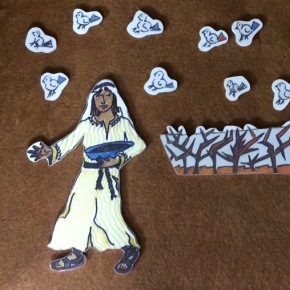
 Okay, to start off: I’m not going to preach this morning about my rapidly approaching fatherhood. But I just want to point out God’s divine sense of humor in us reading in the Hebrew Scripture a story about the birth of twins. Rather, this morning, I’m going to preach about God’s persistence and God’s extravagance. To do this, I’d like to talk about the second of my three days of Godly Play training.
 Sometimes when we pull a piece of the Gospel out of its natural habitat and read it in our cozy New England church, the impact of the words changes. Take the lesson I just finished, for example. How surprised would you be to learn that Jesus is trying to comfort his disciples with these words? You just heard them. They don’t sound very comforting, do they?
 As most of you know, Leah and I are expecting twins in just a couple of weeks. I’ll let you in on a little secret. I am so excited. And terrified. And excited. Whenever I think of the immensity of the change that is about to take place in our lives, I get this “deer in the headlights” look on my face for a minute. But then I remember to breath, and I remember that we’re going to have a lot of help and support, and I remember what Jesus says at the end of today’s Gospel reading: “I am with you always.” And all that helps.
 I couldn’t help but notice the readings selected for today all have some flavor of courtroom drama. We have the Apostle Paul sightseeing around Athens and discovering an out of the way shrine dedicated “to an unknown god.” When he stands up to debate at the Areopagus (the Athenian equivalent of the Supreme Court), he proclaims to the Athenians that this unknown god is the God who created all that is, the God of Abraham and his descendants, the God and Father of our Lord Jesus Christ. At the end of his speech, some scoff at him and leave; others are intrigued and join Paul on his journey.
 Attending seminary a few subway stops away from Washington D.C. provided some lovely distractions. The National Gallery of Art was my favorite. The Air and Space Museum was a close second. I visited most of the District’s tourist attractions during my three years there, and most lived up to their billing. One that did not was the D.C. zoo. The zoo is squashed into a tiny piece of the District, and the animals are squashed into tiny pieces of the zoo. The panda paddock was smaller than the backyard I mowed every week growing up. The elephants had no room to move. Everything was concrete and wrought iron. And the one time I went there, I couldn’t help but think what an inaccurate use of the word “zoo” I was witnessing.*
 Today we are going on a journey to the center of a word. This word happens to be one of the most misused words in the English language, and it happens to be an important word in our Gospel lesson today. This word is “believe.”
 Where the Wind...