Make Your Face Shine

(Sermon for Sunday, November 27, 2011 || Advent 1B || Mark 13:24-37; Psalm 80 )

Imagine with me the Apostle Peter, who is imprisoned in Rome near the end of his life, talking to his cellmate about the day when Jesus spoke about his coming again.
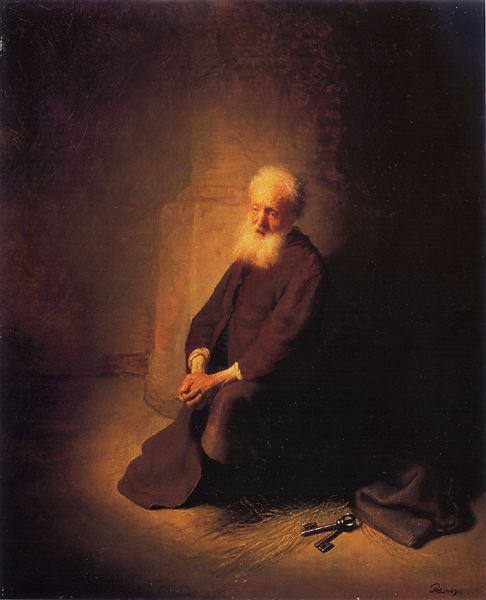
We were used to hearing Jesus say strange things. He would get this faraway look in his eyes, like he was seeing another place and time, or perhaps every other place and time. When we noticed him go distant like that, the twelve of us would gather around close because we knew he would have something to say when he came back to us a moment later. More often than not, the faraway look meant something strange and sometimes unsettling was about to come from his lips. But, as I said, we were used to Jesus saying strange things, having traveled with him for months or years. In fact, I suspect that a few of us – Bartholomew especially – followed Jesus precisely because of those strange things he said.

But this one time was different. I think Bartholomew was just trying to bait Jesus into saying something memorable when he pointed out the architecture around us and said: “Teacher, look! What awesome stones and buildings!”

I don’t think Jesus was in a mood to banter with Bartholomew because his response was short and clipped: “Do you see these enormous buildings? Not even one stone will be left upon another. All will be demolished.”

I remember seeing the smile drain off of Bartholomew’s face. The conversation ended as quickly as it had begun. But Jesus’ words had unsettled me. I knew that the temple had been demolished in the past by invaders, but if the Romans had wanted to destroy such a grand building, wouldn’t they have done so already?

Later that day, we were sitting on the Mount of Olives, and James, John, Andrew, and I went to Jesus privately to ask about what he had said. The temple rose out of the city across from us, and Jesus gazed at those old stones for several minutes. But he had that faraway look in his eyes, so we knew he was seeing something other than Jerusalem’s skyline.

We waited patiently, and finally he came back to us. He spoke in low tones for a time, as if the sky and the trees around us weren’t prepared for what he had to say. He spoke of wars and earthquakes and famines. He spoke of deceivers and false prophets. He spoke of stars falling from the sky and the sun going dark. I had hoped for something comforting after his clipped response to Bartholomew, but what Jesus had to say troubled me even more.

Seeing the distressed look on my face, Jesus squeezed my shoulder and said, “But after this they will see the Son of Man coming in clouds with great power and glory.”

He meant the words to be reassuring, but my mind was still filled with images of famine and falling stars. All I could think to say was, “When will this happen, Lord?”

Jesus shook his head and shrugged. “I don’t know,” he said. “No one does but the Father. That’s why you need to keep alert. Think what happens at a house when the master goes off leaving the slaves in charge. They don’t know when the master will return – in the evening or at midnight or when the rooster crows or at dawn – so they stay awake.” Jesus fixed his eyes on each of us in turn and said: “The same goes for you: keep awake.”

A week later I failed to do what he said. It was the most important week of Jesus’ life, of my life, and I failed to keep awake to the great power and glory of God being revealed in the world. Even during his trial and crucifixion, even during that pivotal moment, I could not keep awake and alert. Did Jesus know? When his eyes went faraway on the Mount of Olives, did he see me falling asleep in the garden at midnight? Did he hear the rooster crow when I abandoned him? Did he see me sobbing when I realized my betrayal?

After such total failure, I vowed from then on always to keep alert for the Lord’s coming. And over the years, I discovered three things. Very quickly, I discovered just how easily the distractions of this world can lull me to sleep. There is always something other than God clamoring for my attention, something immediate and important. And yet this something doesn’t necessarily lead me astray from following God. Rather, the things that clamor for my attention simply make me walk with my head down so I don’t see God’s glory all around me. The distractions win out much of the time because God doesn’t clamor. God whispers. God nudges. God invites. I don’t know about you, but keeping awake and alert is the only way I ever notice God’s subtle movement.

I also discovered that Christ still comes to me even now – again and again – but like God’s movement, subtly. Now, I know what you’re going to ask. Before you do, the answer is yes. I do believe Jesus when he said the Son of Man will come again in great power and glory. But I also know that I saw him in the face of the woman who brought us fresh clothes, and I see him in you. I know this sounds like a paradox – how can Jesus be present with us here in this rotten prison and still be coming again? I wish I could explain, but I’m no theologian. But Jesus taught me how the truth tastes, and this seeming contradiction tastes true.

Thirdly, I discovered that the best way to keep awake was to keep a light burning. Yes, I know they don’t allow us candles in this stinking cell, but that’s not what I mean. Many years ago, I wandered into a synagogue somewhere in Galilee and found the scroll of the book of psalms open on a table. I glanced down and read the first few lines of the eightieth psalm. And one of them has been with me ever since, rising unbidden from my consciousness whenever I begin to fall asleep. The verse reads: “Restore us, God! Make your face shine so that we can be saved!”

“Make your face shine!” God is the light that shines to keep me awake. Now, my friend, I don’t think you know the history of my people. Well, the psalm was written when Israel was in exile. That’s why they prayed, “Restore us, God!” But what they discovered in exile was that God was there with them even though they assumed God had stayed in Jerusalem. So they prayed: “Make your face shine” so they could see God more clearly when they were far from home. And I have taken up their prayer.

I am far from home. I have been distracted by many things clamoring for my attention. I don’t always notice Christ’s subtle presence in the people I meet. But when this prayer to God springs to my lips – “Make your face shine” – I become more alert. I notice Christ’s face shining in the faces of those I meet. I look up from all the immediate and important things and notice God’s glory shining all around me. I may be far from home. And the Son of Man may not come in great power in glory for years, even centuries. But I have tasted the truth that Christ’s face shines in the darkness of my life. I failed to keep awake during Jesus’ own dark days. But because his face is shining light on my path, I will not fall asleep again.


Four Bags of Saline

I first posted this Advent reflection on the site Day1.org, which is having a Advent/Christmas Blog tour.

* * *

On Tuesday afternoon, I contracted a viral infection that systematically began evacuating the contents of my stomach, intestines, gall bladder, and liver as quickly as possible. Every half hour I scurried from my fetal position on the couch back to the restroom where I’m sure the neighbors and the folks in the next county could hear my wretched retching. After about four hours of agony, my fiancé finally convinced me to go to the Emergency Room. Severely dehydrated, I accomplished the weak-kneed feat of maneuvering down the stairwell and out to the car, all the while clutching a white, plastic wastebasket like a shipwreck survivor clinging to a life preserver.

With my fiancé supporting me, I stumbled into the ER at about eleven at night. The woman behind the counter took my information and fitted me with a bar-coded bracelet. Another woman took my vital signs and then told me to take a seat in the waiting area. I don’t know how long we waited. My sense of time was reduced to half-hourly dashes to the restroom followed by several, sweat-drenched minutes sitting on the tile floor heaving with exhaustion. Sometime after my fourth trip to the restroom, a nurse mercifully called me back. I sat in a wheelchair as an orderly navigated me to a bed in the hallway of the overcrowded emergency department.

The nurse poked an IV tube into the back of my right hand and fed into my bloodstream the same anti-nausea medicine they give to chemotherapy patients. Then she hooked up a bag of saline, and I watched through half-lidded eyes as the saline began dripping from its elevated place into the tube. My fiancé read the words on the machine to me: 500 milliliters per hour. The equipment was making the saline drip at a proscribed rate – the bag would be empty in two hours. With the anti-nausea medicine suppressing my urge, I now had a new way to measure the time.

One empty bag of saline later, I was showing marked improvement. A little color had returned to my cheeks, and I was thirstier than I had ever been. The nurse allowed me ice chips and promised a popsicle later on if I continued to feel better. I crunched down a Styrofoam cup’s worth of ice and then collapsed back on the bed in the hallway. While I sucked on the ice chips, the nurse hung another bag of saline, and sped up the distribution of the liquid into my body. Now I was receiving 1000 milliliters an hour, or one full bag.

A second empty bag of saline later, I received the promised popsicle, and my fiancé correctly guessed the punch line to the truly horrendous joke stamped on the popsicle stick (How does thread get to school? On a spool bus). After I finished the popsicle, the nurse propped me back in the wheelchair for a ride to the radiology department for a chest x-ray. The doctor wanted to make sure that my gastric pyrotechnics hadn’t torn my esophagus. The short trip wore me out, and I dozed off and on through my third bag of saline, also pushed into me at 1000 milliliters an hour.

By the end of bag three, I just wanted to go home and crawl into my own bed away from the bright fluorescence and constant beeps and blips of the ER. My doctor had other plans, however, and instructed the nurse to hang a fourth bag of saline. This time, she turned off the machine controlling the dispersal of the IV into my arm. The bag would finish not in one hour or two like the other bags, which were “pushed” into me, but at the undefined rate of gravity.

I knew that eventually the fourth bag of saline would empty. I knew that I would be allowed out of the ER for the blissful comfort of my own bed and sleep uninterrupted by illness or beeping monitors. I just didn’t know when. This is the same quandary that the season of Advent invites us to explore. We don’t know when Jesus will return, but we know that he will return. Now, we live in a culture dependent on the constant, steady, and unwavering march of time. We punch in time cards at work. The train leaves the station at 7:12 sharp. The firm expects so many billable hours. Time is money. So when Jesus himself says, “But about that day and hour no one knows, neither the angels of heaven, nor the Son,* but only the Father,” his words run smack into our conception of time. How could we not know when something will happen? How could we not know when to begin our preparation for the big day?

By not putting a date and time on his return, Jesus pushes us to celebrate the much more important fact that his return will happen. He understands human nature too well. By initiating the expectation of return without a time frame, he delivers us the perfect set of variables to make us practice constant vigilance. When I knew the saline bag would run out in one hour, I had no need to watch it. The 1000 milliliters ticked by one after another in predictable, rhythmic progression. But when the nurse turned off the machine during the fourth saline bag, I had to keep looking up at it to see how quickly gravity was doing its work.

I knew the bag would empty, but I wanted to be sure I knew exactly when those last drops would fall so that I could leave the hospital. In the same way, during the season of Advent, we practice our awareness of God’s presence in our lives so that we can more readily identify the signs of Christ’s reign breaking into the world. During the season of Advent, I invite you to turn off the machines that push the IV. Let gravity take over. Know that the “when” is less important than the “what.” Jesus is coming; indeed, Jesus is always here, as well. When we worry less about the when, we can begin to see the presence of God happening all around us. So turn off your clocks. Forget marking off days in your Advent calendar. And just live with the grace-filled knowledge that Christ is coming.

Fully human

The following post appeared in the Advent issue of Episcorific (a ‘zine for and by the 20s and 30s of the Episcopal Church). You can download the full magazine in .PDF form here.

* * *

The trouble with being human is that most of us aren’t very good at it. We are way better at being couch potatoes or social butterflies or unique snowflakes or chickens. We explain the very act of making more humans by referring to the birds and the bees. A frightened human is a scaredy cat; an insufferable one is a less polite term for donkey. We may exist as humans, but we spend a lot of time filling the roles of other species.

And these other species are darn good at being themselves. Bees fly around collecting nectar and pollinating flowers. Trees keep soil from eroding. Grass scrubs the air of carbon dioxide. Cockroaches allow husbands to feel manly. If evolution teaches us one thing it’s that species thrive when they don’t try to fill the role of some other species.

While we are busy being butterflies and potatoes, we forget that in reality we are human. And who really wants to be human? Our skin isn’t very well adapted to our climates. Our young can’t fend for themselves for at least twenty-two years. Our bodies break down with alarming frequency. And to top it off, I can’t think of another species on this planet that kills its own kind with as much regularity and aplomb as we humans.

But somehow we have survived down through the ages amidst the dangers of saber-toothed tigers, drought, pestilence, war, and deficit spending. We have survived, but, as Tennyson writes, “We are not now that strength which in old days / Moved earth and heaven.” I’m not even convinced that we’ve ever been that old strength. I don’t think that we’ve ever lived into our humanity to the greatest extent possible.

And here’s where Jesus comes in. Jesus didn’t come to show us a new way to be human. Jesus came to show us how to be fully human. The Gospel makes a big deal about Jesus’ own humanity. Matthew and Luke talk about Jesus’ birth. John shows Jesus tired, angry, and sad. In all four accounts of the Gospel, he is brutally murdered. And why present God the Son as such a frail collection of bones and tissue and synapses? Well, he couldn’t be the “Word made flesh” without flesh. And he couldn’t be our hope and our salvation without fully identifying with our lives, however “nasty, brutish, and short” they may be (thanks to Thomas Hobbes for those appropriate adjectives).

So Jesus is fully human – not some ghost or apparition or hologram. And he’s fully divine. 100% of both. This 100% of humanity is the real miracle here. It’s impossible for God not to be 100% divine (God wouldn’t be God without the perfect batting average). But it’s very possible (indeed, likely) to be less than fully human. Jesus succeeded in realizing this unlikely full humanity, and that’s one of the reasons he’s so special. His life and his example teach us to be fully human.

If we aren’t fully human now, what takes up the rest of the space? In Mere Christianity, C.S. Lewis explains this question well. Lewis calls us “toy soldiers.” We begin as automatons – clockwork beings in need of winding and direction. But God doesn’t want toy soldiers. God wants sons and daughters to love and adopt as God’s children. Jesus’ example and his grace enable us to move through the messy, painful, joyous process of outgrowing our clockwork. Only by becoming fully human, can we fully embrace God’s love for humanity. If we can recognize God’s love for humanity, perhaps we can love other humans, as well.

Food (namely herbs and stewed rabbit) for the journey

The following post appeared Wednesday, December 9th on Episcopalcafe.com, a website to which I am a monthly contributor. Check it out here or read it below.

* * *

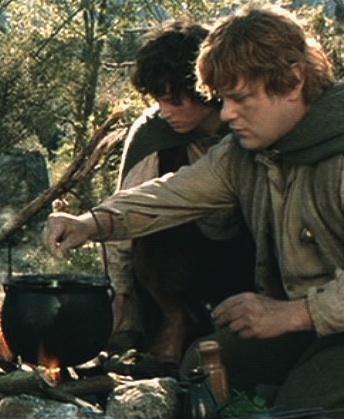
The hobbits Frodo Baggins and Samwise Gamgee arrive in a heather-strewn woodland between the River Anduin and the mountains that border the dreaded land of Mordor. After some walking around and griping about the knavish Gollum, who is their deranged hostage and guide, they sit down for a meal, as hobbits often do. They eat herbs and stewed rabbit and then…

Frodo (Elijah Wood) and Sam (Sean Astin) make stewed rabbit in The Two Towers (2002)

…I have no idea what happens next.

I’m twelve years old, and I have made it nearly two-thirds of the way through The Lord of the Rings. But I can no longer bear it, and I shelve the book. It’s just so boring. All they do is walk! They start in one place, walk for a bit, meet someone and chat, and then walk some more! I just want them to get somewhere! I want to yell, “Get to your destination, Frodo – don’t stop to eat herbs and stewed rabbit, which the author has described in painstaking detail! Just get to the mountain and be done with the ring! Enough of this walking…”

A year later, I’m thirteen (a much wiser and more mature age), and once again I pick up The Lord of the Rings. Maybe this year, I’ll finish it. I begin at the beginning, and they walk and meet folks and chat and run away from enemies and Frodo and Samwise reach the heather-strewn woodland and eat herbs and stewed rabbit and then…

…I have no idea what happens next.

My wisdom and maturity are no match for the walking. Again, I stop reading. The quest is just too long and arduous and their destination is still on the other side of the mountains and several hundred pages away.

A year later, I’m fourteen, and I pick up The Lord of the Rings again. On page 641, Frodo and Samwise sit down for a dinner of herbs and stewed rabbit and then…

…I keep reading. They find themselves in the middle of an ambush, Sam sees an oliphaunt, the hobbits are captured by people who are supposed to be on their side, and the story goes on and on. A few days later, I finish it. And I’ve read it at least eight more times since.

Finally, at fourteen, I could appreciate the journey, and let the destination take care of itself. Tolkien understood that a destination is more than a physical place. A destination is the culmination of all the shaping events of the journey that brings you to that ultimate location.

Every year, after the tryptophan has worn off, we begin just such a journey in our walks with God. While secular Christmas disgorges itself out of shipping containers every year the day after Thanksgiving, we have the opportunity to let Christmas happen only after the four weeks of Advent have run their course. Christmas is the destination. And Advent is about not arriving at your destination before you are shaped by the journey.

Have you ever had the soup du jour at a restaurant? It’s not some fancy French dish. It’s just the soup made for that particular day. Likewise, my journey happens every day. Every encounter, every decision, every road taken or not shapes me. The season of Advent gives me a dedicated four weeks to notice the shaping influence each day has on my journey with God.

On the first Sunday of Advent, we heard the psalmist pray, “ Show me your ways, O Lord, and teach me your paths…All the paths of the Lord are love and faithfulness” (25:3, 9). This Advent, I’m adopting this prayer because I’ve always had trouble not skipping to the end of the story. Every year of my childhood, I wanted to open the windows of my Advent calendar all at once. I just couldn’t wait to open tomorrow’s window tomorrow. Now, at twenty-six (a much wiser and more mature age) I pray for God to give me the patience to notice each day’s impact on my life. When I ask God to “teach me your paths,” I’m not hoping for some inside knowledge about the destination. I’m simply asking for guidance along the road.

Some time ago, I heard this illustration (the origin of which no longer resides in my brain). Have you ever noticed that headlights only show you thirty or forty yards ahead of your car on a dark night? But they still get you to your destination. Likewise, God teaches me God’s path even as I am struggling to stay on it. As I walk towards Christmas on this particular Advent journey, Christ walks a few steps ahead of me, illumining the road to his own nativity, to his own unique and wonderful expression of love and faithfulness.

Despite my opening description, my love for Tolkien’s works of fiction is deep and abiding. They taught me the lesson of Advent: don’t arrive at your destination before being shaped by the journey. I pray that, during this season of Advent, God teaches us God’s paths, which are love and faithfulness. And I pray that we may meet someday on the road, about which Tolkien’s Bilbo Baggins rhymes:

The Road goes ever on and on
Down from the door where it began.
Now far ahead the Road has gone,
And I must follow, if I can,
Pursuing it with weary feet,
Until it joins some larger way,
Where many paths and errands meet.
And whither then? I cannot say.

Red sky in the morning…

In the Gospel, Jesus mentions that we can tell when summer is coming by the budding of the fig tree. He recognizes that we’re pretty good at figuring out what’s ahead. Arthritic knees feel the storm before it strikes. “We’ve got to talk” means Friday’s dinner date is off. Red sky in the morning, sailor take warning. If we humans are paying attention (even just a little bit), not much can slip by us.

And so, I pay attention to the signs: every retail store is trying to sell you a Garmin GPS system, pop singers are taking it in turns to butcher “O Holy Night” on the radio, and astronauts aboard the International Space Station can see your neighbor’s decorations. So this is Christmas, I echo John Lennon’s hopeful lament.garmin

Now, I promise this article isn’t going to degenerate into the generic, tired outrage about consumerism during the holiday season, so stick with me for a few minutes. I’m paying attention to the signs, and all I see are discounted LCD flat screens and all I hear is another cover of “Frosty the Snowman.” Ever since the commercial sector replaced black and orange with red and green, we have been living in a winter wonderland of perpetual Christmas Eve. And I’m telling you, I could have weight-trained with the circular-laden Thanksgiving edition of the newspaper.

I’m paying attention, but the luster and volume of perpetual Christmas Eve flash brighter and shout louder than the subtle, increasingly subversive current that charges this holiday with meaning. This subtle event is, of course, the birth of an infant. Not so newsworthy, right? Indeed, the Bethlehem Gazette would have only covered the event because of the odd behavior of a bunch of shepherds.

You see, the people of Israel weren’t looking for an infant born out in the barn. They were looking for a triumphant, well-muscled, military superhero to be their messiah, to be their exterminator of all things Roman. And so they missed the signs because they were paying attention to the wrong thing. They were so busy yearning for pomp and swagger that they missed love and humility. While we don’t have to worry about the Roman Empire, we often fall in the same trap of misplaced attention. By observing some mutated version of Christmas for weeks ahead of time we fail to recognize a truly wonderful season of preparation for Christmas, which the Church has been celebrating for centuries.

Today marks the sixth day* of that season of Advent, the four weeks leading up to the celebration of the birth (or Incarnation, if you want to be technical) of Jesus Christ. During the season of Advent, we pause, we notice our ragged breath, and we take time to catch it. We prepare a place in our hearts to receive once again the love of God in the presence of Jesus Christ and wonder how we let that place get so cluttered since last year. And as we prepare to celebrate the Incarnation, we realize just how badly our society has missed the point.

This Advent, drag your eyes and ears away from all that clamors for your notice, all that sound and fury. Pay attention to the true signs of the subtle, subversive event of the presence of Christ in our midst. Your neighbor’s decorations may sparkle and glitter, but they do not shine like the light of the world. That pop singer’s quivering ornamentations might adorn “O Holy Night,” but they do nothing for a world that still lays long in sin and error pining. And that GPS system you bought on Black Friday for $89.95 might give good directions, but it won’t show you the way.

The way, the truth, the life comes. Pay attention and see the signs of Christ’s presence in our midst. And don’t just notice those signs. Be one.

Footnotes

* This post began its life as an article in my local newspaper. Today is actually the ninth day of Advent, and the article actually appeared on the seventh day — so I’m wrong across the board.

Of sandwiches and second comings

(Sermon for November 30, 2008 || Advent 1, Year B RCL || Mark 13:24-27; 1 Corinthians 1:3-9)

At the end of this sermon, I’m going to explain why the phrase “O come O come Emmanuel” is a funny phrase. But first, I want to talk about my parents’ crèche.

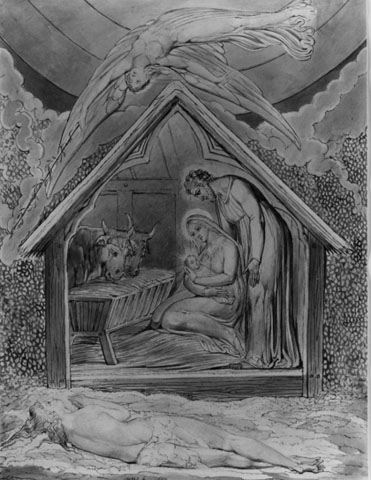
During the season of Advent when I was growing up, my family placed a beautiful Nativity scene on the shelf above the TV. The wooden stable had a bark and moss covered roof, above which we suspended angels on fishing line. Inside the stable, a bearded Joseph leaned heavily on a staff and a kneeling Mary pondered things in her heart, while a donkey and a cow looked on. Outside the stable, a pair of shepherds, a woman balancing a jug of water, and assorted townsfolk queued up like bridesmaids and groomsmen in a wedding photo. Each character was transfixed by something going on at the center of the stable, something that was obviously important if the painted expressions on their faces could be believed. The trouble was that nothing was going on at the center of the stable. An unassuming manger stood in between Mary and Joseph, who stared lovingly down into the empty box.

blakenativity
William Blake "The Descent of Peace"

You see, we waited until Christmas Eve to place the baby Jesus in the manger. (Confidentially, we hid him on the shelf behind the stable until our plastic Mary came to full term.) So, for the entire month of December, our crèche was incomplete. As a child, I might have laughed at the incongruity of the scene if I had known any other Advent tradition. Jesus hadn’t come yet, but the fishing line angels were already fingering their harps, the shepherds were already choosing which lamb to present, and the cattle were already lowing (whatever lowing is).

Without Jesus in the manger, none of these activities made sense. But putting the babe away in that manger a month before Christmas removed the period of expectant waiting that Advent is all about. This is the tension we acknowledge during these next four weeks. By preparing to celebrate Jesus’ Incarnation, we are also preparing for his second coming. To be able to come again, he had to leave. But even as we prepare for his coming again, we remember that Christ abides with us even now in the present.

This incongruity is quite confusing. How can Jesus be coming again and abiding with us at the same time? This makes no sense. If I say I’m going to the kitchen to make a sandwich, I can’t watch football on the couch in the living room at the same time. (I can, of course, pause the football game with the wonderful invention of DVR, but that’s beside the point.)

I can either make a sandwich or watch football. We are used to our world working in this either/or way. We exist in time and space. At this moment in time and at this place in space, I exist in this pulpit talking to you. I can neither make sandwiches nor watch football right here right now. Indeed, many years ago I gave up praying for the ability to teleport and succumbed to the reality of our either/or world.

But we get so caught up in “how things are for us” that we forget God lives outside and above and throughout this reality. We are bound by our either/or perceptions. Our God lives an expansive both/and kind of existence. Both three persons and One God? Yes. Both fully human and fully divine? You bet. Both coming again and abiding with us still? No problem.

The problem comes when we, in all our haste and distraction and busy work, forget that Christ abides with us still. Acknowledging the promise of “coming again” is much easier for us because it takes place in some amorphous future. Now, we humans have developed an awful routine of sloughing the future off on those people who will be alive in the future. This routine has spawned the byproduct of ignoring the consequences of our actions for those unfortunate future people. If we can push those consequences off into an amorphous future, surely we can install Jesus’ second coming there, too.

But when Jesus warns his disciples to “keep alert” and to “keep awake,” he reminds them that the future has a persistent habit of becoming the present. On some day that only the Father knows the Son of Man will come in the clouds with great power and glory. At some hour the master of the house will come, says Jesus. Don’t let the vague obscurity of the future lull you to sleep or you will miss the promise fulfilled in the present.

The Apostle Paul is aware that there are numerous sleepy followers of Christ in Corinth, the city to which Paul addressed this morning’s lesson. He reminds the Corinthians of Jesus’ promise to come again when he mentions “wait[ing] for the revealing of our Lord Jesus” and being “blameless on the day of our Lord Jesus Christ.” In the same breath that he speaks about the future, Paul also focuses on how Jesus Christ abides with the Corinthians and impacts their lives in the present. Christ has given them the “grace of God.” They have been “enriched in him in speech and knowledge of every kind.” They are “not lacking in any spiritual gift.” Christ will “strengthen” them even as they wait for the day of his revealing.

With these words, Paul teaches us that the best way to prepare for the coming of Christ is to realize that Christ continues to grace and enrich and strengthen us even now. Forgetting that Christ is present in our lives feeds the delusion that the future happens only to people yet unborn. On the other hand, setting all our desire on Jesus’ coming again blinds us to the presence of Christ in our midst. Thus, we can’t afford to let our either/or world dictate to which alternative we will subscribe. Only by keeping awake to the presence of Christ in our lives today will we be able to keep alert for the coming of Christ tomorrow.

When we come to the altar in a few minutes, we will share that presence of Christ in our midst. We will be nourished in the breaking of the bread and strengthened to go out and enrich the lives of all we meet. We will be given the opportunity to let our haste and distraction and busy work fall away, and for one shimmering moment, we will remember that the grace of God weaves our lives together. And as the body and blood of Christ fills us, the master of our internal houses will wake us up and set us by the door to watch for his coming again.

Okay, I promised that I would explain why the phrase “O come, O come, Emmanuel” is a funny one. Well, “Emmanuel” means “God with us.” So, when we chant that hauntingly beautiful melody, we are saying: “O come someone who is already here.” No matter how nonsensical our either/or world says this line of reasoning is, we still pray for “God with us” to come to us. By asking us to believe that Christ will come again even as Christ abides here, God invites us to join God in a moment of sweeping both/and reality. During the season of Advent, we cultivate the hope for this expansive existence. At the same time, God jostles our faith to make sure both our presents and our futures are full of the love of God. Keep alert for the coming of Emmanuel. And keep awake for the joy of God with us.