The Living Among the Dead

NOTE: DevotiONEighty is off this week. It will return next Monday, April 8th.

(Sermon for Saturday, March 30, 2013 || The Easter Vigil || Year B || Luke 24:1-12)

I doubt they slept much the last two nights, the women who rose early on the first day of the week to minister to their dead Lord. Every time they shut their eyes, I’m sure they saw the silhouette of Jesus’ cross in the distance, his limp body all but unrecognizable because of his torturous hours hanging there. And because dead bodies never, ever look like the lives ones they were a moment before; especially Jesus’ body, he who was so full of abundant life that he was just giving of his abundance to anyone who asked. No, I doubt these women slept much, though if they did finally fall into fitful slumber, it was because they cried themselves to sleep. When all you have left is your tears, you’d want to hoard them; but that’s when they flow all the more freely.
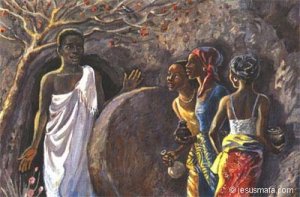
"Women at the Tomb" (Jesus Mafa - click for more info)
“Women at the Tomb” (Jesus Mafa – click for more info)

I’m sure the tears began again when they awoke early on the first day of the week. New grief is like that. Each morning you wake and remember again that your loved one is gone, and again the pain stabs you anew, just as fresh as the first time. But even in the midst of their grief, these women took up their burdens of fragrant spices and trudged out into the darkness, so they could arrive at the tomb at first light.

But these brave women, who are ready to care for the body of their Lord, to do their duty out of love and compassion, are making the happiest mistake in the history of mistakes. They are prepared to wash and anoint a lifeless body, but what they find is no body at all. They find an empty tomb, save for a discarded burial shroud. Their grief threatens to overwhelm them because the duty they were planning to perform – the one they had been clinging to since his death – is gone now, too. They didn’t think they could be more desolate, but they were wrong. The empty tomb magnifies their desolation.

But into this scene of despair and grief comes the sudden presence of two gleaming messengers. They enlighten the woman as to their mistake: “Why do you look for the living among the dead? He is not here, but has arisen.” Then they remind the women what Jesus had said about himself while they were all still in Galilee.

The women remember Jesus’ words, and first one, then another, then another breaks out into a tentative smile. “Could it be true?” they ask each other.

“Yes, yes, yes it could.”

“Jesus never lied to us.”

“How could we forget his words?”

Then one repeats the messengers’ question: “Why are we looking for the living among the dead?”

This question echoes down through the centuries, and we find ourselves asking it when we read the beginning of the final chapter of Luke’s account of the Gospel. Why do you look for the living among the dead? How often in our day-to-day lives could we hear the gleaming messengers asking us this question? How often do we trudge down the well-worn path to life-defeating things hoping this time – maybe this time – something life-affirming will happen?

Perhaps you’ve had a string of boyfriends who were real losers. Your friends tell you so at every opportunity, but you’ve got a blind spot for bad boys. They treat you with no respect. From time to time they’ve even called you a name that I can’t say during this sermon. And yet you meet another one and all the signs are there, but you dive in headfirst anyway. To you the gleaming messengers say, “Why do you look for the living among the dead?”

Perhaps you’ve been sober for three months. Your sponsor hands you your chip and slaps you on the back. You’ve got a couple of other three-month chips in a drawer somewhere, but that’s not on your mind right now. On your way home from the meeting, you run into an old buddy from back in the day. The next morning, you stagger to the drawer and toss the newest chip in. Maybe you’ll get another one in a few months time. To you, the messengers say, “Why do you look for living among the dead?”

Perhaps you work through your family vacation because you’ve got too many projects on your plate. Or you spend every waking hour mindlessly surfing YouTube and Facebook. Or you derive your self-worth only by what others say of about you. To you – to all of us – the messengers say, “Why do you look for the living among the dead?”

The Resurrection of Jesus Christ spurred this question all those centuries ago. The women made the happy mistake of looking for a dead Christ, when the Risen One was alive again. They brought to the tomb their grief, their tears, and their emptiness. And they left them there because the power of the Risen Christ outshone any desolation left in them.

When we look for life-affirming answers in the midst of life-defeating things, we replicate the women’s happy mistake, but with none of their good intentions. When we look for the living among the dead, we are trudging the well-worn path to the newly hewn grave where a dead messiah awaits. That way is full of tears and lifelessness.

But the good news of the Resurrection is this: when we arrive at the tomb, at rock bottom, at the ends of our ropes, we will find the Living Christ shining radiantly in the midst of our dead messiahs. We will find his empty tomb, which is ready to receive all of our muck, all of our bad choices, all of our life-defeating tendencies. When we deposit all of our dead ends there, we can leave the tomb unencumbered, and chase off after the Risen Christ, fresh, free, and born anew.

So why do you look for the living among the dead?

He is not here, but has arisen.

Way of the Cross: Stations 13-14 (March 29, 2013)

…Opening To…

We adore you, O Christ, and we bless you;
Because by your holy cross you have redeemed the world.

…Listening In…

Now there was a man named Joseph who was a member of the council. He was a good and righteous man. He hadn’t agreed with the plan and actions of the council. He was from the Jewish city of Arimathea and eagerly anticipated God’s kingdom. This man went to Pilate and asked for Jesus’ body. Taking it down, he wrapped it in a linen cloth and laid it in a tomb carved out of the rock, in which no one had ever been buried. It was the Preparation Day for the Sabbath, and the Sabbath was quickly approaching.The women who had come with Jesus from Galilee followed Joseph. They saw the tomb and how Jesus’ body was laid in it, then they went away and prepared fragrant spices and perfumed oils. (Luke 23:50-56; context)

…Filling Up…

This Holy Week we are be meditating on the fourteen “Stations of the Cross.” The Opening and Sending sections of this week’s Devos, as well as the italicized verses at the end of each station come from the Episcopal “Way of the Cross” service found in the Book of Occasional Services. (If you’d like to hear the complete work, check out the music page.)

Station 13: The body of Jesus is placed in the arms of his mother
Daughter of Jerusalem,
Cradle your Son.
“My heart is poured out in grief,
My eyes are spent, but my sorrow’s just begun.
My name shall be ‘Mara.’
Bitter I have become.
O Death, I feel your sting,
But is it true that the grave’s
Power will be undone?”

Her tears run down her cheek:
And she has none to comfort her.

Station 14: Jesus is laid in the tomb
Grieving,
They pull the thorns from Jesus’ head;
Not quite believing
Their way, their truth, their live is dead.
The future looming:
A void where light is never shed.
Now they’re entombing
The bridegroom who will never wed.

You will not abandon me to the grave:
Nor let your Holy One see corruption.

Closing Antiphon

…Praying For…

Dear God, your holy Son relinquished his life to destroy death, and he died so I might live. Help me to die to self each day and live for him he rose again on the third day. As I wait and watch by the tomb, grant me the grace to remember his presence in my life, in whose name I pray. Amen.

…Sending Out…

I leave this moment with you, God, glorying in the cross of our Lord Jesus Christ, in whom is our salvation, our life, and resurrection.

Way of the Cross: Stations 11-12 (March 28, 2013)

…Opening To…

We adore you, O Christ, and we bless you;
Because by your holy cross you have redeemed the world.

…Listening In…

When Jesus saw his mother and the disciple whom he loved standing nearby, he said to his mother, “Woman, here is your son.” Then he said to the disciple, “Here is your mother.” And from that time on, this disciple took her into his home. After this, knowing that everything was already completed, in order to fulfill the scripture, Jesus said, “I am thirsty.” A jar full of sour wine was nearby, so the soldiers soaked a sponge in it, placed it on a hyssop branch, and held it up to his lips. When he had received the sour wine, Jesus said, “It is completed.” Bowing his head, he gave up his life. (John 19:26-30; context)

…Filling Up…

This Holy Week we are be meditating on the fourteen “Stations of the Cross.” The Opening and Sending sections of this week’s Devos, as well as the italicized verses at the end of each station come from the Episcopal “Way of the Cross” service found in the Book of Occasional Services. (If you’d like to hear the complete work before Friday, check out the music page.)

Station 11: Jesus is nailed to the Cross
They climb the Skull and fling him down
Like so much dross.
See him stretch his arms of love on the
Hard wood of the cross
That all might come within the reach of his embrace.
Hear the nail pierce his hand
Taste the heaving tang of fear
The unrelenting hammer strikes home.
They lift high the Son of Man
His broken glory now appears
As he draws all to himself.

They pierce my hands and my feet:
They stare and gloat over me.

Station 12: Jesus dies on the Cross
With the Beloved his mother stands:
To each other his final breath ties.
Darkness eclipses the surrounding lands;
“It is finished. It is finished,” he cries.
“My spirit, O Father, I give to your hands,”
With choking gasps he sighs.
Then my Lord bows to the grave’s demands,
Breathes his last, and dies.
He breathes his last and dies

Christ for us became obedient unto death:
Even death on the cross.

…Praying For…

Dear God, your holy Son stretched his arms out on the cross and drew the whole of Creation to himself. Help me to reach out my own arms in love to all I meet, especially to those in the most need. In Jesus Christ’s name I pray. Amen.

…Sending Out…

I leave this moment with you, God, glorying in the cross of our Lord Jesus Christ, in whom is our salvation, our life, and resurrection.

Way of the Cross: Stations 9-10 (March 27, 2013)

…Opening To…


We adore you, O Christ, and we bless you;
Because by your holy cross you have redeemed the world.

…Listening In…

When they came to a place called Golgotha, which means Skull Place, they gave Jesus wine mixed with vinegar to drink. But after tasting it, he didn’t want to drink it. After they crucified him, they divided up his clothes among them by drawing lots. (Matthew 27:33-35; context)

…Filling Up…

This Holy Week we are be meditating on the fourteen “Stations of the Cross.” The Opening and Sending sections of this week’s Devos, as well as the italicized verses at the end of each station come from the Episcopal “Way of the Cross” service found in the Book of Occasional Services. (If you’d like to hear the complete work before Friday, check out the music page.)

Station 9: Jesus falls the third time
By the waters of Babylon,
I hung my harp from the wall.
Darkness my only companion,
For the third time I see my Lord fall.
This strange land will hear no song of Zion,
This strange land that sees him crawl.
Remember, O Lord, my affliction:
The wormwood and the gall

He was led like a lamb to the slaughter:
And like a sheep that before its shearers is mute, so he opened not his mouth.

Station 10: Jesus is stripped of his garments
The stench of decay is all around
When the bloody procession slows.
At Golgotha the only sound
Is the cawing of a thousand greedy crows.
They stop and strip his clothes to the ground
And offer him wine he loathes.
The soldiers are slapping their wagers down:
They gamble for his clothes,
And they gamble for his clothes.

They gave me gall to eat;
And when I was thirsty they gave me vinegar to drink.

…Praying For…

Dear God, your holy Son was stripped of his clothes and his humanity, and he was reduced to a discarded piece of flesh hung on the cross. Yet he did not lose his dignity, nor his power, nor his conviction. In my dark days, clothe me with Christ and help me cling to him, in whose name I pray. Amen.

…Sending Out…

I leave this moment with you, God, glorying in the cross of our Lord Jesus Christ, in whom is our salvation, our life, and resurrection.

Way of the Cross: Stations 7-8 (March 26, 2013)

…Opening To…

We adore you, O Christ, and we bless you;
Because by your holy cross you have redeemed the world.

…Listening In…

A huge crowd of people followed Jesus, including women, who were mourning and wailing for him. Jesus turned to the women and said, “ Daughters of Jerusalem, don’t cry for me. Rather, cry for yourselves and your children. (Luke 23:27-28; context)

…Filling Up…

This Holy Week we are be meditating on the fourteen “Stations of the Cross.” The Opening and Sending sections of this week’s Devos, as well as the italicized verses at the end of each station come from the Episcopal “Way of the Cross” service found in the Book of Occasional Services. (If you’d like to hear the complete work before Friday, check out the music page.)

Station 7: Jesus falls a second time
Again my Lord falls to the ground,
Lays in the dust;
Underneath the cross’s beams he
Calls me to trust
That his words are true, despite his frailty.
Surely this humility
Is the true life-giving way
To serve as Jesus served.
He bears our iniquities
For we like sheep have gone astray
And have served only ourselves.

“But as for me, I am a worm and no man:
Scorned by all and despised by the people.”

Station 8: Jesus meets the women of Jerusalem
“Daughters of Jerusalem,
Weep not for me;
But weep for yourselves
For your children, let your tears fall freely.”
How vast is your grace, Lord?
As vast as eternity?
Blessed are you who wipe
Away every tear from our eyes.
Joy shall our children see.

Those who sowed with tears:
Will reap with songs of joy.

…Praying For…

Dear God, your holy Son took up the cross and in its weight bore the weight of the world. Help me to find the will to help bear the weight of some of this world’s suffering, for the sake of Jesus Christ, in whose name I pray. Amen.

…Sending Out…

I leave this moment with you, God, glorying in the cross of our Lord Jesus Christ, in whom is our salvation, our life, and resurrection.

Way of the Cross: Stations 5-6 (March 25, 2013)

…Opening To…

We adore you, O Christ, and we bless you;
Because by your holy cross you have redeemed the world.

…Listening In…

They led him away to crucify him. As they were going out, they found Simon, a man from Cyrene. They forced him to carry his cross. (Matthew 26:31-32; context)

…Filling Up…

This Holy Week we are be meditating on the fourteen “Stations of the Cross.” The Opening and Sending sections of this week’s Devos, as well as the italicized verses at the end of each station come from the Episcopal “Way of the Cross” service found in the Book of Occasional Services. (If you’d like to hear the complete work before Friday, check out the music page.)

Station 5: The Cross is laid on Simon of Cyrene
A stranger comes from the country,
Simon by name;
As they lay the cross on him,
He sees a flame
In Jesus’ eye which seems to say:
“Take my yoke and learn from me,
Take your cross and follow me,
And I will be with you.
Search your heart and yearn for me
And no longer hollow be
For I have already filled you.

“Whoever does not bear his own cross and come after me:
Cannot be my disciple.”

Station 6: A woman wipes the face of Jesus
A woman walks out from the crowd,
Damp cloth in hand;
As she wipes his sweaty brow,
She beholds a man
Acquainted with grief, a man of sorrows.
His appearance is so marred
But intact is his soul,
Which bears our total rejection.
For our transgressions is he scarred;
By his passion we are whole,
And with his stripes we are healed.

“Restore us, O Lord God of hosts:
Show us the light of your countenance, and we shall be saved.”

…Praying For…

Dear God, your holy Son walked the way of the cross with the help of a stranger. Give me the courage to invite the other into my life for our mutual benefit and for your greater glory. In Jesus Christ’s name I pray. Amen.

…Sending Out…

I leave this moment with you, God, glorying in the cross of our Lord Jesus Christ, in whom is our salvation, our life, and resurrection.

Way of the Cross: Stations 3-4 (March 22, 2013)

…Opening To…

We adore you, O Christ, and we bless you;
Because by your holy cross you have redeemed the world.

…Listening In…

Simeon blessed them and said to Mary his mother, “This boy is assigned to be the cause of the falling and rising of many in Israel and to be a sign that generates opposition so that the inner thoughts of many will be revealed. And a sword will pierce your innermost being too.” (Luke 2:34-35; context)

…Filling Up…

This Holy Week (as well as yesterday and today and tomorrow), we are be meditating on the fourteen “Stations of the Cross.” The Opening and Sending sections of this week’s Devos, as well as the italicized verses at the end of each station come from the Episcopal “Way of the Cross” service found in the Book of Occasional Services. (If you’d like to hear the complete work before next Friday, check out the music page.)

Station 3: Jesus falls the first time
Humbling
Himself, becoming most obedient;
And he is stumbling,
In human likeness was he sent
Now he’s falling,
The cross’s weight will not relent
And still he’s calling:
Return to God in love, repent

“Surely he has borne our grief:
And carried our sorrows.”

Station 4: Jesus meets his afflicted mother
Daughter of Jerusalem,
Handmaid of the Lord:
See your holy Son
Beaten, stricken, and deplored.
How vast is your ruin?
As vast as the sea?
Blessed are you who mourn
For in the light of the Lord
Comforted shall you be.

“A sword will pierce your own soul also:
And fill your heart with bitter pain.”

…Praying For…

Dear God, your holy Son knew the scorn of the world as well as the love of his mother. Help me always to remember there are people who love me, even during dark days. In Jesus Christ’s name I pray. Amen.

…Sending Out…

I leave this moment with you, God, glorying in the cross of our Lord Jesus Christ, in whom is our salvation, our life, and resurrection.

The Way of the Cross: Stations 1-2 (March 21, 2013)

…Opening To…

We adore you, O Christ, and we bless you;
Because by your holy cross you have redeemed the world.

…Listening In…

Pilate saw that he was getting nowhere and that a riot was starting. So he took water and washed his hands in front of the crowd. “I’m innocent of this man’s blood,” he said. “It’s your problem.” All the people replied, “Let his blood be on us and on our children.” Then he released Barabbas to them. He had Jesus whipped, then handed him over to be crucified. (Matthew 26:24-26; context)

…Filling Up…

This Holy Week (and today and tomorrow leading up to it), we will be meditating on the fourteen “Stations of the Cross.” The Opening and Sending sections of this week’s Devos, as well as the italicized verses at the end of each station come from the Episcopal “Way of the Cross” service found in the Book of Occasional Services. My take on the Stations is not just poetic, it’s musical. So you can listen to an acoustic version using the music players. I hope these pieces deepen your Holy Week experience as writing and performing them has deepened mine.

Station 1: Jesus is condemned to death
Morning,
And Jesus stands condemned to die;
With thorns adorning
His bloody face and piercing eye.
The crowd is jeering:
“Away with him and crucify.”
And Pilate fearing,
Hands him over in reply.

“God did not spare his own Son:
But delivered him up for us all.”

Station 2: Jesus takes up his Cross
Bearing
His cross alone the way he treads;
While he is sharing
Our suffering, sorrow, pain, and dread.
The world is violent,
A place where sin and shame are bred;
And he is silent,
Like a lamb to slaughter he is led

“The Lord has laid on him the iniquity of us all:
For the transgression of my people was he stricken.”

…Praying For…

Dear God, your holy Son suffered unjust condemnation and bore the staggering weight of the cross on his back. Help me to accept the overwhelming love that Jesus showed in these humbling acts. In his name I pray. Amen.

…Sending Out…

I leave this moment with you, God, glorying in the cross of our Lord Jesus Christ, in whom is our salvation, our life, and resurrection.

“Z” is for Zoe (March 20, 2013)

…Opening To…

Batter my heart, three-person’d God ; for you
As yet but knock ; breathe, shine, and seek to mend ;
That I may rise, and stand, o’erthrow me, and bend
Your force, to break, blow, burn, and make me new. (John Donne)

…Listening In…

So then let’s also run the race that is laid out in front of us, since we have such a great cloud of witnesses surrounding us. Let’s throw off any extra baggage, get rid of the sin that trips us up, and fix our eyes on Jesus, the pioneer and perfecter of our faith. He endured the cross, ignoring the shame, for the sake of the joy that was laid out in front of him, and sat down at the right hand of God’s throne. (Hebrews 12:1-2; context)

…Filling Up…

This Lent, we are exploring our faith by running through the alphabet. Today, “Z” is for Zoe. I know, I know, I’m cheating again by using a Greek word like I did a few days ago. Honestly, I couldn’t think of a good English word that starts with “Z.”

“Zoe” (pronounced zo-AY) means “life.” We get the word “zoology” from it. For that matter, we get the word “zoo” from it. I remember visiting the zoo in Washington D.C. and feeling profoundly depressed as I left. The D.C. zoo is squashed into a tiny piece of the District, and the animals are squashed into tiny pieces of the zoo. The panda paddock was hardly bigger than the backyard I mowed every week when I was growing up. The elephants had no room to move. Everything was concrete and wrought iron. I couldn’t help but think what an inaccurate use of the word “zoo” I was witnessing.

You see, “Zoe” means “life,” yes, but the connotation of the Greek doesn’t stop there. The word from which we get “zoo” means expansive life, life without bounds, the kind of life that the creature is meant to live. Jesus uses this word when he answers Thomas’s question (John 14): “Lord, we don’t know where you are going. How can we know the way?” Jesus says, “I am the way, the truth, and the life.” I Am the Life. It is in Jesus’ life – his zoe – that we find the kind of life that we, as creatures of God’s own Creation, are meant to live.

As the Way, the Truth, and the Life, Jesus Christ does not give us a rulebook or a series of tasks to accomplish in order to gain that zoe for ourselves. Rather, he gives us himself, he gives us his own footsteps, he gives us his own trail that he blazed through the hardships and joys of this life.

And all he asks for in return is us.

…Praying For…

Dear God, you sent your son to be the trailblazer of the path back to you. Help me to follow in Christ’s footsteps so that I may participate in the fullness of the life you would have for me. In Jesus Christ’s name I pray. Amen.

…Sending Out…

I leave this moment with you, God, enlivened by your word, sustained by your grace, and filled with your love.

“Y” is for YHWH (March 19, 2013)

…Opening To…

Batter my heart, three-person’d God ; for you
As yet but knock ; breathe, shine, and seek to mend ;
That I may rise, and stand, o’erthrow me, and bend
Your force, to break, blow, burn, and make me new. (John Donne)

…Listening In…

The one who enters through the gate is the shepherd of the sheep. The guard at the gate opens the gate for him, and the sheep listen to his voice. He calls his own sheep by name and leads them out. Whenever he has gathered all of his sheep, he goes before them and they follow him, because they know his voice. (John 10:3-4; context)

…Filling Up…

This Lent, we are exploring our faith by running through the alphabet. Today, “Y” is for YHWH. Collectively, these four letters (when written in their original Hebrew) are known as the tetragrammaton, which (conveniently) means “four letters.” But these aren’t just any four letters – these four letters when written in this order spell God’s name, the name that the ancient Hebrews wrote down but never uttered aloud.

This name comes from the Hebrew verb hiyah, which means “to be” or in the first person singular, “I Am.” This is what God says to Moses in the burning bush encounter when Moses asks God God’s name. God says, “I am who I am.” Thus, the word that the Hebrews chose to call God comes from the very word for existence itself. God is the great “I Am,” the great “Being,” who is the bestower of be-ing.

The ancient Hebrews did not say this name aloud, preferring to substitute the name Adonai whenever the tetragrammaton cropped up in the text of Scripture. The name stood for the One who is so holy that the name just wasn’t spoken. This makes sense. Names are powerful things. Naming something grants some measure of control over that something. Conversely, taking away a name does the same thing – think about the Jews thrown into concentration camps and branded with numbers during World War II.

When we keep silent where the name of God is concerned, we are confirming our position as God’s subjects. We are not the ones in power. We are not the one’s with a name on our lips. Rather, God is the one who calls us each by name, as Jesus says when he talks about the sheep: “He calls his own sheep by name and leads them out.”

…Praying For…

Dear God, your very name means “the foundation of existence.” Help me to find my place in that existence, help me discover my own being, which flows from the life you breath into me. Help me hear you calling my name. In Jesus Christ’s name I pray. Amen.

…Sending Out…

I leave this moment with you, God, enlivened by your word, sustained by your grace, and filled with your love.