

Sermon for Sunday, February 7, 2016 || Last Epiphany C || Luke 9:28-36
 Every year on the Sunday before Lent begins, we read this Gospel lesson. We call it the story of the Transfiguration, which is a fancy way of saying “something turning into something else, usually a more beautiful something else.” And if we stopped there with the label we apply to the story, we would get something out of it to strengthen our faith. We would see some evidence that Jesus was really whom he said he was, since his face changed and his clothes dazzled and two famous dead prophets came round for a chat. But I don’t think this evidence is really what Luke means for us to get out of this story. I don’t even think the term “Transfiguration” applies to Jesus. Rather, since the whole story is told from the disciples’ perspective, I think they are the ones who are “transfigured.” I’ll explain what I mean by that in a minute, but first I’d like to tell you about my fifth grade science fare project.
While many of my friends were slapping papier-mâché over chicken wire frames to make baking soda and vinegar volcanoes, I was enamored by the properties of light. So for my project, I procured a small triangular prism, glued it inside a shoebox, and positioned a penlight to shine at the prism. Then I cut a slit in the box so the judges could see the subtle rainbow made when the white light broke apart into every child’s mnemonic friend, ROY G. BIV. (That’s Red, Orange, Yellow, Green, Blue, Indigo, Violet for those of you who never met Roy in school.) I remember feeling so proud of that science project, like I had done magic by shining light through a prism. My mother hung prisms in the most sun-drenched windows of our house, so we always had rainbows dancing on the walls, and now I had captured one in a shoebox!
In the end, however, the explosive grandeur of the baking soda and vinegar volcanoes ruled the day, and I did not take home a blue ribbon. But because of my research I did find a way to rationalize my loss. “That blue ribbon is no better than my yellow ‘honorable mention’ ribbon,” I told myself. “It only appears blue because it reflects a certain wavelength of the visible spectrum.” See, I learned something!
I also learned that we humans see because light breaks open in predictable ways. Objects absorb, reflect, and refract light in particular patterns, which allow our brains to catalog them. The first Genesis creation story begins with God saying, “Fiat Lux!” (God speaks in Latin, didn’t you know?) “Let there be light!” Why? Well, because from the human perspective, we need light to give everything else definition and vibrancy. And yet, the light we see is a teeny, tiny part of the spectrum – just a 300 nanometer band, in fact.
Of course, we often labor under the presumptuous notion that only what we see exists, despite all evidence to the contrary. We listen to the radio. We microwave leftovers. We sunburn. All these things happen due to parts of the (electromagnetic) spectrum that we can’t see. But they are just as real as our friend, ROY G. BIV.
Now, the jump from science to theology is a short one here. When he takes the three disciples up the mountain, Jesus also negates the presumptuous notion that only what we see exists. “And while he was praying,” Luke tells us, “the appearance of his face changed, and his clothes became dazzling white.” The appearance of his face changed. Peter, James, and John see Jesus in a different and more glorious way than they had seen him before. In this moment on the mountaintop, Jesus gives his friends the gift of seeing him with transfigured eyes. They are used to seeing a dusty traveler with ruddy skin weathered by so many nights out of doors. But now they see him as God sees him: a luminous being shimmering in the light of God’s glory and favor. Their transfigured eyes see him for once unfettered by any notion of the usual expectation of humanity. Their transfigured eyes see into their collective memory, see connection to the prophets of old. And their transfigured senses continue to expand when their ears hear a voice that commands them to listen to Jesus.
I’m sure the experience overwhelmed Peter, James, and John. It certainly left them speechless. Just imagine if suddenly you could see the rest of the spectrum: the gamma and x-rays speeding by, the ultraviolet and infrared light expanding your vision, all the other waves crowding your visual cortex. I think I might last about half a second before my brain just stopped working, overloaded by the torrent of stimulation. If the disciples felt anything like that when they saw the true and radiant reality of Jesus on the mountaintop, then it’s no wonder Peter just started rambling incoherently.
The point of this whole thought exercise is to focus us on the following questions. As we approach Lent, a season of rededication to spiritual practice and realignment of skewed priorities, what encompasses the limited spectrum through which each of us views our possibilities? What blinders have we affixed to our eyes that keep us from seeing all the possibilities that God’s grace illuminates around us? And how can we receive the same gift Jesus gave his friends, the gift of transfigured eyes?
Too often we shackle ourselves to the tyranny of the currently possible. The spectrum we see is the one we were taught or the one we are used to or the one we are comfortable with. But there is so much more than the currently possible. Who could have predicted a hundred years ago the technology we have today? And who can predict where your faith might lead you tomorrow if you decide to take a risk today, to trust God today, to say “yes” to something today?
Too often we affix blinders to our eyes so that we see only one path. It’s just so much easier to keep our heads down and trudge along. But the truth of the matter is that our path is not a single road, but a person. When Jesus said, “I am the way, the truth, and the life,” he never meant for us to separate the three. Our path is a dynamic one, full of choices and consequences, and it takes a lifetime, but we never walk the path alone.
Too often we see only what we expect to see. And so we pray for transfigured eyes so we might catch glimpses of how God sees. This Lent, I invite you to join me in praying for such eyes. Each day for practice, make a point to notice something you’ve never, ever seen before. Today’s something might be bird in flight at sunset. Tomorrow’s might be the shape of your child’s face, so different now than it was a year ago. The next day’s might be the lettering on the cardboard sign of a silent and bundled figure at the traffic light. Whatever you see, engage it with appreciation or concern or thanksgiving. Practice noticing. Train your eyes to see past the surface to God’s dazzling reality underneath. That’s what transfigured eyes are for: to discover God’s glorious presence at the heart of all things, and to be thankful.
 We’ve all heard those words from the Apostle Paul a hundred times. “Love is patient. Love is kind.” I read them at my sister’s wedding. Perhaps you had them read at your own. Statistically speaking, if you go to a wedding there’s a better than average chance you’ll hear First Corinthians 13. Now, it is true beautiful chapter can stand apart as an ancient ode to love. But when we sequester these verses to the marital service alone, we miss how Paul uses them in the greater context of his letter. We miss how love is the corrective for the issues facing the church in Corinth. We miss what love is for. So let’s put these famous words back in context, and with a little help from Harry Potter, we’ll remember a thing or two about love.
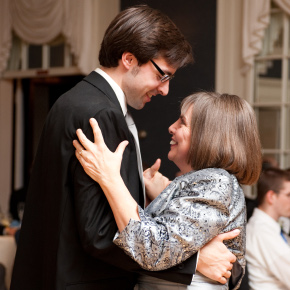 I love my mother with all my heart. For thirty-three years and five days, she has never wavered in her steadfast love for me, support of me, and delight in me. She delivered me in the middle of a Maine snowstorm; she endured through my advanced childhood self-centeredness; and she never let her own demons keep her from being my nurturer, advocate, mentor, and friend. I get my love of reading from her. I get my precociousness from her. And I get my ability to be quiet and listen from her. When I had my first ever bona fide moment with God, it was my mother who held me and rocked me – her seventeen-year-old baby boy – while I bawled my eyes out, overwhelmed by the immensity and clarity of it all.
 “You are my Son, the Beloved; with you I am well pleased.” Whenever I read this beautiful verse of Scripture, my lungs expand with more air than normal. I take a deep, cleansing breath, and I remember the truth of these words, and I lament how easy it is to forget them.
 Well, here we are in 2016. Another year has come and gone, and oh so quickly. Years are short and not necessarily memorable unless we take the time to remember them, to stitch them into our living tapestries. I love that today’s Gospel mentions that Mary “treasures all these things in her heart.” Mary treasures both the painful memories, like losing Jesus in the caravan, and the happy memories, like finding him again in the temple. Mary treasures her memories, and they become the warp and weft of her life. They become the story of her walk with God.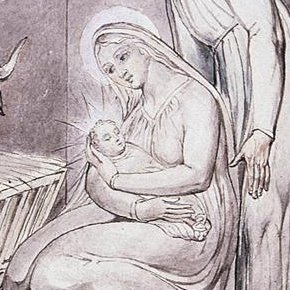
 Right now, you might be thinking, “Wait a second…where are the baby and the manger and the shepherds and the angels? I know it’s late, but I don’t think I nodded off during the Gospel reading.” Now, I don’t know whether or not you nodded off, but I can assure you that I didn’t say anything about the baby or the manger or the shepherds or the angels. Tonight, I read a different version of the story of Jesus’ Nativity. Allow me to explain in brief, and then we’ll get to what I really want to talk about on this most Holy Night, which is God making a home here.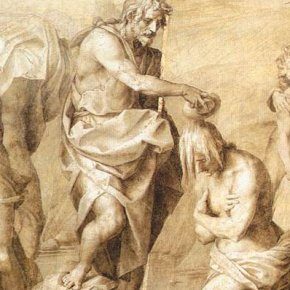
 I think the Gospel lesson I just read sounds harsher than it really is. Notice the last line: “So, with many other exhortations, [John] proclaimed the good news to the people.” Either this means that the “good news” came in these other exhortations spoken off camera, or everything that John says is to be considered “good news.” I think it’s the latter. Of course, good news doesn’t usually begin by calling people a “brood of vipers.” John the Baptist is not exactly a people person; after all, he’s spent a lot of time by himself in the wilderness. He’s definitely a loner, unlike his cousin Jesus who comes on stage in a few verses and who surrounds himself pretty quickly with a group of friends. But even though John’s social skills may have suffered from his solitude, he’s astute enough to know the crowds expect a spectacle. And he gives them one right off the bat by calling them a “brood of vipers.”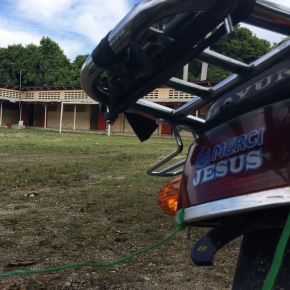
 As many of you know, Tim Evers and I spent much of last week in Haiti visiting our mission partner, St. Luc School. As you will see later in this sermon, I’m so thankful that a coincidence of calendar had us travel there during Advent. My first glimpse of the country came from 10,000 feet in the air. The Haitian landscape rises rugged and mountainous to the east where it abuts the Dominican Republic and flattens to the west where a peninsula bathes in the Caribbean Sea. Our destination was in the countryside west of the capital.
 I find it ironic that the framers of our lectionary chose the Gospel lesson I just read as the one for today. Today is the feast we call “Christ the King” or “Reign of Christ.” And yet, for the entire length of his conversation with Pontius Pilate, Jesus specifically dodges Pilate’s questions about his kingship. “Are you the king of the Jews?” Do you ask this on your own, or did others tell you about me? “So you are a king?” You say I am a king. But if Jesus is king of anything, if Jesus claims to reign over anything in this passage, his kingdom would not include land or crops or livestock or resources. His reign would be over “the truth.” For this I was born, and for this I came into the world, to testify to the truth.
 Note: For the sermon at St. Mark’s on 11/15, I was planning to read the Bishop’s address to the Diocesan Annual Convention, which took place the same weekend. Then when the terrorist attack in Parish happened, I knew I needed to say something different. Arriving home from convention in the evening of Saturday, I had little time to put a sermon together, so I went back in my vault to see if I had anything appropriate. I found a sermon from six years ago and started with that as my base. But with the Paris attacks on my mind, the old sermon morphed into something completely different, with nearly two-thirds of the words being new.
 Where the Wind...