

Sermon for Sunday, February 28, 2016 || Lent 3C || Luke 13:1-9
 This is a sermon about grace. I’ve been wanting to share with you my definition of grace for a while now, but the time didn’t seem right. Then after spending time with Megan Palmer’s family two weeks ago, preparing for and leading Megan’s service last weekend, and having the stomach flu most of this past week, the time to talk about grace has finally come. Maybe I was waiting for a moment when I was sure I had recently experienced it. But before we talk about grace, I need to tell you about my dad’s sense of humor.
Growing up, my favorite movie was Return of the Jedi. I watched it about once a week, except for the year I was six when I watched it once a day. VCRs were still relatively recent inventions, and none of us realized you could wear out a VHS tape until I wore out Return of the Jedi. Whenever I finished watching the movie and the iconic John Williams score started blasting throughout our house, my father would turn up in the living room doorway and ask, in all seriousness, “Did the rebels win this time?”
Whenever my sister or I got hooked on a particular movie, this same joke would resurface, notably in the late 90s. “Did the Titanic sink this time?” And after I got my Lord of the Rings Special Edition DVDs: “Was the ring destroyed this time?” Now when it comes to senses of humor, mine is a chip off the old block, for better and worse. And so when my kids start watching the same movie over and over again, I will never in a million years be able to resist the urge to ask: “Did they find Nemo this time?”
I tell you all this because, believe it or not, it impacts the way I interpret today’s Gospel lesson. You see, I think the Gospel writer Luke and my dad share this bit humor. Luke narrates Jesus telling this parable: “A man had a fig tree planted in his vineyard; and he came looking for fruit on it and found none. So he said to the gardener, ‘See here! For three years I have come looking for fruit on this fig tree, and still I find none. Cut it down! Why should it be wasting the soil?’ The gardener replied, ‘Sir, let it alone for one more year, until I dig around it and put manure on it. If it bears fruit next year, well and good; but if not, you can cut it down.’”
Do you get the joke yet? It’s pretty subtle (and not exactly haha funny), and maybe you had to grow up with a dad like mine to see it. The joke is this: that fig tree is never getting cut down. Luke preserved it in his Gospel. Luke knew this great story he was writing would be shared and he hoped it would be shared until the sun stopped putting forth its light. Every time someone read this parable, the fig tree got another chance. Luke wrote these words down about 1,936 years ago, which is 1,935 more years than that fig tree had to produce. And the fig tree is still standing. Every time we read it, there is the tree still standing. Yes, the rebels win at the end of Return of the Jedi – every time – because that’s how movies work. And yes, the fig tree is still standing because that gardener is taking care of it and always will. I told you this is a sermon about grace. Do you see it yet? We’re getting there.
Now you might quibble here and say Luke’s joke doesn’t work because, even though the fig tree is never going to be cut down, it’s also never going to bear fruit. It’s stuck in this in-between time, a time of potential but no results. Yes, this is true, and we’ll get back to that in a minute.
But first, one more word about why I think Luke is playing with his readers here. Matthew, Mark, and Luke share a lot in common, so much in fact that we often refer to them as the “synoptic” Gospels. “Synoptic” means “with the same eyes.” But Luke’s version is the only one with this parable about the fig tree. There’s a fig tree in Matthew and Mark, which Luke does not include, and their fig tree fares much worse. In Matthew and Mark, the fig tree withers and dies when Jesus gets a bit petulant that it doesn’t have any figs on it. But Luke doesn’t share that story. Luke shares this one, the one about the fig tree that always has another chance to bear fruit whenever the story is read.
The key words here are “another chance.” That’s grace. “If it bears fruit next year, well and good; but if not, you can cut it down.” Next year. Another chance. We read the parable again. Next year. Another chance. That’s grace.
Growing up, I always heard my dad define the concept of grace together with the concepts of justice and mercy, as a way to distinguish between them. His version went like this: “Justice is getting what you deserve. Mercy is not getting what you deserve. Grace is getting what you don’t deserve.” I’ve always loved that, and these definitions have guided me my whole life. But recently, I’ve added this: “Justice is having a chance. Mercy is having a second chance, or a third, or a fourth. Grace is not having your chances numbered.”
Grace is not having your chances numbered. Grace is being the fig tree that will always have the gardener tending to it, no matter how long it takes to bear fruit. Grace keeps us moving ever on, especially when we are stuck in the in-between time, the time of potential but no results. Grace gives us another breath when grief has knocked the wind from us. Grace gives us another chance when disillusionment or apathy sap our will to seek for justice and peace. Grace gives us another bit of rope when we think we’ve come to the end of ours.
Grace is the sublime consequence of a God who will never give up on us. That’s pretty good news, right? And yet, while God will never give up on us, we still have every opportunity to give up on God. Our chances are not numbered except by how many we are willing to take, by how often we are willing to trust God to be with us, come what may. That’s God’s promise to Moses in today’s reading from the Hebrew Scriptures, by the way. “I will be with you,” says God. No matter how often you fail, no matter how many chances you need, I will be with you. That’s grace.
It’s true that our chances are only numbered by how many we are willing to take. It’s also true that another chance is always shimmering on the horizon of possibility. And so grace beckons us to take more chances, to lead more expansive lives, to trust more deeply in the God who will never give up on us. And to bring that God to people who have never even been given one chance, who have never experienced the blessing of justice, let alone mercy or grace.
Yes, the rebels win at the end of Return of the Jedi. Every time. Yes, the Titanic sinks. Yes, the ring is destroyed. Yes, they find Nemo. Yes, the fig tree still stands. And yes, grace abounds in limitless chances to trust in a God who never gives up.

 Last fall, I had to renew my passport before my trip to Haiti with Tim Evers. I had originally gotten my passport in advance of a choir trip to England back in college in 2003, and that first document was still valid when Leah and I went to South Africa for our honeymoon in 2011. But they’re only good ten years, so in the fall of 2015, I found myself stapling an unsmiling picture to an application I picked up at the post office. I filled in all the information – name, address, social security number. I checked the box marked “U.S. Citizen,” dropped the package in the mail with the processing fee, and a few weeks later, received my new passport.
 Right now, the bedtime ritual at home goes something like this: bath time around 6:15; diapers and pajamas at 6:30; stories, snuggles, and songs until 6:45; and then, blessedly, sleep. We rotate through many beloved and well-worn bedtime books: Goodnight, Moon; Time for Bed; Guess How Much I Love You; The Going to Bed Book. Leah and I can recite every one of these and more. But I tell you, I can’t wait until Charlie and Amelia are old enough to ask us to make up bedtime stories.
 Every year on the Sunday before Lent begins, we read this Gospel lesson. We call it the story of the Transfiguration, which is a fancy way of saying “something turning into something else, usually a more beautiful something else.” And if we stopped there with the label we apply to the story, we would get something out of it to strengthen our faith. We would see some evidence that Jesus was really whom he said he was, since his face changed and his clothes dazzled and two famous dead prophets came round for a chat. But I don’t think this evidence is really what Luke means for us to get out of this story. I don’t even think the term “Transfiguration” applies to Jesus. Rather, since the whole story is told from the disciples’ perspective, I think they are the ones who are “transfigured.” I’ll explain what I mean by that in a minute, but first I’d like to tell you about my fifth grade science fare project.
 We’ve all heard those words from the Apostle Paul a hundred times. “Love is patient. Love is kind.” I read them at my sister’s wedding. Perhaps you had them read at your own. Statistically speaking, if you go to a wedding there’s a better than average chance you’ll hear First Corinthians 13. Now, it is true beautiful chapter can stand apart as an ancient ode to love. But when we sequester these verses to the marital service alone, we miss how Paul uses them in the greater context of his letter. We miss how love is the corrective for the issues facing the church in Corinth. We miss what love is for. So let’s put these famous words back in context, and with a little help from Harry Potter, we’ll remember a thing or two about love.
 I love my mother with all my heart. For thirty-three years and five days, she has never wavered in her steadfast love for me, support of me, and delight in me. She delivered me in the middle of a Maine snowstorm; she endured through my advanced childhood self-centeredness; and she never let her own demons keep her from being my nurturer, advocate, mentor, and friend. I get my love of reading from her. I get my precociousness from her. And I get my ability to be quiet and listen from her. When I had my first ever bona fide moment with God, it was my mother who held me and rocked me – her seventeen-year-old baby boy – while I bawled my eyes out, overwhelmed by the immensity and clarity of it all.
 “You are my Son, the Beloved; with you I am well pleased.” Whenever I read this beautiful verse of Scripture, my lungs expand with more air than normal. I take a deep, cleansing breath, and I remember the truth of these words, and I lament how easy it is to forget them.
 Well, here we are in 2016. Another year has come and gone, and oh so quickly. Years are short and not necessarily memorable unless we take the time to remember them, to stitch them into our living tapestries. I love that today’s Gospel mentions that Mary “treasures all these things in her heart.” Mary treasures both the painful memories, like losing Jesus in the caravan, and the happy memories, like finding him again in the temple. Mary treasures her memories, and they become the warp and weft of her life. They become the story of her walk with God.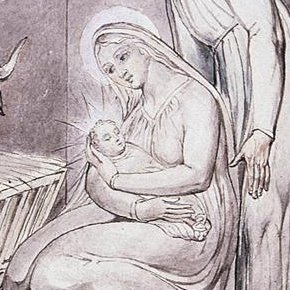
 Right now, you might be thinking, “Wait a second…where are the baby and the manger and the shepherds and the angels? I know it’s late, but I don’t think I nodded off during the Gospel reading.” Now, I don’t know whether or not you nodded off, but I can assure you that I didn’t say anything about the baby or the manger or the shepherds or the angels. Tonight, I read a different version of the story of Jesus’ Nativity. Allow me to explain in brief, and then we’ll get to what I really want to talk about on this most Holy Night, which is God making a home here.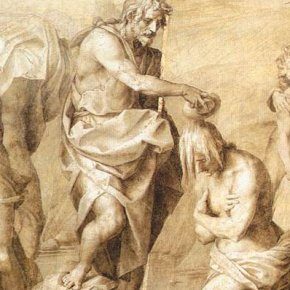
 I think the Gospel lesson I just read sounds harsher than it really is. Notice the last line: “So, with many other exhortations, [John] proclaimed the good news to the people.” Either this means that the “good news” came in these other exhortations spoken off camera, or everything that John says is to be considered “good news.” I think it’s the latter. Of course, good news doesn’t usually begin by calling people a “brood of vipers.” John the Baptist is not exactly a people person; after all, he’s spent a lot of time by himself in the wilderness. He’s definitely a loner, unlike his cousin Jesus who comes on stage in a few verses and who surrounds himself pretty quickly with a group of friends. But even though John’s social skills may have suffered from his solitude, he’s astute enough to know the crowds expect a spectacle. And he gives them one right off the bat by calling them a “brood of vipers.”
 Where the Wind...