
Sermon for Sunday, October 11, 2026 || Proper 23A || Exodus 32:1-14
Today’s sermon is a nuts and bolts sermon, one of those occasional times where I dip into Christianity 101 so that both recent and long-time followers of Jesus can find themselves on the same page. Today we’re going to talk about worship: what worship is not, what worship is, who we worship, and why we worship.
And lest we think that only religious people worship, we have to get something out of the way right at the top. Everybody worships something. The most secular person in the world worships something. The most religious person in the world worships something too, and that something might not even be God. Everybody worships something.1 That something might be abstract like power or control or wealth or fame or pleasure. That something might be another person: a spouse, a parent, a coach, a celebrity, a politician. That something might even be one’s own sense of self: worshiping what one sees in the mirror, completely isolated and self-referential.
The trouble is that every single one of these objects of worship will not and cannot bring us life. The abstract things like power and pleasure leave us chasing them, wanting more and more and more to satisfy. The other people we might worship are still just people; when we put them on pedestals, we deny them their fallible humanity by saddling them with our need for perfection. And when we worship ourselves, we take healthy self-esteem too far, and it curdles into narcissism. The narcissist, then, seeks outside validation for their supposed divinity, poisoning all relationships, including the one with their own self.
None of these abstract things or other people bring life as objects of worship because we treat them like objects. My kids are taking intro to Latin right now and learning about noun cases, and we’ve spent a lot of time lately talking about direct and indirect objects. A direct object receives the action from the subject of the sentence. “I hold my prayerbook.” The prayerbook is the object of my holding. I, the subject, am the one doing the holding. When I worship an object, I am still the subject of the action. I am still in charge of the action. I chase power or pleasure. I place someone on a pedestal and then expect divine intervention from a human source.
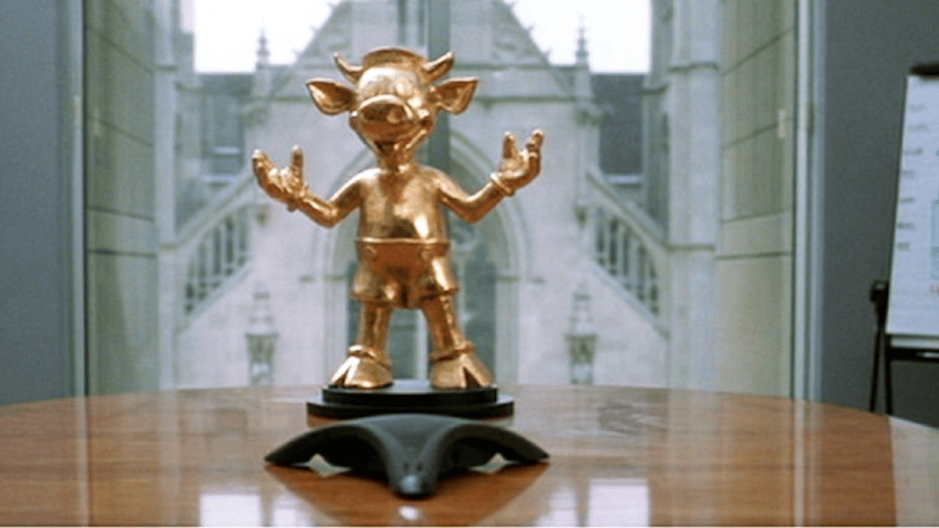
The special church word for this is “idolatry.” We see a perfect example in today’s reading from the book of Exodus. Moses is taking too long on the mountain chiseling out the Ten Commandments. The people down below are getting restless, so Moses’ brother Aaron consents to forming a god statue for the people to worship instead of God, who seems too far away at the time. Aaron forms a mold of a calf and pours the molten gold inside. When the statue is finished, Aaron proclaims that the calf, not the God of Israel, rescued the people from Egypt. And this is the part of the story that would be funny in another context. A few verses after our reading leaves off this morning, Moses confronts his brother. Aaron says, The people told me to make gods for them, so they gave me their gold and I threw it into the fire, “and out came this calf!”
Out came this calf! It’s as if Aaron is surprised what came out of the mold that he himself cast. But the calf did not form itself. It is an object, the direct object of Aaron’s action. The calf is an idol that makes no demands of its worshipers, that doesn’t compel them to change their lives in any way, and that serves as a good fall guy when a worshiper doesn’t want to take responsibility for their actions.
If we don’t worship an object, then what should we worship? There’s really only one other grammatical answer. We should worship a subject. Remember, the subject is the one doing the action. If we go back far enough to the very beginning of Creation, or really before the beginning, there is only one Subject (with a capital-S) who was never first the object of some other subject’s action. We name that first Subject God. The theological image of the Holy Trinity contemplates God as three Subjects all in perfect relationship, such than none is objectified and thus all are One God. We name this perfect relationship Love.
So, if God is the first and primary Subject of existence, it doesn’t make sense for us to use God as an object of our worship. God is never an object. God is always and only a Subject. Saying “I worship God” might be a grammatically correct sentence, but it’s not a theologically correct one. God must be the subject of the sentence. So the proper way to think about worship is this: “God draws us into worship.”
We can say other similarly theologically accurate things: “God loves us into being. God invites us into prayer. God calls us to service.” In each of these examples, God is the actor. We are the respondents. When we worship, God beckons us towards God. We bend toward God as a flower bend towards the sun. We become God-referential instead of self-referential, and thus find ourselves in a more “real” reality, one in which we are not the center of the universe. Unlike idolatry, which confirms us as the center, true worship pulls us from this supposed center and draws us to the real center of life and love and existence. Worship grounds us to the Foundation of All Being, whom we call God.
In the end, we worship to learn humility; that is, literally getting close to the ground, close to that Foundation. We worship to give ourselves into God’s lifegiving love, so that we’re less likely to give ourselves to idolatrous things that suck life from us or to other people that our our idolatry sucks the life from. And we worship together because we find God’s lifegiving love most readily in the midst of a caring beloved community.
This week, I invite you to think about how you worship. Do you allow yourself to embrace the humility needed to be one whom God draws into worship? Do you surrender yourself into the life of God? Or is there an object you might be worshiping. An abstract one like power or pleasure? Another person like your spouse or a politician? Or yourself? If so, ponder how such worship can never bring you life because it does not involve the Giver of Life.
In all of this, remember that none of us is finished. We are all still cookie dough, not cookies.2 There is never a stage in which we completely move past idolatry into perfect worshipers of God. Each day is an opportunity to move closer to that worship, to bend the flower of our hearts a little more towards God’s sun. And in so doing to take on the life of God, which is the life that truly is life.
Banner image: Mooby the Golden Calf from Dogma (1999)
- https://wherethewind.com/2022/08/29/the-fountain-and-the-cistern/ (I borrowed this idea from a 2005 commencement speech by David Foster Wallace and used it in a sermon in 2022.) ↩︎
- If you caught this as a reference to Buffy the Vampire Slayer, then two thumbs up from me. ↩︎

