
Sermon for Sunday, March 8, 2026 || Lent 3A || John 4:5-52
Only once in my life have I truly felt like a foreigner. It wasn’t on our honeymoon in South Africa because we were ensconced at a small game reserve the whole time. It wasn’t in Israel because I was there as a tourist doing touristy things. It wasn’t even when I visited Haiti because, though I stood out due to my pale skin, every Haitian I met made me feel like family. The only time I have ever felt like a foreigner was the first day of the second half of sixth grade when I walked into Mrs. Green’s social studies class at Hillcrest Middle School in Tuscaloosa, Alabama.
There were three things that marked me as a foreigner, an immigrant from the cold, distant land of New England. First, I was the new kid. Second, I did not know I was supposed to call my teacher, “Ma’am.” And third, I had a wicked Rhode Island accent. In a comedy of errors that is seared into my memory, when I needed a drink of water, I asked, “Can I go to the Bubbl-ah (Bubbler)?” It took about ten minutes to figure out I meant the water fountain, at which point I could only go if I addressed Mrs. Green as “Ma’am.”
It took me a while to find my footing in the Deep South. There were unspoken rules I didn’t understand. I technically spoke the same language as my classmates, but we often got lost in translation. The only common language I shared with the other boys in my class was baseball, so I clung to my team in those early years. When I got traded in eighth grade to another team, I was devastated. I felt ostracized. I was a foreigner all over again, an interloper who didn’t belong.
What is it about humans that we have such a powerful ability to turn each other into foreigners? Is it our tribal origin asserting itself even in a globalized world? Is it the ease at which we embrace zero-sum thinking; that is, for my group to get ahead, I have to push your group behind? Whatever it is, turning one another into foreigners is the root of so much of the pain and violence the world has seen and continues to endure.
We could embrace an identity as earthlings, which would put us in the same family, not just with every other human, but with every other living thing on this “fragile earth, our island home.” Within this planetary identity, we could celebrate regional differences of culture, language, religion, and appearance. We could prize diversity without division. We could value unity without uniformity.
But instead, down through history, we’ve chosen to make one another into foreigners. And once someone is foreign, they become scary or they become exploitable or they become expendable. From there, it is a small hop to the calculation that one life is less valuable than another due to any number of factors that makes someone else foreign.
And this is why our Gospel lesson today is so astounding. Jesus flies directly in the face of this dismal pattern when he meets the woman at the well. He and his disciples are in Samaria, which stands between Galilee and Jerusalem. Samaria was once considered part of Israel, but the people intermarried with their conquerors to such a degree that the Israelites considered them foreign half-breeds. The Gospel writer even makes sure the reader knows that “Jews do not share things in common with Samaritans.” It’s incredible: within a few hundred years, people with common ancestors had become segregated from each other, made into foreigners, an “us” and a “them.”
Jesus asks the woman for a drink, and she is taken aback that he would talk to her. But Jesus couldn’t care less about the social taboos. For Jesus, no one is a foreigner because his kingdom is not a particular land; his kingdom is the eternal realm of the Spirit.1 Jesus and the woman have a deep conversation about the gift of eternal life, about worshiping God in Spirit and truth, and about Jesus’ identity as the Christ. The woman runs back to town without her water jar and proclaims that Jesus might just be the Messiah! In the Eastern churches, this woman is named Photini, which means, “Enlightened One,” and she is celebrated as the first person to name Jesus as the Christ.
In their conversation Jesus transgresses several boundaries to speak with her. When he reveals his divine identity to her, she knows herself more deeply than ever before. And all this happens even though she and Jesus were not supposed to acknowledge each other’s existence at the well.
All of this has me thinking about and crying over the fact that we are dropping bombs on foreigners – again. We are killing people who look differently, dress differently, and worship differently than most of the people in our country. And our leaders hope that the majority of us will be okay with this. But each and every one of us can make our voices heard. We can shout from the rooftops that there is no such thing as a foreigner. We are not afraid of people who look, dress, and worship differently than we do. We will not succumb to the old justification that killing is all right as long as the people dying are foreign. That is not the way of Jesus.
The Way of Jesus offers the gift of living water to one who is supposed to be foreign. The Way of Jesus forges deep connections across difference. The Way of Jesus makes peace, not through violence, but through the building of relationships. This is the hard work of love, which Jesus commands us to extend to our enemies.
My thick Rhode Island accent marked me as a foreigner in Alabama at the beginning of 1995. The accent faded over time into the way I speak now, but the feeling of being a foreigner never really did. Breaking down the barriers that separate us is a difficult but necessary job. And Jesus shows us the way.
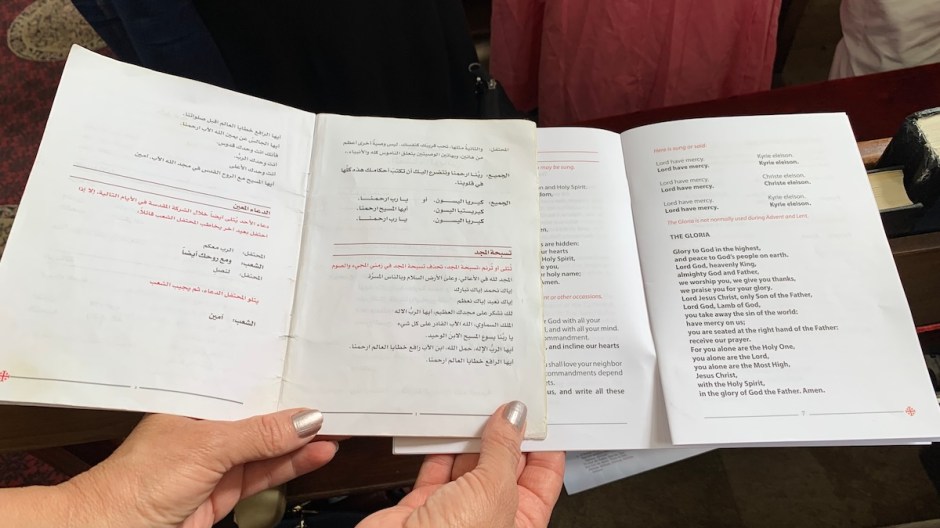
When I was in Nazareth in 2019, our group of pilgrims went to church on Trinity Sunday. The service was in Arabic, but it was an Episcopal service, so even though I don’t speak Arabic, I could follow along. Even so, there were two words I understood perfectly well: “Salaam” – Peace. And “Allah” – God. As we stand with Jesus as witnesses to the nonviolent way of love, in which no one is a foreigner, pray to Allah for salaam, pray to God for peace.
Banner image: The Arabic and English programs for the Trinity Sunday service at the Episcopal Church in Bethlehem.
- In other accounts of the Gospel, Jesus appears a little more tribal, especially in the story of the Syrophoenician (or Canaanite) woman. But by the end of that story, Jesus realizes that he is thinking too small. ↩︎
 Where the Wind...