
Sermon for Sunday, February 1, 2026 || Epiphany 4A || Micah 6:1-8
This sermon is about telling the truth. But to enter into a discussion about truth-telling, we first have to talk about words. Specifically about how our words can both curtail and expand our thoughts, and about how those in power can create societal narratives based on the words they choose. Language is a tool of creativity. The way we tell our creation story begins with God speaking creation into existence: “God said, ‘Let there be light,’ and there was light.” In the Hebrew language the “word” happens to people like the prophet. The Word of God is an encounter that compels the prophet to action. Likewise, the Gospel of John identifies the person of Jesus as the Word of God, the ultimate happening of the Word as it becomes flesh and dwells among us as a human being.
Words matter because words shape thoughts. Here’s an example. We just sang my favorite hymn, “Come thou fount of every blessing.” The traditional words of the second verse begin, “Here I raise my Ebenezer / hither, by thy help, I’ve come.” The Eben Ezer was the stone that Samuel set up to commemorate God’s help in the Israelites victory over the Philistines. Eben Ezer means “stone of help.” When we sing about raising our stones of help, we set ourselves within the same story that Samuel was telling about God. And we prayerfully imagine our way into the reality of God’s constant presence and faithfulness.
But you might have noticed that we didn’t sing those words just now because The Hymnal 1982 rewrites the verse and takes out the word “Ebenezer.” The rewritten verse begins: “Here I find my greatest treasure.” While this thought is fine, it doesn’t link at all to the next words: “hither, by thy help, I’ve come.” Treasure-seeking is not the point of the hymn. The point of the hymn is recognizing our helplessness on our journey and God’s inspirational blessing that helps our hearts tune to the resonance of God’s presence. Changing a single phrase distorts the meaning of the whole verse. So we need to be careful how we use words.
Words define the parameters of our thoughts. One of the best ways to blaze new cognitive trails is to name a new idea with a word. There’s an old joke that college professors like to make up words, which makes sense when you consider they’re in the business of trying to come up with new thoughts. Once an idea has a name, we can all talk about it and awaken new neural paths. Until I heard the word “cisgender,” I had no idea I had a place on the spectrum of gender identities. Now that I know that word and understand the concept it represents, I see people who are not cisgender as part of that same spectrum and not as a nebulous (and perhaps frightening) other. Not only do new words create new thoughts, the ways we combine words can expand our minds. Instead of saying, “The blind,” you can say, “a person who is blind,” thus putting the person in front of their ableness.
Similarly, encouraged by reading Black authors, I no longer use the words “slavery” and “slave.” Instead, I follow their lead and use the words “enslavement” and “enslaved.” The word “slave” conjures up an identity for a person, as does the word “master.” One is surely inferior to the other, hence those words’ usage to perpetuate the system. But calling those same people “enslaved person” and “enslaver” changes the narrative and removes the notion of superiority for the white “master.” Now the “enslaver” is engaged in an evil business, and the “enslaved person” is still a person no matter the condition of their bondage.
Combinations of words can expand our minds, but just as easily combinations of words can contract our minds. In his seminal 1949 novel Nineteen Eighty-Four, George Orwell creates a totalitarian regime that controls its populace in a number of ways. One of these ways is called Newspeak, which collapses the English language into an incredibly narrow vocabulary designed to restrict the types of thoughts the population is allowed to think. Combined with another control mechanism called Doublethink, the Orwellian state constructs a tiny world of thought in which the populace is trapped.
We can see these Orwellian processes happening in real time in our own country right now. Labeling peaceful protesters as domestic terrorists is one example. Using the term “law enforcement” for federal agents who are engaged in actions that far exceed their legal mandate is another. These classic propaganda techniques are used either to induce a population to accept lies or to confuse a population into inaction. In a recent piece, scholar of authoritarianism Timothy Snyder wrote, “Words matter, uttered first or repeated. They create an atmosphere, they normalize — or they do not. We can choose to see, to call things by their proper names, to call out people who lie. We have to.”1
As followers of Jesus Christ, we live in Jesus’ Truth Kingdom. In his conversation with Pontius Pilate, Jesus says, “For this I was born, and for this I came into the world, to testify to the truth. Everyone who belongs to the truth listens to my voice.” This prompts Pilate’s famous question, “What is truth?” Whether he asks this sincerely or derisively, we know that Pilate is a small cog in a system built on propaganda. The so-called “Pax Romana,” the “Peace of Rome” was doublespeak that hid a vast system of state-sponsored violence.
Jesus shows us another way, the way of unflinching truth gathered through confronting the world as it really is and not as those in power would have us believe. In this work of truth, Jesus stands in the tradition of the Old Testament prophets. We read the most well-known verse out of all the prophets this morning. The Prophet Micah is trying to move Israel’s devotion to God away from the rituals that have become nothing more than empty gestures, incapable of catalyzing the repentance they were designed for.
“Shall I come before [God] with burnt-offerings, with calves a year old?” Micah asks. “Will the Lord be pleased with thousands of rams, with tens of thousands of rivers of oil?”
These are rhetorical questions. The answer is an obvious and resounding, “NO!” Micah continues: God “has told you, O mortal, what is good; and what does the Lord require of you but to do justice, and to love kindness, and to walk humbly with your God?”
Doing justice starts from a place of truthfulness. We unravel the old thoughts that led to injustice and start with new combinations of words that lead to greater truth-telling. We do not succumb to the propaganda of an Orwellian state, but instead live in Jesus’ Truth Kingdom. We reject the state’s command to ignore the evidence we can see with our own eyes. We embrace Jesus’ Way when he says, “You are truly my disciples if you remain faithful to my teaching. Then you will know the truth, and the truth will set you free” (John 8:31, CEB).
In all of this, we rely on the God who spoke Creation into being and continues to speak our lives into being. The Truth that is Christ has already set us free. So raise your Eben Ezer, for hither by God’s help we’ve come this far. And with God’s help, we will go much farther, doing justice, loving kindness, and walking humbly with our God.
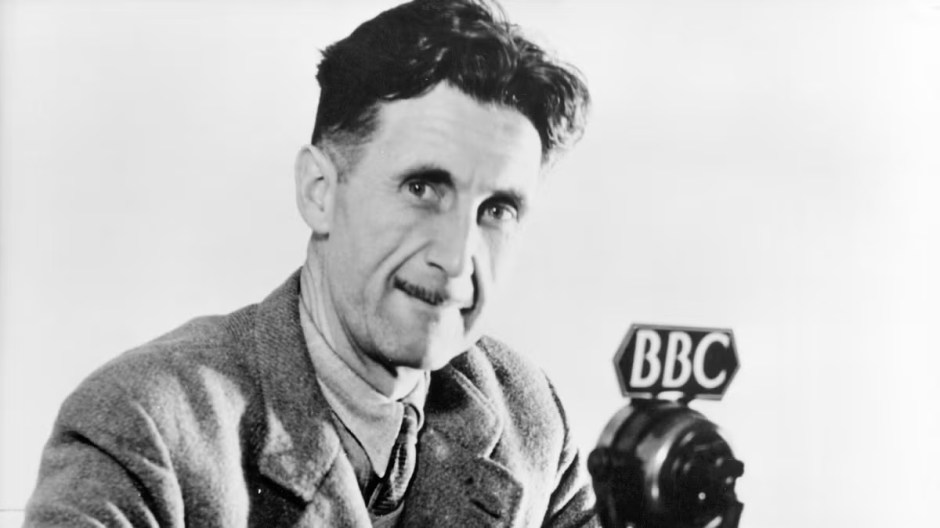
Banner image: George Orwell
This sermon borrows heavily from a chapter I wrote for the book How to Heal Our Divides.
- Snyder, Timothy (https://substack.com/inbox/post/185715823): Earlier in the same article, he says,
The lies begin as clichés, memes that are pounded into our heads by the government and by those in the media who repeat them, mindlessly or with malice.
One of these cliches is “law enforcement,” which is uttered over and over like a incantation. “Law enforcement” is not a noun. It is not a thing in the world. It is an action.
And action is something that we have a right to see and judge for ourselves. People enforcing the law do not wear masks. And people wearing masks who trespass, assault, batter, and kill are not enforcing the law.
They are violating it.
It is indeed the job of some local, state, and federal authorities to enforce the law. It is a disservice to them when federal employees carry out public executions. It is a greater disservice to them when such actions are defined as “law enforcement.”
↩︎
 Where the Wind...