
Sermon for Sunday, September 7, 2025 || Proper 18C || Luke 14:25-33
The Gospel lesson Deacon Chuck just read for us contains one of Jesus’ more inflammatory statements: “Whoever comes to me and does not hate father and mother, wife and children, brothers and sisters, yes, and even life itself, cannot be my disciple.” We’re going to unpack this inflammatory statement today, but first I want to tell you all about a person named Sméagol.

Click here for Apple Podcasts or search
“WheretheWind.com Sermon” on your podcast app of choice.
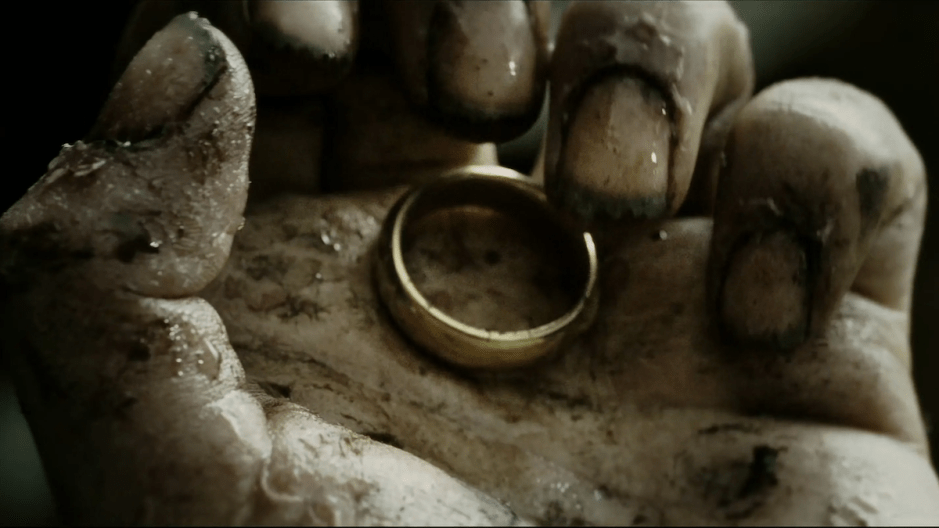
One day, Sméagol went fishing with his best friend Déagol. Déagol ended up in the water, and in the silt of the riverbed, he found a beautiful ring. Now, that day happened to be Sméagol’s birthday, so he asked Déagol to give him the ring as a present. When Déagol refused – for such was the allure of this ring – Sméagol killed him and took the ring for himself. Unable to live with what he had done, Sméagol fled with the ring, found his way to the Misty Mountains, and exiled himself on a tiny island in the middle of dark underground lake.
The ring, which he now called his “birthday present,” was a magic ring and it gave him unnaturally long life. For nearly five hundred years, Sméagol lived alone under the mountains with only the ring for company. In time, he called it not only his birthday present but also “My Precious.” The ring’s power and Sméagol’s sunless existence changed him into the wretched creature Gollum, whom Bilbo Baggins meets in a famous chapter of J.R.R. Tolkien’s fantasy classic The Hobbit. Later, because of Gollum’s overwhelming desire to possess the ring, he plays a pivotal role in the events of The Lord of the Rings.
My Precious. It seems an innocuous phrase, even a lovely phrase, a term of endearment. My kids are precious to me, unique and irreplaceable. Sometimes, I call them “my love” or “my sweet.” So when Jesus tells me to hate them, I really don’t understand, especially because Jesus is usually telling us to love one another. Now, it’s so easy just to skip over this passage because it makes us feel uncomfortable, but if we do, we are missing one of Jesus’ greatest lessons. So let’s stick with it for a few minutes.
In order to make sense of what Jesus is saying here, we have to look to the end of the passage, the end of his train of thought. After Jesus talks about building towers and raising armies, he says, “So therefore, none of you can become my disciple if you do not give up all your possessions.”
The thing is, if you go back and read the rest of the passage or indeed the rest of the chapter, Jesus has said nothing about physical possessions until this moment. This makes sense because he’s addressing large crowds, many of whom probably don’t have many possessions in the first place. And while our accumulated stuff certainly plays into Jesus’ calculus here, there is something more fundamental that he is inviting us to give up. And it all centers around a tiny two letter word:
“My.”
My Precious.
Grammatically, the word “my” is an adjective that denotes possession. “My” hair. “My” beard. “My” iPad. The pronoun version of the word “my” is often one of the first words a small child learns: “Mine!” The child uses this word when they’re clinging to something that they won’t let go of. Or when someone else is holding something that the child desires. Mine. My own. My Precious.
The fundamental thing Jesus invites us to give up is symbolized by the word “my.” This fundamental thing is our possessiveness. Possessiveness springs from the need for control, the need to exert power over someone or something. We see this in an abusive spouse’s need to control their partner’s interactions outside the home. We see this in an overbearing boyfriend or girlfriend who grows suspicious or irritated any time their partner isn’t hanging out with them. We even see this at a societal scale when some Americans claim to possess a larger share of “Americanness” than those who arrived in this country later than they did or who look or love or vote differently than they do.
Possessiveness is all about control, and the need for control springs from a lack of trust, both a lack of trust in the object of the control and in the institutions that are supposed to see to its nurture. My generation grew up in the age of “helicopter parents.” This parenting phenomenon was so called because parents “hovered” over their children, never letting them experience confusion or hardship. Parents were unwilling to let their kids make mistakes because they wanted to shelter their children from those mistakes’ consequences. And while all of this hovering came from a place of love, it also came from a lack of trust – a lack of trust that the child and their environment could conspire to allow the child to grow through mistakes and hardship into the independent person they were becoming.
Now that I am a parent of middle schoolers, I sympathize with the helicopter parents of my childhood. It is so hard to let your child make a mistake that you, from your own experience, see coming a mile away. And yet, without that painful experience, growth doesn’t happen. Parenthood is a series of leave-takings – from Day One when they leave the womb. This week I lived through the leave-taking that is dropping the twins off at middle school, and I surprised myself when I got a little choked up driving away. But even as I did so, the Holy Spirit prompted me to pray – to let go of my children and to place them into the hands and the heart of God.
For in truth they are not mine at all. None of our children belong to us. They belong to themselves, and it is our duty and our joy to walk with them and nurture them to grow into the people God yearns for them to be. When Jesus tells us to hate our children or any of the other people with whom we are in relationship, he’s not talking about the emotion of hate. Jesus is talking about giving up our possessiveness of them, our need to control them. And instead to grow deeper into our trust of God, who holds all of Creation in the palm of God’s loving hand.
In The Lord of the Rings, Gollum calls the ring “My Precious” because he has to believe it is worthy of everything he sacrificed to obtain it, most especially the life of his cousin. His need to possess the ring overrides every other piece of his miserable life. This week, I invite you to pray about the relationships in your life. Do any of these relationships instill in you the need for intense possessiveness? If so, talk to God about why that might be. What are you afraid to lose if you let go? From where does your lack of trust arise? Jesus teaches us to give up our possessiveness. We take up our cross and follow him when we surrender ourselves to trust in God and believe that God is holding us all in the palm of God’s hand…together.
 Where the Wind...
Beautiful! 🙂